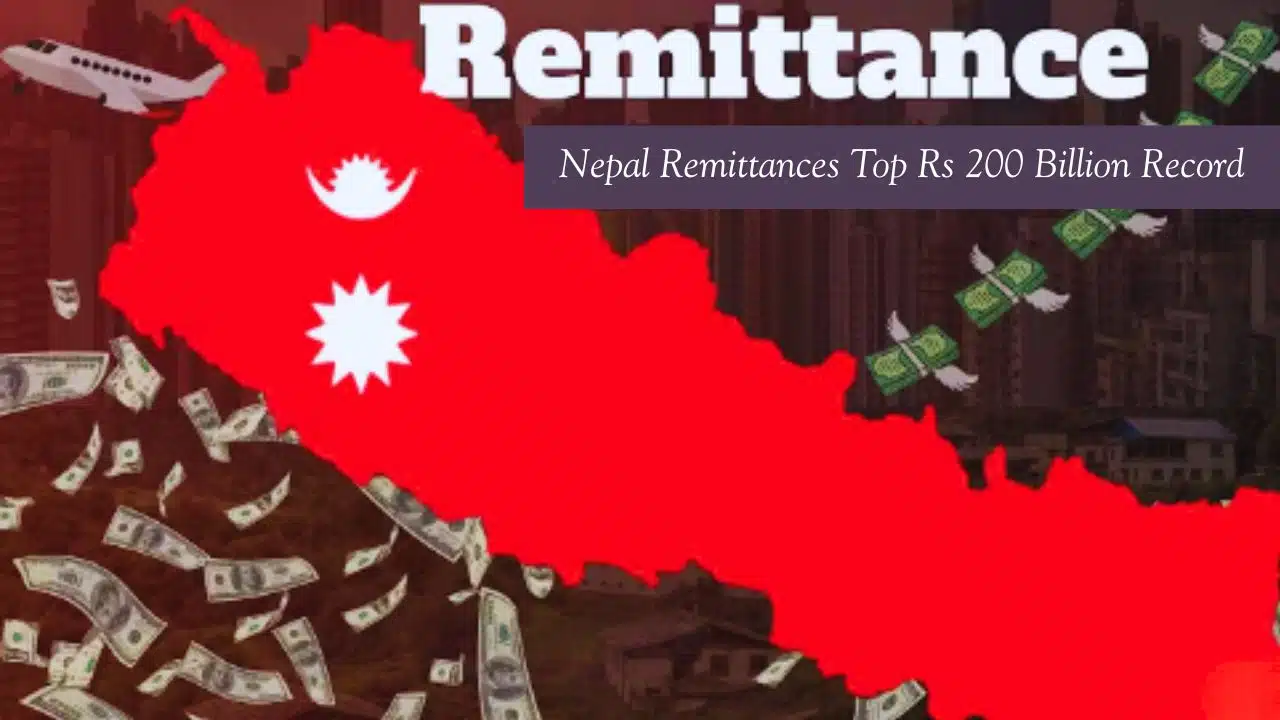
For the first time ever, Nepal’s monthly remittance inflows have surpassed 200 billion Nepali rupees, reaching a record Rs 201.22 billion during the period from mid-September to mid-October 2025. This breakthrough figure, confirmed by Nepal Rastra Bank’s latest macroeconomic report released on November 16, represents a substantial 39.6 percent increase compared to Rs 144.17 billion received in the same month of the previous year. The surge underscores the vital role remittances play in Nepal’s economy, where they account for approximately 25 percent of the country’s gross domestic product and provide essential support to millions of households reliant on overseas earnings.
This milestone comes amid a broader trend of accelerating remittance growth, with the first quarter of fiscal year 2025-26 (mid-July to mid-October) seeing total inflows of Rs 553.31 billion, up 35.4 percent from the previous year’s 11.9 percent rise. In US dollar terms, this equates to $3.94 billion, a 29.2 percent year-on-year increase, highlighting how currency fluctuations and migration patterns are amplifying the value of these transfers. Economists attribute this robust performance to a mix of seasonal, structural, and global factors, which have collectively pushed Nepal’s foreign exchange reserves to Rs 2.97 trillion—or $21.21 billion—enough to cover 16.4 months of goods and services imports.
Festival Season Sparks Unprecedented Remittance Surge
The timing of this record aligns closely with Nepal’s major festival season, including Dashain, Tihar, and Chhath, when expatriate workers traditionally send larger sums home to cover family celebrations, gifts, and daily needs. During this festive period, which often spans late September to early November, household spending spikes dramatically, with economists estimating that up to 40 percent of Nepal’s annual GDP-linked economic activity occurs in these months alone. For context, the October inflow not only topped the Rs 200 billion mark but also exceeded the previous monthly high of Rs 189 billion recorded in June-July 2025, demonstrating sustained momentum even beyond peak festivals.
Building on earlier progress, remittances in the first two months of the fiscal year (mid-July to mid-September) reached Rs 352.08 billion, a 33.1 percent jump from Rs 264.9 billion the year prior, with the second month alone contributing Rs 174.67 billion. This seasonal boost is not isolated; historical data from Nepal Rastra Bank shows that festival periods have consistently driven 20-30 percent higher inflows compared to non-festive months, as workers prioritize remittances to support rural economies where agriculture and small-scale trade dominate. Net secondary income, which includes remittances and other private transfers, further swelled to Rs 610.61 billion in the first quarter, up from Rs 443.76 billion last year, reinforcing the sector’s stabilizing influence on Nepal’s balance of payments.
Key Drivers Behind the Remittance Boom
A confluence of economic, regulatory, and technological factors has propelled this remittance surge to new heights. The appreciation of the US dollar against the Nepali rupee—depreciating 2.3 percent to Rs 140.22 per dollar by mid-October from Rs 137 in mid-July—has directly enhanced the local value of dollar-denominated earnings from key destinations like the United States, Gulf countries, and Europe. This currency dynamic alone accounts for a significant portion of the growth, as most Nepali migrants earn in stronger foreign currencies.
Stricter anti-money laundering (AML) regulations introduced in recent years have also been pivotal, channeling funds away from informal hawala or hundi systems toward formal banking and digital platforms, which offer greater security and traceability. These measures, enforced by Nepal Rastra Bank and international partners, have reduced risks associated with unregulated transfers and built public trust, resulting in more accurate reporting of inflows. For instance, incentives like lower fees for formal channels and improved documentation have shifted an estimated 20-30 percent of previously informal remittances into official streams, providing a clearer picture of Nepal’s actual financial health.
Digitization has emerged as another transformative force. Labour researcher Jeevan Baniya, deputy director at Social Science Baha, highlights how mobile banking apps, peer-to-peer transfers, and online wallets have simplified remittances, particularly in tech-savvy destinations. In South Korea, a major hub for Nepali workers, formal channels now dominate; a 2017 report by the International Organization for Migration noted that over 80 percent of transfers used hundi due to limited options, but widespread digital adoption has reversed this trend, with nearly all funds now flowing legally. Similarly, rising wages and better job prospects in high-income countries like Japan, Australia, and Canada—where Nepali students and skilled workers are increasingly migrating—have boosted average remittance sizes, with per-worker earnings up 10-15 percent in these markets compared to traditional Gulf roles.
Escalating Outmigration: A Double-Edged Sword
The remittance surge is inextricably linked to Nepal’s growing labor migration, as domestic challenges push more people abroad. In the first quarter of 2025-26, 200,716 Nepalis departed with work permits, an 18 percent increase from 170,593 the previous year, averaging roughly 2,230 exits daily—a pace that excludes students (119,409 left in 2024) and tourists. Breakdowns show 123,459 first-time approvals and 77,257 renewals, with the Department of Foreign Employment reporting the UAE and Qatar as leading destinations; in the first month alone, 44,466 workers left, including 36,928 new migrants.
Over the last fiscal year, 839,266 individuals sought foreign employment, comprising 505,957 first-timers and 333,309 renewals, up from 741,297 the year before—a trend driven by scarce local jobs, sluggish GDP growth averaging 4-5 percent, and political volatility. World Bank analysis points to new migration corridors, such as Japan and South Korea, where higher wages (often $1,500-2,500 monthly versus $300-500 in the Gulf) attract skilled youth, contributing to the current account surplus expanding to 6.7 percent of GDP in fiscal 2025. However, this outflow depletes Nepal’s workforce, particularly in rural areas where remittances sustain 70 percent of households, per central bank studies, perpetuating a cycle of dependence.
Economic Stability Amid Persistent Challenges
While remittances have fortified Nepal’s external position—with gross reserves rising 11.3 percent to Rs 2,979.81 billion by mid-October, representing 136.6 percent of import coverage—the benefits have not trickled down to create domestic jobs. Business leaders like Prabal Jung Pandey of Lomus Group note that low government development spending (often below 70 percent of budgeted amounts) and subdued market demand have kept economic growth anemic at around 4.5 percent for the year. Imports of intermediate goods have risen, signaling potential for value-added exports like textiles or agro-processing, but weak infrastructure and investment hinder progress.
Youth unrest has compounded these issues, with nationwide protests in early September 2025—led by young people demanding action on unemployment, corruption, and governance—causing widespread disruptions, property damage, and a dip in investor confidence. These events reflect deeper frustrations Nepal’s unemployment rate hovers at 10-12 percent among youth, exacerbated by stalled projects, frequent government turnovers (five coalitions since 2021), and a manufacturing sector contributing just 10 percent to GDP. As a result, migration has become the default path for economic mobility, with rural families often relying on a single abroad earner for survival.
Navigating Remittance Dependence and Future Pathways
Nepal’s evolution into a labor-exporting economy has deepened, with remittances projected to reach $28.56 billion in total transaction value for 2025, growing at a 1.01 percent CAGR through 2030. This reliance, while providing short-term relief—boosting consumption, reserves, and even education/health spending—poses long-term risks, including brain drain, reduced productivity, and vulnerability to global downturns. Experts like Guru Prasad Paudel, Nepal Rastra Bank’s spokesperson, view the surge optimistically: “The rise in remittances has increased foreign reserves, and rising intermediate goods imports indicate value addition and export potential,” though he acknowledges spending constraints as a key barrier.
To break this cycle, reforms are essential: enhancing AML compliance to sustain formal channel growth, investing remittances in productive sectors like agriculture modernization or SME financing, and addressing root causes through job creation policies. Political stability and anti-corruption measures could stem the youth exodus, fostering a more balanced economy. As Baniya observes, the global market for Nepali labor is expanding, but without domestic opportunities, “the opportunities waiting for us” may remain abroad, leaving Nepal’s workforce—and future—scattered across borders.