

In the grand cosmic detective story of finding life beyond Earth, astronomers have long faced a blinding problem. To see the faint atmosphere of a distant planet, they must stare directly at the raging inferno of the star it orbits. It is like trying to analyze the smoke from a candle while staring into a spotlight.
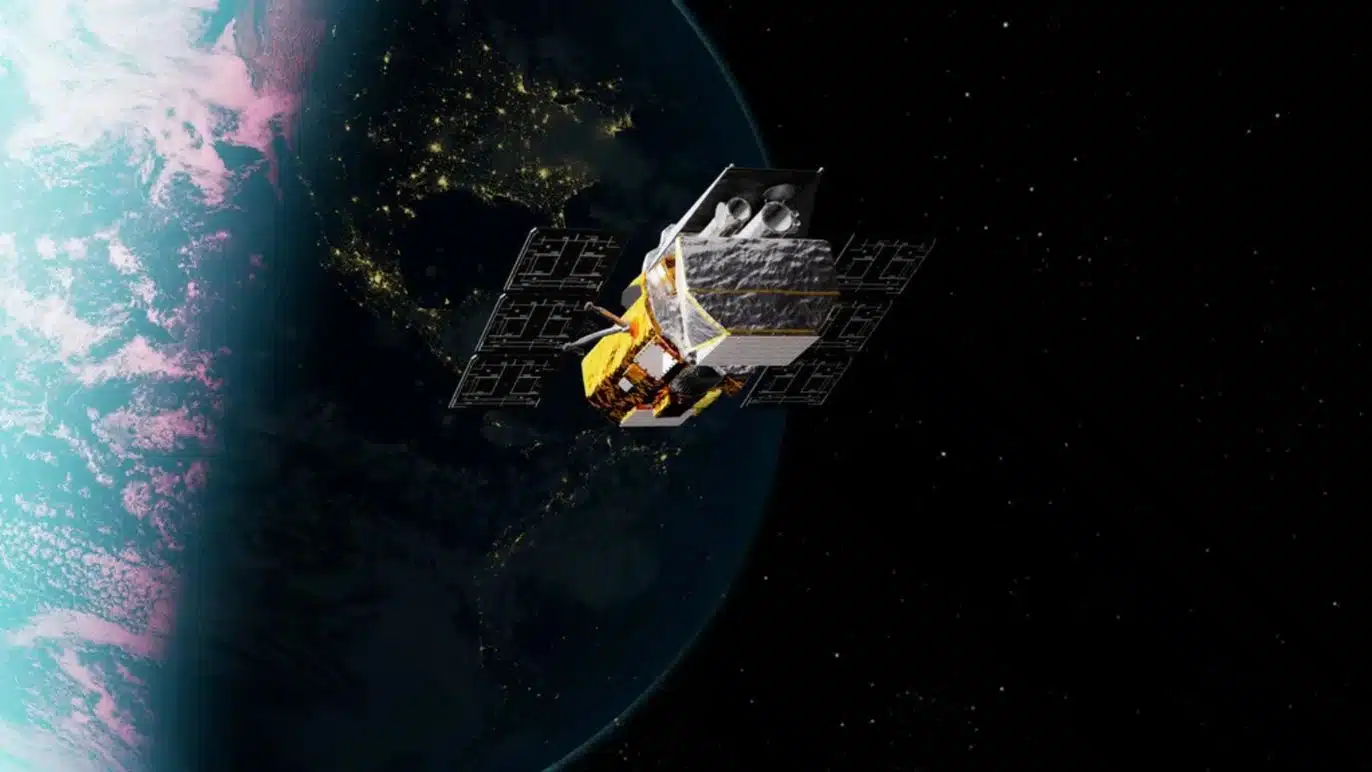
Scheduled for liftoff in late 2025 aboard a SpaceX Falcon 9 rocket, the Pandora mission represents a pivotal shift in how we search for extraterrestrial life. Unlike the massive, multibillion-dollar James Webb Space Telescope (JWST), Pandora is small—a “SmallSat” roughly the size of a kitchen fridge—but its mission is critical. It is designed to stare at 20 hand-picked stars for days at a time, untangling the chaotic “noise” of stellar storms from the true signatures of alien atmospheres.
“Pandora is the key to unlocking the data we’re already getting from our biggest telescopes,” says a mission scientist from NASA’s Goddard Space Flight Center. “If we want to know if a planet has water, or oxygen, or the conditions for life, we first have to understand the star it calls home.”
The “Stellar Noise” Problem
To understand why Pandora is necessary, one must understand how we currently hunt for alien life. Astronomers use a technique called transmission spectroscopy. As an exoplanet (a planet outside our solar system) passes in front of its star, starlight filters through the planet’s atmosphere. Different gases absorb light at different wavelengths—water vapor, methane, and carbon dioxide all leave unique “fingerprints” in the light spectrum.
By analyzing these fingerprints, scientists can theoretically tell if a planet is a barren rock, a gas giant, or a watery world capable of supporting life.
However, stars are not uniform lightbulbs. They are violent, churning balls of plasma covered in “starspots” (cooler, dark patches similar to sunspots) and bright regions called faculae. These features change constantly as the star rotates.
“When a star has spots, it messes up the spectrum,” explains Dr. Elisa Quintana, an astrophysicist at NASA Goddard. “A starspot can mimic the signal of water vapor in a planet’s atmosphere. We might think we’ve found a habitable ocean world, but it could just be a stormy star fooling our instruments.”
This is known as stellar contamination, and it is currently the biggest hurdle in confirming the existence of biosignatures on other worlds. This is where Pandora comes in.
A Small Satellite with Giant Ambitions
Pandora is part of NASA’s Astrophysics Pioneers program, a new initiative designed to do high-impact science with smaller, lower-cost hardware. While the James Webb Space Telescope cost $10 billion and took decades to build, Pandora has a cost cap of roughly $20 million and was developed in just a few years.
Despite its modest budget and size, Pandora packs a heavy scientific punch. The satellite is equipped with a 0.45-meter (18-inch) telescope—roughly the size of a backyard observatory telescope—but with specialized detectors that allow it to see in two kinds of light simultaneously:
- Visible Light: To monitor the star’s brightness and track starspots as they rotate into view.
- Near-Infrared Light: To capture the spectrum of the planet’s atmosphere.
By observing both at the same time, Pandora can “subtract” the star’s noise from the planet’s signal. It creates a baseline of stellar activity that allows scientists to clean up the data from larger telescopes.
“Think of Pandora as noise-canceling headphones for the cosmos,” says Thomas Barclay, a scientist at the University of Maryland, Baltimore County, and a member of the Pandora team. “It listens to the background static of the star so that the clear note of the planet can be heard.”
The “Goldilocks” Hunt
Pandora’s target list is a “Who’s Who” of intriguing exoplanets. Over its primary one-year mission, the satellite will survey approximately 20 stars and their 39 confirmed planets. These targets range from massive, scorching “Hot Jupiters” to small, rocky worlds that might resemble Earth.
Crucially, Pandora will focus on planets that orbit red dwarfs (M-dwarfs). These stars are smaller and cooler than our Sun, making them the most common type of star in the galaxy. Because they are dim, their “Goldilocks Zone”—the distance where liquid water can exist—is very close to the star. This makes their planets easier to detect, but it also puts them in danger. Red dwarfs are notoriously active, frequently erupting with massive flares and covered in large starspots.
“If life exists elsewhere in the galaxy, the statistical probability is that it exists around a red dwarf,” says Dr. Jessie Christiansen, a lead scientist at the NASA Exoplanet Science Institute. “But because those stars are so noisy, they are the hardest places to confirm habitability. Pandora is going to stare at these systems for 24 hours at a time, catching every flicker and flare, giving us the truth about those environments.”
The mission will specifically look for:
- Water Vapor: The primary ingredient for life as we know it.
- Clouds and Hazes: Which can obscure the surface and indicate complex atmospheric chemistry.
- Methane and Carbon Dioxide: Potential biomarkers that, when found together, can suggest biological activity.
Partners in the Cosmos: Pandora and Webb
Pandora is not working alone. In many ways, it is the specialized scout for the heavy artillery: the James Webb Space Telescope (JWST).
JWST is the most powerful space telescope ever built, but it is also in incredibly high demand. Astronomers from around the world fight for just a few hours of observation time. JWST cannot afford to stare at a single star for days on end just to understand its starspots. It is too valuable for that.
“Webb is a sniper; Pandora is a surveillance drone,” explains a mission engineer. “Webb takes a high-precision shot to get the spectrum. Pandora watches the target for days, mapping the behavior of the star so we can interpret Webb’s shot correctly.”
By combining Pandora’s long-duration monitoring with JWST’s high-resolution snapshots, NASA is creating a “super-dataset” that is greater than the sum of its parts. This synergy is essential for the future Habitable Worlds Observatory, NASA’s next-generation flagship mission planned for the 2040s, which will need to suppress starlight to a degree never before attempted to image Earth-like planets directly.
The Engineering Feat
Building a space telescope on a budget is no small feat. The Pandora mission is a collaboration between NASA’s Goddard Space Flight Center, Lawrence Livermore National Laboratory (LLNL), and the University of Arizona.
LLNL utilized its expertise in compact optics to design Pandora’s all-aluminum telescope. Unlike traditional mirrors made of glass, Pandora’s mirrors are made of the same material as its housing. This means that as the satellite heats up or cools down in orbit, the entire structure expands and contracts at the same rate, keeping the images perfectly in focus without the need for heavy, expensive thermal control systems.
“It’s an elegant engineering solution to a complex problem,” says Pete Supsinskas, a project manager at LLNL. “We stripped away the complexity to leave just the raw capability we needed.”
The spacecraft bus—the “body” of the satellite that provides power and communication—was built by Blue Canyon Technologies in Colorado. The mission operations center will be located at the University of Arizona, where students will work alongside veteran engineers to fly the spacecraft.
The Search for “Alien Earths”
The term “alien life” often conjures images of little green men or sci-fi civilizations. However, for astrobiologists, the discovery of a single microbe—or even just the conditions for a microbe—would be the most profound discovery in human history.
For decades, we have been finding planets. The Kepler mission taught us that planets are everywhere; there are likely more planets than stars in the galaxy. The TESS mission found planets nearby, in our cosmic backyard. Now, we are in the third era of exoplanet science: Characterization. We are no longer asking “Is there a planet?” We are asking “What is that planet like?”
Is it a water world? Is it a super-Venus with a crushing atmosphere? Or is it a blue marble with a nitrogen-oxygen atmosphere like ours?
“We are standing on the precipice of answering the question: Are we alone?” says Dr. Thomas Zurbuchen, former Associate Administrator for the Science Mission Directorate at NASA. “Missions like Pandora are the stepping stones. We can’t just look for signals; we have to understand the noise. If we find a biosignature in 2030, it will be because Pandora taught us how to read the data in 2026.”
Looking Ahead
As Pandora undergoes final testing and integration with the SpaceX Falcon 9 launch vehicle, the excitement within the exoplanet community is palpable. The launch, tentatively set for late 2025, will kick off a year of intense observation.
If successful, Pandora could be extended for another year, widening its survey to even more stars. It proves that space exploration doesn’t always require multi-billion dollar behemoths. Sometimes, a small box, watching patiently in the dark, is exactly what is needed to shed light on the universe’s greatest mysteries.
When Pandora opens its eye to the cosmos later this year, it won’t just be looking at stars. It will be looking for the subtle, ghostly breath of living worlds hidden within their glare.
Pandora Mission: Fact File
- Launch Date: Late 2025 (Target)
- Rocket: SpaceX Falcon 9 (Rideshare)
- Orbit: Sun-Synchronous Low Earth Orbit (LEO)
- Mission Duration: 1 year (primary), with potential for extension.
- Cost: ~$20 Million
- Telescope: 0.45-meter (18-inch) Cassegrain
- Wavelengths: Visible (0.4 – 0.8 microns) and Near-Infrared (0.8 – 2.4 microns)





















