


Resellers are no longer confined to only one platform; in today’s digital marketplace, they have a choice.
Today’s savvy sellers are in a position to embrace multi-platform selling to stay competitive, whether selling refurbished electronics, vintage fashion, or operating a small home goods store.
What would be the reason?
Multi-platform selling provides a critical hedge against the unpredictability of only using a single platform.
It makes perfect business sense to use more platforms, for example, eBay, Etsy, Poshmark, Facebook Marketplace, Mercari, and others.
However, more complexity can be expected with more reach.
Things can quickly become overwhelming without the right systems in place when managing listings, inventory, and pricing across multiple platforms.
To help resellers streamline their operations and scale successfully in the ever-evolving world of e-commerce, this article will look at strategies, tools, and best practices.
1. Why Diversifying Marketplaces Makes Sense for Sellers
Algorithms change, so feeling comfortable and relying on one platform might very well change.
Customer traffic often changes, and platform structures might shift.
New compliance rules can eat into margins or reduce visibility, or sellers could suddenly find their products buried in search results.
Both stability and opportunity can be provided by diversifying:
- Each platform attracts its own demographic and provides exposure to different audiences.
- While Facebook Marketplace serves a hyper-local buyer base, Etsy, for example, leans into handmade and vintage.
- If one site throttles your reach or suspends your account, other platforms remain active revenue channels, which would provide protection.
- Some products perform better on certain platforms depending on the product, which provides an optimized product fit.
- Depop, for example, might be ideal for selling clothing, which would not be the same on eBay.
Resellers aren’t just casting a wider net; they’re also building resilience by selling on multiple marketplaces.
2. What to Look for in Cross-Listing Solutions
Resellers often turn to cross-listing tools to manage multi-platform sales effectively.
By duplicating and managing listings across marketplaces, platforms are usually able to simplify the process.
But this is not the case all round.
When choosing a cross-listing solution, here’s what to look for:
- Does the platform support the marketplaces you are using? In other words, is it compatible?
- To prevent overselling, can it update stock in real time, in other words, synchronize inventory?
- To account for different fee structures, can prices be adjusted by platform? In other words, does it offer pricing flexibility?
- Is friction reduced in the process, and is the dashboard intuitive? In other words, what is its user interface and workflow like?
- Is there documentation or community support, and can you get help when needed? In other words, is customer support available?
To ensure you choose a solution that grows with your business rather than creates new bottlenecks, use these criteria to evaluate tools.
3. Comparing Manual vs. Automated Listing Methods
Manually listing across platforms is the ideal way for resellers to start their journey if they only have a few items.
It becomes a serious waste of a reseller’s precious time to manually add items once their catalog has grown.
Manual listing downsides:
- Duplication of listings across platforms is time-consuming.
- Outdated inventory, mislabeling, and typos can increase as inventory grows.
- To maintain promotional uniformity, managing edits and price changes can become difficult too.
Automation benefits:
- With a few clicks, you can create one listing and push it across multiple platforms through batch posting.
- When a sale is made, stock levels can be automatically updated through inventory sync.
- To save time and reduce errors, everything can be managed from a centralized dashboard.
Automation quickly proves to be more efficient and reliable for most sellers aiming to scale beyond the status of hobbyist.
4. How the “Best Cross-Listing Tool” Empowers Resellers
It’s important to find a platform that fits your workflow and goals in the myriad of cross-listing platforms that are available.
Some platforms prioritize global reach or volume-based businesses, while some tools specialize in vintage marketplaces.
A recent roundup of the best cross listing tool options offers practical comparisons and recommendations for those seeking reliable automation platforms.
This was done to help resellers make informed decisions about which solution would best support their business.
To streamline every aspect of multi-platform selling, these tools make it easier to list across multiple sites and provide features like analytics, bulk editing, and centralized messaging.
5. Tips for Streamlined Multi-Platform Inventory Management
Organizing becomes critical once your listings span several marketplaces.
Overselling, missed sales, or customer dissatisfaction results from having a disorganized inventory.
To stay on top of things, here are some proven practices:
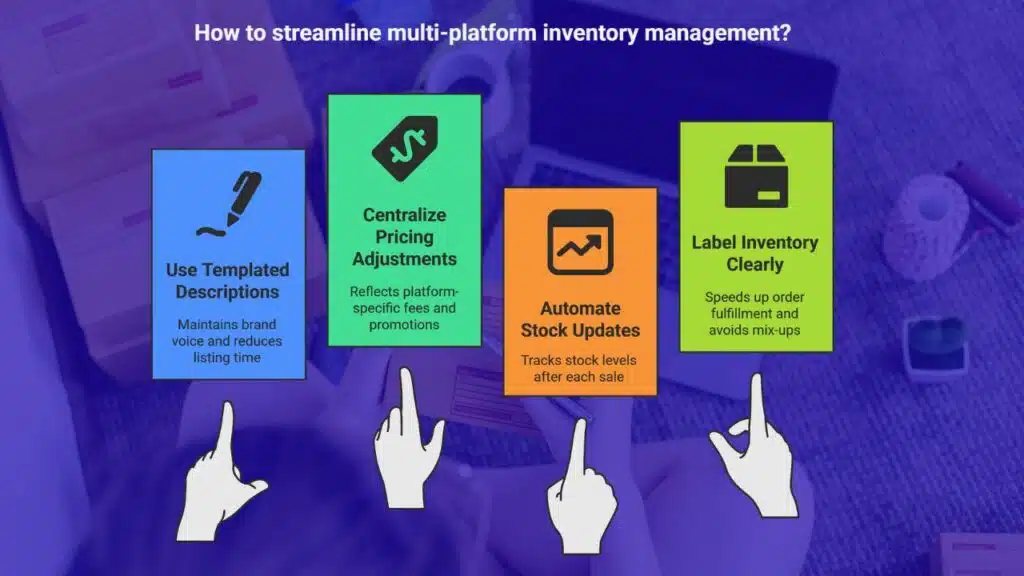
- To maintain brand voice and reduce listing time, use templated product descriptions.
- To reflect platform-specific fees or promotions, centralize pricing adjustments.
- By using a unified system that updates automatically after each sale, all stock levels can be tracked.
- To make order fulfillment faster and avoid mix-ups, inventory has to be labeled clearly.
You can focus more on growth and less on logistics when your inventory is centralized and your workflow is consistent.
6. Ensuring Quality & Compliance Across Listings
More than duplicating listings is required with multi-platform selling.
Meeting the policies and standards of each marketplace matters for visibility and customer trust.
Best practices include:
- Using neutral backgrounds and multiple angles on high-quality photos.
- Keeping to platform-specific guidelines tailored to accurate, detailed descriptions.
- To ensure visibility in search, use the correct categories and attribute tagging.
- Item condition, prohibited goods, or shipping rules need to be monitored for compliance.
- To save you from policy violations or listing takedowns, some advanced cross listing tools even flag inconsistencies or non-compliance before you publish.
7. Scaling Smart: When to Invest in Advanced Listing Tools
Advanced tools are not always needed by sellers from the word go.
Managing listings as sales grow and volume creates complexities, advanced tools become a requirement.
When is upgrading required?
- When you have to list 59+ items over at least 3+ marketplaces on a consistent basis.
- When, due to stock discrepancies, you’re missing sales.
- When sourcing or selling is overtaken by admin.
- When inefficient workflows are holding you back from growing your business.
You can free up your time and enable smarter, faster growth by investing in a robust cross-listing and inventory management tool.
Conclusion: Maximizing Reach, Minimizing Hassle with Cross-Listing Strategy
Resellers need every advantage they can get in this era where e-commerce competition is fierce and customer expectations are high.
To protect your business from platform-specific risks, embracing a multi-platform selling strategy will enable you to widen your market.
You can scale and streamline your operation by combining smart listing tools for efficient inventory management.
Consider exploring tools that support seamless cross-listing, whether you’re just getting started or looking to take your store to the next level.
Mastering multi-platform selling becomes less of a chore and more of a strategic advantage when you have the right systems in place.





















