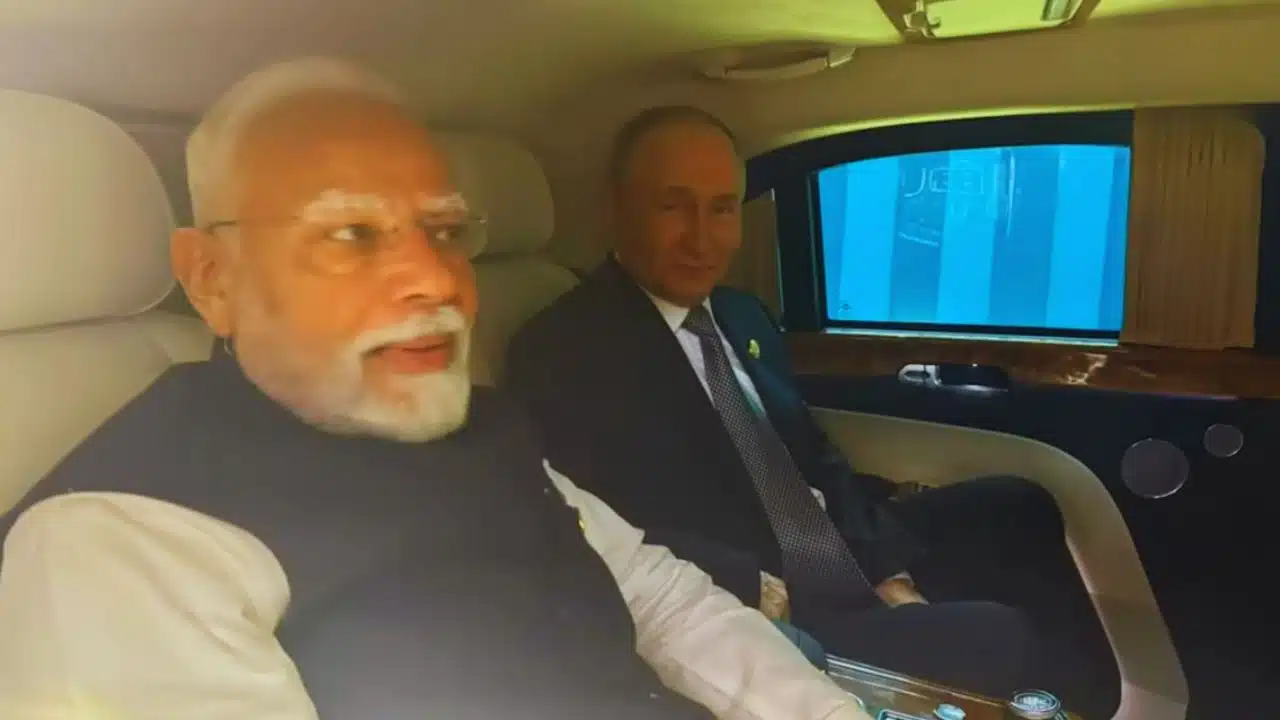
After the conclusion of the Shanghai Cooperation Organisation (SCO) Summit in Tianjin, China, Prime Minister Narendra Modi and Russian President Vladimir Putin made headlines with a rare diplomatic gesture. Instead of proceeding separately to their scheduled bilateral meeting, the two leaders decided to ride together in the same car.
According to official sources, President Putin personally insisted that he and Modi travel together after the SCO proceedings. He even waited for about 10 minutes so that the Indian Prime Minister could join him in the vehicle. The decision to share a ride was not merely logistical—it sent a strong signal about the depth of trust and personal rapport between the two leaders.
Extended Private Conversation Inside Putin’s Limousine
The journey was not just symbolic. Both leaders used the car ride to engage in a long, uninterrupted private conversation. Reports suggest that their discussion continued for 45 to 50 minutes, even after arriving at the Ritz-Carlton Hotel, where the formal bilateral meeting was scheduled.
The Kremlin later confirmed that the two leaders had what was described as a “tête-à-tête conversation” lasting about an hour, inside Putin’s official Aurus limousine. This is the same armoured luxury vehicle that the Russian president often uses for key diplomatic events, and bringing Modi into it highlighted the warmth of the relationship.
Prime Minister Modi himself reflected on the experience in a post on X (formerly Twitter), saying:
“After the proceedings at the SCO Summit venue, President Putin and I travelled together to the venue of our bilateral meeting. Conversations with him are always insightful.”
The personal exchange, away from the public eye and official delegations, underscored the value both leaders place on their dialogue.
The Significance of Putin’s Gesture
This shared car ride carries important symbolic weight given the broader geopolitical climate. In recent months, the United States has sharply criticized India’s continued purchase of Russian oil, arguing that it indirectly funds Moscow’s war effort in Ukraine. U.S. President Donald Trump has gone further by imposing 50% tariffs on Indian goods, the highest such duties faced by any Asian country.
Despite these pressures, India has not backed down. New Delhi has repeatedly asserted that its energy security and national interest will guide its import policies. Officials have also branded Washington’s tariffs as “unfair, unjustified, and unreasonable.” By choosing to visibly stand together in Tianjin, Modi and Putin sent a message of solidarity in the face of Western pressure.
India–Russia Relations: A Steady Partnership
India and Russia share one of the steadiest post-World War II relationships among major powers. Historically, Moscow has been a key defense supplier and energy partner for New Delhi. Since the start of the Ukraine war in 2022, when many Western nations imposed sanctions and price caps on Russian oil, India has become one of Moscow’s largest oil buyers.
While there are no absolute international bans on importing Russian crude, the West has enforced price caps and payment restrictions. India, however, has continued to secure discounted energy deals, justifying them as essential for a developing nation’s energy needs. Both countries are also working on a rupee–ruble trade mechanism, aimed at reducing dependence on the U.S. dollar and insulating their trade from external financial disruptions.
Formal Bilateral Meeting After the Ride
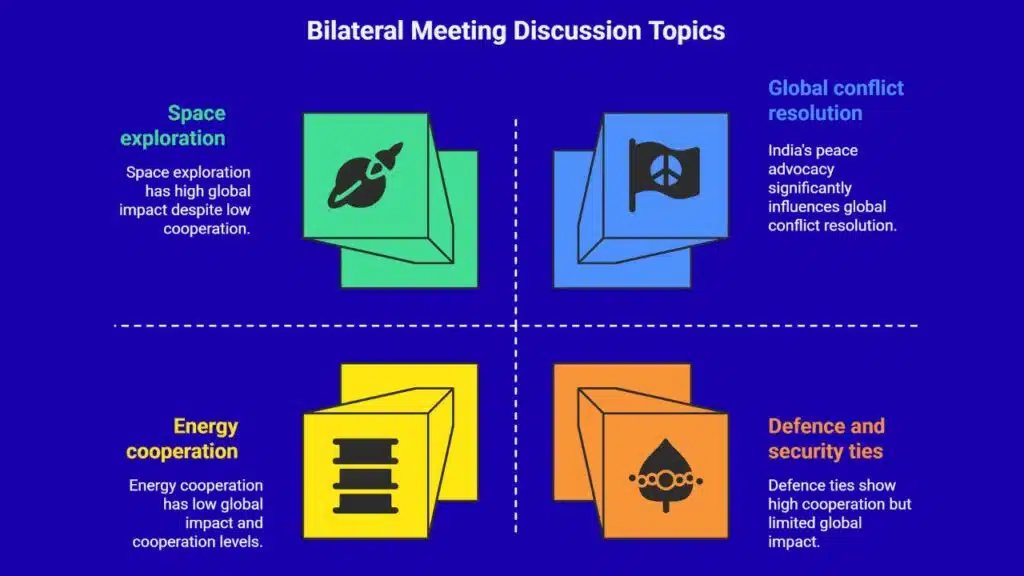
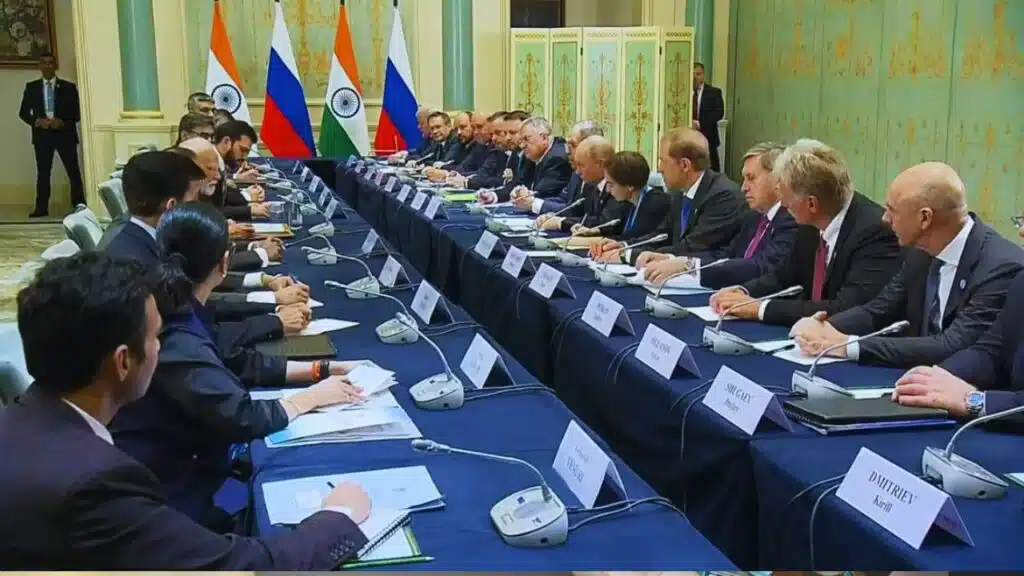
Following their extended car ride, the two leaders proceeded to a formal bilateral meeting that lasted more than an hour. Sources indicate that the discussions covered a wide range of issues:
- Energy cooperation, including the oil trade and potential expansion of joint projects.
- Defence and security ties, where Russia remains one of India’s largest suppliers.
- Space exploration, with possible collaboration on upcoming missions.
- Global conflict resolution, including India’s role in advocating peace in Ukraine.
President Putin publicly acknowledged India’s and China’s efforts to play a constructive role in addressing the Ukraine crisis. He said he appreciated the initiatives by both Asian powers, positioning them as important players in global conflict resolution, which has long been dominated by the West.
Photos That Spoke Volumes
The summit also provided striking images of Modi, Putin, and China’s President Xi Jinping together. One widely circulated photograph showed the three leaders walking side by side, smiling and conversing informally before the SCO family photo. The moment evoked memories of a similar interaction during the BRICS Summit in Kazan in 2024.
In Tianjin, Modi stood at the centre, with Putin on one side and Xi on the other—a placement symbolically underlining India’s position between Russia and China in the evolving multipolar world order.
Another notable visual emerged when Modi and Putin walked past Pakistan’s Prime Minister Shehbaz Sharif, who appeared isolated while the Indian and Russian leaders were engaged in animated conversation. Observers noted the contrast: while Sharif stood silently, Modi and Putin appeared relaxed and deeply engrossed in their dialogue.
What Lies Ahead: A December Visit
This SCO Summit meeting was Modi and Putin’s first in-person interaction since October 2024, when they met on the sidelines of the BRICS Summit in Kazan. They have, however, spoken over phone calls since then—including after Putin’s meeting with Trump in Alaska earlier this year.
The Tianjin meeting also helped set the stage for the future. The Kremlin has confirmed that President Putin is expected to travel to India in December 2025. This upcoming visit is likely to focus on deepening strategic ties, expanding trade mechanisms, and further balancing India’s position in a shifting global order.
The sight of Putin waiting for Modi and sharing a ride in Tianjin was more than a diplomatic courtesy. It was a carefully calibrated gesture highlighting the resilience of India–Russia relations in the face of global turbulence.
As Western pressure mounts over energy trade and tariffs, both leaders demonstrated not only personal warmth but also a shared strategic vision. Their extended private conversation, followed by substantive talks, shows that New Delhi and Moscow are intent on strengthening their partnership, even as they navigate a complex multipolar world.
The Information is collected from NDTV and India Today.