

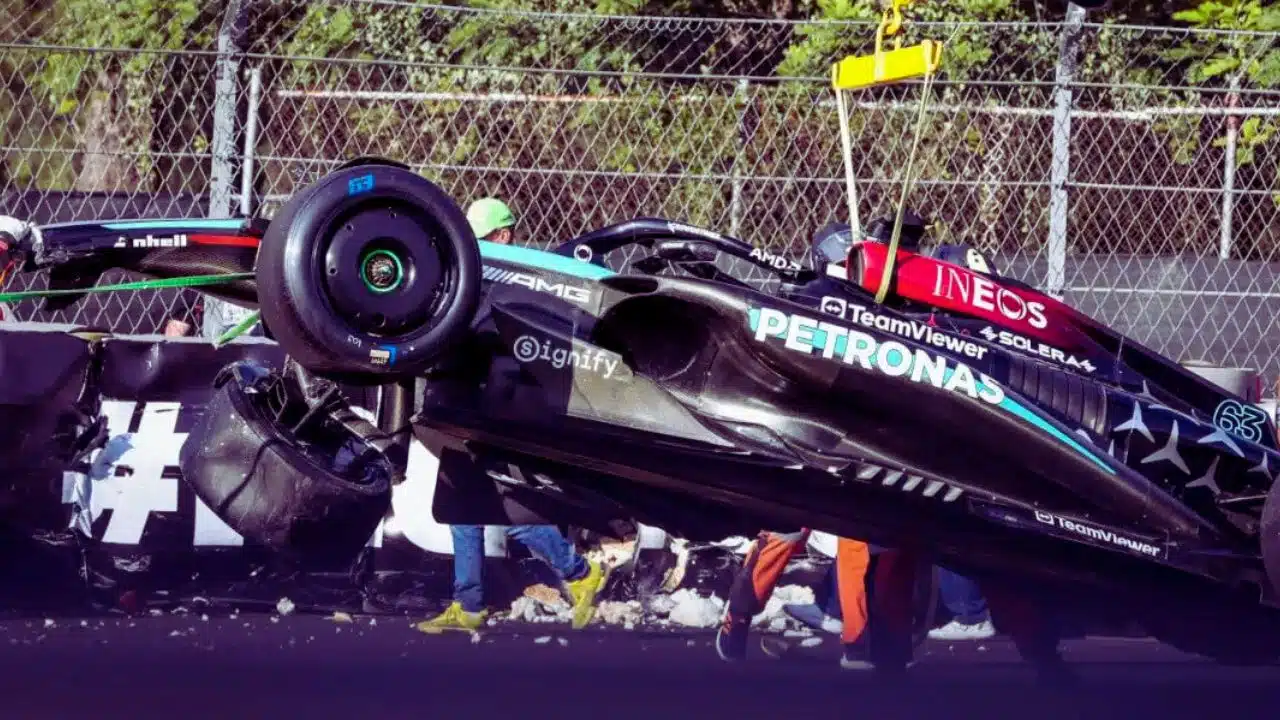
Mercedes-AMG driver George Russell faced a terrifying 35G crash during the second practice session (FP2) at the Mexican Grand Prix. The accident came on the heels of another high-speed incident just days earlier at the United States Grand Prix, marking a stressful week for both Russell and his team. Russell, who had shown promising pace in the initial practice session (FP1), suffered a sudden loss of control of his W15, sliding off at Turn 8 after only four laps in FP2. The crash into the TecPro barriers left his car heavily damaged, and Russell was visibly shaken as he gingerly climbed out, seen holding his ribs and limping slightly due to the intense impact.
Medical personnel quickly escorted Russell to the track’s medical center, where he was evaluated for injuries. After examination, Russell confirmed he was unharmed aside from feeling “a bit winded.” Speaking to F1 TV, Russell expressed frustration, “Honestly, I don’t really know what happened. The car just started bouncing along the ground, and before I even had a chance to catch it, it was already spinning. It just seems like it is one thing after another at the moment.” He explained that he had taken a similar line through Turn 8 during FP1 with no issues, making the FP2 accident all the more puzzling and disheartening for both driver and team.
Mercedes’ Budget Cap Under Strain as Accident Costs Mount
The impact of Russell’s crash extends beyond just driver safety, severely affecting Mercedes’ financials due to the stringent cost cap regulations. Under Formula 1’s current budget constraints, Mercedes and other teams must limit their spending to ensure a level playing field and promote long-term financial sustainability in the sport. With the W15 sustaining heavy damage in the crash, Mercedes must now repair or replace numerous high-cost components, adding strain to a budget already stretched thin by recent incidents.
Team Principal Toto Wolff confirmed the extensive damage to the car in an interview with Sky Deutschland, noting that while Russell himself escaped serious harm, the W15 wasn’t as fortunate. “35G, so that was a really big impact,” Wolff stated, describing the crash’s severity. “He was taken to the medical center, but he’s okay. But of course, the car is badly damaged. We do have the parts.” Wolff elaborated that although the chassis may be salvageable, other critical parts, including the gearbox and possibly the engine, must be inspected or replaced. “I think we can keep the old chassis, but everything else has to go. The engine has to come out, the gearbox has to be checked, and everything else. Two corners of the car are completely gone. So it’s serious damage.”
Repeated Incidents Push Mercedes Closer to Budget Cap Limits
Mercedes is feeling the cumulative impact of recent accidents, each straining the team’s budget further. Russell’s crash during qualifying at the U.S. Grand Prix last week and Mercedes junior driver Kimi Antonelli’s accident in Monza added to the repair bill, bringing Mercedes uncomfortably close to breaching the cost cap. Wolff candidly acknowledged the severity of the situation, saying, “We’re in serious trouble. We are all struggling to stay within the budget cap, and of course, we had a bad accident with Kimi at Monza, then the second one with George last week, and now again.”
The budget cap, a rule introduced in Formula 1 to ensure financial parity, limits annual team spending on car development, maintenance, and repairs. For Mercedes, one of the sport’s powerhouse teams, the recent spate of accidents adds a new level of difficulty as they strive to stay competitive without overextending their finances. Teams that exceed the cost cap face strict penalties from the FIA, including possible fines and limitations on future development resources, which can have a lasting effect on competitiveness.
Russell’s Crash Adds to Performance Frustrations for Mercedes
Beyond the financial implications, Russell’s crash reflects ongoing struggles with the car’s handling and stability. Russell’s description of the incident sheds light on a broader issue: the W15 has been inconsistent, with performance varying between practice sessions and races. Russell’s pace in FP1 had provided a promising start for the weekend, with Mercedes fans hopeful for a strong showing at the Mexican Grand Prix. Yet, the sudden and unexpected loss of control in FP2 suggests underlying handling issues, adding to the team’s frustrations.
“It’s frustrating,” Russell said, referring to the crash, adding that he had attempted to replicate his successful FP1 line through Turn 8 in FP2. “I tried taking the same line and cutting that corner but, for whatever reason on this occasion, the thing just started going on me.” For Mercedes, this incident underscores ongoing efforts to fine-tune the car’s setup to achieve consistent performance across varying track conditions.
Balancing Performance and Budget Constraints Through Season’s End
As the season nears its final races, Mercedes faces a balancing act between maintaining competitive performance and managing budget restrictions. Wolff and his team will need to strategize carefully to avoid further incidents that could impact their budget or risk damaging their car’s components. Mercedes, which has historically been a dominant force in Formula 1, now finds itself contending with unexpected challenges, both on and off the track.
With every incident raising both financial and performance stakes, Russell’s crash in Mexico highlights a critical juncture for the team. As they push to remain competitive under Formula 1’s budgetary guidelines, Mercedes must navigate each race weekend with both caution and precision.





















