Preschoolers encounter measurement problems long before anyone gives them a ruler. They want to know whether a toy will fit inside a box, which child built the taller tower, or why water from a tall glass does not fill a wide bowl.
Adults sometimes answer these questions too quickly. The more useful response is often, “How could we find out?”
Measurement play for preschoolers gives children a chance to compare, predict, test, and revise their ideas. It covers more than reading numbers from a measuring tape. Children explore length, height, weight, capacity, temperature, and time through objects and routines they already understand.
You do not need a packaged math kit. Identical blocks, cups, string, spoons, containers, timers, and household objects provide enough material for weeks of exploration. What matters most is how the activity is introduced and how much thinking the child is allowed to do.
What Counts as Measurement Play?
Measurement describes a particular attribute of an object or event. Adults normally use standard units—centimeters, inches, kilograms, pounds, minutes, or liters. Preschool children usually begin with direct comparisons.
A child might:
- Hold two stones to decide which feels heavier
- Place crayons side by side to find the longer one
- Pour water between containers to see which holds more
- Compare how long two familiar activities take
- Arrange sticks from shortest to longest
- Build a doorway tall enough for a toy figure
These are genuine measurement experiences even when no standard unit appears.
The progression often begins with words such as big, small, long, heavy, full, and empty. Children then become more precise. They compare objects directly, arrange several items by one attribute, and use repeated informal units such as blocks or footsteps. Rulers, scales, measuring cups, and clocks make more sense after those foundations are taking shape.
This progression is not a test. A child may use a kitchen scale one day and compare two objects by hand the next. Both activities help build understanding.
What Children Learn Beyond Measurement
Measurement is part of early mathematics, but it draws on several areas of development at once.
When children estimate how many blocks will cover the side of a book, they make a prediction and hold that idea in mind. When they compare the prediction with the result, they have to notice a difference and rethink their approach. When they explain why two measurements disagree, they use language and reasoning together.
Measurement also gives children a reason to solve practical problems. Consider a child building a bridge for a toy truck. The opening needs to be wide enough, the structure must remain stable, and the child may have to rebuild it several times. The mathematics belongs to the problem rather than sitting beside it as a separate exercise.
Language becomes more precise, too. Preschoolers often use bigger for anything longer, taller, wider, heavier, or more spacious. Adults can gently narrow the description:
“The box is taller. Do you think it also holds more?”
That question is more useful than simply supplying the correct word. It separates two attributes and gives the child something to investigate.
Start With Comparison, Not the Ruler
A common mistake is introducing standard tools before children understand what the tools measure.
Rulers can be interesting to explore, but recognizing the number 12 beside an object does not necessarily mean a child understands length. Before formal units, children need practice lining up objects, using the same starting point, and noticing whether something is longer or shorter.
A sensible path looks like this:
- Compare two objects directly.
- Arrange several objects by one attribute.
- Measure with identical informal units.
- Discuss why different units produce different answers.
- Introduce a standard tool when it solves a meaningful problem.
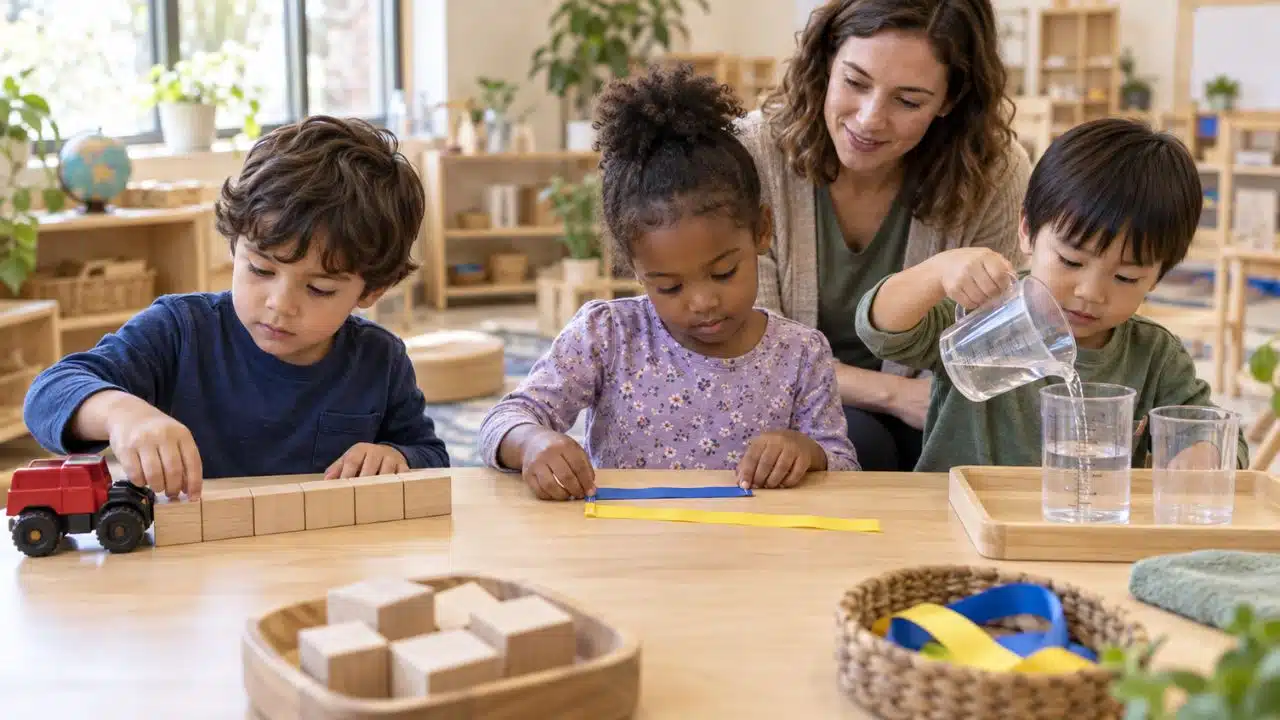
For example, a child can first decide which of two ribbons is longer. Later, the ribbons can be measured with identical blocks. A ruler becomes useful when the child wants an answer that another person can reproduce without having the same blocks.
There is no need to teach conversions between metric and customary units during preschool measurement play. Use the system familiar in the child’s home or school, while treating other units encountered in books, recipes, or conversations as normal variations.
Seven Measurement Activities Using Everyday Materials
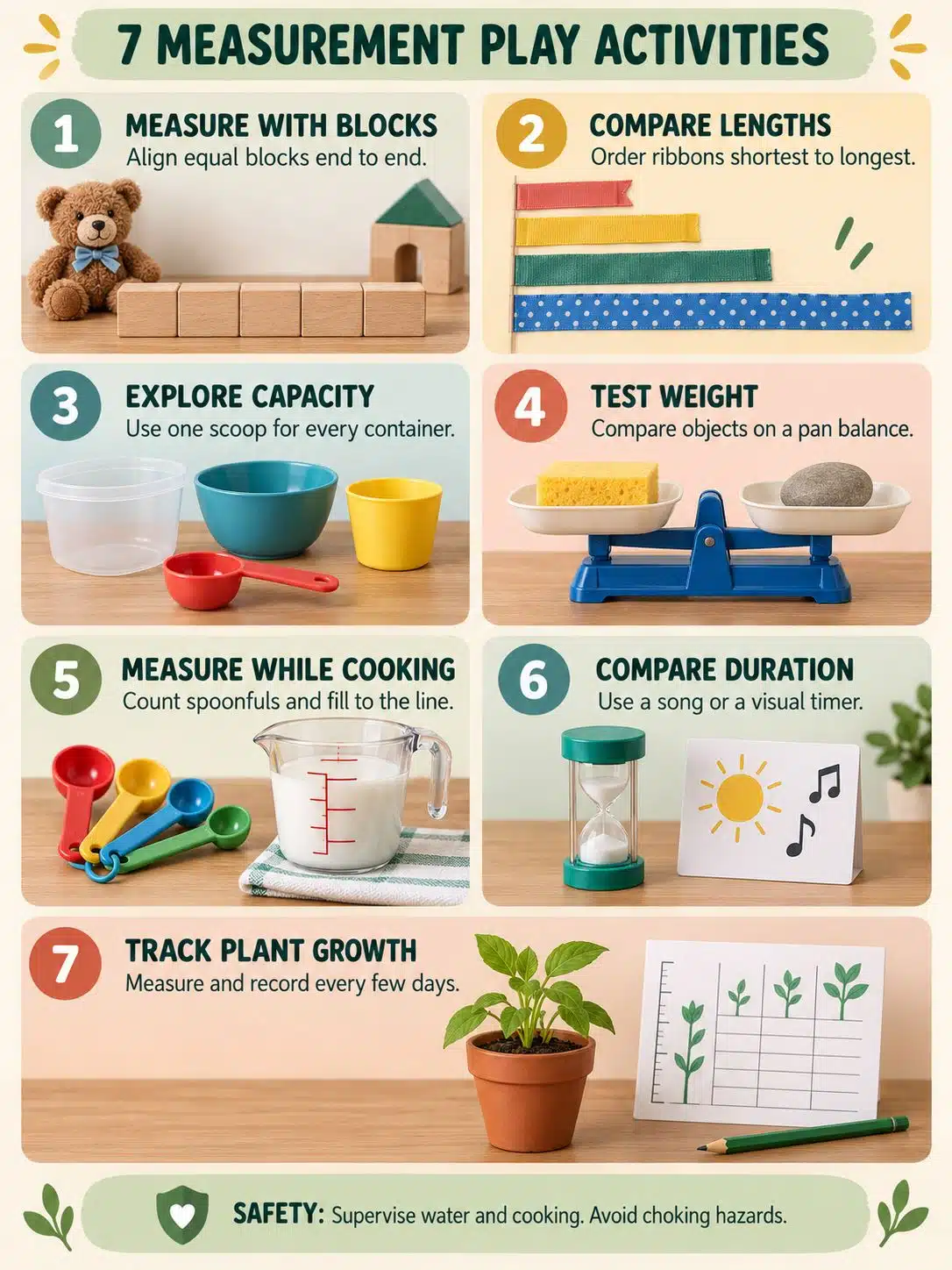
1. Measure familiar objects with blocks
Choose a book, toy vehicle, pencil case, or shoe. Ask the child which object will need the most blocks to measure its length.
Use identical blocks and place them from one end of the object to the other. They should touch without overlapping. If the child starts one line from the edge and another from the middle, resist the urge to rebuild both lines. Ask, “Will these starting places give us a fair comparison?”
Objects rarely match a whole number of blocks perfectly. That is not a problem. “Longer than eight blocks but shorter than nine” is more honest than forcing an exact answer.
Large connecting blocks are easier for younger children to align than coins or small counters. They also reduce the risk presented by loose, mouth-sized pieces.
2. Make a length basket
Place pieces of ribbon, yarn, or paper strips in a basket. Begin with three pieces whose lengths are visibly different. Ask the child to arrange them from shortest to longest.
Children may compare the loose ends while the starting ends remain scattered. Lining up one end of every strip makes the relationship much clearer.
Once three pieces become easy, add others with subtler differences. This is more useful than starting with eight nearly identical ribbons and turning a simple comparison into a frustrating visual puzzle.
The activity also works outdoors with sticks or leaves. Natural materials should be checked for sharp edges, thorns, insects, or irritating sap.
3. Investigate which container holds more
Capacity play is easy to set up in a bath, at a water table, or outdoors. Provide several unbreakable containers and one scoop. Include contrasting shapes: tall and narrow, short and wide, or deep and shallow.
Ask for a prediction before pouring. Then count how many scoops fill each container or pour the contents of one into another.
Many preschoolers assume the tallest container must hold the most. Explaining that this is not always true will have less impact than letting the child watch the water overflow or leave extra space.
Use the same scoop for every container. If the scoop changes, the numbers no longer provide a fair comparison. The lesson can quietly shift from capacity to confusion.
Water activities require close supervision. For dry pouring, select materials that are appropriate for the child’s age and avoid small loose items when mouthing remains likely.
4. Test weight with a balance
A pan balance makes weight visible: the heavier side moves downward. Children do not have to read a numerical scale to understand the comparison.
Start with an obvious pair, such as an empty plastic cup and a wooden block. Then introduce objects whose size might be misleading. A large sponge can be lighter than a small stone.
Let the child choose two objects and predict what the balance will do. If both sides remain level, that creates a different question: are the objects the same weight, or merely close enough that the balance does not show a difference?
A stable pan balance is easier for preschoolers than an improvised hanger balance, which can tilt abruptly and drop its contents.
5. Use measurement during cooking
Cooking gives measuring an immediate purpose. Children can count spoonfuls, fill a cup to a marked line, compare an empty bowl with a full one, or watch a timer.
Choose the recipe carefully. Baking often depends on fairly accurate proportions, so it is not always the best place for unrestricted measurement experiments. An adult can handle critical quantities while the child measures ingredients where a small variation will not spoil the result.
The useful conversation is concrete:
- “We need two spoonfuls. How many have we added?”
- “Is the cup full to the line?”
- “Which bowl feels heavier now?”
- “What will happen if the container is too small?”
Uncooked flour, raw dough, batter containing raw eggs, hot cookware, appliances, and sharp tools require adult control. Young children can participate without having access to every part of the recipe.
6. Compare duration without teaching the clock
Time is harder to investigate because children cannot hold it or place two periods side by side. Familiar routines make duration easier to notice.
Use a sand timer or visual timer while washing hands, tidying toys, or waiting for paint to dry. Compare whether putting on shoes takes longer than singing a familiar song. Talk about which part of the morning happens first and what follows it.
Words such as before, after, first, next, quickly, and a long time matter before formal clock reading.
Avoid using every timer as a race. Countdown pressure can make transitions harder for children who need more time to process instructions or shift between activities. The timer should make time visible, not turn an ordinary task into a performance test.
7. Follow a plant’s growth
Grow a child-safe plant in a stable container and measure it every few days. Children can use connecting blocks, a paper strip, or a ruler. Mark the height on paper and add the date with adult help.
Checking every hour will not reveal a useful change. Waiting several days allows the child to see that some differences emerge slowly.
This activity is particularly valuable because the measurement has a continuing purpose. Children can make predictions, compare records, draw what they see, and discuss why measurements might differ if the plant bends or the starting point changes.
Ask Fewer, Better Questions
Adults can weaken a good activity by asking so many questions that the child stops exploring and begins searching for the answer the adult wants.
One thoughtful prompt is usually enough:
- “How could we check?”
- “What should line up?”
- “Can you arrange these in order?”
- “Could we use the same unit for both?”
- “Why did we get different answers?”
- “Does taller always mean it holds more?”
- “What changed when you tried again?”
Allow time for an answer. Some children respond by moving objects rather than speaking. A child who silently realigns two ribbons may understand the problem perfectly well.
For multilingual children, use measurement vocabulary in the home language as well as the classroom language. Mathematical understanding does not depend on learning the English term first.
When to Help—and When to Wait
A line of blocks may contain a gap. A child may count one block twice or begin measuring away from the object’s edge. These are useful mistakes because they reveal the child’s current method.
Immediate correction produces a neater result but can remove the thinking. A short observation often works better:
“I see a space between these two blocks. Could that affect the answer?”
Step in more directly when safety is involved, when frustration has replaced productive effort, or when the materials make the task unnecessarily difficult. Otherwise, give the child a chance to notice, revise, and measure again.
Slower work should not be confused with weaker understanding. One child may arrange five sticks immediately; another may compare them in pairs several times. Watch the method, not just the speed.
Worksheets Have a Limited Place
Pictures of long and short objects can provide extra practice, but worksheets are a poor substitute for physical measurement. A printed page cannot reproduce the experience of lifting, aligning, filling, pouring, balancing, and adjusting.
For most preschoolers, the stronger sequence is hands-on exploration followed by simple recording. Children might draw the containers they compared, make one mark for each scoop, paste paper strips in length order, or dictate a sentence about what happened.
Recording should capture the investigation, not replace it.
Adapting Measurement Play for Different Learners
The same mathematical idea can be explored with different materials.
A child with limited hand control may find large foam blocks easier to arrange than small counters. High-contrast strips can make starting points and edges easier to see. A child who avoids wet or gritty textures can investigate capacity using large cups and crumpled paper rather than water or sand.
Children who communicate nonverbally can point, sort, place objects, or choose picture symbols for longer, shorter, heavier, and lighter. Understanding should be judged through the child’s actions as well as spoken language.
If the activity causes repeated frustration, simplify the comparison. Two clearly different objects are a better starting point than several nearly identical ones. Complexity can be added later.
What Progress May Look Like
Formal testing is rarely needed during everyday measurement play for preschoolers. Look for changes in how the child approaches a problem.
The child may begin to:
- Identify a specific attribute instead of calling everything “bigger”
- Align objects before comparing their length
- Arrange three or more items in order
- Repeat one equal-sized informal unit
- Notice gaps or overlaps
- Revise a prediction after testing
- Explain why two measurements differ
- Select a sensible tool for the task
For classroom documentation, record what the child did rather than attaching a broad label. “Mina aligned four ribbons at one end and ordered them by length” is more informative than “Mina understands measurement.”
One successful activity does not prove mastery, just as one difficult attempt does not show that a child is behind. Development varies, and early-learning frameworks are not intended to function as pass-or-fail checklists.
Final Thoughts
Measurement play for preschoolers is most effective when it begins with a real reason to measure. Find a container for the toys. Build a bridge wide enough for a truck. Work out which jug holds more. Check whether the plant has grown.
Start with direct comparison and let the child do the physical work. Add precise language when it helps. Bring in identical informal units when a clearer answer is needed, and introduce standard tools when children are ready to understand what those tools solve.
For a first activity, choose two objects and ask one question: “How could we find out?” The conversation and experimentation that follow matter more than producing a perfect number.
Frequently Asked Questions about Measurement Play for Preschoolers
What if two children get different measurements?
Look at their methods before deciding that one answer is wrong. They may have used different-sized units, left gaps, overlapped blocks, or started at different points. Ask them to repeat the measurement using the same unit and starting position. Comparing the two attempts can teach more than simply announcing the correct result.
Does a child need to recognize written numbers before measuring?
No. Children can compare, order, match, fill, pour, and identify something as longer or heavier before reliably recognizing numerals. Written numbers become useful when children want to record or communicate a result, but numeral recognition should not block physical exploration.
Why does my child keep saying the taller container holds more?
Height is the most noticeable feature, so it can dominate the child’s judgment. Offer a tall, narrow container and a shorter, wider one, then let the child transfer the contents between them. Repeated pouring experiences help children examine the assumption without requiring an abstract explanation.