Math Fluency Strategies should not feel like a punishment disguised as practice. I have seen too many children freeze the moment math facts appear, not because they are lazy or “bad at math,” but because they were pushed toward speed before they had enough confidence, number sense, and strategy. That is where math fluency needs a better approach.
Strong math fluency is not just about answering fast. It is about solving accurately, choosing smart methods, understanding number relationships, and feeling calm enough to think. When children build that foundation early, their future learning in science, coding, engineering, money skills, robotics, and problem-solving becomes much easier.
In my experience working around kids’ learning, e-learning, and STEM-focused content, math fluency works best when practice is short, visual, playful, and consistent. It should help children think better, not simply race against a timer.
For parents building a wider learning path, math sits at the heart of my complete STEM learning for kids roadmap because numbers support experiments, design, coding, measurement, games, and real-world decision-making.
What Is Math Fluency?
Math fluency means a child can solve math problems accurately, efficiently, and flexibly. Accuracy means the answer is correct. Efficiency means the child can solve problems without getting stuck for too long. Flexibility means the child can choose from more than one strategy instead of relying on one memorized trick.
The National Academies describes procedural fluency as the skill in carrying out procedures flexibly, accurately, efficiently, and appropriately. That definition matters because real fluency is not rote recall alone. It includes understanding, method choice, and confidence.
A fluent child not only knows that 8 + 7 = 15. They may think:
“I can take 2 from 7, make 10 with 8, and then add the remaining 5.”
That is real number sense. The child is not guessing. The child is using a relationship.
Why Math Fact Fluency Matters
Math fact fluency matters because basic facts take up mental space when children do not know them well. If a child is solving a word problem but still struggling with 6 + 7, their brain has to work too hard on the small step. That leaves less attention for understanding the actual problem.
Education Week explains that math fact fluency helps free working memory so students can handle more complex mathematical work, including multi-step problems and modeling.
This is why kids’ math skills should grow in layers:
| Skill Layer | What It Builds | Simple Example |
| Number sense | Understanding quantities and relationships | Knowing 9 is close to 10 |
| Math fact fluency | Faster recall with understanding | Knowing 6 × 4 = 24 |
| Strategy choice | Flexible problem-solving | Using doubles, tens, or fact families |
| Application | Real-world use | Solving money, time, science, or measurement problems |
When these layers work together, children become more confident. They do not just memorize facts. They understand how numbers behave.
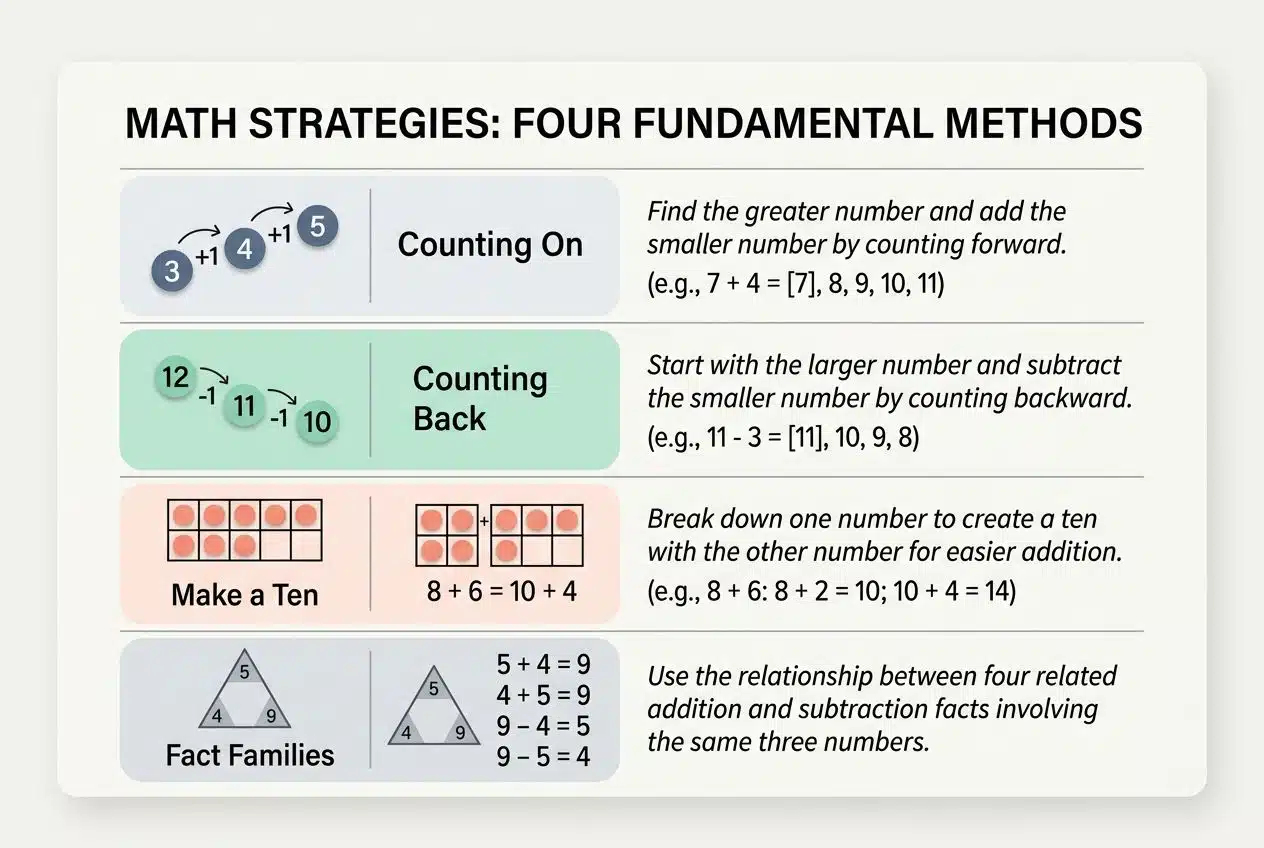
Math Fluency Strategies That Actually Work
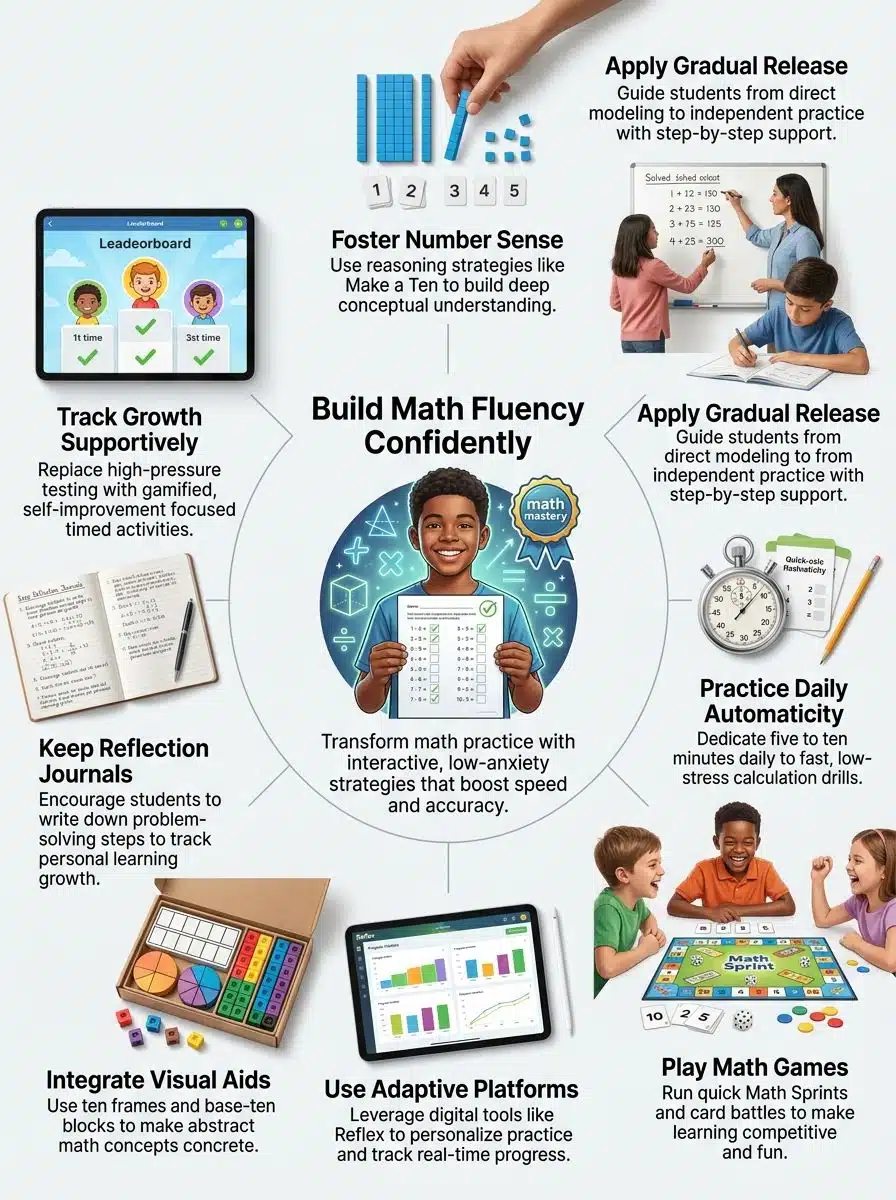
The best Math Fluency Strategies combine understanding, repetition, and confidence. Children need enough practice to become automatic, but they also need to know why a strategy works.
Common Core math standards reflect this balance. By the end of Grade 2, students are expected to add and subtract fluently up to 20 using mental strategies. By Grade 3, they are expected to multiply and divide fluently within 100 using relationships between operations and properties. That means fluency should not begin with pressure. It should begin with a strategy.
1. Start With Number Sense Before Speed
Speed without understanding is fragile. Before asking children to answer quickly, help them see number relationships. Use objects, drawings, fingers, ten frames, number lines, blocks, coins, and real-life examples.
For example, instead of only drilling 9 + 6, show how 9 needs 1 more to become 10. Then 6 becomes 1 + 5. So 9 + 6 becomes 10 + 5. That one small move makes the fact easier to understand and remember.
Useful number sense activities include:
- comparing which number is bigger;
- making 10 with different pairs;
- counting forward and backward;
- using coins for addition and subtraction;
- breaking numbers into parts;
- estimating before solving.
This is the math foundation kids need most: a clear feel for numbers before formal speed practice.
2. Teach One Strategy at a Time
Children get confused when adults teach too many shortcuts at the same time. Start with one strategy. Model it. Practice it. Talk through it. Then move to the next.
| Strategy | Best For | Example |
| Counting On | Early addition | 5 + 3 becomes 5, 6, 7, 8 |
| Counting Back | Early subtraction | 12 – 3 becomes 11, 10, 9 |
| Make a Ten | Addition near 10 | 8 + 7 becomes 10 + 5 |
| Doubles | Addition facts | 6 + 6 = 12 |
| Near Doubles | Related addition facts | 6 + 7 is 6 + 6 + 1 |
| Fact Families | Operation connections | 4 + 6 = 10, so 10 – 6 = 4 |
In my view, “Make a Ten” is one of the most powerful early strategies. It helps children stop seeing numbers as fixed blocks and start seeing them as flexible parts.
3. Use Math Talks to Hear Thinking
A math talk is a short discussion where children explain how they solved a problem. This is one of the easiest ways to improve math fact fluency without adding more worksheets. Write a simple problem like 8 + 7. Ask children how they solved it. One may count on. Another may make 10. Another may use near doubles.
Now the class sees that math can have more than one path. That matters because flexible thinking is part of fluency.
For home learning, parents can do this casually: “How did you get that answer?”
Not in a suspicious tone. Not like an interrogation. Just with curiosity. When children explain their thinking, they often understand it better themselves.
4. Keep Daily Practice Short
Long practice sessions often create fatigue. Short daily practice works better for most children. Five to ten minutes is enough when the practice is focused.
A simple routine could look like this:
- 2 minutes of review facts;
- 3 minutes of strategy practice;
- 2 minutes of a quick game;
- 1 minute of reflection.
Ask one final question:
“Which fact felt easier today?”
That small reflection helps children notice progress. The goal is not to overwhelm them. The goal is repeated contact with facts until the brain starts recognizing patterns faster.
5. Use Games Instead of Endless Worksheets
Worksheets have a place, but they should not be the whole plan. Games give children repeated practice without making math feel heavy. The trick is to choose games where the math stays visible.
Good options include:
- Math War with cards;
- Dice addition races;
- Multiplication bingo;
- Target number games;
- Flashcard partner checks;
- Board games with mental math;
- “make 20” card challenges;
- Quick whiteboard rounds.
For example, in Math War, two players flip cards and add or multiply them. The higher answer wins the round. It is simple, fast, and easy to adjust by age. Games help children practice facts while staying emotionally relaxed. That is important because anxiety can block thinking.
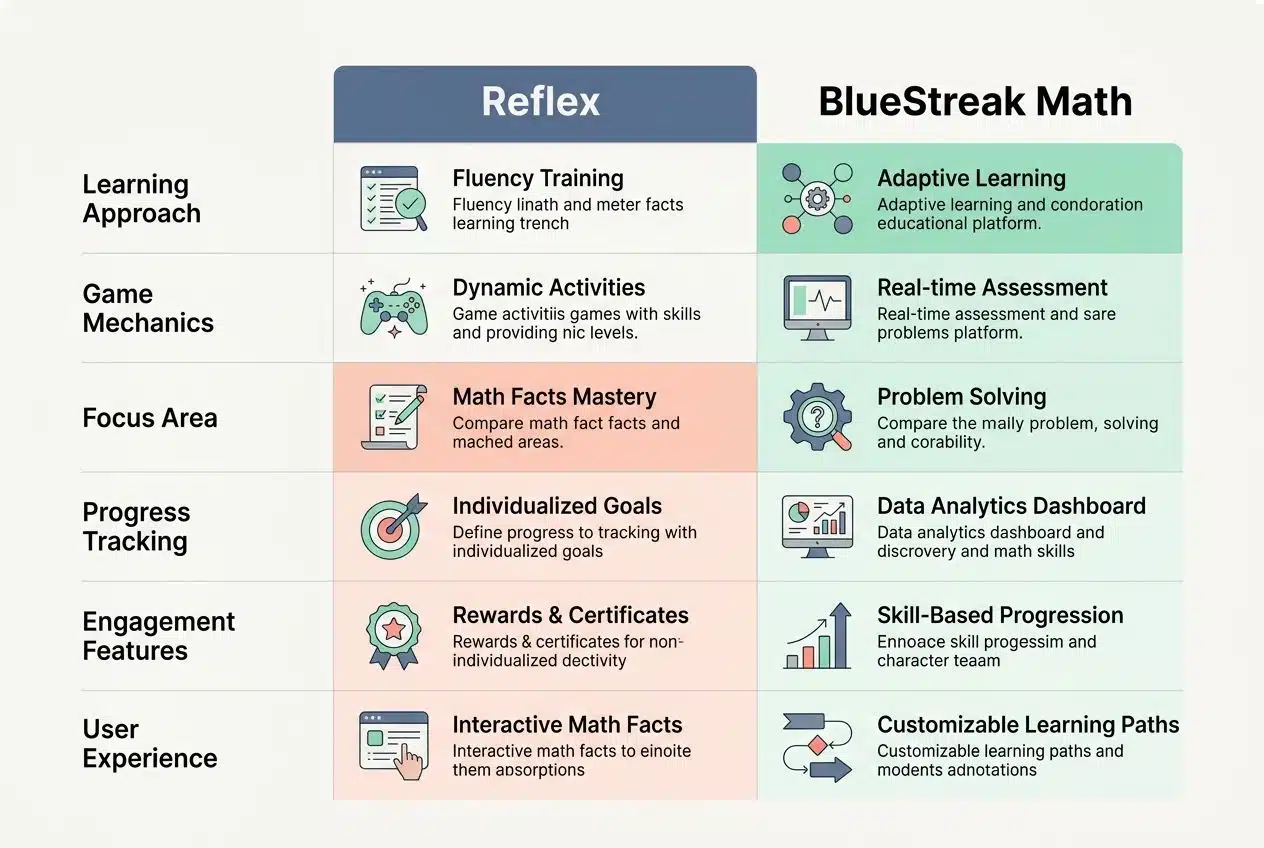
How Edutorial Can Support Play-Based Math Practice
Children usually respond better when early math feels like play, not pressure. That is where a structured kids’ learning platform, such as Edutorial can support practice outside worksheets.
It presents itself as a gaming and technology platform, with learning-focused arrivals such as alphabet, number, and spelling games. For young learners, this kind of playful environment can make number recognition, counting, sequencing, and logic practice feel more approachable.
One useful example is 123 Magic Number Fun: Math Kid. According to its Google Play listing, the app is designed for toddlers, preschoolers, and kindergartners ages 2 to 8, with 12 number games covering number tracing, counting, matching, number sequence, addition, subtraction, multiplication, division, missing numbers, and puzzle-style practice.
I would not use any app as a replacement for parent-child practice or classroom instruction. But for short, focused sessions, a math learning game can help children repeat important skills without feeling like they are trapped in another worksheet.
The best way to use a math app is simple:
- Keep the session short.
- Sit nearby when possible;
- Ask what strategy the child used.
- Connect the game to real-life counting or measuring.
- Stop before the child becomes tired.
That way, digital practice supports the child’s math confidence instead of becoming passive screen time.
Use Visual Tools Before Removing Support
Some children need to see the math before they can hold it mentally. That is not a weakness. That is learning. The What Works Clearinghouse practice guide recommends visual representations as part of mathematics intervention, especially for students who need help connecting abstract symbols with mathematical ideas.
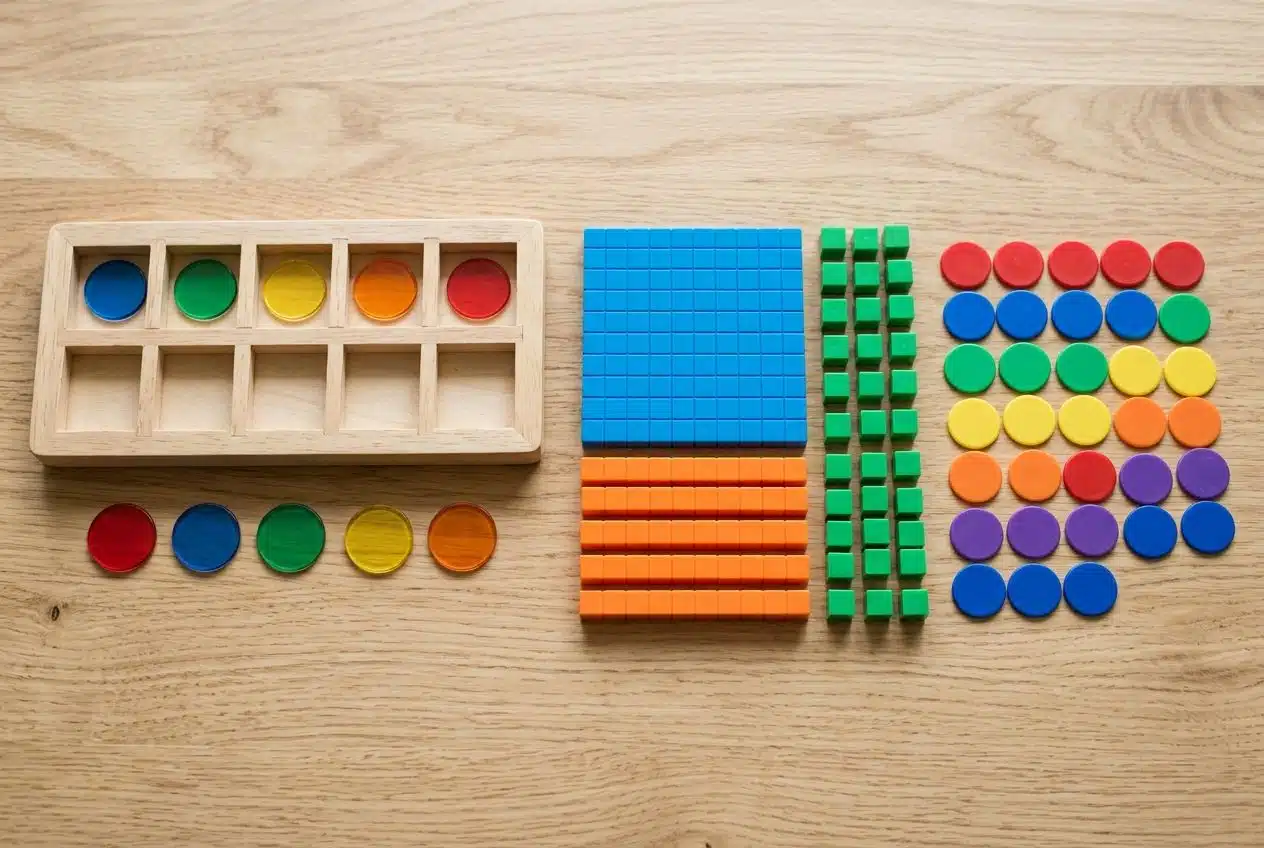
Useful visual tools include:
- Ten frames;
- Number lines;
- Base-ten blocks;
- Counters;
- Fraction tiles;
- Dot cards;
- Arrays;
- Place value charts.
A good sequence is:
Concrete → Drawing → Mental math → Faster recall.
For example, a child may first use counters to solve 7 + 5. Then they draw dots. Then they picture the dots mentally. Later, they recall the fact automatically. Skipping the early visual stage can make some children appear fast for a week, but confused later.
How to Build Math Fact Fluency Without Stress
Timed practice can help, but it must be handled carefully. The problem is not the timer itself. The problem is using the timer as a fear. A timer should show progress, not shame. Use timed activities only after children understand the strategy. Start with accuracy first. Then slowly build speed.
A better fluency check looks like this:
- Give a short set of facts.
- Let the child solve calmly.
- Track correct answers.
- Notice which facts caused trouble.
- Practice those facts with a strategy.
- Repeat after a few days.
If speed improves but accuracy drops, slow down. Fast, wrong answers are not fluency. They are panicked.
How Parents Can Support Math Fluency at Home
Parents do not need to become math teachers. They need to make numbers part of normal life. Simple daily moments help more than many people realize.
Try these:
- Count the change after shopping.
- Ask your child to estimate the total price.
- Double a recipe.
- Compare two product prices.
- Count steps while walking.
- Ask how many minutes are left before dinner.
- Use sports scores for addition and subtraction.
- Measure furniture before moving it.
These small moments make math feel useful. When a child sees math in food, games, money, time, travel, and building, math becomes less scary and more natural.
How Teachers Can Track Math Fluency Progress
Tracking should be simple. If the system is too complicated, it will not last.
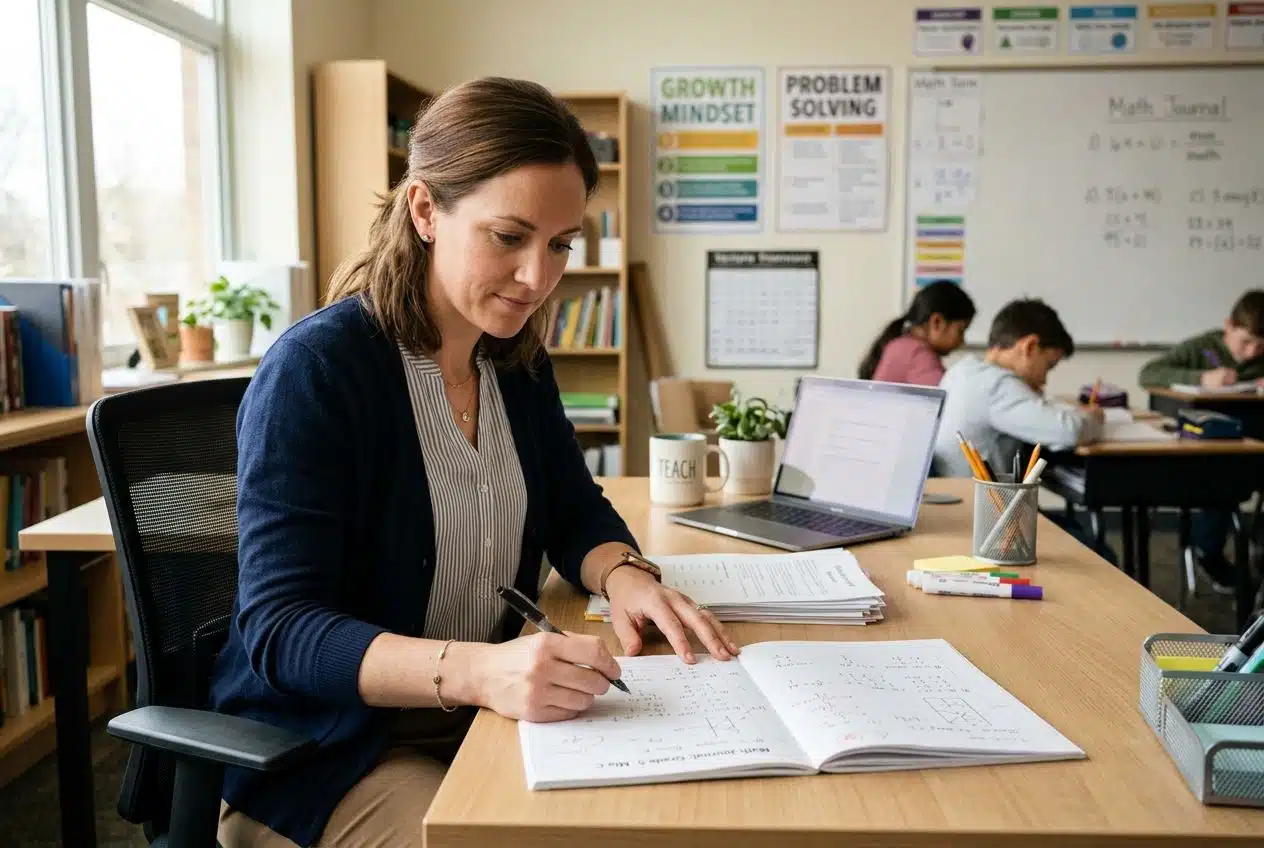
Track three things:
- Accuracy;
- Strategy use;
- Speed over time.
Do not rely only on timed scores. A child may answer quickly but use weak thinking. Another child may solve slowly but use a strong strategy that will become faster with practice. A simple weekly tracker can help.
| Student Check | What to Look For |
| Accuracy | Are answers correct? |
| Strategy | Can the child explain the method? |
| Speed | Is recall becoming smoother? |
| Confidence | Does the child stay calm? |
| Error pattern | Which facts need review? |
Math journals also work well. Ask students to write one sentence: “I solved this by…” That one sentence can reveal more than a score.
Common Mistakes That Slow Math Fluency
Many children struggle with fluency because the learning process is rushed.
1. Pushing Speed Too Early
Children need understanding before speed. If they do not know the relationship, the fact becomes a memory burden.
2. Using Only Flashcards
Flashcards can help, but they should not be the full strategy. Children also need games, visuals, math talks, and real-life practice.
3. Ignoring Mistake Patterns
If a child keeps missing 7 + 8, do not just repeat it louder. Teach a strategy, such as near doubles or making 10.
4. Treating All Children the Same
Some children need visual support longer. Some need more verbal explanation. Some need movement, games, or smaller practice sets.
5. Making Math Feel Like a Race
A little speed practice is fine. Constant racing can make anxious children shut down.
A Simple 2-Week Math Fluency Plan
Here is a practical plan parents or teachers can use.
| Day Range | Focus | Activity |
| Days 1–2 | Baseline | Short fact check without pressure |
| Days 3–5 | Strategy | Teach Make a Ten or doubles |
| Days 6–7 | Game practice | Use cards, dice, or bingo |
| Days 8–10 | Mixed review | Combine old and new facts |
| Days 11–12 | Explanation | Ask children to explain methods |
| Days 13–14 | Progress check | Repeat short fact check and compare growth |
This plan is simple, but it works because it balances strategy, repetition, and reflection.
The Real Goal: Calm, Flexible, Confident Math Thinking
Math Fluency Strategies work best when we stop treating fluency as only speed. Yes, children need faster recall. But they also need strong number sense, clear strategies, visual support, and enough confidence to try without fear. When math fact fluency grows this way, children do not just perform better on basic facts. They build the kind of math foundation kids need for science, coding, engineering, money skills, and future problem-solving.
Start small. Try one math talk. Play one card game. Practice for five minutes. Teach one strategy clearly. Track one small improvement. Add digital practice through tools like Edutorial when they support the learning goal.
That is how math becomes less scary and more useful. And that is the kind of fluency children can actually carry forward.
Frequently Asked Questions About Math Fluency Strategies
1. What Are Math Fluency Strategies?
Math Fluency Strategies are methods that help children solve math facts accurately, efficiently, and flexibly. They include number sense practice, making 10, doubles, fact families, visual tools, short daily review, games, and calm progress tracking.
2. Is Math Fluency Just Memorization?
No. Memorization can be part of fluency, but it is not the whole thing. True fluency means children understand number relationships and can choose smart strategies, not just repeat facts from memory.
3. How Often Should Kids Practice Math Facts?
Short daily practice works best for most children. Five to ten minutes a day is usually better than one long weekly session. The practice should include review, strategy, and a little fun.
4. Are Timed Tests Good for Math Fluency?
Timed checks can be useful when they are short, low-pressure, and used to track progress. They should not be used to shame children. Accuracy and strategy should come before speed.
5. What Is the Best Way to Help a Child Who Hates Math Facts?
Start with games, visual tools, and easy wins. Avoid long drills at first. Help the child understand one useful strategy, then practice through cards, dice, real-life examples, or quick challenges.
6. How Can Parents Build Kids’ Math Skills at Home?
Use everyday math. Let children count money, estimate prices, measure ingredients, compare scores, track time, and solve small real-life problems. These simple habits make math feel practical and less intimidating.