

You set goals every New Year, but by spring, does that notebook of big plans end up buried in a drawer? It’s frustrating. You picture yourself winning, hoping the universe will deliver, or maybe you grind away at a rigid plan but feel like you’re walking through mud. You aren’t alone in this struggle. Manifestation vs Goal Setting isn’t just about wishing on a star or making endless to-do lists; it’s about how your brain connects a clear vision with the grit to get there. Studies show that while imagining success primes your mind, taking action is the only thing that moves the needle.
This guide breaks down how to make belief and strategy work together. I’m going to share the exact tools and mental shifts that turn “someday” into “today,” because the right mix is often the missing piece.
What Is Manifestation?
Manifestation is simply the practice of focusing your thoughts on a desired outcome to make it a reality. While it often sounds mystical, it is actually a way of training your brain to recognize opportunities you might otherwise miss.
Defining Manifestation and Its Principles
At its core, manifestation uses the power of focused intention. You decide exactly what you want, whether it’s a promotion, a new home, or a healthier body, and you hold that idea clearly in your mind. This isn’t just about positive thinking; it’s about direction.
A popular technique many people use is the 369 Method. This involves writing down your specific desire three times in the morning, six times in the afternoon, and nine times at night. This repetition keeps your focus locked on your goal all day long.
The key is to act as if your success is inevitable. This builds a sense of confidence that changes how you walk into a room or handle a challenge.
Visualization and Belief in Manifestation
Visualization is the engine that powers manifestation. When you close your eyes and picture your success in vivid detail, you are actually engaging a powerful part of your brain called the Reticular Activating System (RAS).
The RAS acts like a filter for the millions of bits of information bombing you every second. When you visualize a goal, you “program” this filter to spot things that will help you achieve it. It’s the same reason you suddenly see red cars everywhere after you decide to buy one.
Research backs this up. A study from the Cleveland Clinic found that participants who simply visualized exercising a finger muscle increased its strength by 13.5% without lifting a finger. Your brain builds neural pathways just by thinking, which primes you for the real work ahead.
“See it in your mind, hold it in your hand.”
What Is Goal Setting?
Goal setting is the blueprint that turns your vision into a construction site. It helps you build a step-by-step plan, so every action you take moves you one inch closer to the finish line.
Definition and Importance of Actionable Steps
Actionable steps are the small, boring tasks that actually get things done. They bridge the gap between “I want to run a marathon” and “I will run three miles this Tuesday.”
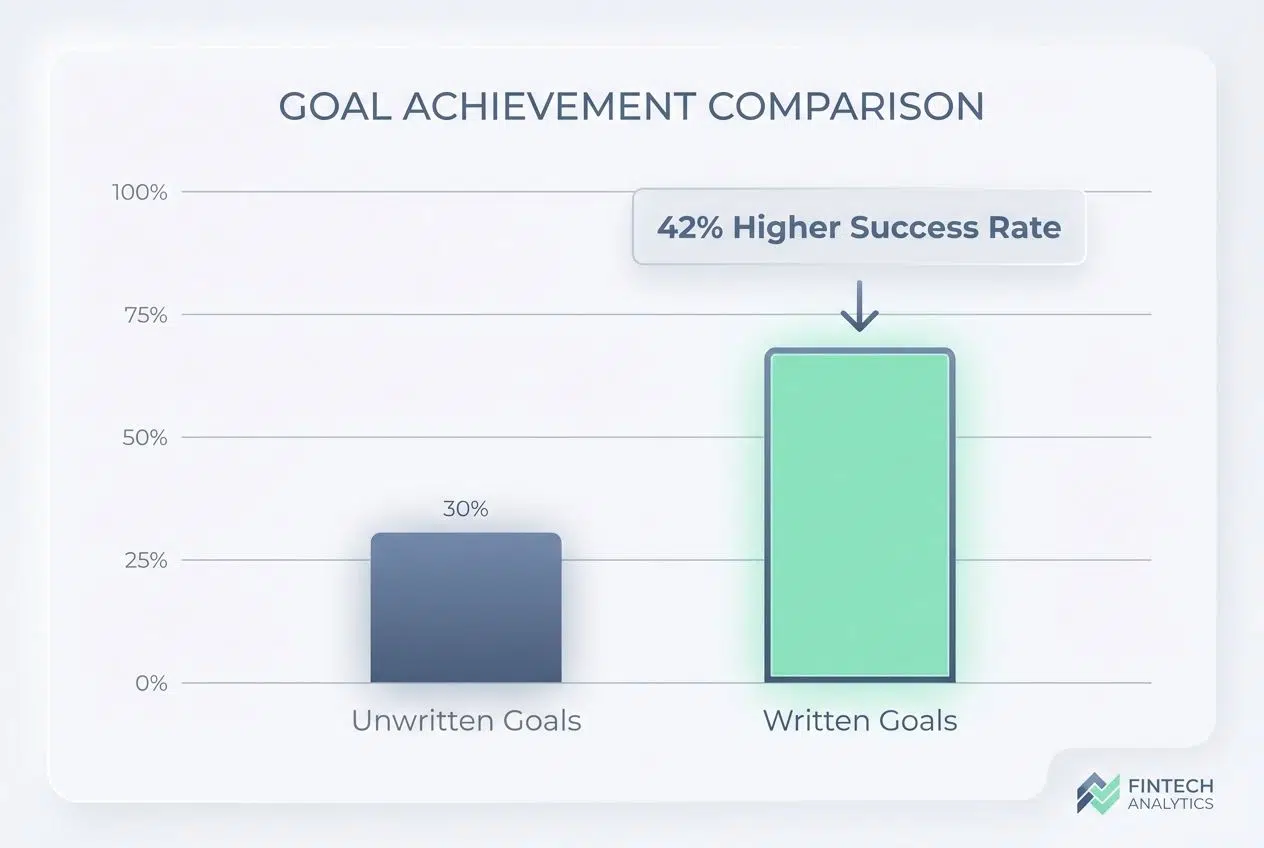
According to a famous study by Dr. Gail Matthews at Dominican University, you are 42% more likely to achieve your goals just by writing them down. That simple act moves a wish from your imagination into the physical world.
Clear steps act like a GPS. When you know exactly what to do next, you stop wasting energy deciding what to do and just focus on doing it. This reduces the “decision fatigue” that often leads to quitting.
Implementing WOOP and SMART Goals
While many people know SMART goals, a newer, scientifically validated framework called WOOP is gaining traction. Created by researcher Gabriele Oettingen, it stands for Wish, Outcome, Obstacle, Plan.
Unlike standard goals that only focus on the positive, WOOP forces you to identify what might go wrong and plan for it. Studies show this method can double the rate of goal achievement compared to positive thinking alone.
However, the classic SMART framework is still excellent for structure:
- Specific: “I want to save $5,000,” not “I want to save money.”
- Measurable: “I will check my balance every Friday.”
- Achievable: “I will save $100 a week,” not “$1,000 a week.”
- Relevant: “This creates an emergency fund for my peace of mind.”
- Time-bound: “I will reach this goal by December 31st.”
Key Differences Between Manifestation and Goal Setting
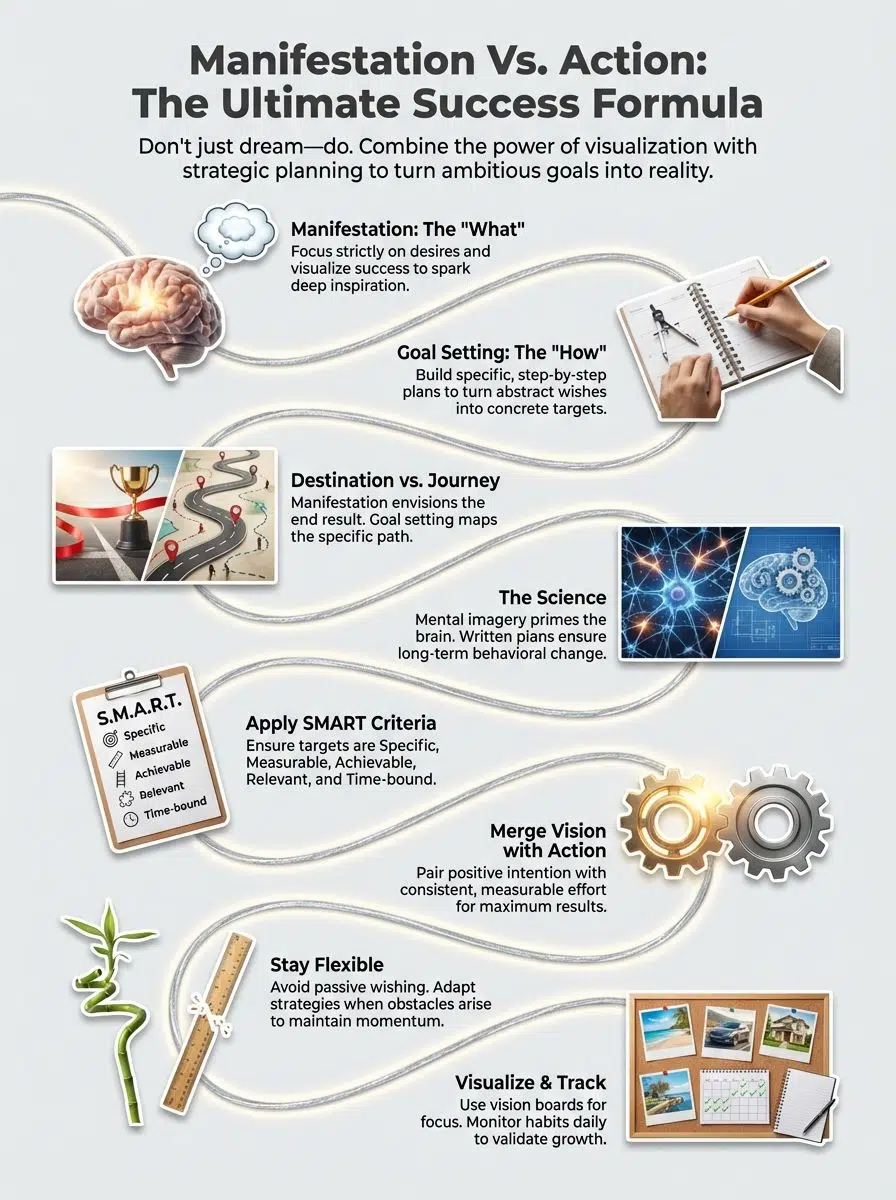
Manifestation shines a spotlight on the “what” and “why,” while goal setting handles the “how” and “when.” They are two sides of the same coin, but they operate very differently.
Comparing Focus on “What” Versus “How”
The difference often comes down to energy versus execution. Manifestation builds the emotional energy to start; goal setting builds the discipline to finish. Here is how they stack up.
| Focus | Manifestation (The “What”) | Goal Setting (The “How”) |
|---|---|---|
| Core Function | Clarifies the destination and builds desire. | Maps the route and tracks progress. |
| Primary Tool | Vision boards, affirmations, 369 Method. | Planners, Asana, Google Calendar. |
| Brain Mechanism | Reticular Activating System (RAS) filtering. | Prefrontal Cortex (Logic & Planning). |
| Common Pitfall | “Magical Thinking”: Waiting for results without work. | “Analysis Paralysis”: Over-planning and never starting. |
| Success Stat | Increases confidence and opportunity spotting. | Written goals increase success by 42%. |
| Famous Example | Jim Carrey wrote himself a $10M check for “acting services.” | Serena Williams followed a strict daily training regimen. |
Mindset Versus Structured Planning
Your mindset dictates whether you stick to the plan when things get hard. Structured planning dictates whether you know what to do when you wake up motivated.
A pure “Goal Setter” might burn out because they lose sight of the big picture. They get stuck on the treadmill of tasks. A pure “Manifestor” might feel good but never actually produce results because they lack a deadline.
The sweet spot is using manifestation to keep your spirits high during the grind, and using goal setting to keep you moving when you don’t feel inspired.
The Science Behind Manifestation and Goal Setting
Your brain doesn’t just have thoughts; it reacts to them biologically. Understanding this can help you “hack” your own motivation.
Psychological benefits of visualization
Visualization is mental rehearsal. When you imagine performing a task, your brain fires the same neural pathways as if you were actually doing it. This is why Olympic athletes like Michael Phelps visualize their races in detail, down to the feeling of the water, before they dive in.
This practice reduces anxiety. By “living” the experience in your head first, the real event feels familiar and safe. It lowers cortisol (stress hormone) levels and boosts dopamine, the chemical associated with reward and motivation.
Behavioral impact of structured planning
Structured planning relies on a psychological concept called “implementation intentions.” This is basically an “if-then” plan for your brain: “If it is 7:00 AM, then I will put on my running shoes.”
Research from the British Journal of Health Psychology found that 91% of people who wrote down when and where they would exercise actually did it. In contrast, only 38% of those who just “intended” to exercise followed through.
When you have a plan, you remove the need for willpower. You don’t have to decide to work; the plan was decided for you yesterday.
Combining Manifestation and Action for Success
Blending big dreams with real moves fires up your motivation like adding fuel to an engine. You get further, faster, when you pair imagination with steady effort.
Setting clear intentions
Clear intentions act as a compass. Instead of a vague hope like “I want a better job,” try an intention like “I am attracting a leadership role that utilizes my creative skills.”
Write this intention down. You might use a digital tool like Notion or a physical journal like The Five Minute Journal to keep this intention front and center every morning. This simple habit keeps your RAS filter clean and focused on your target.
Taking consistent, measurable steps
Moving from setting intentions to taking action is where most people get stuck. The trick is to make the steps so small you can’t say no.

- Use the 5-Second Rule: As popularized by Mel Robbins, if you have an impulse to work on a goal, you must physically move within 5 seconds, or your brain will kill the idea. Count 5-4-3-2-1 and go.
- Gamify Your Progress: Apps like Habitica turn your real-life goals into a role-playing game. You get points and gear for completing tasks, which hacks your brain’s reward system.
- Set “Micro-Deadlines”: Don’t just have a deadline for the end of the month. Set a deadline for 2:00 PM today.
- Celebrate Small Wins: Did you write one paragraph? Great. Acknowledge it. This releases dopamine and encourages you to do it again.
- Track Visually: Use a habit tracker app like Strides to see your streak. Not breaking the chain becomes a powerful motivator.
Balancing belief with effort
Faith in success lights the way, while effort paves every step. You need to believe it’s possible to keep going when the work gets boring, and the work will get boring.
Think of it like farming. Manifestation is the sun and rain; action is the hoeing and planting. You can’t have a harvest with only one or the other. You need to cultivate the belief that your hard work is adding up, even when you can’t see the sprout yet.
Common Misconceptions About Manifestation vs Goal Setting
There is a lot of bad advice out there. Some people think wishing is enough, while others think you have to suffer to succeed. Neither is true.

Manifestation as a passive process
A dangerous trend on social media is the idea of “Lucky Girl Syndrome”, the belief that if you just assume everything will work out, it will. While optimism is great, it becomes a trap if it replaces work.
This passive approach is often called “toxic positivity.” It ignores the reality that obstacles exist. Real manifestation involves “inspired action”, taking steps because you feel pulled toward your vision, not just sitting on the couch waiting for the phone to ring.
Goal setting as rigid or inflexible
On the flip side, many people think goal setting means you can never change the plan. They treat their goals like a binding legal contract. This leads to guilt when life inevitably happens.
Modern productivity experts recommend an “Agile” mindset, borrowed from software development. This means you set a clear direction but remain flexible on the details. If your plan to run at 6:00 AM isn’t working, don’t quit the goal; change the plan to run at 6:00 PM.
Benefits of Merging Manifestation and Action
Mixing vision with steady effort creates a feedback loop of success. Action builds confidence, and confidence inspires bigger actions.
Cultivating a Balanced Mindset and Behavior
A balanced mindset protects you from burnout. If you only grind, you lose passion. If you only dream, you lose respect for yourself.
People who blend these two approaches tend to be more adaptable. They have the “North Star” of their manifestation to guide them when the path gets foggy, and the “Map” of their goals to guide them when they are tired.
Enhancing Focus and Building Resilience
Resilience is the ability to bounce back, and nothing builds it faster than knowing why you are suffering through a tough task.
According to a report by BetterUp, people with high “future-mindedness” (a clear vision) are more resilient and perform better at work. They don’t see a setback as a failure; they see it as a plot twist in the movie of their success.
Tips for Effective Goal Achievement
Small changes can turn big dreams into real wins. Here are a few practical ways to upgrade your toolkit.
Use SMART goals (or try WOOP)
We discussed SMART earlier, but don’t be afraid to experiment. If SMART feels too rigid, try the WOOP method we mentioned. It is particularly good for people who struggle with anxiety or procrastination because it pre-plans your solutions to problems.
Incorporate vision boards and affirmations
Vision boards work, but they don’t have to be poster board and glue. You can use Canva to create a digital vision board for your phone’s lock screen. This ensures you see your goals dozens of times a day.
For affirmations, try recording yourself speaking them and listening to the audio while you commute. Hearing your own voice state your goals is a powerful way to reprogram your subconscious beliefs.
Review and adapt your strategies regularly
Set a recurring “date” with your goals. Every Sunday night, spend 15 minutes reviewing what worked and what didn’t.
Did you miss your workouts? Why? Maybe you need to pack your bag the night before. This weekly review prevents a bad week from turning into a bad month. It allows you to pivot quickly, keeping your strategy fresh and effective.
Final Thoughts
You learned how dreams need both strong belief and smart actions. Using vision boards, positive thoughts, and SMART goals can make progress clear and simple.
Mix planning with passion for the best success; this combo keeps your feet on the ground while your mind aims high. Every day is a fresh chance to step closer to what matters most, so keep moving forward.





















