


The easiest way to get South Asian marketing wrong is to take one English campaign, translate the headline into a few languages, and call the work finished. I would not consider that localization.
South Asia includes Afghanistan, Bangladesh, Bhutan, India, the Maldives, Nepal, Pakistan, and Sri Lanka. These countries share historical and cultural connections, but they do not form one audience. Language, purchasing power, internet access, payment habits, media use, and regulation can change sharply between countries, and often between states, cities, and communities within the same country.
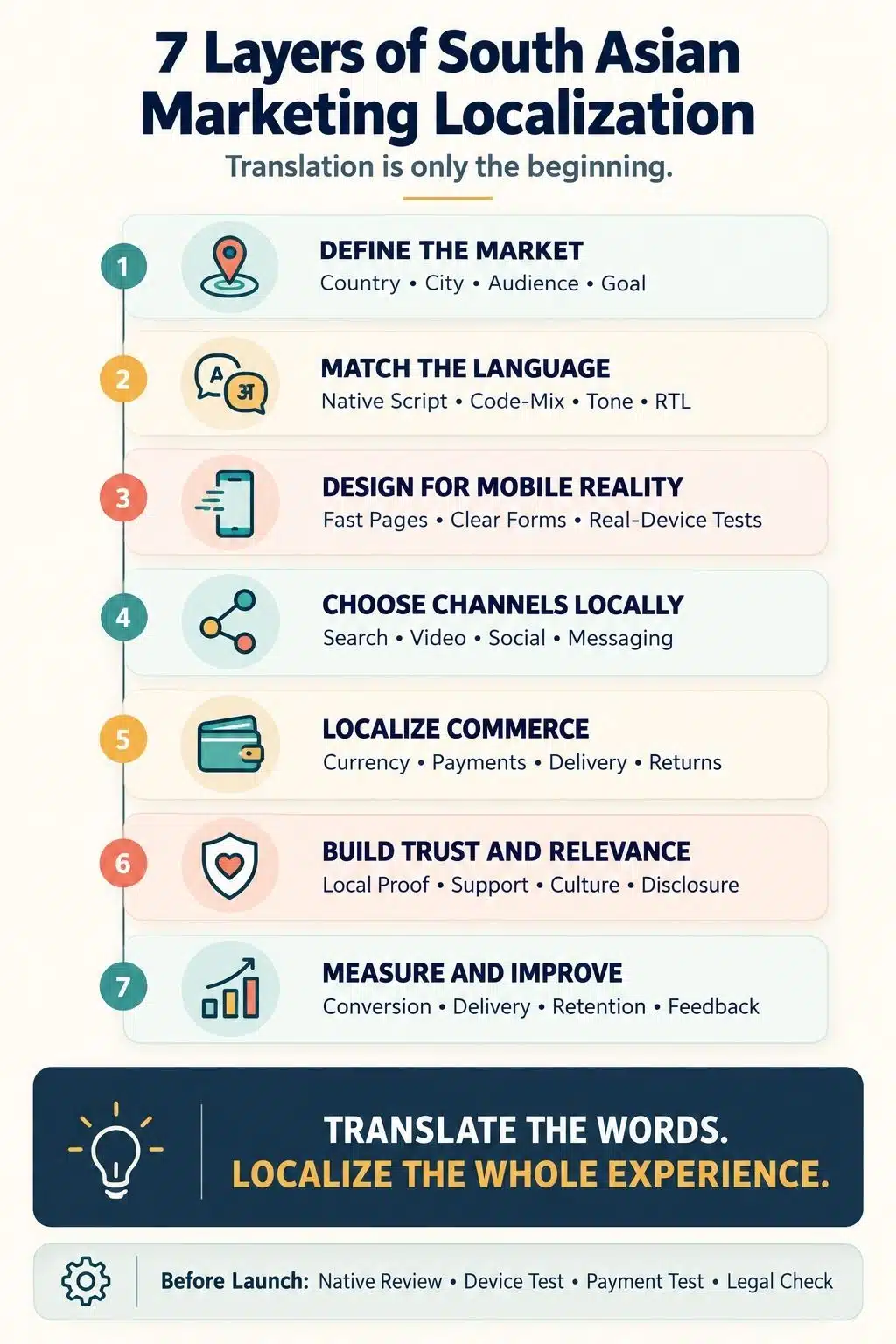
I therefore approach localize digital marketing for South Asian markets as a market-design problem. The words matter, but so do the offer, channel, page speed, payment method, delivery promise, customer support, and measurement plan. If those elements do not fit the market, a polished translation will not rescue the campaign.
Start With a Market, Not a Region
“South Asia” is useful as a geographic label. It is usually too broad to be a campaign audience.
Before creating an advertisement, I narrow the brief to a country, location, language, customer group, and commercial goal. “Young professionals in South Asia” remains vague. “Bangla-speaking first-time online buyers in Dhaka looking for an affordable skincare starter set” gives a team something it can research and test.
I also avoid letting India stand in for the whole region. A lesson from Delhi, Mumbai, or Bengaluru cannot automatically be applied to Karachi, Dhaka, Kathmandu, Colombo, Thimphu, Malé, or Kabul. Even within India, a campaign that works in one state may need a different language, price point, creator, and cultural reference elsewhere.
This is a useful starting framework:
| Market | Practical language starting point | Early priorities |
| India | English, Hindi, and the relevant state or city language | Regional search behavior, UPI and COD, local creators |
| Bangladesh | Bangla, with English or code-mixed language for specific audiences | Mobile financial services, delivery coverage, natural consumer language |
| Pakistan | Urdu and English, plus regional languages where relevant | Right-to-left design, payments, regional differences |
| Sri Lanka | Sinhala and Tamil, with English for selected audiences | Bilingual coverage, resident versus tourism journeys |
| Nepal | Nepali, plus local languages or English where research supports them | Urban-rural reach, wallet and QR payments, distribution |
| Bhutan | Dzongkha and English according to the audience | Precise targeting and realistic media reach |
| Maldives | Dhivehi for residents; English and traveler source-market languages for tourism | Booking behavior, payments, right-to-left Dhivehi design |
| Afghanistan | Dari and Pashto according to location and audience | Connectivity, operational feasibility, payments, regulatory review |
This is not a set of fixed rules. Language choice should follow the customer, not a national stereotype.
Localize Meaning, Not Just Words
Literal translation often preserves a sentence while losing the reason someone should care.
A phrase that sounds confident in English may feel stiff, exaggerated, or rude in another language. Formal translation can also miss the way people actually communicate. Across South Asia, many users move between local scripts, English words, borrowed terms, transliteration, and code-mixed language depending on the subject and platform.
I treat translation, transcreation, and localization as different jobs. Translation protects the meaning. Transcreation rebuilds the message so it sounds persuasive locally. Localization adapts the complete experience, including imagery, forms, prices, payments, delivery, and support.
For India, Hindi and English alone are rarely a complete national strategy. The country recognizes 22 scheduled languages, while the 2024 Internet in India study found widespread use of Indic-language content, including among urban users. In Bangladesh, conversational Bangla may suit a consumer campaign better than formal, textbook-style wording. Pakistan may require Urdu, English, or a regional language depending on the audience. Nationwide communication in Sri Lanka may need both Sinhala and Tamil.
The same language can also require different treatment across borders. Bangla in Bangladesh is not automatically the same marketing locale as Bangla in India. Tamil content created for Chennai should not simply be copied into Sri Lanka. Currency, terminology, products, cultural references, regulations, and search behavior may all differ.
Before scaling content, I create a glossary covering product names, approved translations, terms that should remain in English, preferred spellings, tone, calls to action, and prohibited claims. This keeps advertisements, landing pages, support messages, and creator briefs consistent.
Native review remains essential, but fluency alone is not enough. The reviewer should understand the country, audience, category, and platform. A grammatically correct financial message can still confuse a first-time customer. A fashionable expression used in one city may sound unnatural elsewhere.
Make the Interface Fit the Script
Urdu, Dari, and Pashto use Arabic-derived scripts and are written from right to left. Dhivehi uses the right-to-left Thaana script. Supporting them involves more than aligning a paragraph to the right.
Navigation, icons, carousels, forms, error messages, buttons, and checkout steps must work in the correct direction. Mixed strings need special attention because telephone numbers, prices, coupon codes, and Latin-script brand names may appear inside a right-to-left sentence.
Fonts must support the required characters and shaping without slowing the page. Bengali, Devanagari, Sinhala, Tamil, Tibetan-derived, Arabic-derived, and Thaana scripts also need suitable line height and spacing. I make the final check on real phones, not only inside a design file.
Make Mobile Experiences Work Under Real Conditions
Most teams already say they design for mobile. The more useful question is: which mobile experience?
A customer may be using an entry-level Android phone, an older browser, an unstable connection, expensive data, or a device shared with relatives. Mobile-internet access also remains uneven by gender and location in parts of South Asia. Testing only on a new phone and fast office Wi-Fi leaves important users out.
My mobile checklist is practical:
- Compress images and provide lighter video options.
- Remove scripts and animations that do not help the customer complete a task.
- Keep forms short, preserve progress, and make errors easy to correct.
- Add captions to video and make audio optional.
- Use readable local-script fonts and large tap targets.
- Offer a clear call or messaging option where assisted support is appropriate.
- Avoid exposing sensitive details in notifications on shared devices.
Page speed is not only an SEO concern. It affects whether a paid click becomes a real visit, whether product information loads, and whether a buyer trusts the checkout enough to continue.
Choose Channels by Customer Behavior
There is no single best social platform for South Asia. YouTube, Facebook, Instagram, TikTok, Messenger, Snapchat, LinkedIn, search, marketplaces, and messaging services have different levels of relevance across the region. They also perform different jobs. A platform that creates product discovery may not be the best place to answer questions or close a sale.
I map the channel to the customer journey:
- Search captures an existing need.
- Video demonstrates a product or explains a difficult idea.
- Short-form social content supports discovery and repeated exposure.
- Creators add context and social proof.
- Messaging supports questions and assisted purchases.
- Marketplaces provide familiar checkout and trust mechanisms.
- Email and owned communities support retention.
Platform access, advertising products, and audience behavior can change. I check them before each campaign rather than recycling an old regional channel plan.
Reach estimates also need careful interpretation. Advertising reach is not the same as monthly active users, while registered accounts are not necessarily active or unique people. I use platform figures to form a hypothesis and let first-party campaign data decide where the budget goes.
Research Local Search Intent From Scratch
I do not translate a spreadsheet of English keywords and assume the search strategy is finished.
People may search in a native script, use a transliterated spelling, keep an English product term, or combine languages in one question. Wording can also change between search, social media, and everyday conversation.
For each market, I examine:
- How customers describe the problem, not only the product.
- Native-script, transliterated, English, and code-mixed searches.
- Location names and regional modifiers.
- Questions people ask before buying.
- Language found in reviews, forums, marketplaces, and support conversations.
Each meaningful website locale should have its own URL and genuinely useful content. Accurate hreflang signals can help search engines understand the relationship between versions, while a visible language selector allows visitors to make their own choice. Automatically forcing a version based only on an IP address can frustrate travelers, multilingual users, and people using a VPN.
A page is not localized if it replaces the English words but keeps foreign examples, unavailable products, the wrong currency, and an unusable checkout. Publishing many thin translations may expand the page count, but it does not create a people-first experience.
Localize the Offer and Checkout Together
Customers do not convert because a headline was translated. They convert when the offer makes sense.
That includes local currency, final price, taxes, delivery areas, delivery time, returns, warranties, available plans, and payment methods. I make these details visible before the last checkout step.
Payment behavior is especially easy to oversimplify. India has a mature real-time payment ecosystem led by UPI, yet cash on delivery still matters for part of the e-commerce market. Bangladesh has widely used mobile financial services. Pakistan and Nepal have growing bank, wallet, and QR-payment systems. Sri Lanka also has an interoperable national QR-payment standard.
Cards, bank transfers, wallets, QR payments, cash, and marketplace checkout may all be relevant, but not in the same proportion for every audience. Neither “South Asia is a cash market” nor “everyone now pays digitally” is accurate enough to guide a campaign.
Where cash on delivery is offered, I measure confirmed orders, completed delivery, cancellations, and return-to-origin costs. An advertisement can appear profitable at the order stage and lose money after failed delivery. For digital payments, I watch failed transactions, unclear error messages, refund time, and access to preferred local methods.
Build Trust Beyond the Advertisement
Localization is often presented as a creative task, but trust is also built through operations. Customers want to know whether a business is real, whether it delivers to their area, what the final price will be, and what happens if the product is wrong or damaged. A localized page should answer those questions plainly.
Useful trust signals include verifiable business details, realistic delivery promises, clear return and refund terms, locally relevant reviews, secure-payment information, and a support channel customers can actually use. Familiar payments and marketplaces can help, but they cannot compensate for vague policies or poor service.
I also avoid fake countdowns, fabricated testimonials, exaggerated discounts, and claims the business cannot prove. These tactics may produce short-term clicks, but they weaken the local reputation a brand needs to build.
Use Creators and Cultural Context With Care
I would choose a creator by audience fit, not follower count. The important questions are whether the creator’s viewers live in the target market, understand the campaign language, trust the creator in that category, and take the intended action.
The brief should cover product facts, prohibited claims, advertising disclosures, pronunciation, tone, and the amount of creative freedom available. Effective creator content should feel natural while remaining truthful and clearly identified as advertising when a commercial relationship exists.
Cultural relevance requires the same care. Ramadan and Eid, Diwali, Durga Puja, Pohela Boishakh, Dashain, Tihar, Vesak, and Sinhala and Tamil New Year may all matter, but not to every country, community, or customer.
Before using an occasion, I confirm its relevance, date, local meaning, appropriate imagery, and promotional timing. Some dates change annually, and celebrations vary across borders and communities.
Local context can also be quieter than a festival campaign. Weather, school calendars, salary cycles, wedding seasons, cricket schedules, travel periods, and delivery constraints may be more useful. The aim is to understand people’s lives, not decorate a global advertisement with cultural symbols.
Treat Compliance as Part of Localization
Privacy, consumer protection, advertising, and influencer rules differ across South Asian markets and continue to change. Legal review belongs near the beginning of market planning, not at the end of proofreading.
Before launch, I check consent for tracking and direct messages, data retention, cross-border data handling, children’s advertising, creator disclosures, pricing claims, contests, and cancellation or refund terms. Health, finance, gaming, and other regulated sectors require additional care.
Because laws and implementation timelines change, I would not rely indefinitely on a regional legal checklist. Country-specific review is the safer option when a campaign processes personal data or makes regulated claims.
Measure Business Outcomes, Not Cheap Clicks
A lower cost per click does not automatically mean a market or language is performing better. It may be sending less qualified traffic, creating failed payments, or producing orders that are never delivered.
I connect campaign metrics to the full journey:
| Stage | What I measure |
| Awareness | Qualified reach, video completion, brand-search growth |
| Consideration | Engaged visits, product views, message starts, qualified leads |
| Purchase | Conversion rate, acquisition cost, payment completion, average order value |
| Fulfillment | Confirmed and delivered orders, cancellations, returns, refunds |
| Retention | Repeat purchases, opt-outs, complaints, support resolution |
Results should be segmented by country, language, location, device, channel, and customer type. I test one meaningful variable at a time, such as language, offer, creator, payment option, or call to action, so the result is easier to interpret.
Search queries, failed form entries, support conversations, and reviews also reveal localization problems that an advertising dashboard may miss.
Local Relevance Is the Real Advantage
The best localized marketing does not need to hide where a company comes from. It simply shows that the company has paid attention.
Customers should find language they naturally use, an offer that fits their situation, a page that works on their phone, a payment method they recognize, and policies they can understand. They should not have to work around a global campaign that was never designed for them.
Translate the words when necessary, but localize the decision, the experience, and the relationship. That is how regional reach becomes genuine relevance, and how a brand earns the right to grow in a new market.
Frequently Asked Questions on Localize Digital Marketing for South Asian Markets
1. Do I need to translate my marketing into every South Asian language?
No. I would begin with the languages used by the most valuable, reachable audience for that campaign. One properly researched local experience is more useful than ten weak translations. Expand when customer and performance data justify it.
2. Is English enough for digital marketing in South Asia?
It may be enough for some B2B, technology, higher-education, tourism, or internationally oriented audiences. It should not be assumed. Local-language or code-mixed content may improve understanding and trust even among customers who can read English.
3. Which digital channel works best in South Asian markets?
There is no regional winner. The right mix depends on the country, audience, category, and goal. Use current platform data to form a hypothesis, run a local pilot, and judge the channel by qualified business results.
4. Can AI translate marketing content for these markets?
AI can help with a first draft, terminology list, or content variation. It should not be the final reviewer. A qualified in-market person still needs to check meaning, persuasion, cultural context, claims, and how the words appear in the finished design.
5. How do I know whether localization is working?
Compare each localized journey with a clear baseline. Look beyond clicks to engaged visits, qualified leads, completed payments, delivered orders, returns, repeat purchases, and customer feedback. Good localization should improve understanding and commercial performance.





















