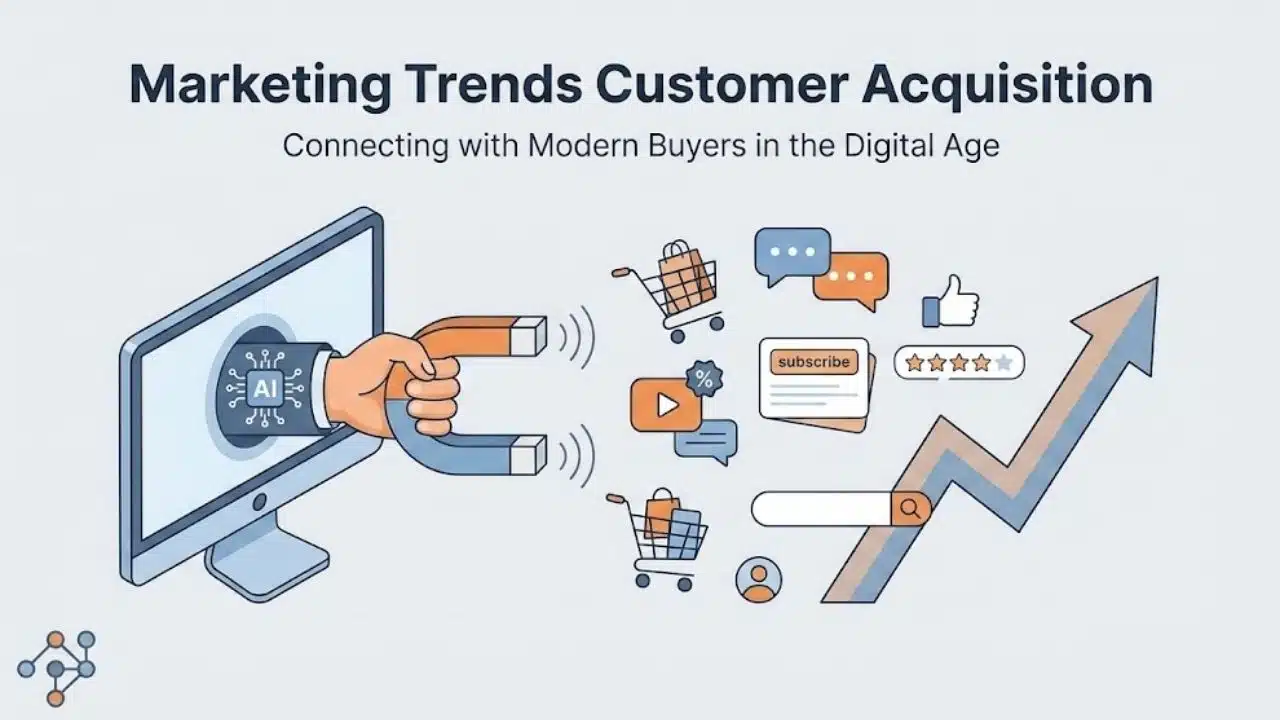
A campaign can report an impressive ROI while revenue stays flat, or organic clicks can drop even as search visibility remains intact. Modern marketing trends customer acquisition strategies reveal that buyer journeys no longer follow a linear path from ad to landing page to checkout. Today, customer acquisition is shaped by AI answer engines, dark social discovery, and first-party data loops.
To lower customer acquisition costs (CAC) and drive real revenue, modern growth teams must pivot from passive distribution to trust-driven, agentic workflows, self-guided buying, and revenue-aligned analytics that prioritize pipeline contribution over vanity metrics.
What Marketing Trend Lists Often Miss
These trends are connected. Automated campaigns need dependable conversion data. Creator content needs clear usage rights before it can become a paid advertisement. Commerce media needs incrementality testing before its reported return can be trusted.
Adding another channel will not repair poor product data, weak landing pages, slow lead response, or unreliable tracking. Those supporting systems are less interesting than a new platform feature, but they usually have more influence on acquisition performance.
Marketing Trends Customer Acquisition: The 10 Shifts That Matter
These ten shifts are not equally important for every business. Some affect the foundations of acquisition, while others suit particular channels or markets. Understanding limits, costs, and requirements will help teams choose where to experiment and where to hold back.
1. AI Search Is Reworking Early Discovery
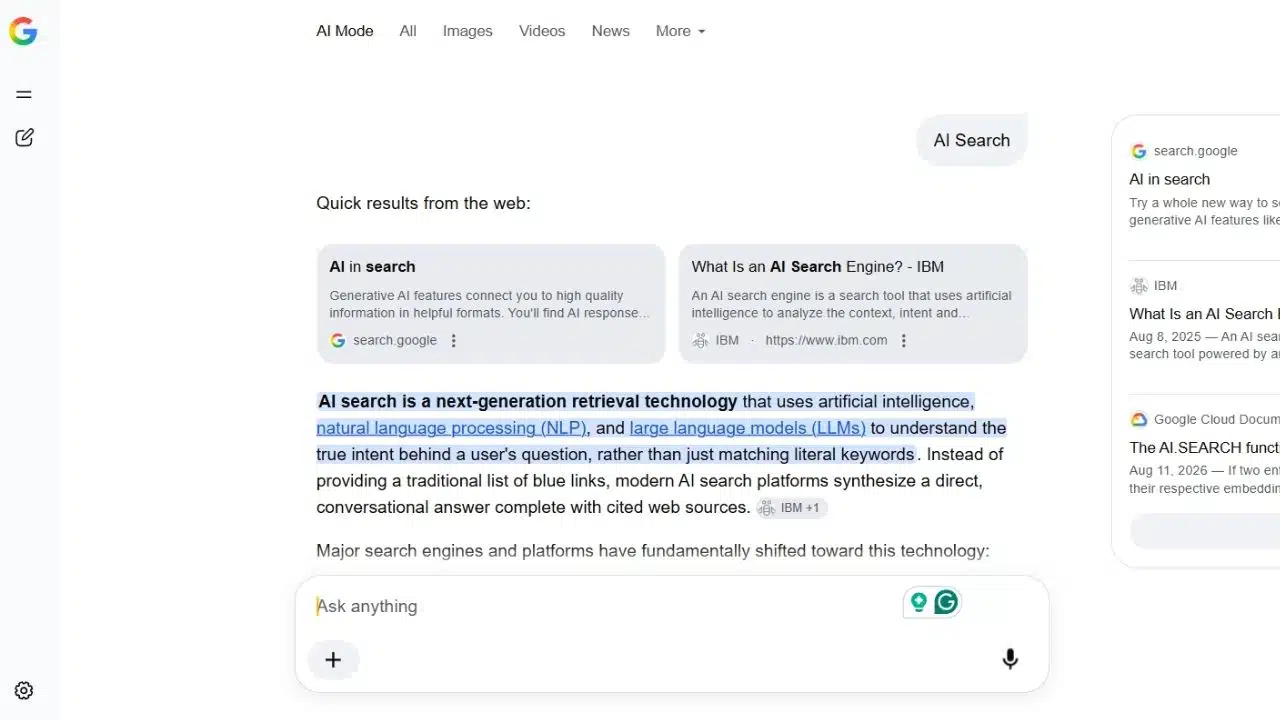
AI-powered search is the broadest change on this list because it affects how customers research almost every category. Google AI Overviews are available in more than 200 markets, while AI Mode supports longer, conversational, and multimodal searches. Instead of typing several short queries and visiting multiple pages, a customer can ask for a comparison that includes budget, location, technical requirements, and personal preferences.
Brands need content that remains useful when a search system extracts, compares, or summarizes it. Clear product information, original evidence, visible authorship, credible explanations, and honest limitations are more valuable than a large archive of generic keyword pages.
Traditional SEO still matters. Search engines need to crawl, understand, and trust the underlying pages before they can present the information elsewhere. What changes is the measurement. Organic clicks alone no longer describe visibility, so teams should also watch branded searches, assisted conversions, referral traffic, direct visits, and appearances within AI-generated results.
Advertising availability is uneven. At the time of writing, eligible advertisements can appear above or below AI Overviews across supported markets. Ads placed inside an AI Overview are limited to English in selected countries.
2. Ad Platforms Are Taking Over More Campaign Decisions
Google AI Max, Performance Max, Meta Advantage+, and similar systems can automate parts of bidding, targeting, placement, landing-page selection, and creative delivery.
Google currently treats AI Max as an optimization layer within Search campaigns, not a separate campaign type. It is enabled by default when new Search campaigns are created, although advertisers can adjust its features and controls.
The easiest mistake is giving these systems a weak success signal. If every form submission receives the same value, the platform may find more inexpensive submissions rather than more qualified customers.
Before increasing automation, check:
- Which events are treated as conversions
- Whether low-quality leads are being sent back to the platform
- How returns, cancellations, and offline sales are handled
- Which locations, products, search terms, and brand references require exclusions
- Whether creative assets represent genuinely different messages
Automation can remove repetitive work. It cannot decide which customers are worth acquiring unless the business supplies that definition.
3. First-Party Data Has Become an Acquisition Asset
Google did not proceed with the proposed universal phaseout of third-party cookies in Chrome. In 2025, it confirmed that Chrome would retain its existing user-choice approach rather than introduce a new standalone cookie prompt.
That decision did not recreate the older tracking environment. Browser restrictions, mobile privacy controls, regional laws, consent requirements, and closed advertising platforms still make cross-site data less dependable.
Of all the changes filed under Marketing Trends Customer Acquisition, first-party data may be the most underrated. Purchases, qualified leads, product usage, store visits, subscription activity, and consented email engagement can improve both targeting and measurement.
More data is not automatically more useful. Every field should have a business purpose, appropriate permission, a retention policy, and a practical connection to campaign decisions. Global companies also need market-specific legal review rather than copying one consent setup across every country.
4. Incrementality Is Exposing Weak Attribution
Consider a branded search campaign. Someone sees several advertisements, reads a review, visits the website directly, and later clicks a branded search ad before purchasing. Last-click attribution may award the entire conversion to paid search, even though the advertisement may have captured existing demand rather than created it.
Incrementality asks what would have happened without the marketing activity. Holdout groups, matched-market tests, geographic experiments, econometric models, and marketing mix modeling can provide a more credible answer.
IAB and IAB Europe recommend selecting the method based on the decision being made and the quality of the available counterfactual. Google’s Meridian is also available as an open-source marketing mix modeling framework.
Advanced modeling is unnecessary for many smaller teams. A controlled regional test or a temporary audience holdout can answer a useful question without a large analytics department. Businesses spending heavily across several overlapping platforms should treat incrementality as a priority, not an optional reporting upgrade.
5. Commerce Media Is Expanding Beyond Retail
Commerce media once referred mainly to advertising on retailer websites and apps. It now appears across marketplaces, travel services, financial platforms, delivery companies, and some B2B environments.
It is most relevant to brands that sell through third parties. Advertising can reach customers while they are browsing a category, booking a journey, comparing an option, or preparing to buy. Transaction data may then connect the campaign to a purchase made within the same platform.
That closed loop is useful, but it is not automatically impartial. Networks use different attribution windows, fees, audience definitions, and conversion rules. They may also claim customers who would have purchased without the advertisement.
Direct-to-consumer businesses with little activity on outside marketplaces have less reason to rush into commerce media. For everyone else, a limited test with an incremental sales target is more sensible than shifting a large budget based on platform-reported return alone.
6. Creators Are Becoming a Formal Media Channel
IAB estimates that U.S. creator advertising spending reached $37 billion in 2025 and projects it will reach $44 billion in 2026. Those figures cover the United States, not global spending.
Creator advertising earns its place in Marketing Trends Customer Acquisition discussions because brands now use creator content beyond the original sponsored post. It may appear in partnership ads, affiliate campaigns, product pages, retargeting, and other paid placements.
Follower count remains an unreliable shortcut. A specialist with a smaller audience may produce better prospects than a large lifestyle creator with little authority in the category. Product knowledge, audience relevance, disclosure practices, brand safety, and the ability to explain the offer matter more.
Content rights require attention before publication. A brand may need permission to edit, localize, promote, or reuse an asset on its website. Negotiating those rights after a post performs well can be expensive or impossible.
7. Video Is Carrying Too Much Work for One Asset
Short-form video, online video, and connected TV are being used across the acquisition journey. IAB forecasts that U.S. digital video advertising will surpass $80 billion in 2026, although spending patterns differ considerably by country.
The overrated approach is producing one expensive brand film and resizing it for every placement. A connected TV advertisement, a vertical social clip, a product demonstration, and a retargeting video serve different purposes.
A practical video system needs multiple openings, lengths, formats, demonstrations, and calls to action. Production quality matters, but clarity matters more. Connected TV can deliver substantial reach, though its attribution will rarely be as direct as a paid-search or ecommerce report suggests.
8. Visual Search Is Creating New Product Entrances

A customer no longer needs to know how to describe an item. Google Lens and other visual search tools can identify products from photographs, screen captures, or selected parts of an image.
Google reported in 2024 that Lens handled nearly 20 billion visual searches each month and that 20% were shopping-related. These are company-reported, time-sensitive figures, so they indicate scale rather than a permanent benchmark.
This trend deserves particular attention in fashion, furniture, beauty, food, travel, home improvement, and consumer electronics. Accurate product feeds matter as much as attractive photography. Titles, variants, dimensions, materials, prices, images, and availability should remain synchronized.
Google can use structured data and Merchant Center feeds across Search, Images, Shopping, and Lens. A beautiful image paired with stale availability or an incorrect price still creates a poor acquisition experience.
9. Conversational Commerce Can Reduce Purchase Friction
Ads that click to WhatsApp can appear across Facebook and Instagram and send an interested customer directly into a conversation. They are useful when a purchase involves quotations, appointments, availability checks, recommendations, or questions that a product page cannot answer quickly.
The format is more valuable in markets where customers already use messaging to communicate with businesses. It is a poor choice for companies that cannot answer promptly.
WhatsApp Business Platform pricing currently varies by the recipient’s market and message category. Its pricing documentation also provides a 72-hour free messaging window after a customer enters through an eligible WhatsApp ad or Facebook Page call-to-action. Businesses should confirm current regional terms before building a cost forecast.
The campaign needs more than an advertisement. Response targets, qualification questions, consent controls, CRM capture, and a clear handoff from automation to a person should be established before traffic starts. Sending paid prospects to an unattended inbox wastes both money and goodwill.
10. The Product Experience Is Becoming Part of Acquisition
Interactive demos, calculators, templates, free tools, sample outputs, and limited trials allow potential customers to understand an offer before speaking with sales.
Product experience belongs in Marketing Trends Customer Acquisition planning when the product can reveal value quickly. It is especially useful for SaaS, B2B tools, and services that are easier to understand through interaction than through a long landing page. It is less suitable when meaningful use requires extensive configuration, sensitive company data, or a lengthy implementation.
Sign-ups are not enough. Better indicators include completing setup, generating an output, importing data, inviting a colleague, or returning after the first session. A free experience that never guides users toward the product’s core value becomes a support cost rather than an acquisition channel.
The Practical Takeaway
The strongest Marketing Trends Customer Acquisition plan begins with a diagnosed weakness. If discovery is falling, examine AI search, visual search, product data, and expert content. If paid campaigns are becoming expensive, improve conversion signals and test incrementality before changing platforms. If prospects hesitate during consideration, creators, video, messaging, or an interactive product experience may provide the missing proof.
Choose one constraint, define the business outcome, and run a controlled test. New channels may change where customers are found, but accurate data, credible evidence, and disciplined measurement still determine whether acquisition remains profitable.