

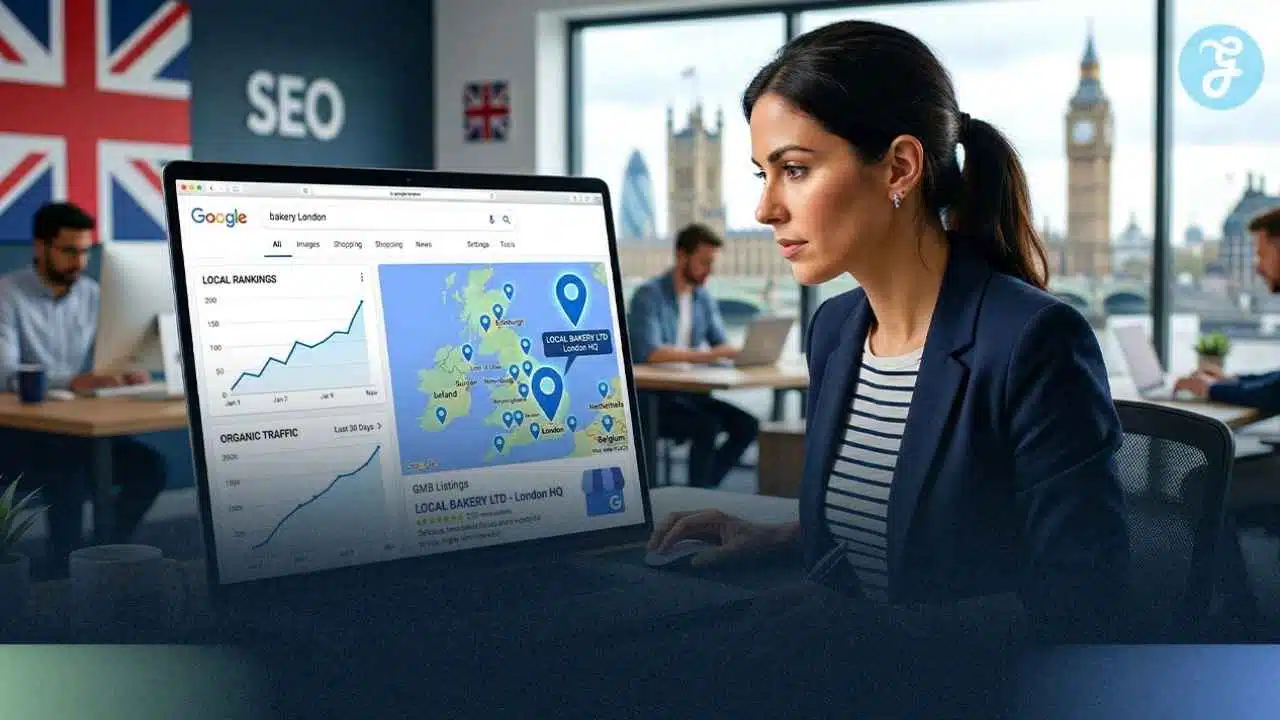
If you run a local business in the United Kingdom, you already know the competition is fierce. Whether you own a busy coffee shop in London, a plumbing service in Manchester, or a boutique in Edinburgh, getting noticed by people right down the street is how you keep the lights on. Traditional advertising simply does not work like it used to. When people in your neighborhood need something, they do not look at billboards or open a phone book. They pull out their phones and search on Google.
If your business does not show up at that exact moment, you are literally handing cash to your competitors. Implementing a strong strategy for local SEO UK searches changes that entirely. Optimizing your digital storefront ensures that when someone nearby wants what you sell, your name is the first one they see. This guide breaks down twelve practical, no~nonsense tips you can use right now to climb the search rankings, get more foot traffic, and increase your revenue.
What is Local Search and Why Does it Matter?
Local search optimization focuses on improving your digital visibility for geographical specific queries. When a user types something into Google, the search engine looks at their IP address and device location to provide results that are physically close to them. This means you do not have to compete with massive global brands; you only have to beat the businesses in your specific zip code or city.
For UK business owners dealing with high operational costs and tight margins, capturing this free, highly targeted organic traffic is the best way to scale predictably. People now expect immediate answers. A user searching for an emergency electrician at two in the morning does not care about a great blog post from a company three hundred miles away. They want a phone number for someone who is open right now in their town. By targeting these intent~heavy searches, you put your brand in front of buyers who have their credit cards ready to spend.
| Concept | Traditional Optimization | Local Optimization |
| Target Audience | National or Global | City, Town, or Zip Code |
| Key Platforms | Website, Broad Backlinks | Google Business Profile, Local Citations |
| Search Intent | Informational or Broad | Transactional and Immediate |
| Best For | E~commerce, Software, Blogs | Restaurants, Tradespeople, Clinics |
1. Claim and Optimize Your Google Business Profile
Your Google Business Profile is the absolute foundation of your local presence. Google prioritizes these profiles heavily, displaying them in the highly coveted Local Pack right at the top of the search results page. If you do not claim and completely fill out this free listing, you are missing out on the easiest traffic you will ever get. An optimized profile acts as a secondary website, giving searchers your hours, address, and reviews before they even click a link.
You need to verify your account, which often requires a quick video upload showing your physical location, equipment, or signage to prove you are a real operating entity. Once verified, write a solid description that naturally mentions your services and your city without keyword stuffing. Upload high~quality photos of your storefront, interior, and team every single week to show Google your business is active. Finally, keep your operating hours updated, especially around holidays, so customers never arrive to find locked doors and leave a bad review.
| Profile Element | Action Required | Expected Impact |
| Business Name | Enter exactly as it appears in reality | Builds trust and prevents account suspension |
| Categories | Pick one primary and relevant secondary ones | Dictates which searches you appear for |
| Operating Hours | Update regularly, especially for bank holidays | Prevents bad reviews from locked doors |
| Photos | Upload exterior, interior, and team shots | Increases click~through rates heavily |
2. Master Local Keyword Research with a UK Focus
Finding the right words is half the battle. You need to know exactly what your potential customers are typing into their phones. Keyword research for a geographical area requires you to combine your main service with your specific location. People in different parts of the UK use different slang and terminology, so you must localize your approach completely. Start with free tools like Google Keyword Planner to see search volumes for your services combined with your city name.
Look closely at the autocomplete suggestions Google gives you when you start typing a query. If you are a solicitor in Bristol, type that into Google and see what else pops up in the dropdown menu. Those suggestions are exactly what real people in your area are searching for every single day. Incorporate these exact phrases naturally into your page titles, headers, and body content to signal high relevance to search engines.
| Keyword Type | Example | Search Intent |
| Broad Service | Boiler repair | High volume, low specific intent |
| Geo~Modified | Boiler repair Leeds | High intent, local focus |
| Long~Tail Local | Emergency gas boiler repair near me | Immediate need, high conversion |
| Hyper~Local | Boiler repair Headingley | Specific neighborhood targeting |
3. Ensure NAP Consistency Across UK Directories
NAP stands for Name, Address, and Phone number. Search engines are like digital detectives; they cross~reference your business information across the entire internet to make sure you are legitimate. If your details are different on different websites, Google loses trust in your business and drops your ranking. Keeping your NAP exactly the same everywhere is a boring but highly necessary technical task. You need to submit your exact NAP details to major UK directories to build foundational trust.
Think of platforms like Yell, Thomson Local, Yelp, and your local Chamber of Commerce. If you ever move to a new office or change your main contact number, you must track down every single one of these listings and update them immediately. A mismatched address is a fast way to ruin your local SEO UK progress and confuse potential customers trying to find your front door.
| NAP Component | Wrong Way | Right Way |
| Business Name | John’s Plumbing Fast | John’s Plumbing Ltd |
| Address | 12 High St, LDN | 12 High Street, London, E1 6AN |
| Phone | 077 123 4567 | 07712345678 |
| Consistency | Mixed formatting everywhere | Identical on every single site |
4. Build High Quality Local Backlinks
Links pointing to your website from other sites act as digital votes of confidence. In the local search game, a link from a small, highly relevant community website in your town is often much more powerful than a link from a massive national news site. Google uses these local links to verify that you are an active, trusted member of your specific geographical community. Get out there and talk to people to build these connections naturally. Partner with a non~competing business down the street.
If you run a gym, partner with a local health food store and agree to link to each other on your websites. Sponsor a local event, a school fete, or a charity run. These sponsorships almost always result in a link from the organizer’s website directly to yours. Over time, building a healthy profile of local links proves to search algorithms that your business is a pillar of the local economy.
| Backlink Source | How to Get It | Value Level |
| Local News Sites | Send a press release about a charity event | Very High |
| Local Sports Teams | Sponsor a local youth football club | High |
| Neighborhood Blogs | Offer to write a guest post or give an interview | High |
| Supplier Websites | Ask for a link from companies whose products you sell | Medium |
5. Gather and Manage Customer Reviews
Online reviews are the modern equivalent of word~of~mouth marketing. Most people will not spend their money with a local business until they read what other people have experienced. Beyond just building trust with buyers, a steady stream of positive reviews is one of the strongest ranking signals Google looks at when deciding who gets the top spots in the Local Pack. Do not wait for people to leave a review organically; you have to ask them directly.
Generate a direct link from your Google Business Profile and put it in your email signature, print it on your receipts, or text it to the client after a job is finished. Make it as frictionless as possible. When you get a bad review, do not argue online. Apologize professionally, offer to fix it offline, and show future readers that you handle criticism with maturity and excellent customer service.
| Review Strategy | Action Step | Result |
| Generation | Send an automated SMS link after service | Increases total review count |
| Responding | Reply to all positive reviews within 24 hours | Shows you care about customers |
| Damage Control | Reply calmly to negative reviews, offer a fix | Mitigates trust loss from bad feedback |
| Showcasing | Embed Google reviews onto your website homepage | Boosts on~page conversion rates |
6. Create Location Specific Website Content
If you want Google to view you as a local authority, your website needs to actually talk about your local area. Having a generic website that never mentions your city makes it incredibly hard to rank locally. You need dedicated pages that clearly explain what you do and exactly where you do it. If your company covers London, Surrey, and Kent, do not just list those names on your homepage. Build a separate, highly detailed page for each county.
On the Surrey page, talk about specific projects you completed in Guildford or Woking. Include photos of your team working in those areas and embed a local Google Map. Write blog posts about local events, community news, or industry regulations specific to your city. This hyper~localized content proves to search engines that your service area is real and heavily supported by actual business activity on the ground.
| Content Type | Purpose | Best Practice |
| Location Pages | Target specific towns you operate in | Create one unique page per town |
| Local Guides | Provide value related to your industry | Write about local regulations or tips |
| Case Studies | Show proof of your work in the area | Mention the neighborhood and the results |
| Team Bios | Humanize your company | State that your staff lives locally |
7. Optimize for Voice Search and Mobile Users
Most local searches happen on mobile phones while people are on the move. Furthermore, a massive chunk of these searches are now done via voice commands using Siri, Alexa, or Google Assistant. People speak differently than they type, which means your content strategy needs to adapt to conversational questions rather than just short, robotic keywords. Ensure your website is incredibly fast and responsive on smaller screens.
If a page takes more than three seconds to load on a mobile connection, the user will leave and click on your competitor. Make sure all your phone numbers are clickable so someone can call you with one tap. To capture voice search traffic, structure your headings as full questions and answer them clearly and directly in the paragraph immediately following. Adding a robust FAQ section to your site is one of the easiest ways to start capturing this conversational search traffic.
| Search Method | Typical User Query | Optimization Tactic |
| Typed Desktop | Plumber Birmingham | Use standard H2 tags and clear text |
| Typed Mobile | Plumber near me | Fast loading speed, clickable phone numbers |
| Voice Search | Who is the best emergency plumber open now? | Create a detailed FAQ page |
| Maps App | Plumber | Keep Google Business Profile hours accurate |
8. Implement Local Business Schema Markup
Schema markup is a piece of code you put on your website that speaks directly to search engines in their native language. Instead of forcing Google to guess what your website is about by reading the text, schema explicitly tells the search engine your exact business name, address, phone number, and what kind of business you are. You do not need to be a software developer to use schema. There are dozens of free tools online that will generate the JSON~LD code for you automatically.
You just fill out a form with your business details, copy the code, and paste it into the header of your website. If you run WordPress, basic SEO plugins will often handle the heavy lifting for you with a few clicks. Implementing this code eliminates any guesswork for search engine crawlers, making them much more confident about placing your business at the top of local map packs.
| Schema Type | Information Provided to Search Engines | Benefit |
| LocalBusiness | Core identity, NAP details, geo~coordinates | Confirms location accuracy |
| OpeningHours | Exact times you are open each day of the week | Helps you show up for “open now” searches |
| Reviews | Star ratings and review text | Can trigger review stars in search results |
| Service | Specific jobs you perform and price ranges | Clarifies your offerings to the algorithm |
9. Leverage Social Media for Local Engagement
While getting likes on a Facebook post does not directly push your website up the Google rankings, social media still plays a massive supporting role. An active local social media presence drives traffic to your site, gets people searching for your brand name, and helps you build the community connections that lead to real local backlinks. Get involved in local Facebook groups where people constantly ask for recommendations for local services.
Do not just spam your website link; answer questions helpfully, offer free advice, and let your profile naturally guide them to your business. When you post on your own channels, always use location tags and local hashtags so people browsing your area can discover your brand easily. By becoming a helpful, visible part of the local online community, you generate indirect brand signals that heavily support your local SEO UK efforts over time.
| Platform | Best Local Use Case | Strategy |
| Community groups and local discussions | Answer questions, share local news | |
| Visual portfolio and location tagging | Use local hashtags, tag local landmarks | |
| B2B networking within your city | Connect with local CEOs and founders | |
| TikTok | Behind~the~scenes content | Show the human side of your daily operations |
10. Optimize Your Core Web Vitals for Better UX
Google cares deeply about user experience. They measure this using a set of metrics called Core Web Vitals, which analyze how fast your page loads, how quickly it becomes interactive, and how stable the layout is while it loads. If your website is frustrating to use, Google simply will not rank it at the top. Run your website through Google PageSpeed Insights. It will give you a list of exactly what is slowing you down. Usually, for local business websites, the biggest problems are massive image files uploaded straight from a camera.
Compress your images before uploading them, convert them to modern formats, and ensure they have strict width and height dimensions set. Clean up your code, delete plugins you no longer use, and invest in high~quality web hosting. A lightning~fast site keeps mobile users happy and keeps Google ranking you above slower competitors in your neighborhood.
| Core Web Vital | What It Measures | How to Improve It |
| LCP | Loading performance of the main content | Compress large images, upgrade hosting |
| INP | Responsiveness to user clicks and taps | Reduce heavy javascript execution |
| CLS | Visual stability of the page | Set exact dimensions for all images |
| Mobile Friendly | How well the site works on phones | Use a responsive, modern website theme |
11. Participate in the Local UK Community
Search engines try their best to reflect reality. If you are a highly respected, active business in the real world, Google wants to show you at the top of the digital world. What you do offline directly feeds into your online success. When you get involved locally, people talk about you online, link to you, and search for your name. Stop hiding behind your laptop. Host a free seminar at your office. Sponsor the local roundabout or high street flower displays.
Whenever you do something community focused, send a quick press release to the local newspaper. These offline activities naturally generate the digital PR, backlinks, and brand mentions that push a solid local SEO UK campaign over the finish line. The more active you are in your physical neighborhood, the more authoritative your business looks to search algorithms scanning the web for local signals.
| Offline Activity | Online Benefit | SEO Impact |
| Hosting a Workshop | Generates local event listings | High |
| Donating to Charity | Gets your name in local press | Very High |
| Joining Chamber | Provides a high~trust directory link | Medium |
| Local Radio Interview | Drives direct brand searches | Medium |
12. Track Your Local SEO Performance
If you do not track your numbers, you are flying blind. You need to know which parts of your strategy are bringing in money and which parts are wasting your time. Setting up proper tracking allows you to make data~driven decisions instead of just guessing. Review your data at least once a month. Look at your Google Business Profile insights to see if phone calls and direction requests are increasing.
Check Google Search Console to see if you are starting to appear for new local keywords and how many clicks those keywords generate. If you notice that your location page for a specific town is getting lots of traffic but no one is filling out the contact form, you know you need to improve the copywriting on that specific page. Always let the raw data dictate your next move so you can double down on the tactics that actually generate revenue.
| Tracking Tool | What It Measures | Why You Need It |
| Google Search Console | Clicks, impressions, and exact search terms | Shows what keywords actually bring traffic |
| Google Analytics | User behavior once they reach your site | Tracks conversions, form fills, and bounce rates |
| GBP Insights | How people interact with your map listing | Shows calls, website clicks, and direction requests |
| Rank Tracker | Where you sit in search results daily | Tracks progress against your local competitors |
Final Thoughts
Cracking the code for local visibility does not happen overnight. It takes consistent effort, attention to detail, and a willingness to outwork the competitors in your town. By claiming your profile, cleaning up your directory listings, building local links, and creating content that actually speaks to your neighborhood, you lay a concrete foundation for long~term growth.
Focus on providing real value to your community both offline and online. Stick to the plan, monitor your data, and watch as your local SEO UK strategy turns nearby searches into loyal, paying customers. Over time, these consistent daily actions will compound, building a digital moat around your local business that competitors will struggle to cross.
Frequently Asked Questions (FAQs) About Local SEO UK
1. Can I rank locally if I run my business from home and do not want to show my address?
Yes, you absolutely can. You can set up your Google Business Profile as a service~area business. This allows you to hide your physical home address from the public map while still selecting the specific towns, cities, or zip codes that you travel to in order to serve your customers.
2. Does the distance from the searcher’s phone override everything else in local search?
Proximity is a massive ranking factor, but it is not the only one. If your business is incredibly well optimized, has hundreds of positive reviews, and strong local authority, you can often outrank a poorly optimized competitor who happens to be physically closer to the person searching.
3. Why did my Google Business Profile get suspended out of nowhere?
Suspensions usually happen because of strict guideline violations. The most common reasons include keyword stuffing your actual business name, using a P.O. Box or virtual office instead of a real physical address, or having multiple listings for the exact same business location to try and trick the system.
4. How do I handle a fake negative review from a competitor?
Do not panic. First, reply professionally stating that you have no record of them in your customer database. Then, flag the review directly inside your Google dashboard as a conflict of interest or spam. You may need to reach out to Google support directly with proof if the system does not remove it automatically.
5. Are localized domain names like .co.uk better for local UK ranking than .com?
Using a .co.uk domain sends a strong initial geographic signal to search engines that your business operates in the United Kingdom. While a .com can rank perfectly well in the UK if optimized correctly, a .co.uk domain instantly builds local trust with British consumers who prefer shopping close to home.





















