
I know “link building is dead” sounds like one of those SEO headlines people write every year to start an argument. But this time, I mean something more specific. Links are not dead. Good links still matter. A real editorial link from a trusted publication can still help discovery, context, credibility, and referral traffic. I would never tell a serious publisher or brand to ignore earned links.
What I think is dying is the old link-building industry that treated authority like something you could manufacture.
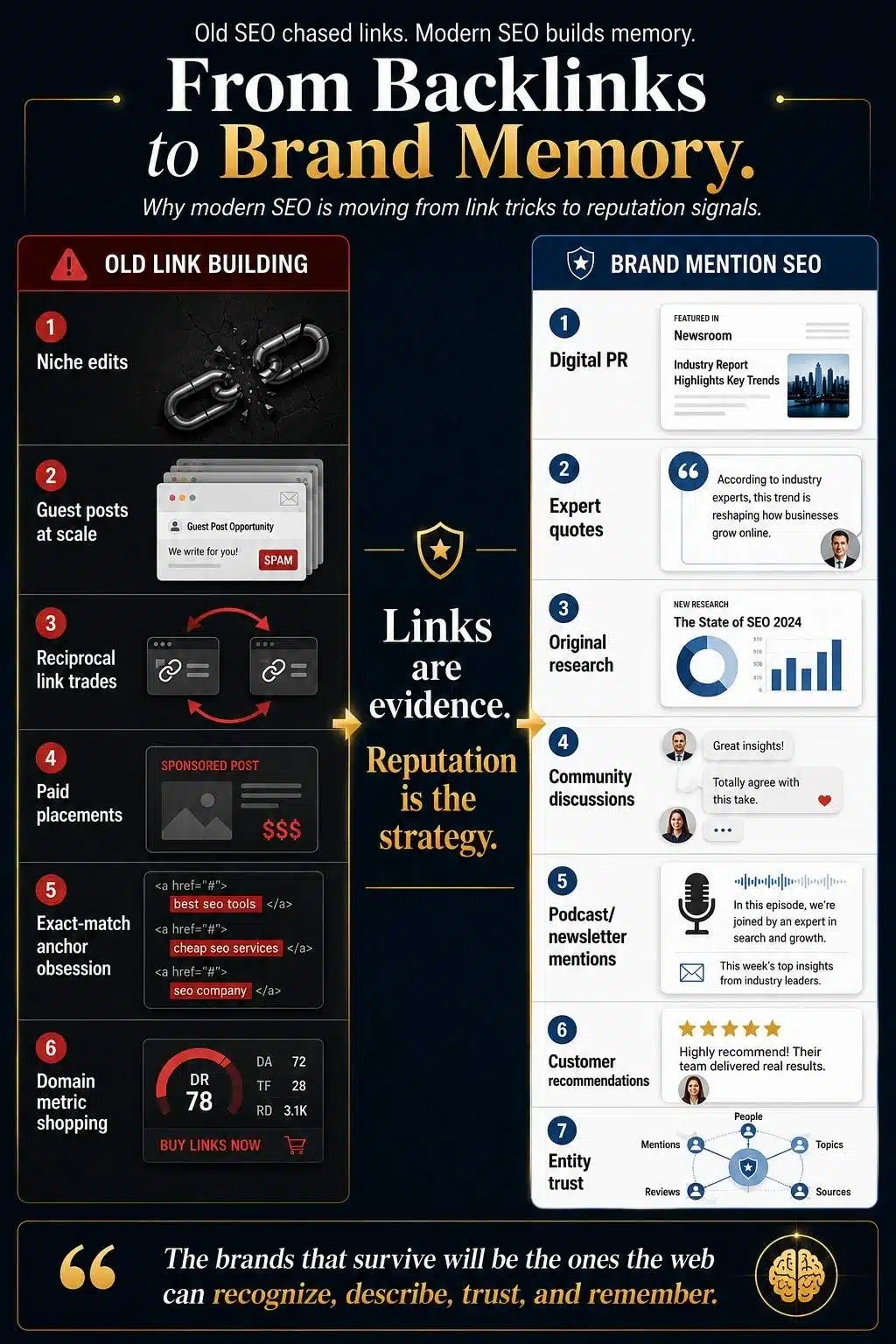
The niche edit. The paid guest post. The reciprocal link trade. The “insert this anchor text” email. The fake expert quote. The rented article on a website nobody reads. The spreadsheet is full of domains sorted by traffic, DA, DR, price, and delivery time. That version of SEO feels tired now.
For years, too many marketers acted as if the web were a voting system that could be quietly bribed. Buy enough links, trade enough favors, place enough guest posts, and authority would arrive like a package at the door. It worked often enough to become an industry. That was the problem.
Search has changed. The web has changed. AI search has changed how visibility works. Users do not only click blue links anymore. They ask questions across Google, YouTube, TikTok, Reddit, LinkedIn, newsletters, podcasts, AI tools, forums, and private communities. In that world, the future of backlinks looks smaller than the future of reputation.
Brand mention SEO matters because search engines and AI systems not only need to know who links to you. They need to understand who talks about you, where your name appears, what context surrounds your brand, and whether the wider web treats you like a real authority or just another website begging for traffic.
That is the shift. Link building is dead as a manipulation game. Brand building is alive because trust is much harder to fake.
Link Building Is Dead, But Links Are Not
I want to be clear because this topic gets oversimplified fast. Links are not dead.
Google still uses links to discover pages and understand relevance. Search engines still need links to crawl the web. A strong link from the right source still has value. A relevant citation from a respected site can still improve trust, send real visitors, and support your wider SEO work.
So no, I am not saying backlinks have disappeared. I am saying the old link-building playbook has lost its soul. The old mindset treated links like units.
Get twenty links this month. Build ten guest posts. Buy five niche edits. Match competitor backlinks. Push exact-match anchors. Repeat next month.
That model made sense when SEO teams could treat ranking as a mechanical process. But search is no longer only a ranked list of pages. It is becoming a reputation system spread across search results, AI summaries, social platforms, communities, video content, reviews, expert discussions, and publisher coverage.
A backlink can help the system understand you. A fake backlink can damage it. That is where the old link-building industry starts to collapse.

The Niche Edit Became a Back Alley SEO Deal
I understand why niche edits became popular. On paper, they looked efficient. Instead of publishing a new guest post, you placed your link inside an old article that already had age, authority, and maybe some traffic. The page was indexed. The link looked natural. The client got a backlink without waiting for new content to rank.
But in practice, niche edits became one of the ugliest parts of SEO.
Many of them are not editorial recommendations. They are paid insertions dressed up as relevance. A sentence gets rewritten. A commercial anchor text appears. A money page gets the link. Nobody reading the article asked for it. Nobody on the editorial side truly chose it. The link exists because someone paid for access.
That is not authority. That is a rented trust. And a rented trust has a smell. You can see it in the anchor text. You can see it in the placement. You can see it in the pattern across sites that publish about everything from SaaS tools to casino bonuses to roof repair to crypto apps.
The biggest risk is not only a Google penalty. The bigger risk is brand damage. If my brand appears in shady link neighborhoods, I am not building authority. I am leaving behind a trail of desperation. A serious brand should not need to sneak into old articles like a fake guest at a private party.
Guest Posting at Scale Became Content Pollution
Guest posting was not always bad. A thoughtful guest essay on a relevant publication can still be useful. It can introduce your ideas to a new audience. It can build relationships. It can show expertise. If a link comes naturally from that, fine.
But guest posting at scale is different. That version is not about expertise. It is about inventory. The article is written quickly. The topic is chosen because it can hold an anchor text. The publication accepts because it needs money or filler content. The writer does not know the audience. The audience does not care. The link is the only reason the article exists.
This is how the web became polluted with forgettable content.
- “10 Tips to Grow Your Business.”
- “7 Ways to Improve Your Marketing.”
- “Why Every Company Needs SEO.”
- “Best Digital Trends for 2026.”
Nobody needed another one of those articles. They were published because someone needed a backlink. That is the part I find hard to defend. If the only reason an article exists is to carry a link, it probably should not exist.
AI search makes this even more uncomfortable. Generic advice is easier than ever to summarize. If your guest post adds nothing beyond common knowledge, it is not an authoritative asset. It is filled with a hyperlink. A lot of brands are still paying to be forgettable.
Why Brand Mentions Beat Backlinks Now
A backlink tells search engines that one page points to another. A brand mention tells a wider story.
It says your name exists in context. It shows who discusses you. It shows what topics surround your brand. It can appear in news coverage, expert roundups, podcast transcripts, Reddit threads, LinkedIn posts, YouTube descriptions, comparison articles, customer reviews, research reports, conference pages, community discussions, and newsletters.
Old SEO often ignored mentions without links. I think that is a mistake now.
- A journalist may mention your research but not link to you.
- A podcast guest may name your company in a transcript.
- A customer may recommend your tool on Reddit.
- A creator may mention your brand in a YouTube workflow.
- An analyst may compare you with competitors.
- A LinkedIn discussion may connect your name with a specific problem.
There may be no backlink. But there is still brand memory. And brand memory matters. Modern SEO is becoming more entity-driven. A brand is not just a domain anymore. It is a name, a topic, a reputation, a set of relationships, and a pattern of trust across the web.
Backlinks still help. But mentions often reveal what links alone cannot: whether people actually talk about you when you are not in the room.
The Future of Backlinks Is Editorial, Not Mechanical
I do not think the future of backlinks is volume. I think it is editorial gravity.
A strong backlink now usually comes from something that deserved attention before an SEO asked for it. Original data. A useful tool. A strong opinion. A public experiment. A founder with a real point of view. A product people genuinely recommend. A study journalists can use. A resource communities trust.
That is much harder than buying links. That is exactly why it works. The old link builder asks, “Where can we place this link?” The better question is, “What would make people talk about us even if we did not ask?” That question changes everything.
It moves SEO closer to PR, editorial, product, customer experience, research, and community. It forces brands to become quotable. It pushes companies to publish work worth citing. It makes visibility a result of reputation, not just outreach.
This is uncomfortable for SEO teams that grew up on tactics. But it is healthy for the web.

The PR-SEO Convergence Nobody Saw Coming
For years, PR and SEO lived in separate rooms. PR wanted reputation, coverage, positioning, and relationships.
SEO wanted rankings, traffic, links, and technical performance. Both sides often misunderstood each other.
PR teams saw SEOs as backlink hunters with spreadsheets. SEOs saw PR teams as brand storytellers who did not care enough about measurable traffic. Both were partly right. Now those walls are breaking.
The best SEO campaigns look more like editorial PR. The best digital PR campaigns understand search demand, topical authority, entity relevance, and organic impact. A journalist’s mention can influence branded search. A research report can earn links and citations. A strong op-ed can shape topical authority. A founder quote can build entity association. A public study can travel across search, newsletters, social feeds, and AI answers.
This is where SEO is going. It is no longer only about optimizing what sits on your website. It is about shaping how the open web understands your brand. That means PR cannot ignore search anymore. And SEO cannot survive as a link-buying department.
Digital PR Is Just Link Building With Better PR Unless It Grows Up
Digital PR has become fashionable in SEO. I think that is both good and dangerous. It is good because it pushes teams toward earned attention. It is dangerous because many agencies are simply rebranding link building as digital PR without changing the behavior underneath.
They still pitch weak stories, links as the only KPI, mass email journalists, create thin data campaigns, call every mention a win, even when nobody relevant cares. That is not digital PR. That is link building, wearing a cleaner shirt.
Real digital PR starts with a story worth telling. It understands journalists, audiences, timing, data, emotion, and public conversation. It does not treat media outlets as link vending machines.
The best digital PR can produce links, yes. But it can also produce something more valuable: credibility. A link may help a page. Credibility helps a brand. And if search is moving toward entity trust, AI citations, expert visibility, and cross-platform reputation, credibility is the bigger asset.
The Reciprocal Link Scam Is Still Everywhere
The reciprocal link scam refuses to die. You know the email.
“I found your article very useful. I have a relevant article on my website. Can you add my link? In return, I can add your link to one of our high-authority sites.”
Sometimes it is called collaboration. Sometimes it is called a partnership. Sometimes it comes from a “content manager” with a fake profile photo and a Gmail address. Sometimes there is a whole network behind it.
The pitch sounds harmless. But the pattern is rotten. Natural reciprocal links happen all the time. That is normal. Partners link to each other. Publications cite each other. Companies mention customers, vendors, research sources, and useful resources. The problem is excessive link exchange built only for rankings. That is not relationship building. That is a quiet link cartel.
For publishers, this is especially dangerous. A serious publication cannot afford to look like it trades editorial trust for favors. Once readers or search systems begin to see your outbound links as transactional, your credibility weakens. No backlink is worth that.
“Link Building Obsolete” Is Too Simple, But the Old Playbook Is Finished
The phrase “link building is obsolete” is tempting. It is bold. It is clickable. It feels like a clean break. But the truth is messier.
- Bad link building is obsolete.
- Mechanical link building is obsolete.
- Spammy outreach is obsolete.
- Guest-post factories are obsolete.
- Niche edit marketplaces are obsolete.
- Reciprocal link loops are obsolete.
- Metrics-only link acquisition is obsolete.
But earning links is not obsolete. The difference matters. An earned link is a side effect of being useful, visible, trusted, interesting, or newsworthy. A manipulative link is often a side effect of a campaign designed to game ranking signals.
That line can blur. But editors know the difference. Readers know the difference. Search systems are getting better at understanding the difference, too. The future will punish brands that confuse visibility with tricks. It will reward brands that become impossible to ignore.
What Replaces Link Building in 2027
By 2027, I do not think serious SEO teams will talk about link building the way they did in the 2010s or early 2020s. They will talk about authority systems. That means a brand will need more than backlinks. It will need proof across the web.
Original research
Data still travels. If your brand can publish useful surveys, benchmarks, industry reports, experiments, teardown studies, or trend analysis, journalists and creators have a reason to mention you. But the research must be real. Thin surveys with obvious conclusions will not be enough.
Strong editorial point of view
Safe content disappears fast. Brands that want mentions need sharper ideas. Not reckless ideas. Not fake controversy. But clear opinions that people can quote, debate, and remember. A brand without a point of view is hard to mention.
Expert visibility
People trust people before they trust domains. Founders, editors, researchers, analysts, doctors, engineers, creators, and subject experts can become the face of authority. Their interviews, quotes, comments, LinkedIn posts, podcast appearances, conference talks, and bylines all create signals around the brand.
Community presence
The future of search will pull more meaning from communities. That includes Reddit, forums, review sites, YouTube, social platforms, Discord communities, Slack groups, newsletters, and niche industry spaces. You cannot fake community reputation for long. People know when a brand is useful and when it is planting comments.
Product-led reputation
The strongest mention engine is still a product or service people genuinely recommend. No SEO campaign can fully replace that. If customers complain everywhere, AI systems and users will eventually see it. If customers recommend you everywhere, that becomes a moat.
Digital PR with substance
Digital PR should not be a monthly stunt machine. It should be a serious visibility strategy connected to real expertise, real data, real moments, and real audience needs. The best campaigns earn links and mentions because they deserve attention.
Better owned content
Owned content still matters. It is the source layer. If your website does not clearly explain who you are, what you know, what you offer, who writes for you, why you are credible, and how your ideas connect, the rest of the web has less to reinforce. Brand mentions work best when your own site gives search systems a clear home base.
Brand Mentions Demand a Better Brand
Here is the part that many SEO teams will not like. You cannot build brand mentions at scale if the brand has nothing worth mentioning.
A boring SaaS company with copied features, copied messaging, copied blog posts, copied reports, copied “thought leadership,” and copied landing pages cannot magically become memorable through outreach. A publisher that rewrites what everyone else wrote cannot expect to become a cited authority.
An ecommerce site selling the same product with the same descriptions and no real story cannot expect communities to discuss it naturally. Brand mention SEO demands substance.
That means companies have to do better work, research, opinions, customer experience, experts, editorial standards, public proof, positioning, and better answers.
This is why I like the shift, even if it makes SEO harder. The old link economy rewarded people who knew how to manipulate the system. The new reputation economy should reward brands that deserve to be part of the conversation.
What I Would Tell Publishers Now
If I were advising a publisher, I would start with one thing: protect editorial trust. Stop treating external links as a private marketplace. Audit suspicious outbound links. Remove or qualify paid placements. Stop accepting guest posts that exist only to carry anchor text. Reject reciprocal link schemes. Build contributor guidelines that put readers above SEO deals.
Then invest in work that earns mentions naturally. Publish original reporting. Build expert columns. Create quotable analysis. Produce explainers that people actually bookmark. Use clear author bios. Maintain strong topical clusters. Turn your best research into visuals, short posts, newsletters, and social assets. Give journalists and creators something worth citing.
For a publisher, the brand is the moat. Do not trade it for a backlink.
What I Would Tell Brands Now
For brands, I would stop asking, “How many links can we build?” I would ask, “Where should our brand be part of the conversation, and why would anyone mention us?” That question changes the strategy.
It forces you to map your category. It makes you identify journalists, creators, analysts, review sites, communities, podcasts, newsletters, and search results where your audience already learns. It forces you to decide what you want to be known for.
Then you need proof. A useful study. A strong customer story. A better product comparison. A transparent benchmark. A founder’s opinion. A public dataset. A free tool. A guide with genuine experience. A position that is not copied from competitors.
You do not need to shout everywhere. You need to become recognizable in the right places.
Long Live Brand Mentions
Link building is dead because the old version taught brands to chase shortcuts instead of trust. It taught marketers to value placement over reputation, agencies to sell numbers instead of judgment, companies to confuse visibility with authority, and it filled the web with articles nobody asked for.
That era deserves to die. But links themselves are not the enemy. Real links still matter. Editorial citations still matter. Referral traffic still matters. Good publishers still matter.
The difference is that links should now be treated as evidence, not the strategy itself. The strategy is becoming known. It can be for a topic, point of view, or known by journalists, customers, or known in communities, or by search systems, or known well enough that people mention you even when they do not link to you.
That is where SEO is going. The brands that survive will not be the ones with the cleverest link schemes. They will be the ones the web can recognize, describe, trust, and remember.
So yes, link building is dead. Long live brand mentions.