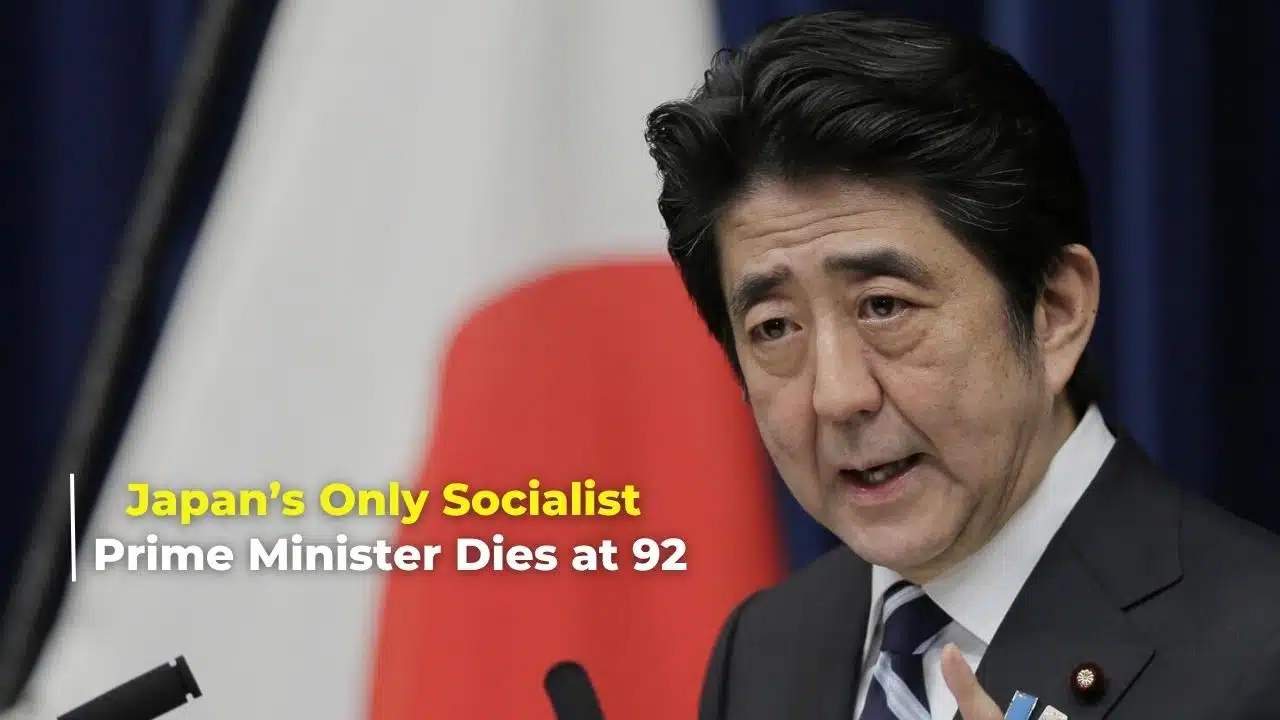
Tomiichi Murayama, the unlikely coalition leader who became Japan’s Only Socialist Prime Minister and issued a historic, formal apology for the nation’s World War II aggression, has died at the age of 101. His death marks the end of an era for Japan’s post-war political landscape, dominated by a figure remembered for his bushy eyebrows, gentle demeanor, and a brief but momentous tenure.
Murayama passed away from natural causes on Friday, October 17, 2025, a family member confirmed to Japanese media outlets (Kyodo News, NHK). His 20-month premiership from June 1994 to January 1996 was a tumultuous period, defined by catastrophic national crises and a defining moment of historical reconciliation that continues to shape regional diplomacy decades later.
Quick Take: The Murayama Legacy
- A Political Anomaly: Murayama was Japan’s first and only socialist prime minister in nearly 50 years, leading an unprecedented and ideologically fraught coalition with his party’s arch-rivals, the conservative Liberal Democratic Party (LDP).
- The Murayama Statement: On August 15, 1995, the 50th anniversary of Japan’s surrender, he delivered a landmark apology for the country’s wartime “colonial rule and aggression,” a statement that became the cornerstone of Japan’s official position on its past actions.
- Trial by Fire: His government faced two of Japan’s worst post-war disasters: the Great Hanshin Earthquake in Kobe (January 1995) and the Tokyo subway sarin gas attack by the Aum Shinrikyo cult (March 1995).
- Iconic Appearance: His trademark thick, white eyebrows made him one of Japan’s most recognizable politicians, a feature often caricatured and symbolic of his avuncular public persona.
- Policy Reversal: Despite leading the Socialist Party, his government upheld the U.S.-Japan security treaty and the constitutionality of the Self-Defense Forces, reversing long-held party policies in a pragmatic but controversial move.
An Unlikely Premier in a Time of Turmoil
Tomiichi Murayama’s ascent to the Kantei, the Prime Minister’s official residence, was a product of Japan’s fractured political scene in the mid-1990s. The long-dominant LDP had been temporarily ousted from power in 1993, leading to a period of unstable coalitions. In a stunning political maneuver, Murayama’s Japan Socialist Party (JSP), which had been the perpetual opposition, formed a grand coalition with the LDP and the smaller New Party Sakigake.
This “unholy alliance” shocked the nation. For decades, the JSP had fiercely opposed the LDP’s core policies, including the U.S.-Japan security alliance and the existence of the Self-Defense Forces (SDF). To form a government, Murayama had to perform a dramatic ideological pivot, acknowledging the SDF as constitutional and endorsing the security pact with Washington. This move stabilized the government but alienated many of his party’s traditional supporters, contributing to the JSP’s eventual decline.
“He was a man of sincerity who dedicated himself to the nation, working to improve the lives of the underprivileged,” current Prime Minister Fumio Kishida said in a statement released Saturday morning (Prime Minister of Japan’s Office). “His 1995 statement is a cornerstone of our country’s post-war diplomacy and will be inherited by future generations.”
Confronting Catastrophe and History
Trial by Disaster: Kobe and the Sarin Attack
Murayama’s leadership was immediately and severely tested. On January 17, 1995, the Great Hanshin Earthquake struck the port city of Kobe, killing more than 6,400 people and causing over $100 billion in damage (The Associated Press, Reuters). His government was heavily criticized for its slow and seemingly disorganized response, with delays in deploying the SDF for rescue operations becoming a major political scandal. The disaster exposed critical flaws in Japan’s crisis management infrastructure.
Just two months later, on March 20, 1995, the nation was gripped by terror when members of the Aum Shinrikyo doomsday cult released deadly sarin nerve gas on the Tokyo subway system during morning rush hour. The attack killed 13 people and injured over 6,000, shattering Japan’s reputation as one of the world’s safest countries (Tokyo Metropolitan Police Department). The back-to-back crises defined Murayama’s domestic legacy, often overshadowing his diplomatic achievements.
The Apology That Defined an Era
The defining moment of his premiership came on August 15, 1995. On the 50th anniversary of Emperor Hirohito’s surrender speech, Murayama issued a statement that became a benchmark for Japan’s official stance on its 20th-century history.
Known as the “Murayama Statement,” it offered the clearest and most heartfelt apology to date. He stated that Japan, “through its colonial rule and aggression, caused tremendous damage and suffering to the people of many countries, particularly to those of Asian nations.” He expressed his “feelings of deep remorse” and stated his “heartfelt apology” (Ministry of Foreign Affairs of Japan).
Key Statistics from the Murayama Era:
- Great Hanshin Earthquake (Jan. 17, 1995):
- Fatalities: 6,434
- Buildings Damaged: Over 630,000
- Source: Fire and Disaster Management Agency of Japan. This figure has been stable in official records for years.
- Tokyo Subway Sarin Attack (Mar. 20, 1995):
- Fatalities: 13 (a 14th victim was later recognized)
- Injured: Approximately 6,300
- Source: Japanese National Police Agency reports and subsequent court records.
- The Murayama Cabinet (June 30, 1994 – Jan. 11, 1996):
- Duration: 561 days
- Coalition Partners: Japan Socialist Party, Liberal Democratic Party, New Party Sakigake.
- Source: Kantei (Prime Minister’s Office of Japan) official records.
This statement was groundbreaking. While previous leaders had expressed remorse, Murayama’s words were direct and unambiguous. It has been upheld by successive Japanese governments, though it has also been a target for revisionist and nationalist politicians who question its historical accuracy and necessity
A Fisherman’s Son Who Reached the Top
Born in 1924 in Oita Prefecture, Murayama was the son of a fisherman. His humble origins stood in stark contrast to the elite political pedigrees common in Japanese politics. He became active in labor unions after graduating from Meiji University and entered politics, serving in the Oita city and prefectural assemblies before being elected to the national Diet’s lower house in 1972.
He was known as a consensus-builder, a trait that helped him navigate the complex negotiations to form his coalition government. His folksy charm and signature eyebrows made him an endearing, if sometimes seemingly overwhelmed, public figure.
“He was not a charismatic orator, but he had a way of making people feel he was one of them,” commented a local resident from his home prefecture in a 2015 interview reflecting on his career (Asahi Shimbun). This connection with ordinary people was a key part of his political identity.
What Happens Next?
Murayama’s death is a symbolic moment, prompting reflection on Japan’s political journey. The Socialist Party he once led has since dissolved and fractured, its influence a shadow of what it once was. The LDP, his one-time partner and rival, is now firmly back in its dominant position.
However, the “Murayama Statement” remains a critical, if contentious, diplomatic touchstone. Its future is a constant subject of debate, especially as geopolitical tensions rise in East Asia. How future leaders interpret, uphold, or attempt to dilute his words will be a key indicator of Japan’s foreign policy direction.
His passing closes a chapter on a unique period of political fluidity and historical reckoning in modern Japan, leaving a legacy of a leader who, despite a short and troubled term, left an indelible mark on his nation’s conscience.