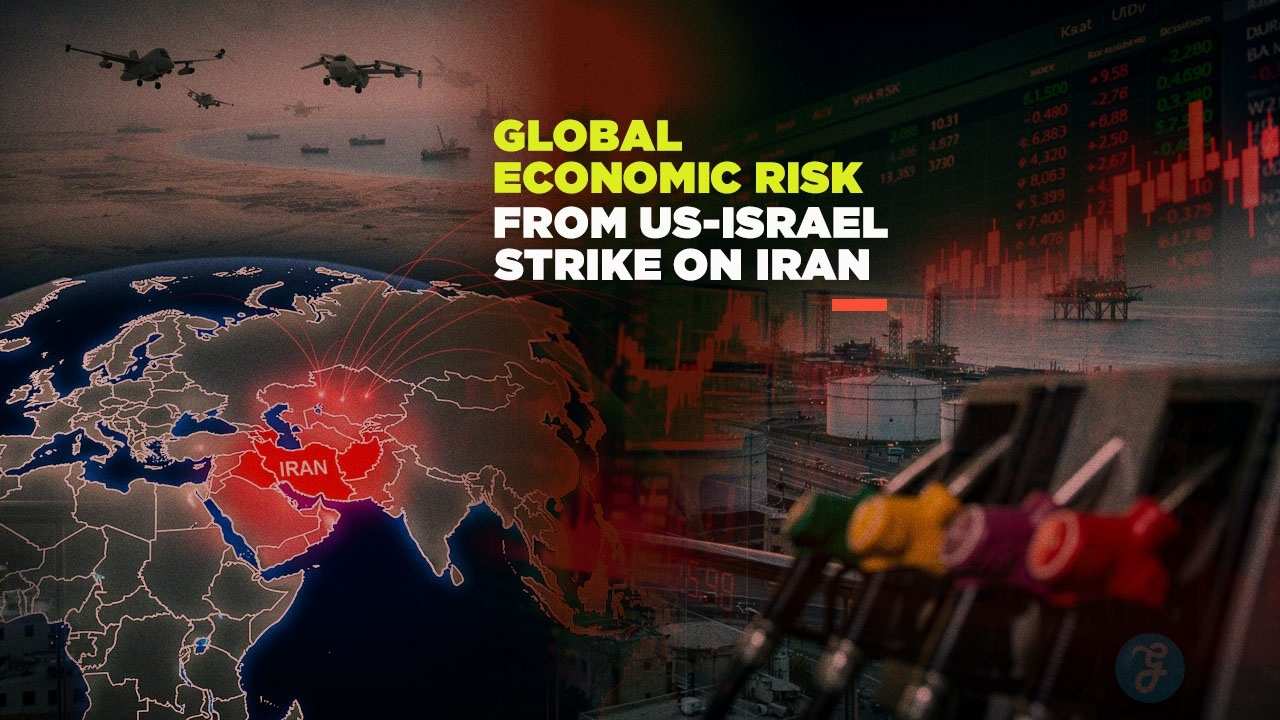
Strait of Hormuz Chokepoint and Iran Energy Contagion is no longer a theoretical risk; at present, it is the defining macroeconomic crisis of our time. The unprecedented events of late February, when the United States and Israel launched “Operation Epic Fury,” culminating in the assassination of Iran’s Supreme Leader Ayatollah Ali Khamenei, have fundamentally rewritten the geopolitical map of the Middle East. But while military planners in Washington and Tel Aviv may celebrate a tactical decapitation of the Islamic Republic’s leadership, the true blast radius of this strike will not be confined to Tehran.
The collateral damage will be borne by the global economy. As retaliation spirals and commercial vessels like the MKD Vyom come under fire, the paralysis of the world’s most critical energy artery threatens to ignite a catastrophic global recession. This is not just a localized conflict; it is a catalyst for an economic winter.
The Geopolitical Earthquake: The Fall of the Leadership
On February 28, 2026, a joint US-Israeli operation pierced the heart of Tehran. The targeted strikes, which utilized precision munitions to destroy a secure compound, resulted in the deaths of Ayatollah Ali Khamenei and several top-tier commanders of the Islamic Revolutionary Guard Corps (IRGC).
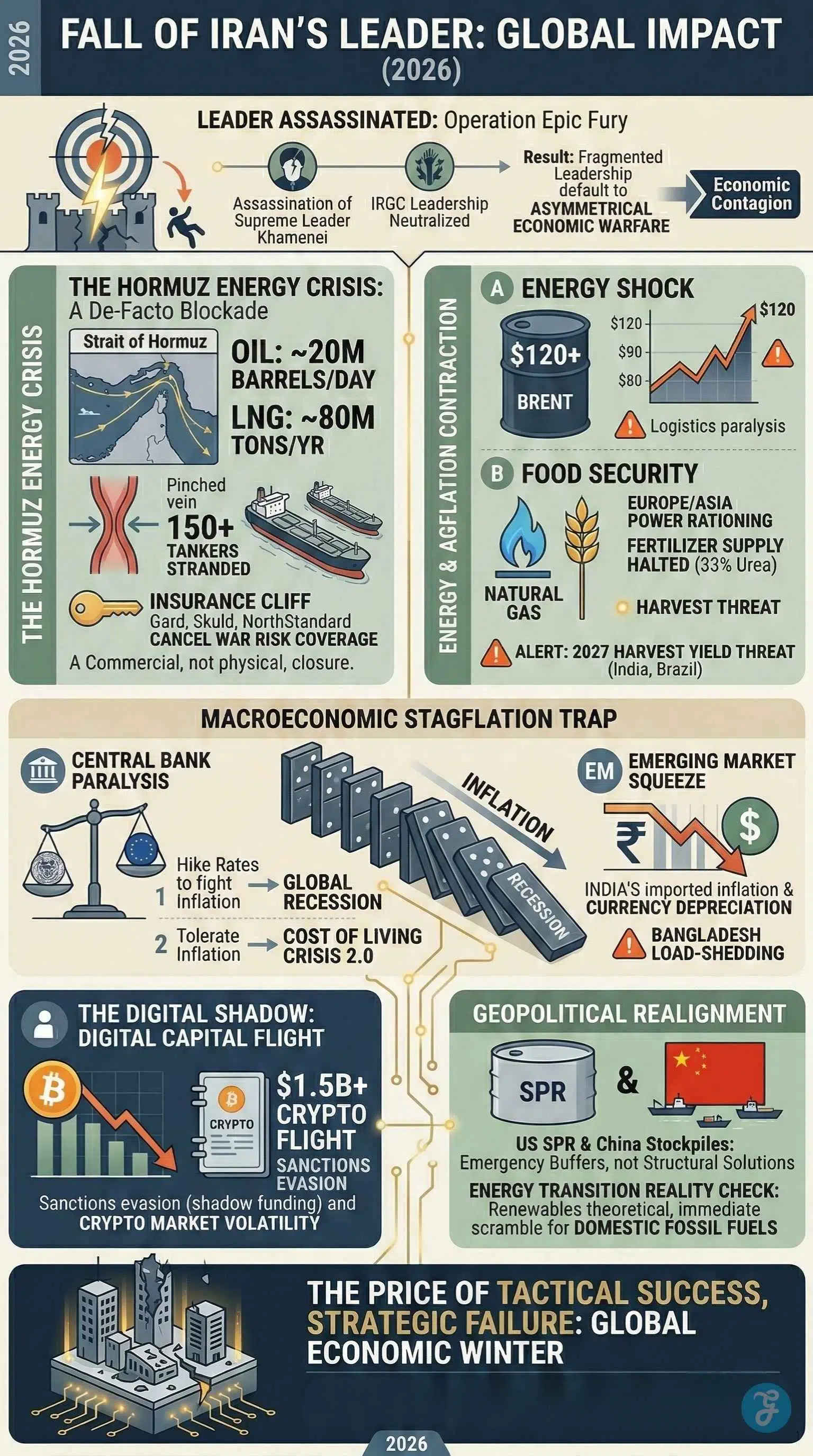
The immediate aftermath has been a masterclass in asymmetrical chaos. Facing an overwhelming conventional military disadvantage against the combined forces of the US and Israel, Iran’s fragmented command structure has turned to its ultimate trump card: economic warfare.
Key Facts of the Escalation:
- The Strike: Coordinated US-Israeli strikes (Operation Epic Fury / Operation Roaring Lion) targeting Iranian leadership, air defenses, and nuclear sites.
- The Retaliation: Iran launched hundreds of drones and ballistic missiles targeting not only Israel but also US military installations across the UAE, Bahrain, Kuwait, Qatar, and Oman.
- The Vacuum: The appointment of Ayatollah Alireza Arafi to the interim leadership council has done little to stabilize a chaotic internal power struggle, making diplomatic off-ramps virtually non-existent.
The illusion of a “short-term disruption” is dangerously naive. A wounded, desperate Iranian security apparatus, untethered from a centralized Supreme Leader, increases the unpredictability of state actions. Their primary objective has shifted from conventional defense to imposing unbearable economic costs on the United States and its allies.
The Strait of Hormuz: The World’s Most Dangerous Chokepoint
To understand the gravity of the economic threat, one must look at the geography of the Persian Gulf. The Strait of Hormuz is the jugular vein of global energy.
The physical limitations of the Strait make it horrifyingly vulnerable to the exact type of asymmetrical drone and missile warfare Iran is currently executing. At its narrowest, the Strait is just 21 miles wide, but the shipping lanes that accommodate massive supertankers are a mere two miles wide in either direction.
The Anatomy of a Blockade
A closure of the Strait does not require a physical wall of warships. It happens through the evaporation of commercial viability:
- Insurance Evaporation: Maritime insurance premiums skyrocket overnight, making transit financially ruinous.
- Collateral Damage: As seen with the recent strike on the MKD Vyom off the coast of Oman, the risk of lethal collateral damage forces international shipping conglomerates to halt operations.
- The Pipeline Myth: Pipeline bypasses (like the East-West Pipeline in Saudi Arabia or the ADCOP in the UAE) have a maximum capacity of roughly 4 to 5 million barrels per day. They cannot replace the Strait.
| Metric | The Strait of Hormuz Impact | Global Significance |
| Daily Oil Transit | ~20 Million Barrels | 20% of Global Supply |
| Daily LNG Transit | ~80 Million Metric Tons/Year | 20% of Global LNG Trade |
| Bypass Capacity | ~5 Million Barrels/Day | Wholly Insufficient |
| Vessel Traffic | 150+ Tankers Currently Halted | Total Logistical Paralysis |
The Insurance Cliff: Why the Strait is ‘Closed’ Without a Wall
The Strait of Hormuz hasn’t just been closed by naval maneuvers; it has been closed by the stroke of a pen in London and Tokyo. Following the strike on Iran’s leadership, major maritime insurers like Gard, Skuld, and NorthStandard have issued cancellation notices for “War Risk” coverage, effective March 5, 2026.
War risk premiums have surged from 0.2% to 1% of a ship’s total value in a matter of 48 hours. For a modern supertanker, this adds hundreds of thousands of dollars to a single voyage. Without insurance, these vessels become floating liabilities that no board of directors will authorize to move. Currently, over 150 tankers and LNG carriers have dropped anchor outside the Gulf, paralyzed not by mines but by the evaporation of commercial indemnity.
The Energy Market Shockwave: Oil and LNG Disruptions
The immediate market reaction to Operation Epic Fury was swift, but it merely represents the initial risk premium. The true shockwave is still building.
The Triple-Digit Threat for Crude
As commercial traffic grinds to a halt, the global market is abruptly deprived of one-fifth of its daily crude supply. Projections from energy analysts warn that a prolonged closure, which US officials anticipate could last weeks, will easily push Brent crude well past $100 to $120 per barrel. OPEC+ spare capacity, primarily held by Saudi Arabia and the UAE, is functionally useless if the oil remains trapped behind the contested waters of the Strait.
The Ignored Crisis: Natural Gas
While oil dominates the headlines, the disruption to Liquefied Natural Gas (LNG) is arguably more dangerous. Qatar, a primary exporter of LNG, shares the Persian Gulf with Iran. With retaliatory strikes hitting the region, the transit of Qatari LNG to Europe and Asia is severely compromised.
- European Impact: Threatens to reignite Europe’s energy crisis just as winter reserves are depleted, sending regional natural gas prices surging by over 40%.
- Asian Impact: Heavy importers like Japan, South Korea, and China face immediate industrial power rationing.
The Silent Threat: Fertilizers and the Global Breadbasket
While the world watches the oil tickers, a more insidious threat is brewing in the chemical holds of stranded tankers. The Strait of Hormuz is the primary artery for the global agricultural industry, with approximately 33% of the world’s urea trade and 50% of seaborne sulphur transiting this narrow passage.
As of March 2026, Middle Eastern producers have suspended offers due to the chaos, sending urea prices soaring past $600 per ton, a 12% increase in a single week. This isn’t just a corporate headache; it’s an “agflation” time bomb. Major farming nations like India and Brazil rely on these Middle Eastern supplies to sustain their crop cycles. A blockade during the spring planting window means lower yields and higher grocery prices in 2027, turning a regional leadership crisis into a global hunger crisis.
The Macroeconomic Contagion: Inflation, Rates, and Recession
The energy shock will not stay confined to the commodities market. A sustained $100+ oil environment bleeds directly into the real economy, creating a toxic environment of stagflation, stagnant growth, and high inflation.
The Stagflation Trap
For every $10 increase in the price of crude oil, core Consumer Price Index (CPI) metrics in the US and Europe generally jump by 0.2 to 0.4 percentage points. The downstream effects are devastating:
- Transportation & Logistics: Surging diesel prices cripple global supply chains.
- Manufacturing: Industrial input costs skyrocket.
- Food Security: High energy costs translate directly to higher fertilizer and agricultural transport costs, triggering global food inflation.
Central Bank Paralysis
The US Federal Reserve, the Bank of England, and the European Central Bank are now trapped. Before the March strikes, central banks were attempting to navigate a “soft landing,” balancing interest rates to cool inflation without triggering a recession.
Now, a massive supply-side inflationary shock forces an impossible choice:
- Hike Rates Further: Crush consumer demand and force a deep global recession to tame energy-driven inflation.
- Tolerate Inflation: Pause rate hikes, allowing the cost-of-living crisis to devastate the middle and lower classes globally.
The Emerging Market Squeeze
Developing nations bear the heaviest burden. India, which relies on the Strait for over 40% of its crude imports, faces devastating currency depreciation against the dollar and massive imported inflation, threatening to destabilize one of the world’s fastest-growing major economies.
The Global Response and Geopolitical Realignment
In the face of this contagion, the global response mechanisms are painfully inadequate.
The Depletion of Strategic Reserves
The US Strategic Petroleum Reserve (SPR) and China’s national stockpiles are emergency buffers, not structural solutions. They can release a few million barrels to temporarily calm market panic, but they cannot replace 20 million daily barrels indefinitely. They buy days or weeks, not months.
China’s Deep Vulnerability
China is the world’s largest importer of crude oil and has been the primary buyer of heavily discounted Iranian crude via the shadow fleet. The abrupt halt of this supply, combined with the broader disruption of the Strait, puts immense pressure on Beijing. How China reacts, whether by pressuring for a rapid diplomatic ceasefire or by leveraging the crisis to assert its own strategic power, will dictate the length and severity of the global recession.
The Energy Transition Reality Check
While high hydrocarbon prices theoretically make renewable energy more competitive, the immediate crisis forces a desperate global scramble for secure, domestic fossil fuels. The luxury of a gradual, heavily subsidized green transition is entirely incompatible with an overnight 20% deficit in global energy baseload.
The Digital Shadow: Crypto and Capital Flight
In 1979, a fallen regime’s wealth was frozen in bank vaults; in 2026, it moves at the speed of light. Following the confirmed death of the Supreme Leader, the U.S. Treasury reported a massive spike in “shadow” financial activity. Reports indicate that over $1.5 billion was moved out of Iran in a 48-hour window, not through banks, but via cryptocurrency rails destined for escrow accounts in Dubai.
This digital capital flight represents a new frontier in geopolitical crisis management. While the Iranian rial plummets, the regime’s elite are utilizing a $7.8 billion crypto ecosystem to bypass the “Epic Fury” sanctions. This doesn’t just fund the survival of a fractured IRGC; it injects massive volatility into global digital asset markets, where Bitcoin has seen 4-8% swings as “whale” wallets associated with the Iranian leadership are liquidated to fund their escape or transition.
Closing Thoughts: The Price of Tactical Victory
The joint US-Israeli strikes of March 2026 may have achieved their immediate tactical objectives in dismantling Iran’s top leadership. However, treating this solely as a geopolitical victory ignores the profound, inescapable reality of globalized trade. The global economy is far too intertwined with the geology and geography of the Persian Gulf to emerge unscathed.
By forcing the remnants of the Iranian regime into an asymmetrical economic war centered on the Strait of Hormuz, the architects of this strike have inadvertently armed a global economic time bomb. The true cost of “regime decapitation” in the Middle East will not just be tallied in the ruins of Tehran compounds; it will be paid at the global checkout counter, in mass industrial layoffs, and in the freezing homes of a new energy crisis.
We must now ask ourselves: was the tactical military success worth the impending global economic winter?