


By 2026, the Inflation Reduction Act (IRA) has matured from a legislative promise into the undisputed backbone of the American industrial landscape. However, the recent passage of the One Big Beautiful Bill Act of 2025 (OBBBA) has further supercharged these incentives, raising manufacturing credits and streamlining the deployment of what is now the largest clean energy boom in global history.
How We Selected Our 5 Best IRA Green Energy Boom 2026 Facts
To identify these critical drivers, we evaluated the Department of Energy’s Q1 2026 investment reports and analyzed the real-world impact of the OBBBA revisions on Section 45X manufacturing credits. We focused on the “multiplier effect” of private capital, the successful geographic reshoring of the battery supply chain, and the democratization of energy funding through the latest direct-pay mechanisms. These selections highlight not just where the money is going, but how it is structurally changing the American economy for the next decade.
The 5 Most Essential Facts About the IRA Green Energy Boom 2026
The following points outline the massive scale of the current investment surge and the specific mechanisms that have made the United States the premier destination for global climate capital.
1. The $1.2 Trillion Private Investment Multiplier
Best for: Institutional investors and economists tracking the long-term fiscal health of the US renewable sector.
Why We Chose It:
-
It demonstrates the massive fiscal efficiency of tax-credit-based industrial policy.
-
It highlights the “irreversibility” of the green transition now that private balance sheets are fully committed.
-
It reflects the 2026 reality that clean energy is the primary driver of US GDP growth.
Things to consider: High interest rates in early 2026 have slightly increased the cost of capital, but the depth of the IRA subsidies continues to offset these pressures.
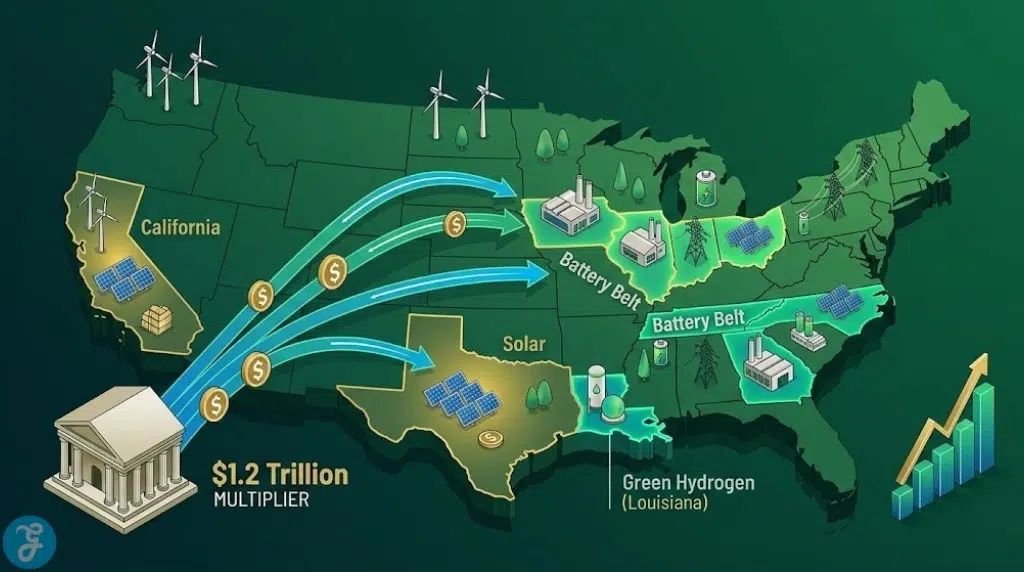
2. The Solidification of the “Battery Belt”
The domestic manufacturing of lithium-ion and solid-state batteries has reached critical mass across a corridor stretching from Michigan down to Georgia. Thanks to the Section 45X Advanced Manufacturing Production Credit, which was recently increased for properties placed in service after 2025, the US has successfully reduced its reliance on overseas battery cells by over 60% compared to 2022 levels.
Best for: Automotive manufacturers and supply chain strategists looking to qualify for full EV tax credits.
Why We Chose It:
-
It represents the most successful “reshoring” of a critical technology in modern history.
-
It creates a “jobs multiplier” in the Midwest and Southeast that spans multiple industries.
-
It aligns with the 2026 National Security mandate to secure the energy supply chain.
Things to consider: Sourcing “Critical Minerals” remains the bottleneck for 2026 production targets despite the surge in domestic refining capacity.
3. Direct Pay: Democratising Energy Wealth
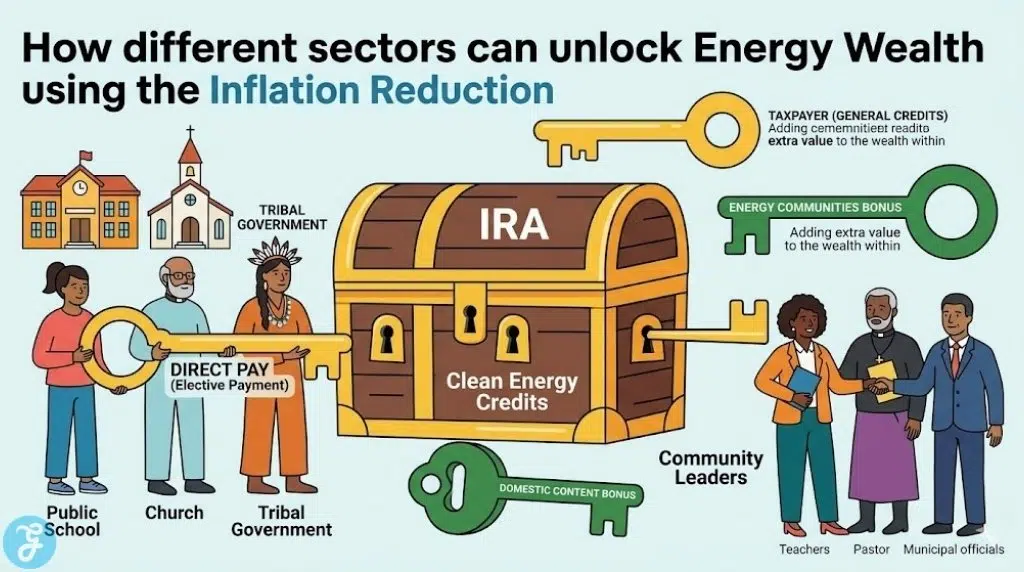
A quiet revolution has occurred in 2026 through the “Direct Pay” (elective pay) mechanism. This allows tax-exempt entities such as public schools, churches, and tribal governments to receive the equivalent of a tax credit as a direct cash payment from the IRS. This has led to a 400% increase in municipal-owned solar and storage projects since the program’s inception.
Best for: Local government officials, school board members, and non-profit executives seeking capital for energy upgrades.
Why We Chose It:
-
It levels the playing field between multi-billion dollar corporations and local communities.
-
It provides a non-debt source of funding for essential public infrastructure.
-
It has turned thousands of public buildings into “virtual power plants” (VPPs) that stabilize the local grid.
Things to consider: The application process for Direct Pay was updated in January 2026; ensure your entity is registered through the new IRS portal to avoid delays.
4. Energy Justice and the 20% “Bonus” Surge
The IRA’s Low-Income Communities Bonus Credit has hit full stride in 2026, with the latest application window having opened in February. Projects located in “Energy Communities”—areas historically dependent on coal, oil, or gas—receive an additional 10% to 20% boost on top of the base 30% credit. As of this year, nearly 75% of new solar projects are being sited in these high-incentive zones.
Best for: Project developers and impact investors focused on environmental justice and high-yield rural projects.
Why We Chose It:
-
It ensures that the economic benefits of the boom reach the populations most affected by the energy transition.
-
It makes projects in economically “distressed” areas more profitable than standard urban developments.
-
It effectively utilizes brownfields and former industrial sites for productive energy generation.
Things to consider: Competition for these “allocated” bonus credits is fierce; projects must demonstrate a clear “direct benefit” to local residents to qualify.
5. Grid Modernisation and the OBBBA Acceleration
The backlog of projects waiting to connect to the US power grid has finally begun to clear in 2026. This is largely due to the One Big Beautiful Bill Act of 2025, which provided supplemental funding for high-voltage transmission lines and streamlined the permitting process for “National Interest Electric Transmission Corridors.”
Best for: Utility-scale developers who have been stalled in “interconnection queues” for the last three years.
Why We Chose It:
-
It addresses the single largest technical barrier to the US reaching its 2035 carbon-free goal.
-
It enables the “wheeling” of cheap wind power from the Great Plains to high-demand coastal cities.
-
It utilizes the 2026 surge in grid-enhancing technologies (GETs) to increase existing line capacity.
Things to consider: While federal permitting is faster, local “Not In My Backyard” (NIMBY) opposition remains a factor in multi-state transmission projects.
Analysing the 2026 Clean Energy Investment Landscape
The current state of the IRA Green Energy Boom 2026 is defined by a shift from “planning” to “execution.” The following section provides a comparative look at the sectors driving this growth and how to evaluate project viability in the current year.
Sector Growth Comparison Table
The table below outlines the three primary pillars of the 2026 energy transition and their relative performance metrics.
| Sector | Primary Incentive | 2026 Status | Top Investment State |
| Manufacturing | 45X / 48C Credits | Hyper-Growth | Georgia |
| Solar & Storage | ITC / PTC Bonus | Steady Expansion | Texas |
| Green Hydrogen | 45V Credit | Early Commercial | Louisiana |
Our Top 3 Picks and Why?
Of the five points discussed, the $1.2 Trillion Multiplier, the Battery Belt Reshoring, and Direct Pay are the most critical. These three represent the structural “anchors” of the boom. The multiplier proves the scale, the Battery Belt proves the industrial success, and Direct Pay ensures the boom is inclusive. Together, they create a resilient economic engine that is less dependent on fluctuating political winds and more on market-driven reality.
Successfully participating in the American clean energy market now requires a sophisticated understanding of how the IRA and OBBBA interact with local market drivers.
The Selection Framework:
-
Domestic Content: To capture the highest 2026 credit levels, ensure your project utilizes the maximum amount of US-made steel, iron, and components.
-
Geographic Siting: Prioritize “Energy Communities” to secure the automatic 10% bonus, which often makes the difference in project Internal Rate of Return (IRR).
-
Monetization Path: Evaluate whether a “Transferability” deal (selling credits to a third party) or “Direct Pay” is the most efficient way to realize the cash value of your incentives.
Decision Matrix (Table):
| Strategy: Large-Scale Utility | Strategy: Municipal / Non-Profit |
| Focus on “Transferability” to unlock capital. | Focus on “Direct Pay” for cash liquidity. |
| Target high-voltage transmission corridors. | Target rooftop solar and fleet electrification. |
| Leverage the 35% Manufacturing Investment Credit. | Leverage the 20% Low-Income Bonus. |
The Final Checklist: 5-point Checklist for 2026 Project Success
-
Has the project been vetted for the latest OBBBA wage and apprenticeship requirements?
-
Does the supply chain comply with the 2026 Foreign Entity of Concern (FEOC) sourcing rules?
-
Have you registered for your unique registration number on the new IRS portal?
-
Is the project located in a designated Energy Community for the 10% bonus?
-
Does the technical design include grid-enhancing technologies to speed up interconnection?
The Enduring Impact of American Industrial Policy
As we move through 2026, the US clean energy sector has transitioned from a niche market into a global standard for industrial policy. The synergy between the IRA and the OBBBA has created a “virtuous cycle” of investment, innovation, and domestic production that is difficult to reverse. By standardizing the incentives and focusing on inclusive growth through Direct Pay and Energy Justice, the US has not only sparked a boom but has built a permanent infrastructure for the 21st-century economy.





















