

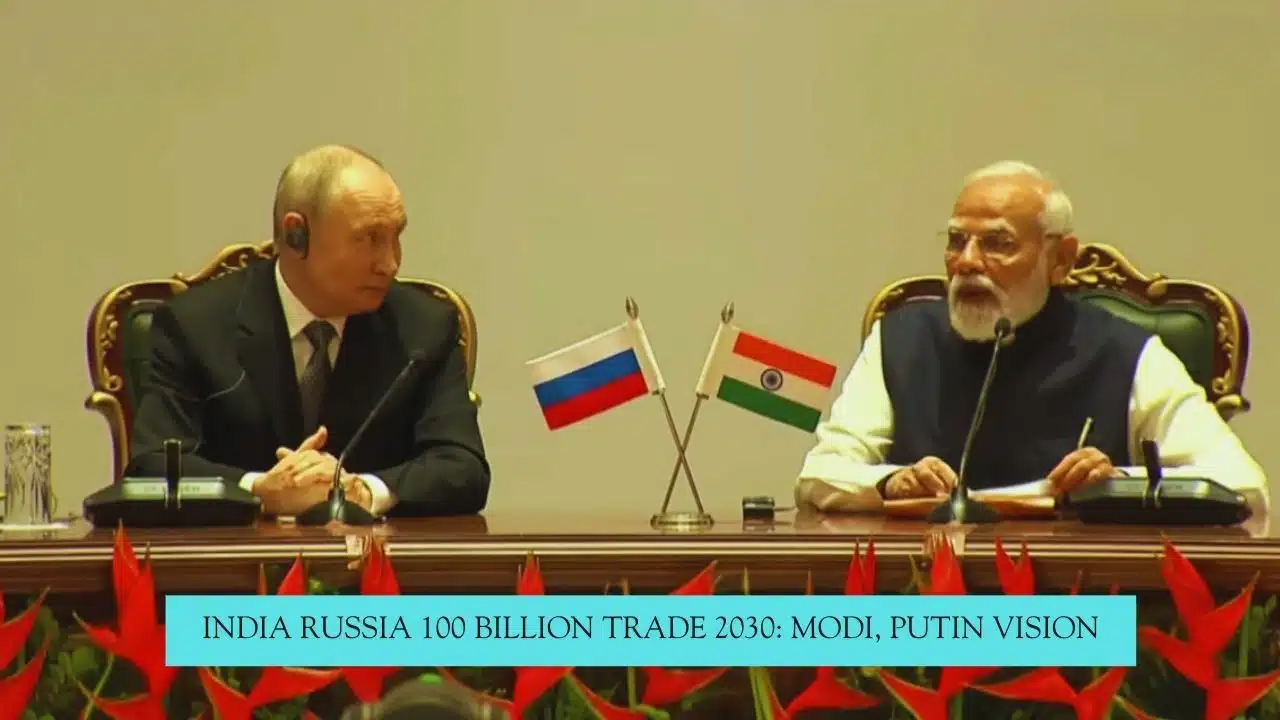
India and Russia have set an ambitious goal to raise their annual trade to 100 billion dollars by 2030, using a new long-term roadmap agreed at the 23rd India–Russia Annual Summit in New Delhi. The plan deepens cooperation in energy, defense, industry, labor, and technology at a time when New Delhi faces strong pressure from Washington over its close economic ties with Moscow.
Trade roadmap to reach $100 billion
At the summit, Prime Minister Narendra Modi and President Vladimir Putin endorsed a Programme / Vision 2030 document that lays out how the two countries plan to expand economic cooperation over the next five years. Their headline target is to lift bilateral trade from around 68.7 billion dollars at present to 100 billion dollars by 2030, building on the sharp increase in commerce since Russia’s 2022 invasion of Ukraine.
Putin noted that almost all bilateral payments are now settled in national currencies, with about 96 percent of trade conducted in rupees and rubles to avoid Western financial sanctions. Both sides see this shift as a way to shield transactions from disruptions to dollar and euro-based systems and to lower transaction costs for businesses.
The roadmap focuses on correcting current trade imbalances by boosting Indian exports in areas such as pharmaceuticals, agriculture, textiles, engineering goods, and services. India and Russia also agreed to speed up negotiations on a free trade agreement between India and the Russia-led Eurasian Economic Union, which they believe could unlock new market access and reduce non-tariff barriers.
Connectivity is another core element of the trade plan. The two sides reaffirmed support for the International North–South Transport Corridor, which links India to Russia via Iran and the Caspian region, and discussed using new routes through the Arctic and Russia’s Far East to cut shipping time and freight costs. Officials say better logistics and customs cooperation will be essential if the 100 billion dollar target is to be met on time.
Energy and nuclear cooperation at the core
Energy remains the backbone of the relationship, with Russia pledging “uninterrupted” supplies of crude oil, petroleum products, gas, and coal to meet India’s long-term demand. Since Western sanctions pushed Russian crude away from Europe, India has emerged as a major buyer, at one point sourcing more than 30 percent of its oil imports from Russia, even though recent sanctions have caused some decline in volumes.
Despite political pressure and tariffs from Washington linked to India’s energy ties with Moscow, New Delhi continues to argue that discounted Russian oil helps control domestic fuel prices and supports economic growth. During the summit, both leaders emphasized that energy cooperation is based on commercial logic and mutual benefit, not on alignment against any third country.
Civil nuclear energy was another key pillar in the talks. The two sides highlighted progress at the Kudankulam Nuclear Power Plant in Tamil Nadu, where the first two units built with Russian assistance are operational and feeding power to the Indian grid. To prepare for the next phase, Rosatom has delivered the first batch of nuclear fuel for Unit 3, produced at the Novosibirsk Chemical Concentrates Plant in Russia, with several shipments planned to provide a full core and reserves.
India and Russia also discussed cooperation on small modular reactors and advanced nuclear technologies, which could be used at new sites beyond Kudankulam. The joint statement mentions examining a potential second nuclear power plant in India with Russian participation, in line with India’s broader goal of sharply increasing nuclear power capacity by 2047 to support clean energy targets.
Beyond nuclear, both sides talked about joint projects in refining, petrochemicals, liquefied natural gas infrastructure, and possible investments by Indian companies in Russian oil and gas fields. Officials were tasked with quickly resolving regulatory hurdles and payment issues affecting ongoing energy projects so that contracts already signed translate into stable, long-term supplies.
Industrial projects and labor mobility
Industry and agriculture featured prominently in the summit outcomes, with new projects designed to secure supplies for key sectors in both countries. One of the headline deals was a memorandum of understanding between Russian fertilizer producer Uralchem and a group of Indian fertilizer companies to build a large urea plant in Russia.
The proposed facility is expected to have an annual capacity of around 1.8 to 2 million tonnes of urea, with Russian and Indian partners sharing ownership. For India, the agreement is intended to lock in long-term fertilizer supplies at predictable prices for its farmers, reducing exposure to global market swings and supply disruptions.
The summit also produced a labor mobility agreement aimed at sending Indian workers to Russia at a time when Moscow is facing a serious labor shortage. Russian estimates suggest the country could be short of more than 3 million workers by 2030, and India, with its young workforce, is positioning itself as a source of skilled and semi-skilled labor.
Under the new framework, around 70,000 Indians are expected to be employed in Russia in sectors such as construction, manufacturing, engineering, hospitality, and services. The agreement includes provisions for pre-departure training, recognition of skills, and mechanisms to protect workers’ rights, and India plans to set up dedicated training centers to prepare candidates for Russian industry needs.
Industrial cooperation will also extend into pharmaceuticals, machinery, information technology, and transport equipment, where both sides see opportunities for joint ventures and technology partnerships. Business forums held alongside the summit in New Delhi brought together companies from both countries to explore projects in sectors ranging from mining and logistics to healthcare and education services.
Balancing global pressure and the Vision 2030 agenda
The summit took place against a complex geopolitical backdrop, with the United States publicly urging India to reduce its reliance on Russian energy and arms even as Washington prepares for its own trade talks with New Delhi. India is trying to maintain a careful balance, seeking closer economic and strategic ties with the U.S. and its allies while refusing to cut long-standing links with Russia.
On the Ukraine conflict, Modi repeated that India is “on the side of peace” and called for dialogue and diplomacy to end the war, a line New Delhi has consistently used since 2022. Putin briefed him on recent contacts with U.S. and other foreign envoys over possible steps toward a peace process, while both leaders reaffirmed that their partnership is not directed against any third country.
The Programme 2030 and associated Vision 2030 documents go beyond trade and energy to cover a wide range of emerging areas. These include cooperation on critical minerals, artificial intelligence, digital public infrastructure, cybersecurity, space, and new transport corridors such as the International North–South Transport Corridor and possible Arctic shipping routes.
Both sides agreed to deepen cooperation in pharmaceuticals and healthcare, including joint production and research, as well as in agriculture and food processing to improve food security and diversify supply chains. In connectivity and payments, they plan to expand the use of national currencies, explore links between their fast payment systems, and study options for using digital financial technologies to make cross-border transactions faster and cheaper.
Cultural and people-to-people exchanges are also part of the long-term agenda. India will open new consulates in Russian regions such as Yekaterinburg and Kazan to encourage more tourism, education links, and business contacts beyond the main cities, while both countries intend to ease visa processes for students, professionals, and tourists.
Taken together, the summit outcomes signal that India and Russia intend to keep expanding their partnership despite global turbulence, anchoring it in trade, energy, and long-term economic projects. Whether they reach the 100 billion dollar trade target by 2030 will depend on how fast they can turn these announcements into concrete investments and overcome sanctions-related and logistical hurdles in the years ahead.





















