


India has taken a decisive step in reshaping its online gaming landscape with the passage of the Promotion and Regulation of Online Gaming Bill, 2025. The legislation, cleared by the Lok Sabha on August 20 and the Rajya Sabha on August 21, introduces a strict ban on all forms of money-based online games while granting formal recognition and support to esports and social gaming platforms.
The Union Cabinet had approved the draft earlier in the week, despite pushback from several industry representatives. With both Houses of Parliament giving their assent, the bill is now set to become one of the most comprehensive regulatory frameworks in the global online gaming sector.
Prime Minister’s Endorsement and Government’s Vision
Prime Minister Narendra Modi praised the legislation as a crucial measure to safeguard citizens while also creating opportunities for innovation. He described the bill as a way to position India as a future hub for creative and skill-based gaming, while reducing the harm caused by online betting and gambling platforms.
The government believes that while the online gaming industry has attracted massive foreign and domestic investment, the costs of unregulated money gaming — addiction, financial distress, and social harm — outweigh potential economic benefits. The new law is presented as a balance between encouraging safe gaming innovation and protecting public welfare.
What the Bill Seeks to Achieve
The central aim of the bill is twofold:
-
Ban Harmful Practices: The legislation prohibits any form of online game that involves real money stakes, including fantasy sports platforms, betting apps, and online casinos. Advertising and promotion of such platforms will also be illegal.
-
Support Esports and Social Gaming: The bill gives esports formal legal recognition as a professional and skill-based activity. It categorizes social and educational games as safe and beneficial, offering opportunities for interaction, learning, and creativity.
By separating money-driven gaming from esports and skill-based platforms, the government intends to nurture India’s growing digital creator economy while cutting down on predatory gaming practices.
Key Features of the Legislation
The Promotion and Regulation of Online Gaming Bill, 2025 includes several critical provisions:
-
Ban on Online Money Games: All games involving financial stakes are prohibited.
-
Advertising Restrictions: Media outlets, streaming services, and social platforms cannot promote money-based gaming.
-
Financial Controls: Banks and digital payment providers are barred from processing or facilitating payments linked to online betting platforms.
-
National Online Gaming Commission (NOGC): A central authority will regulate the sector, issue licenses for approved platforms, and enforce compliance.
-
Penalties for Violations:
-
First-time offenders face fines up to ₹1 crore (about USD 120,000) and up to three years in prison.
-
Repeat violators face up to five years in prison and fines of up to ₹2 crore.
-
-
Consumer Protection: Licensed platforms must adopt safeguards such as age verification, deposit limits, and self-exclusion tools.
-
Dispute Resolution: An Online Gaming Appellate Tribunal will handle disputes between players, platforms, and regulators.
Industry Concerns and Economic Fallout
The decision has sparked deep concern within India’s online gaming industry, which has grown rapidly in recent years. Real-money platforms such as Dream11, MPL, and Zupee, which together employ thousands and attract millions of users, now face the threat of shutdown.
Market analysts estimate that the online gaming sector in India was projected to be worth over USD 3.6 billion by 2029. The ban on real-money games may lead to massive job losses, reduced tax revenue, and an exodus of foreign investment.
The passage of the bill has already impacted listed gaming companies:
-
Shares of Nazara Tech dropped more than 20% across two trading sessions.
-
Casino operator Delta Corp reported a fall of nearly 5%.
Industry representatives argue that while harmful practices need to be curbed, a complete ban on money-based gaming risks wiping out a large part of India’s gaming ecosystem.
Why the Government Pushed for the Ban
The government’s stance is rooted in concerns over the social costs of gambling addiction. Cases of individuals losing life savings, falling into debt, or even resorting to crime due to online betting have been widely reported. Lawmakers emphasized that online money games disproportionately affect young people and lower-income households, leading to financial ruin and mental health problems.
For more than three years, the Ministry of Electronics and Information Technology engaged with industry stakeholders, policy experts, and legal advisors to draft a framework that separates safe gaming from exploitative practices. The final bill reflects this effort, aiming to reduce harm while ensuring that India’s gaming talent is not stifled.
Recognition of Esports and Social Games
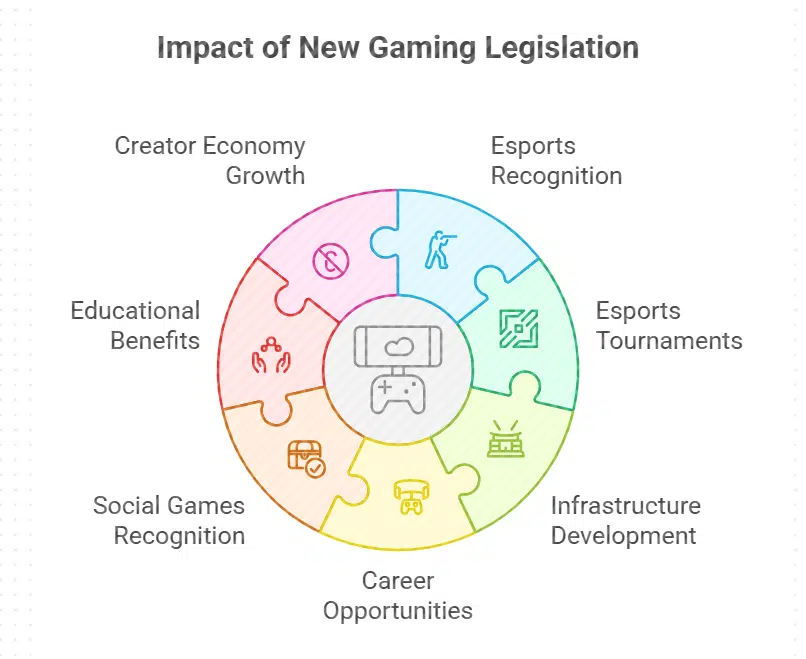
One of the most significant aspects of the new legislation is the formal recognition of esports. Esports are defined as skill-based, competitive games played in professional settings, distinct from chance-based betting. By providing a legal framework, the government intends to create avenues for esports tournaments, infrastructure, and career opportunities for young gamers.
Social games, such as interactive puzzles, educational games, and creative online platforms, are also recognized as safe. These forms of gaming are viewed as contributing positively to learning, collaboration, and India’s fast-growing creator economy.
Balancing Innovation with Regulation
The Online Gaming Bill is designed as a balanced approach. While it criminalizes harmful practices, it also introduces incentives for innovation:
-
Support for domestic game developers.
-
Investment in esports arenas and training facilities.
-
Integration of gaming into India’s broader digital economy strategy.
Officials argue that this approach allows India to develop a responsible gaming ecosystem, similar to regulatory models seen in Europe and East Asia, while avoiding the pitfalls of unregulated betting markets.
What Lies Ahead
With the passage of the Promotion and Regulation of Online Gaming Bill, 2025, India has become one of the first major countries to enforce a nationwide prohibition on online money games while simultaneously boosting esports.
The coming months will be crucial as:
-
The National Online Gaming Commission is established.
-
Guidelines for licensing, age restrictions, and consumer protection are rolled out.
-
Existing platforms either pivot to esports/social gaming or shut down entirely.
For India’s gaming industry, the law marks both a challenge and an opportunity: the end of unregulated money gaming but the beginning of an era where esports and safe digital entertainment could flourish under government backing.






















