

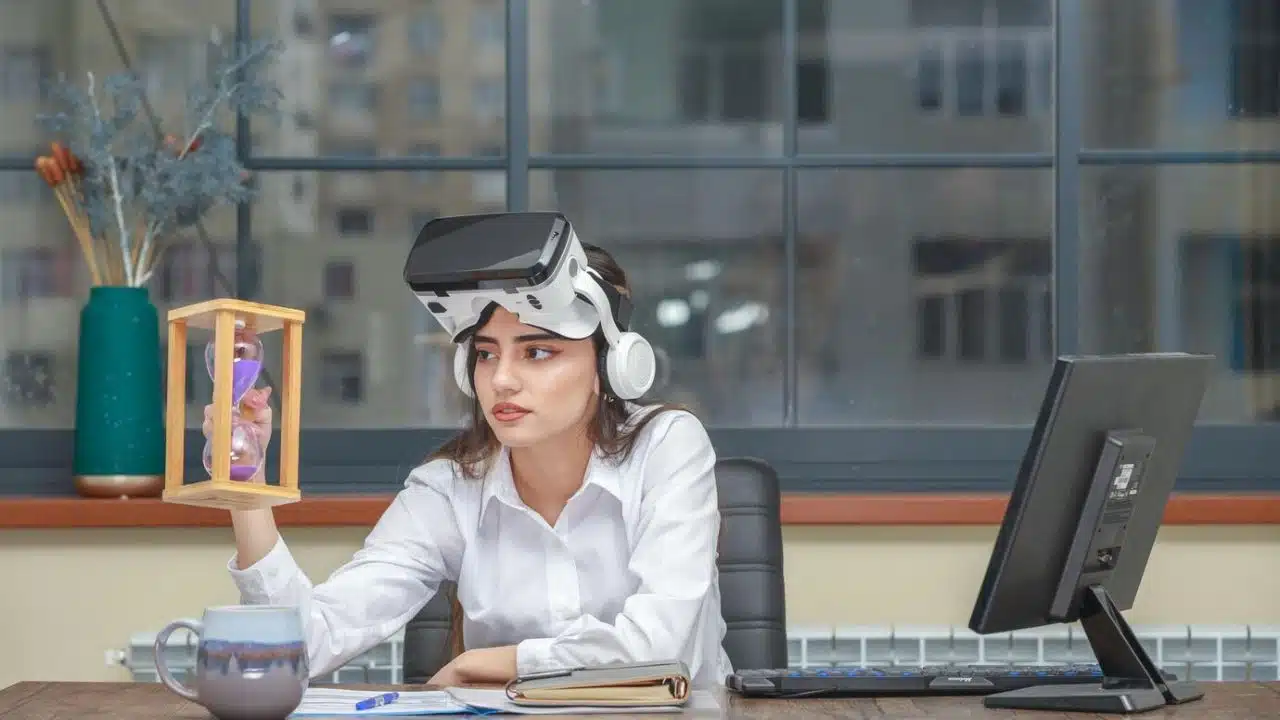
Your modern-day employee needs more than just a supportive team; they need opportunities that will help them grow as individuals and upskill their current knowledge base. Employees worldwide value skill development more than ever, which is why you, as an employer, need to make the most of emerging technologies to help them grow.
Acknowledging the need to incorporate technological developments into learning and development programs has led to the emergence of immersive learning environments in the workplace. Immersive learning uses technology to create engaging learning environments that grip the learner and allow them to use what they have learned in reality. If you are curious to know what is immersive learning and how it can help upskill your employees, the following article will fascinate you.
What Do I Need To Know About Immersive Learning?
Fancy words such as AR and VR may have fascinated you, making you wonder if they can really be used in our everyday lives. Although these technologies felt futuristic in the past, they are a part of our everyday lives. In fact, these technologies are part of immersive learning and are used by organizations to improve the employees’ learning experience.
Immersive learning is a learning approach that is purely based on science. It is based on the cognitive and behavioral theory that believes that experiential learning allows individuals to understand and retain information more efficiently. It recognizes that when you experience something in real life, you tend to remember it more vividly.
In immersive learning, augmented and virtual reality technologies are used to create “close to real” scenarios, which help employees experience a real-life situation in a controlled environment. Both AR and VR have great benefits and are a must in the modern work environment.
Organizations are increasingly accepting the fact that employees need practical knowledge to excel at their jobs. However, in some tasks and job profiles, practical knowledge may not be the best solution as it may risk the safety and reputation of the company and people involved in the process. So, what is the solution to this problem? They found that this conundrum can be solved through immersive learning.
Immersive learning can solve some of the most complex problems organizations face in providing employee learning and development programs. In the section below, we will see how immersive learning is revolutionizing the work environment.
The Revolutionary Role of Immersive Learning
1. Enhances Technical Skill Training
Imagine giving a hammer and nail to a kid and expecting them to fix your broken furniture. Sounds impossible, right? The same is true when you expect your inexperienced employees to have all the technical skills required to perform their respective tasks efficiently. They may have ample knowledge of how the task needs to be performed, but without practical experience, they cannot hone their skills. This is why you need to add immersive learning to your traditional L&D programs.
With the help of AR glasses, your technicians will be guided through the step-by-step process of how to fix a problem. Moreover, since the task takes place in a controlled environment, there is no danger of putting their or others’ safety at risk. In this learning approach, the supervisor can also provide them with continuous real-time feedback that will allow them to understand how they should act if a similar situation occurs in real life.
2. Helps in Soft Skill Development
If you were under the impression that immersive learning can only enhance your employees‘ technical skills, you are wrong. Immersive learning is also a great tool for helping them develop soft skills. Working in an organization where your employees have to deal with different clients and coworkers means that they need great interpersonal skills to help them navigate complex issues.
Virtual reality can be integrated into soft skill development programs to help employees understand how to react to a particular situation.
For instance, VR can be used to help your customer support team deal with various clients and their grievances. The technology can be used to develop digital customers and allow the support team to face difficult questions and problems that these customers are experiencing.
3. Allows Easy Onboarding
You can use immersive learning technologies to help your human resource team onboard new employees easily. The main aim of an onboarding process is to allow new employees learn about the work culture, strategies used, and specific procedures.
The HR team can use the technology to give the new joiners a virtual tour of the entire organization, which will allow them to feel like they are part of it. They can also introduce interactive modules to the employees to help them learn about the different procedures in an engaging manner.
4. Facilitates Continuous Learning and Upskilling
There is a new development emerging every other day. This is why employers need to facilitate continuous learning and upskilling among their employees. However, one can’t deny that in an attempt to help employees hone new skills and knowledge, employers usually end up overwhelming their employees.
Moreover, your employees are no longer in college. So, expecting them to sit for hours with their pen and paper and make notes of what they have learned in the lecture is unfair. As an efficient leader, your aim is to allow your employees to learn new skills without feeling engulfed by loads of information. With immersive learning, you help your employees learn new topics without boring them. In fact, most employees enjoy immersive learning programs as they need to engage all their senses in the learning process and perform tasks they have never experienced before.
Final Words: Make Immersive Learning a Part of Your Working Environment
By now, you should have understood how important immersive learning is in today’s day and age. Your employees expect you to provide them with the best of the best opportunities that will help them upskill their interpersonal and professional skills. However, the traditional form of learning is not engaging enough to immerse your employees completely in the learning process. This is why you need to add immersive learning to your everyday work environment. The learning approach allows employees to have a “real-life” experience without putting anything at risk.
























