
You saved the information, but returning to it is harder. A heading such as “Chapter 4” or “pricing ideas” may make sense during a lecture or meeting, then say almost nothing weeks later. The note relied on context that has disappeared.
Learning how to take notes effectively means preparing information for that later encounter. A reusable note should explain its contents, source, and possible use. It needs enough context to stand alone, not elaborate formatting or a complicated app.
Start With a Purpose
Before writing, decide the note’s job. Different jobs require different details.
- A learning note needs a question, an explanation in your own words, and an example for self-testing.
- A meeting note should separate confirmed decisions from suggestions, with the reason, owner, and deadline for each action.
- A research note needs the claim, evidence, original source, and any relevant limitation.
- A project idea should name the problem, proposed response, and next step.
This distinction stops tasks from disappearing inside long pages. If a note creates a deadline, copy it into the task manager, calendar, or project board. Keep the reasoning in the note and the commitment in the work-tracking system.
How to Take Notes Effectively
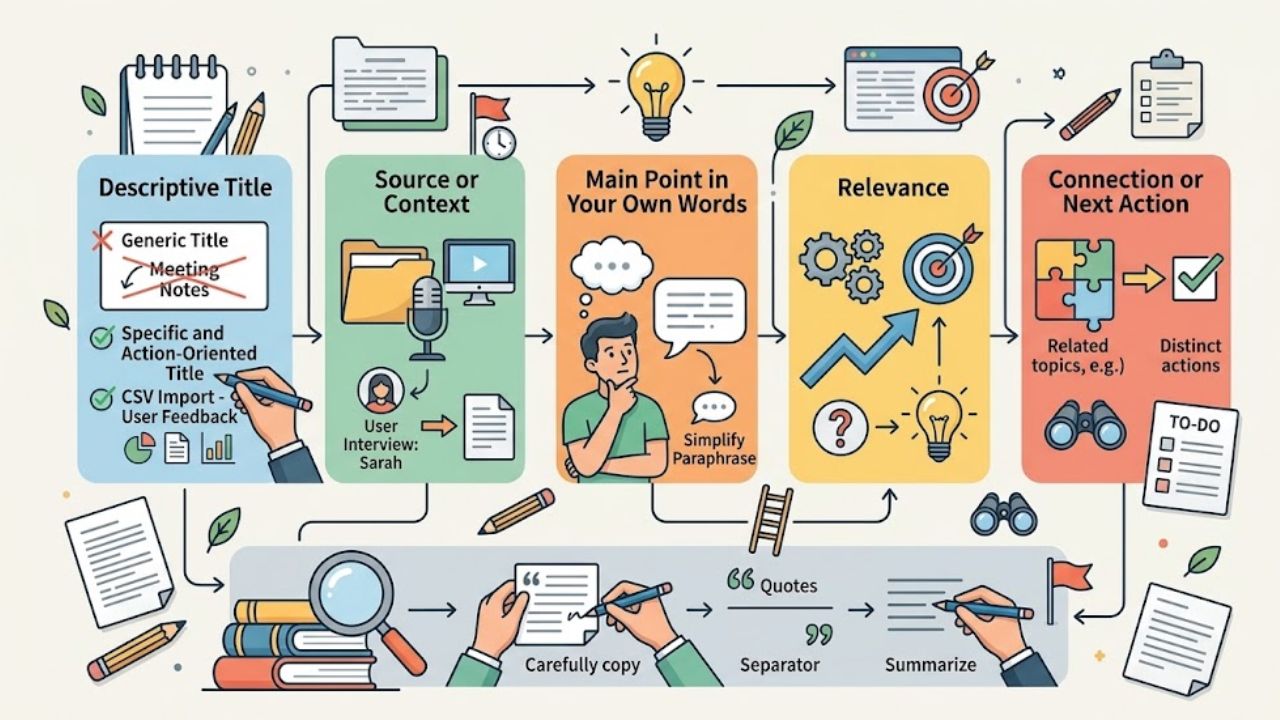
A practical system for how to take notes effectively starts with five simple elements:
- A descriptive title
- The source or context
- The main point in your own words
- Its relevance to your work or learning
- A question, connection, or next action
Compare “Onboarding feedback” with “CSV import causes hesitation during onboarding.” The second title identifies the subject and problem. Add the relevant interview observation and an action to review the column labels, and the note becomes useful rather than merely proving that a conversation took place.
Research notes need extra care. Retain the author, publication, link, page number, or timestamp needed to recover the passage. Put exact language inside quotation marks and separate it from your interpretation. A paraphrase should never be mistaken for a direct quotation.
Capture Less, Process Soon
Anyone learning how to take notes effectively should resist recording every sentence. A transcript preserves volume, but decisions, evidence, disagreements, and unanswered questions can disappear inside it.
A short processing pass makes raw notes easier to reuse. Improve the title, add a brief summary, flag uncertain details, and move actions into the appropriate workflow. Do not create another full transcript.
Cornell University’s note-taking system uses five stages: record, formulate questions, recite, reflect, and review. The divided-page layout is useful, but the stronger idea is what happens after capture. Turning notes into questions shifts review from recognition to retrieval.
In a 2008 Science study, university students learned foreign-language vocabulary through different combinations of study and testing. Once an item had been recalled correctly, repeated retrieval improved delayed recall, while repeated study did not provide the same benefit. This supports self-testing, although one experiment cannot settle every learner or subject.
Use Searchable Titles
Clear titles are central to how to take notes effectively because retrieval often begins with a search or quick scan. “Meeting notes” and “Lecture 7” describe containers rather than content. More useful titles include:
- Annual-plan discount awaiting finance approval
- Cold-climate heat pump performance evidence
- Causes of the 2008 financial crisis
- Homepage promise conflicts with onboarding copy
Use the terms you would naturally type into a search box. Keep tags limited to stable projects, subjects, or statuses. Tagging every noun creates filing work without guaranteeing better retrieval. Paper users need an index, page numbers, or consistent notebook labels for the same reason.
Paper or Digital?
Choosing a medium is only one part of how to take notes effectively. The common claim that handwriting is always better than typing is too absolute. A 2019 direct replication and extension of an influential earlier study found that test performance did not consistently differ among note-taking groups. Its meta-analysis found small, statistically nonsignificant effects favoring longhand, and the researchers considered a firm verdict premature.
If notes must be searched across months, linked to sources, or shared with a team, digital storage is usually the better default. Paper remains useful for focused listening, sketches, equations, and spatial layouts. A hybrid system can work if the transfer stays small: move only the summary, source, and action worth retaining.
Do not switch apps until the current system has a defined failure, such as poor search, unreliable export, or difficult collaboration. New software cannot repair vague titles or a review habit that never happens.
Review Notes Through Use
Knowing how to take notes effectively also means deciding when a note should return to view. Open meeting notes before the next meeting, project notes before selecting new work, and research notes while outlining or fact-checking.
For learning, practice recalling information across separate sessions. A 2013 review of ten learning techniques rated practice testing and distributed practice as high-utility methods. That evidence supports spaced, question-led review more strongly than repeatedly reading the same polished page.
A workable routine is to clear the capture inbox every day or two, check active-project notes weekly, and revisit study material through questions or practice problems. Open reference notes when a task requires them. Archive completed projects instead of continually reorganizing them.
Review should produce something: an answer, paragraph, decision, task, correction, or link to another note. If repeated review changes nothing, it is probably maintenance rather than useful work.
Avoid Common Mistakes
Several habits make otherwise good notes difficult to trust or reuse:
- Copying highlights without recording why they matter
- Mixing confirmed decisions with suggestions
- Burying deadlines inside meeting summaries
- Saving quotations without page numbers or source links
- Creating so many folders that filing becomes its own task
- Spending more time formatting a note than understanding it
- Accepting an automated transcript or AI summary without checking names, numbers, quotations, and commitments against the original material
Rough notes are acceptable. Missing provenance is not. If the original source cannot be recovered, treat its claim as unverified rather than presenting it as established fact.
Set Up a Simple System
For readers learning how to take notes effectively, four locations are enough to begin: Inbox, Active Projects, Reference, and Archive. Use one capture point whenever possible.
Process ten recent notes before migrating an entire archive. Rename them, add missing context, extract tasks, and archive material with no likely future use. This small exercise exposes practical weaknesses faster than designing a large folder hierarchy. Improve older notes only when a current project brings them back into use.
Final Thoughts
Start with one neglected note rather than rebuilding the entire system. Give it a clear title, add its source or context, and extract one useful action or question. Knowing how to take notes effectively becomes valuable when a note can re-enter real work without forcing you to reconstruct the moment in which it was written.
Frequently Asked Questions (FAQs)
What if you never remember to review your notes?
A system for how to take notes effectively should place review beside existing work. Link meeting notes to the next calendar event, keep project notes with working files, or turn study headings into practice questions. A reminder without a specific review task is easy to dismiss.
Should every idea become a separate note?
No. Separate an idea when it can be understood or reused independently. Keep small observations together when splitting them would create fragments that make sense only after several other notes are opened.
Is it worth rewriting handwritten notes digitally?
Usually not word for word. Transfer the summary, source, unanswered question, and next action. Full transcription is justified when the exact record has continuing value or must be shared in a searchable form.