Finding free educational content is easy. Finding material that is reliable, well organised, and useful more than once is harder.
The best free digital learning resources serve a clear purpose. Some help students practise difficult skills. Others provide textbooks, university course materials, interactive experiments, or structured lessons. The right choice depends on the learner’s age, subject, and goal.
The following eight resources offer substantial educational value without requiring payment for their core content. Some charge for optional services, printed materials, institutional features, or formal qualifications, but learners can use their main resources for free.
1. Khan Academy
Best for: Structured academic practice
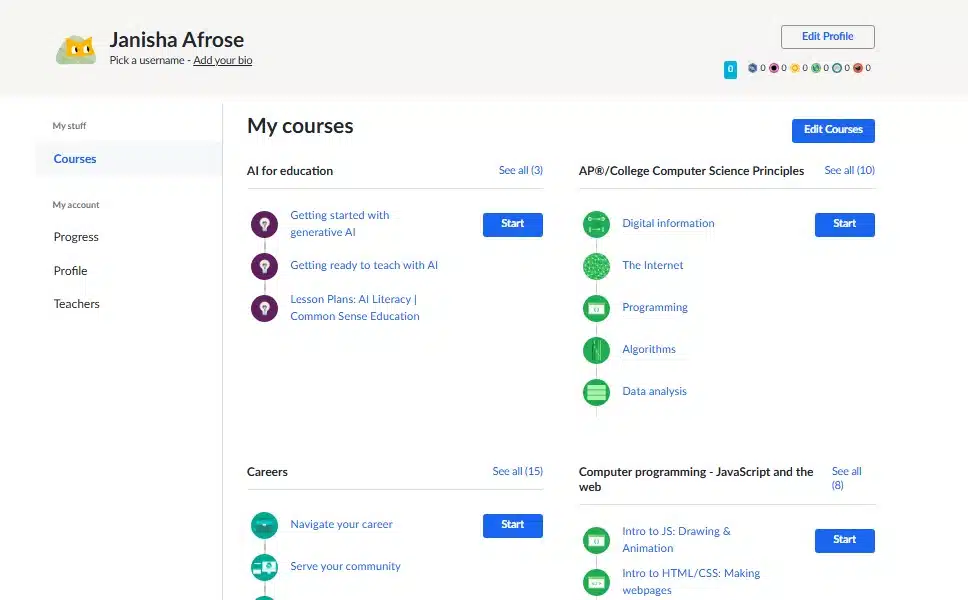
Khan Academy is a strong starting point for students who need both an explanation and a chance to practise what they have learned.
Its courses cover mathematics, science, English language arts, economics, computing, social studies, life skills, and test preparation. Lessons commonly combine videos, articles, exercises, and quizzes. A free account allows learners to save progress and continue where they stopped.
The platform is especially useful for closing a specific knowledge gap. A student struggling with fractions, algebra, grammar, or introductory biology can work directly on that skill instead of beginning an entire course.
Teachers can assign activities and follow student progress. Parents can also use the platform to find age-appropriate practice. However, subject coverage and curriculum alignment vary across countries and languages. Khan Academy works best as a supplement rather than a complete replacement for a school curriculum.
2. OpenStax
Best for: Free academic textbooks
OpenStax provides peer-reviewed, openly licensed textbooks for widely taught high-school and college subjects.
Its library covers mathematics, biology, chemistry, physics, economics, business, psychology, sociology, and several humanities subjects. Every textbook can be read online or downloaded as a PDF without charge. Printed editions are available at a cost.
The books follow a clear academic structure, with chapters, explanations, examples, review questions, and supporting materials. This makes OpenStax useful for students who need a dependable reference book and instructors looking to reduce textbook expenses.
OpenStax does not provide live teaching or personal feedback. Learners should also compare the book’s edition and chapter order with their course syllabus, particularly when studying outside the United States.
3. MIT OpenCourseWare
Best for: University-level self-study
MIT OpenCourseWare publishes materials from thousands of courses taught at the Massachusetts Institute of Technology.
Available subjects include engineering, computer science, mathematics, architecture, economics, management, science, and the humanities. Depending on the course, learners may find syllabi, lecture notes, assignments, examinations, reading lists, and video lectures.
There is no enrolment process, fixed timetable, or required account. Learners can study a complete course or use selected materials to understand one difficult topic.
The academic depth is impressive, but the experience requires discipline. MIT OpenCourseWare does not provide tutor support, academic credit, certificates, or admission to MIT. Some copyrighted readings are unavailable, and not every course includes recorded lectures.
4. PhET Interactive Simulations
Best for: Exploring STEM concepts visually
PhET Interactive Simulations helps learners understand science and mathematics by letting them experiment with ideas on screen.
The simulations cover physics, chemistry, mathematics, earth science, and biology. Students can change variables, make measurements, and immediately observe the results. This is particularly helpful for topics such as forces, electricity, energy, molecules, graphs, and probability.
Many simulations can be used in a web browser or downloaded to a computer. They give students a safe way to investigate cause and effect when physical laboratory equipment is unavailable.
PhET works best alongside a lesson, worksheet, or guiding question. It is not a complete course. Its web simulations are free for non-commercial educational use, while mobile apps and commercial reuse may have different conditions.
5. CodeAI
Best for: Coding and AI literacy
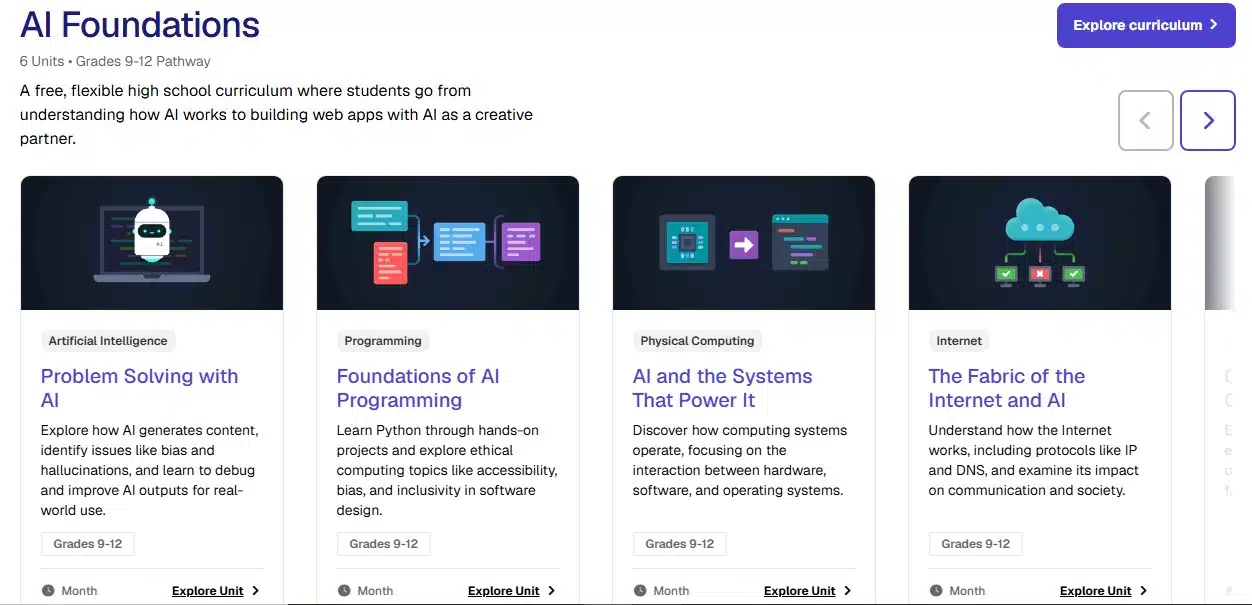
CodeAI is the current name of the nonprofit previously known as Code.org. Both names are worth mentioning because many students, teachers, and parents still recognise the older brand.
The platform provides free K–12 courses and activities in computer science, programming, data science, and artificial intelligence. Younger students can begin with visual, block-based exercises. Older learners can explore programming concepts, web development, and how AI systems work.
Students learn by creating projects rather than only watching explanations. Depending on the activity, they may build an animation, game, website, or simple program.
CodeAI also provides lesson plans and classroom-management tools for teachers. Individual activities can support independent learning, although many full courses are designed for teacher-led classrooms.
6. CommonLit
Best for: Reading comprehension and English language arts
CommonLit offers reading and literacy resources for students in grades 3–12.
Its free Text Library contains literary and informational texts with questions and teaching materials. Educators can search for content by grade, theme, subject, or skill. This makes it easier to find a passage that matches a particular lesson or reading objective.
The free teacher offering also includes CommonLit 360, a full-year English language arts curriculum for grades 6–12. Teachers can use it as a structured curriculum or select individual lessons to reinforce specific skills.
CommonLit is primarily designed around US grade levels and standards. Educators in other countries should check whether each lesson fits their curriculum. Advanced assessments, administrator reporting, institutional integrations, and implementation support may require a paid school plan.
7. Smithsonian Learning Lab
Best for: Learning through authentic objects and sources
The Smithsonian Learning Lab turns museum collections into digital learning materials.
Users can explore millions of images, documents, recordings, texts, and videos related to history, science, art, culture, nature, and technology. Many resources have been organised into collections for particular subjects and grade levels.
The platform is especially valuable for research projects and inquiry-based learning. Students can examine an artwork, historical photograph, scientific object, or primary document instead of relying only on a textbook summary.
Teachers can create collections, add questions and annotations, adapt existing materials, and share assignments with students. However, the platform is not a linear course. Users should distinguish official Smithsonian materials from user-created collections and review the usage rights before republishing individual assets.
8. OpenLearn
Best for: Flexible adult and lifelong learning
OpenLearn is the free learning platform operated by The Open University.
It offers self-paced courses in business, computing, education, languages, health, psychology, science, mathematics, society, and the arts. Courses are labelled introductory, intermediate, or advanced and include an estimated study time.
Visitors can read course content without creating an account. A free account allows learners to enrol, monitor progress, and receive a statement of participation after completing eligible courses. Some courses also provide digital badges.
These records can demonstrate personal or professional development, but they are not formal academic credit or Open University qualifications. OpenLearn also does not provide personal tutor support to free learners.
A Bookmark Should Lead Somewhere
Free digital learning resources can remove a major financial barrier, but progress still depends on focus and consistency. The most useful platform is not necessarily the one with the largest library. It is the one that matches the learner’s immediate need.
Choose one resource, set a manageable goal, and return to it regularly. That simple habit can turn a free website into a meaningful part of someone’s education.
Frequently Asked Questions on Free Digital Learning Resources
1. Are these digital learning resources completely free?
Their main educational content is free. However, some platforms charge for printed books, mobile apps, institutional services, advanced reporting, integrations, or formal study programmes.
2. Which free resource is best for school students?
Khan Academy is the strongest general-purpose choice. CommonLit is better for reading, PhET for science and mathematics, and CodeAI for coding and AI literacy.
3. Can free learning websites replace classroom teaching?
Usually not. They are most effective for practice, revision, exploration, and supplementary learning. Younger students may still need guidance from a teacher or parent.
4. Do any of these resources provide certificates?
OpenLearn offers statements of participation and digital badges for eligible courses, but these are not accredited qualifications. MIT OpenCourseWare does not award certificates or academic credit.
5. Can learners use these resources without an account?
Some of them can. MIT OpenCourseWare requires no registration. OpenStax books can be read or downloaded directly, and OpenLearn content can be viewed without an account. Accounts are generally needed for progress tracking, classroom assignments, or completion records.