
Most advice on how to stop procrastinating focuses on building willpower, generating motivation, or enforcing strict personal discipline. These approaches regularly fail because procrastination is not a time management defect or a flaw in character. It is an immediate emotional regulation response. When a task triggers cognitive overload, anxiety, or confusion, the brain seeks immediate relief by diverting attention to low-friction distractions.
Overcoming this visceral avoidance reflex requires shifting away from raw effort. Implementation intentions provide an empirical behavioral structure that bridges the gap between wanting to complete a task and initiating action.
The Emotional Mechanics of Procrastination
Understanding how to stop procrastinating begins with recognizing the neurological conflict occurring during task initiation. The limbic system, which controls emotional responses and immediate gratification, operates much faster than the prefrontal cortex, which governs long-term planning and logical decision-making.
When faced with an ambiguous or intimidating project, the limbic system perceives the assignment as an immediate threat to emotional comfort. It pushes you toward mood repair activities like clearing an inbox, scrolling social feeds, or cleaning a workspace. The immediate psychological relief reinforces avoidance, creating a habit loop where delay becomes the default response to uncomfortable work.
Traditional productivity tools like calendar blocks and general to-do lists fail to break this cycle. They tell you what needs to get done, but leave the timing, environmental conditions, and initiation steps completely undecided. When the time arrives to begin work, you are forced to make active decisions while experiencing emotional resistance. The resulting cognitive strain usually causes the brain to opt for delay.
Psychological Framework of Implementation Intentions
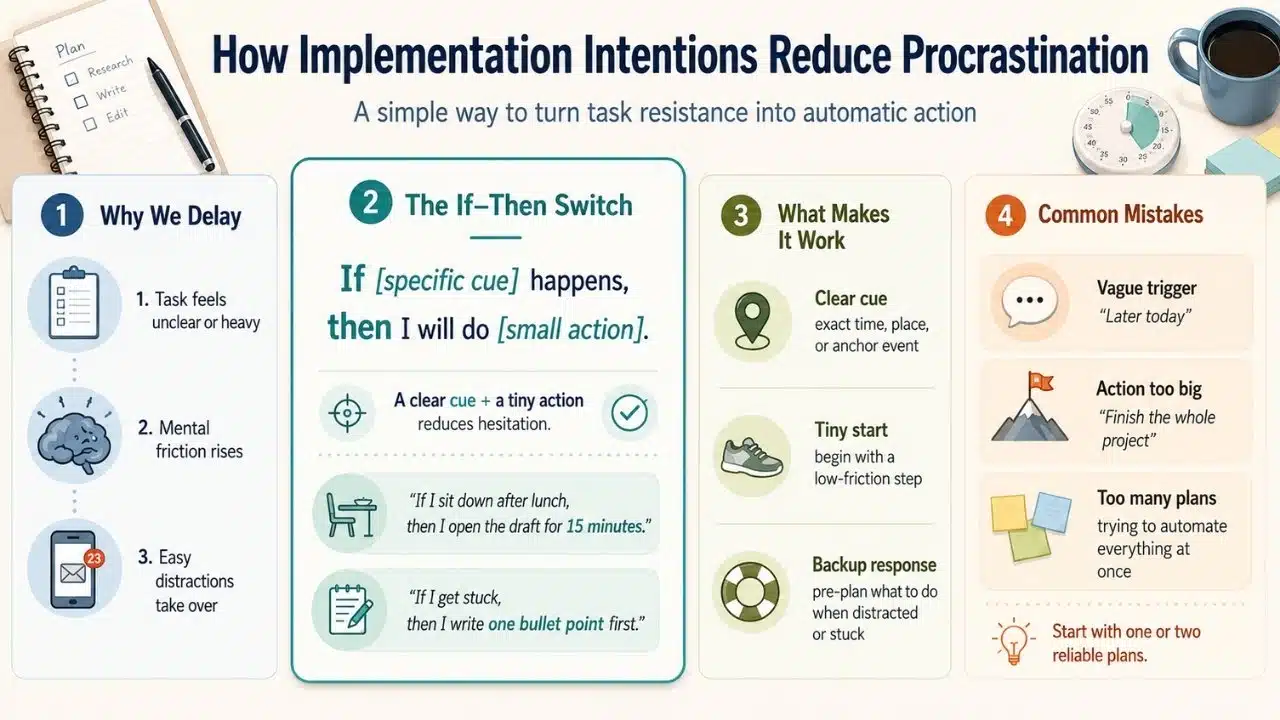
Formulated by psychologist Peter Gollwitzer in 1999, implementation intentions alter how the brain responds to environmental opportunities. Standard goal setting produces outcome intentions, such as deciding to write a research paper or learn a new programming framework. Implementation intentions convert those vague goals into an explicit conditional architecture.
If [Specific Trigger X occurs], then I will perform [Target Action Y].
This simple conditional structure delegates behavioral control from conscious willpower to environmental context. By pre-determining exactly where and when an action will take place, the designated situational cue becomes highly accessible to subconscious memory.
When the specified trigger occurs, the brain recognizes the opportunity instantly. Execution requires significantly less executive processing energy, allowing you to bypass the internal debate over whether you feel ready to work.
Deconstructing the If-Then Architecture
The effectiveness of an if-then plan depends on the precision of both its conditional trigger and its target action. Vague triggers fail to activate automatic responses, while overly complex actions recreate initiation friction.
1. Defining Unambiguous Triggers
A trigger must be a concrete, easily recognizable event in your immediate environment. Relying on subjective internal states like “when I feel energetic” or broad time frames like “this afternoon” forces active decision-making.
Effective situational cues include:
-
Specific clock times paired with exact locations (e.g., “7:30 AM at my kitchen table”).
-
Pre-existing habits (e.g., “Immediately after closing my morning team call”).
-
Physical environmental events (e.g., “As soon as my feet touch the floor after waking”).
2. Specifying Low-Friction Actions
The action component of the statement must be stripped of ambiguity. Asking yourself to “work on the quarterly report” requires you to figure out what working actually entails at the moment of initiation.
Instead, define a small micro-action that requires minimal cognitive startup effort. Opening a blank document, drafting a single introductory sentence, or reviewing three data rows are ideal starting points. Once initiation occurs, momentum takes over and sustaining work becomes exponentially easier.
Standard Goals vs. Implementation Intentions
Replacing abstract desires with conditional planning changes how tasks are approached. The table below illustrates how general goals transform into actionable triggers.
| Dimension | Standard Goal (High Failure Risk) | Implementation Intention (High Execution Rate) |
| Primary Structure | Abstract desire (“I need to finish the marketing deck.”) | Conditional rule (“If I sit at my desk after lunch, then I will open slide three.”) |
| Cognitive Requirement | Demands active decision-making at the moment of execution | Pre-decides the response, eliminating real-time deliberation |
| Environmental Cue | Vague or absent (“sometime today”) | Highly specific (“at 9:00 AM in the quiet conference room”) |
| Emotional Dependency | Requires motivation and emotional readiness | Executes regardless of current mood or energy levels |
| Obstacle Handling | Easily disrupted by unexpected interruptions | Integrates pre-planned coping responses for distractions |
Pre-Programming Obstacle Control
Task initiation is only the first hurdle in learning how to stop procrastinating. Sustaining focus requires managing internal urges to switch tasks when the work becomes challenging.
Coping implementation intentions expand the if-then framework to neutralize distractions before they occur. By analyzing past failure points, you can map out automated responses to common interruptions.
Managing Digital Distractions
Online notifications represent the most frequent catalyst for task abandonment. Rather than relying on willpower to ignore pings, construct explicit distraction protocols:
-
If the urge to check breaking news or social media arises during writing sessions, then I will take three deep breaths and leave my hands on the keyboard.
-
If a non-urgent email notification appears on screen, then I will press the minimize shortcut and continue working until my timer rings.
Handling Technical Frustration and Complexity
When hit with an unexpected technical blocker, the brain immediately seeks escape through lower-friction activities. Coping plans prevent this derailment:
-
If I encounter a bug I cannot solve within ten minutes, then I will step away to sketch the logic on a physical notepad.
-
If I feel overwhelmed by the scope of a section, then I will shrink my focus to writing just the next bullet point.
Step-by-Step System to Automate Your Daily Workflow
Integrating implementation intentions into your daily schedule requires systematic setup. Follow this structured process to build reliable execution habits.
Step 1: Audit Your Avoidance Patterns
Identify two specific tasks you consistently postpone. Examine the underlying emotional trigger driving the delay, such as fear of criticism, confusion regarding setup, or basic boredom.
Step 2: Isolate a Consistent Environmental Anchor
Look for fixed daily events that occur without fail. Reliable anchors include finishing your morning coffee, returning from lunch, or shutting down your email client at the end of the workday.
Step 3: Draft Your Conditional Script
Write out your if-then statement on paper or in a visible note file. Use exact language:
“If [Anchor Event occurs at Location Z], then I will [Perform Micro-Action] for 15 minutes.”
Step 4: Reduce Initial Action Volume
Ensure the target action takes less than two minutes to initiate. If the action feels daunting, scale it down further until starting requires negligible effort.
Step 5: Review and Refine Execution Metrics
At the end of the week, evaluate how reliably the trigger prompted action. If a plan failed, the anchor event was likely too unpredictable or the action step was too large. Adjust the variables and re-test.
Automating Momentum Over Willpower
Lasting productivity is not about forcing focus or waiting for emotional readiness. Procrastination is an initiation bottleneck, and relying on willpower at the exact moment of action invites decision fatigue and task avoidance.
Implementation intentions turn daily environmental cues into automatic launch points. Pre-deciding when, where, and how you will initiate a task bypasses internal debate, allowing you to move smoothly from intention to action. By building a network of explicit if-then triggers, you replace unreliable bursts of motivation with a predictable system for getting hard work done.
Frequently Asked Questions (FAQs) on How to Stop Procrastinating
How do implementation intentions differ from standard habit stacking?
Habit stacking attaches a new habit directly to an existing daily routine, such as flossing after brushing your teeth. Implementation intentions encompass a broader set of conditions, linking target actions to specific times, physical environments, or emotional states. Habit stacking functions as a specialized subset of implementation intentions.
Can implementation intentions help manage executive dysfunction and ADHD?
Yes. Individuals with ADHD often experience significant cognitive friction during task switching and initiation. By removing the need to make real-time decisions about when and how to start, if-then plans lower the working memory load required to engage in challenging tasks.
What is the best way to handle an implementation intention that fails?
A failed plan is an indicator that your conditional trigger was too vague or your starting action was too complex. Re-evaluate the trigger to ensure it is unambiguous, then shrink the initial task duration to a five-minute micro-commitment.
How many implementation intentions should I run simultaneously?
Limit yourself to one or two active plans when first adopting the framework. Attempting to automate too many behavioral triggers at once creates cognitive fatigue, diminishing the automaticity of the responses.