Knowing how to manage scope creep starts with making every requested change visible before the team begins work. Define deliverables, exclusions, the deadline, budget, and approval authority at the start. Then require new requests to be recorded, assessed for their effect on time, cost, quality, risk, and capacity, and approved by the right decision-maker.
Scope creep rarely comes from one dramatic demand. It grows through small additions—a dashboard, another revision, or a late reviewer—that appear harmless in isolation. A clear, documented change process helps teams accept valuable project improvements without quietly overloading the project, damaging quality, or weakening stakeholder trust.
1. Define the Finish Line
“Redesign the website” or “improve onboarding” is an intention, not a controlled scope. Translate it into outputs, acceptance criteria, constraints, assumptions, and exclusions.
A website project might cover five templates, responsive layouts, content migration, analytics, and browser testing while excluding new branding, copywriting, multilingual pages, and maintenance. Exclusions prevent people from carrying different versions of the project in their heads.
Keep the scope short enough to use. A two-page agreement people revisit will do more to manage scope creep than a 40-page specification forgotten after kickoff.
2. Turn Ideas Into Requirements
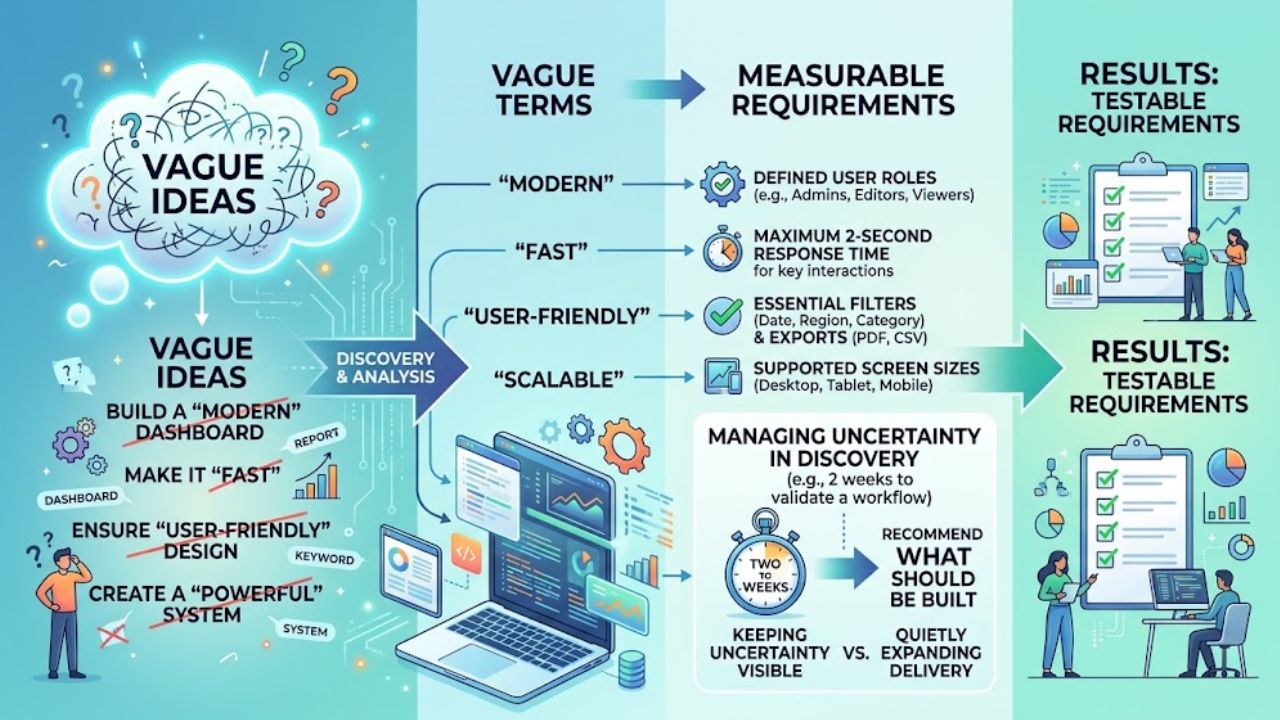
Terms such as “modern,” “fast,” and “user-friendly” invite disagreement because nobody can test them. For a dashboard, “easy to use” might become defined user roles, essential filters, exports, supported screen sizes, and a response-time target.
If the work involves discovery, give that phase a limit and output—for example, two weeks to validate a workflow and recommend what should be built. Uncertainty then stays visible instead of quietly expanding delivery.
3. Set Decision Rights
When several stakeholders can assign work independently, scope control disappears. State who may request, assess, approve, reject, or defer a change.
One owner may be enough for a small project. Larger or regulated programmes may need tiered authority: the project manager handles changes within an agreed tolerance, while changes affecting a major milestone, budget, risk, or compliance obligation go higher. This helps manage scope creep without sending every copy change to an executive committee.
What Project Plans Miss
Not every late request is careless. Customer evidence, regulation, technical discoveries, or new priorities may weaken the original plan. Protecting outdated scope can produce exactly what was requested and still deliver the wrong result.
The harder judgment is whether a change justifies its consequences. Automatic rejection is too rigid; silent acceptance is worse. Compare the request with the project objective, remaining capacity, and the cost of doing nothing.
4. Use a Log to Manage Scope Creep
Every proposed addition should enter one visible system, including requests made in meetings or calls. A spreadsheet is enough for most small projects. Another platform may create more administration than control; specialist tools become useful when volume, dependencies, or approval levels outgrow a simple log.
Record the requester, date, reason, affected deliverables, estimated impact, owner, decision, and status. Keep rejected and deferred requests so old ideas do not return as if nobody considered them.
The usual weakness is not the format. It is the verbal request someone starts acting on “just to keep things moving.”
5. Assess the Real Impact
Build time is only part of a change. A new form field may affect validation, data, analytics, documentation, testing, accessibility, training, and support. The requester can explain its value, but the delivery team should estimate its impact.
Before approval, check:
- Additional work and specialist capacity
- Milestones, dependencies, and delivery dates
- Budget or contract implications
- Rework and technical risk
- Quality, security, compliance, and user impact
- Existing work that may need to move or be removed
The assessment can be brief for a small change, but it should not disappear. To manage scope creep, stop treating “quick” as a unit of effort.
6. Trade Scope, Do Not Stack It
When budget and deadline are fixed, additional work needs a trade-off: remove a lower-priority feature, reduce depth elsewhere, or defer the request. Asking the team to absorb it simply moves the cost into overtime, quality, or delay.
Frame the choice clearly: “We can add the approval flow if reporting moves to phase two,” or, “We can keep both if the delivery date changes.” Similar-looking tasks may carry different testing, integration, or approval work. Estimate before making the swap.
7. Review Changes at Set Times
Set a regular review point, such as a weekly meeting or a planning window between delivery cycles. Give urgent requests a separate route, but define “urgent” narrowly—production failure, safety, compliance, or another agreed critical condition, not seniority or impatience.
Iterative delivery still needs control. Ideas can enter an ordered backlog without going straight into active work. In Scrum, scope may be renegotiated as more is learned, but the Sprint Goal should not be endangered. Scheduled review helps manage scope creep without blocking evidence-based change.
8. Track Hidden Extra Work
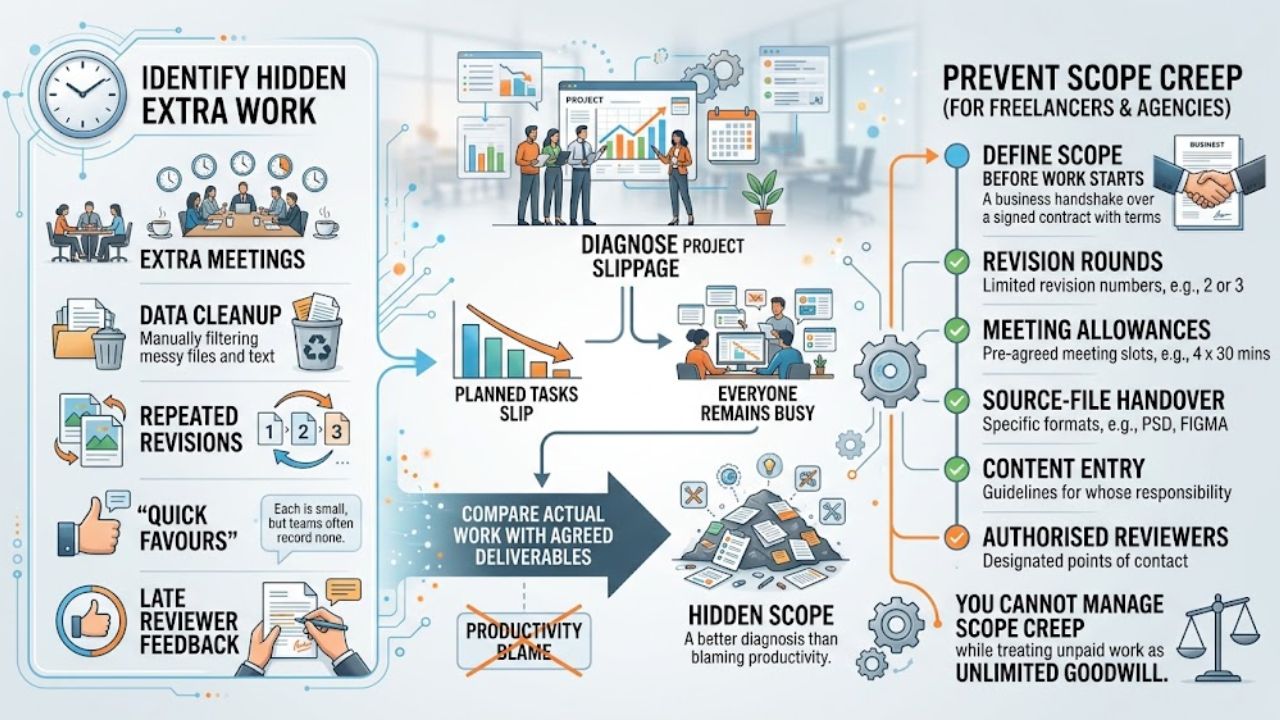
Some additions never receive a change label: extra meetings, data cleanup, repeated revisions, “quick favours,” or feedback from late reviewers. Because each is small, teams often record none of them.
If planned tasks slip while everyone remains busy, compare actual work with agreed deliverables before blaming productivity. Hidden scope may be the better diagnosis.
Freelancers and agencies should define revision rounds, meeting allowances, source-file handover, content entry, and authorised reviewers before work starts. You cannot manage scope creep while treating unpaid work as unlimited goodwill.
9. Escalate Early
Teams sometimes hide extra work because they hope to recover later. By the time a sponsor hears, the choices may be rushing, overspending, reducing quality, or missing the date.
Agree on escalation tolerances early. A project manager might absorb a minor adjustment but escalate changes to a contract, approved budget, major milestone, expected benefit, or material risk. Early escalation preserves options; a late warning reports damage.
10. Update the Baseline
Approval does not complete a change. Update the scope, schedule, budget, responsibilities, requirements, acceptance criteria, risks, and relevant agreements. Tell everyone whose work has moved.
Otherwise, the team works from one project while its documents describe another, creating disputes and weakening the next assessment. A current baseline is essential to manage scope creep. Close a request only after it has been implemented, rejected, or formally deferred and recorded.
Final Thoughts
The most practical way to manage scope creep is to expose the next change before work starts. Check four things on an active project: approved deliverables, exclusions, decision authority, and the place where requests are recorded. Fix any missing element before adding more process.
Make trade-offs part of ordinary project conversation. A worthwhile change still has a cost; do not disguise it as a favour or absorb it through wishful scheduling.
Frequently Asked Questions (FAQs)
Does Every Project Need Formal Change Control?
Every project benefits from a clear way to handle changes, but not every project needs a board or specialist software. One decision-maker, a shared scope note, and a simple log may suit a short internal assignment. Add formality as cost, risk, contractual exposure, or interdependence grows.
What If a Stakeholder Wants More Work Without More Time or Budget?
Present the trade-offs: remove or reduce other work, move the deadline, increase the budget, or defer the addition. If every adjustment is rejected, record the decision and escalate it to whoever owns the constraints. Adding work while fixing scope, time, budget, capacity, and quality is not credible.
Can Agile Projects Still Experience Scope Creep?
Yes. An evolving backlog supports adaptation; it does not make capacity unlimited. Agile teams still need a clear objective, ordered work, visible decisions, and honest negotiation.