


Not long ago, online MBAs were seen as a convenient alternative, best suited for working parents, mid-career professionals, or those unable to relocate. Fast forward a few years, and the landscape has shifted dramatically. Online MBA programs have moved from the margins to the mainstream, embraced by top universities, sought after by ambitious professionals, and increasingly respected by employers.
So what changed? From advances in virtual learning technology to shifting workplace norms and rising tuition costs, a perfect storm of factors has propelled the online MBA into the spotlight. In this piece, we explore the journey of how a once-sidelined format became a powerful force in business education – and why its momentum shows no signs of slowing down.
The Rise of Online MBAs: From Niche to Mainstream
Evolution of Business Education
Traditional MBA programs dominated business education for decades, with in-person instruction at prestigious institutions being the gold standard. The first online MBA programs emerged in the late 1990s but were initially viewed with skepticism by employers and academics alike.
By 2010, technology improvements enabled more sophisticated virtual learning environments, and institutions began developing online curricula. These early programs often struggled with limited interaction and primitive delivery methods, making them unappealing to many prospective students.
The period between 2015 and 2020 marked a turning point, with prestigious business schools like Imperial College, Warwick, and USC Marshall launching comprehensive online MBA programs. These offerings incorporated interactive elements, global collaborations, and innovative assessment methods.
Today, over 300 accredited online MBA programs exist worldwide, with many ranked alongside their traditional counterparts in major education rankings.
Key Drivers Behind Online MBA Popularity
The flexibility offered by online MBA programs is undoubtedly one of the primary attractions for working professionals. Online MBA programs eliminate geographical constraints and allow students to maintain employment while studying.
Cost considerations also play a significant role, as online programs typically cost 25-40% less than traditional MBA pathways while delivering comparable curriculum content.
In recent years, technological advancements have dramatically improved the quality of instruction. Video conferencing, collaborative platforms, and interactive case studies create engaging learning experiences that the majority of people are able to cooperate with.
Over time, more and more industries are now recognising online MBAs as being rightfully equivalent to their in-person alternatives. A 2024 survey of Fortune 500 companies revealed that 82% now view online MBA credentials as equivalent to traditional degrees, compared to just 34% in 2015.
Shifting Perspectives on Online Learning
Academic institutions initially resisted online education, largely due to concerns about maintaining quality and prestige. However, as learning technologies matured, faculty attitudes evolved significantly.
Research now demonstrates comparable learning outcomes between online and in-person MBA programs. A 2023 study published in the Journal of Business Education found no significant difference in knowledge retention or career advancement between delivery methods.
Employers have followed suit in changing their perceptions. Companies increasingly value the self-discipline and technological fluency demonstrated by online MBA graduates. Today’s online MBA students report satisfaction rates nearly identical to their campus-based counterparts, with 91% of graduates indicating they would choose the same pathway again.
Impact and Advantages of Mainstream Online MBAs
Improved Accessibility and Diversity
Online MBA programs, like those provided by the Quantic School of Business and Technology, have dramatically expanded access to business education for professionals who were previously excluded from traditional programs. Geographic limitations no longer prevent talented individuals from accessing top-tier business education, with students able to attend prestigious institutions regardless of their location.
The flexibility of online formats has particularly benefited working professionals who can balance career obligations with educational advancement. This has resulted in more diverse cohorts, bringing together students from various industries, countries, and backgrounds.
Data shows that online MBA programs typically attract more students from underrepresented groups than traditional programs. Women, for example, often constitute a higher percentage of online MBA cohorts than in-person programs.
The reduced overall costs (eliminated relocation expenses, commuting costs, and ability to maintain full-time employment) have made quality business education financially viable for many more candidates, further democratizing access to advanced business credentials.
Career Development and Networking Opportunities
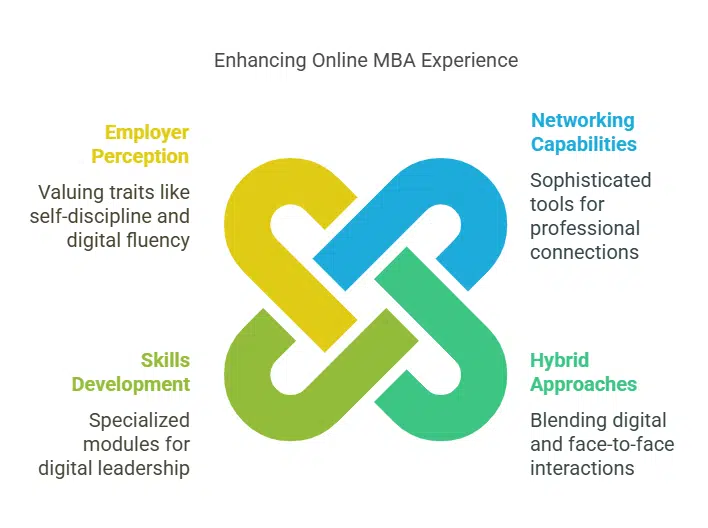
Contrary to early concerns, online MBAs have developed sophisticated networking capabilities that often rival traditional programs. Virtual networking events, digital collaboration tools, and online alumni databases have created robust professional communities.
Many online programs include short residency periods or regional meetups, providing face-to-face interaction opportunities that complement digital connections. These hybrid approaches maximize networking benefits while maintaining program flexibility.
Leadership and soft skills development have evolved significantly in virtual formats, with specialized modules on digital communication, remote team management, and virtual leadership skills increasingly valued in today’s workplace.
Employers increasingly view online MBA graduates as demonstrating valuable traits, including self-discipline, digital fluency, and time management skills – all essential in today’s modern business environments.
Innovative Learning Experiences and Technology
Online MBA programs have pioneered educational technologies that are now transforming business education broadly. Interactive simulations, AI-powered learning assistants, and data-driven personalization have created engaging learning environments.
Virtual reality applications allow students to practice complex business scenarios, from negotiation techniques to crisis management, in realistic but risk-free environments. These technologies often provide more practice opportunities than traditional classroom settings.
Digital collaboration tools within these programs mirror those used in modern workplaces, preparing students for distributed team leadership. Students regularly work in virtual teams across time zones, developing crucial skills for global business operations.
The data analytics capabilities built into online learning platforms provide unprecedented insights into student performance and engagement. This enables targeted interventions and personalized learning paths not easily implemented in traditional classrooms.
Many programs now incorporate content creation and social media management into their curriculum, addressing critical digital transformation skills required in contemporary business settings.






















