
Many think making smart AI needs lots of data. They believe more data is always better. But this isn’t true in today’s tech world. I’ve learned that quality is more important than quantity.
Instead of collecting lots of data, I focus on making it better. This means using the right data, not just more of it.
By being smart about how you use data, you can make strong systems. You don’t need to store a lot of data. Efficiency is key to making progress in AI.
The Myth of More is Always Better
Many groups think more data means better insight. They collect lots of info without a plan. This makes systems big but not useful. People want lots of data because they fear missing out. They think big data will find secrets. But, having lots of data doesn’t always help.
The culture also says more data is better. Companies store everything, hoping for future AI needs. This endless storage doesn’t help their goals.
The Hidden Costs of Data Hoarding
Choosing more data over quality has big risks. These problems affect storage, security, and more. Here are some issues:
- More money for cloud storage and upkeep.
- Bigger security risks because of more data.
- Harder to keep data clean and follow rules.
- Models train and run slower with too much data.
Let’s look at how hoarding affects companies. The table below shows the differences between smart data use and hoarding.
| Metric | Lean Data Strategy | Data Hoarding |
| Storage Costs | Low and Optimized | High and Escalating |
| Security Risk | Easily Managed | Complex and Vulnerable |
| Model Speed | Fast and Efficient | Slow and Bloated |
| Data Quality | High and Clean | Low and Noisy |
To avoid these risks, teams should focus on data quality. Not just how much they have. This way, companies can work better without too much digital stuff.
How Much Data Does Machine Learning Really Need
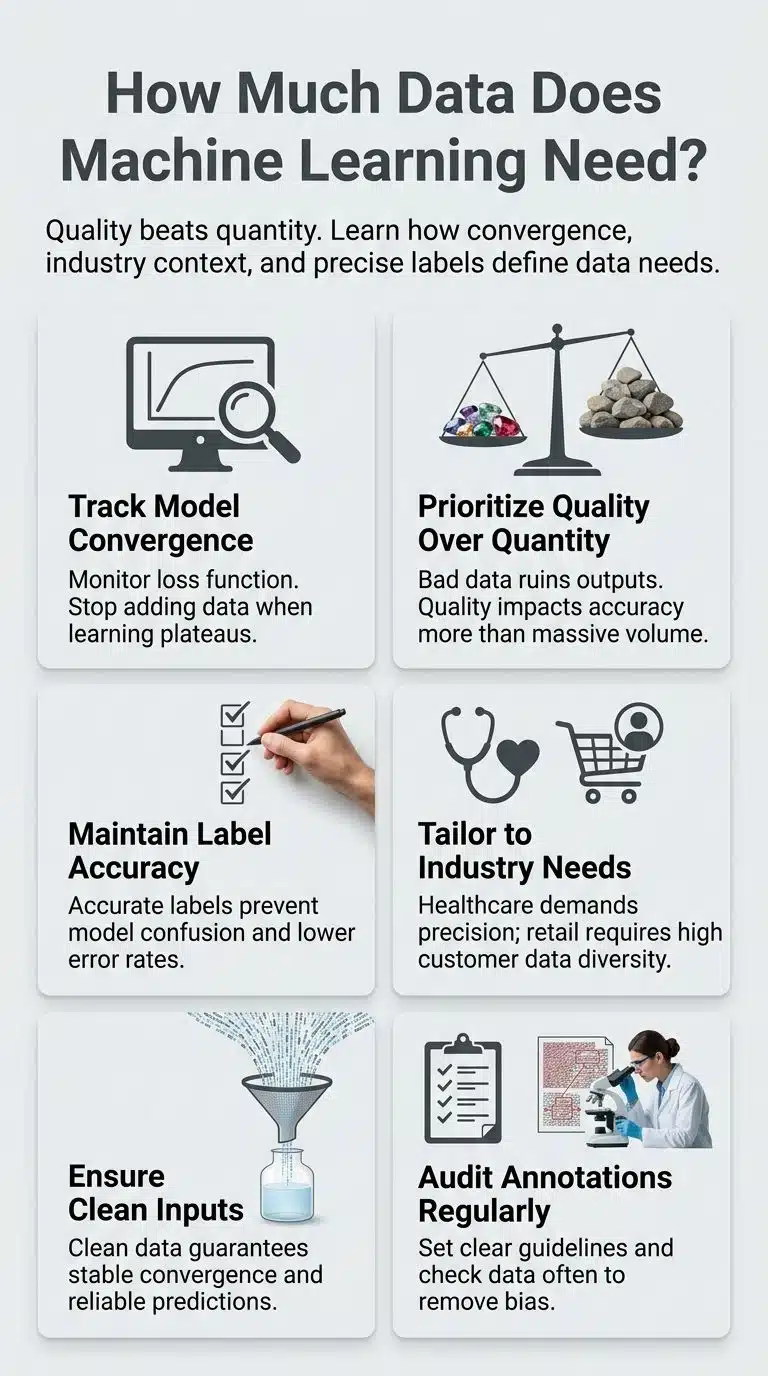
Many think more data means better results. But it’s not always true. I look for the perfect mix for my projects.
Defining the Model Convergence
Model convergence is when a machine learning model stops getting better. It has learned all it can from the data. More data then is just extra work. I watch the loss function to see when this happens. If it stops going down, I know I’m done. This helps me figure out how much data I need.
Contextualizing Data Requirements by Industry
What you need changes based on the industry and goals. Healthcare needs precise data, not just lots of it. Retail needs lots of data to understand many customers.
When I think about data needs, I look at a few things:
- The complexity of the algorithm or model.
- The noise in the data.
- The project’s success metrics.
- The data’s diversity and how well it represents things.
By looking at these, I can guess how much data I need. This way, my models are efficient and work well.
The Critical Role of Data Quality Over Quantity
How good your data is matters more than how much you have. Many teams collect lots of data but forget to check its quality. Making sure your data is good is key to making your models work well.
Why Garbage In Leads to Garbage Out
“Garbage in, garbage out” is true in data science. Bad data makes your model’s output bad. No matter how good your algorithms are, bad data ruins everything. Looking at failed projects, I see bad data as the main problem. Good data lets models learn well. Bad data makes them learn the wrong things.
The Impact of Labeling Accuracy on Model Performance
Good labels are key to learning from data. Even with lots of data, bad labels make models fail. A model’s smarts depend on the data it’s trained with. Bad labels confuse models. When models get mixed signals, they don’t predict well. Keeping labels strict helps models learn the right things. Even with tools, people are key in data work. They add important details that machines miss. But people can get tired and biased.
To fix this, follow strict data work rules. Use clear guidelines and check data often. Treating data work as important makes models better.
| Data Characteristic | Impact on Model | Resulting Performance |
| High Label Accuracy | Clear Pattern Recognition | High Precision |
| Low Label Accuracy | Model Confusion | High Error Rate |
| Clean Data | Stable Convergence | Reliable Output |
| Noisy Data | Overfitting to Noise | Poor Generalization |
To keep your data top-notch, follow these tips:
- Make clear rules for labeling for everyone.
- Check data quality often to fix mistakes.
- Use diverse data to avoid bias.
- Train annotators well to ensure they understand data correctly.
When Small Datasets Outperform Big Data
In some fields, small, chosen datasets do better than big ones. The big data chase often misses the mark. But small datasets in AI can be very accurate. By picking the right data, developers make systems that work well for certain tasks. These systems are also easier to understand.
The Power of Domain-Specific Knowledge
Models get strong from knowing their domain well. I pick data that shows the special details of the area. This helps the model find important patterns that big data misses.
Being precise and knowing the context is key. Using data labeled by experts helps a lot. This way, the model knows the field’s rules well. It works better than just having more data.
Avoiding Overfitting in Niche Applications
Working with little data can lead to overfitting. This happens when a model learns the wrong things from the data. In special areas, this makes the system fail with new data.
To fix this, I use cross-validation and regularization. These keep the model simple and accurate. Watching the training closely helps the system stay strong, even with less data. I think a smart, small dataset is the best for making smart apps.
The Diminishing Returns of Massive Datasets
Looking for more data in AI can lead to less gain. Adding more data doesn’t always make a model better. Sometimes, extra data doesn’t help much after a model gets good enough.
It’s key to know when to stop collecting data. This saves time and money. We don’t want to keep getting more data when it won’t help.
Identifying the Point of Saturation
Watching how models learn is important. When they stop getting better, it’s time to stop adding data. This is when they’ve learned all they can from the data.
Testing in small steps helps find this point. By training on smaller and then bigger data sets, we see when it stops improving. This way, we avoid collecting too much data without a reason.
Computational Efficiency and Environmental Impact
Our choices affect the planet too. Making AI efficient is key for a greener future. Training big models uses a lot of energy, which harms the environment. I aim for models that work well but don’t need a lot of power. This means using less energy for training. It’s better for the planet and for AI’s future.
Being green doesn’t mean we have to make less effective models. It’s about being smart with our data. This way, we make models that work well and are kind to the planet.
Strategies for Success with Limited Data
Working with little data can lead to big ideas. I make the most of every piece of data I have. This way, I create strong models that work well in real life. Pre-trained models are a big help when data is scarce. They’ve learned from lots of data already. This saves me time and computer power.
Using these models, I can quickly get good results. It’s better than starting from scratch with no data.
Using Synthetic Data to Bridge the Gap
When real data is hard to get, I make fake data. It looks like real data but is made by me. This helps my model learn more. Generated data helps balance my training sets. It keeps my model working well without costing too much. It’s key for working with little data.
Best Practices for Data Augmentation
I also make my data bigger by changing it a bit. I rotate, scale, or add noise to images or text. This makes my model stronger and less likely to overfit.
| Strategy | Primary Benefit | Best Use Case |
| Transfer Learning | Reduced Training Time | General Image/Text Tasks |
| Synthetic Data | Increased Data Volume | Rare Edge Cases |
| Data Augmentation | Improved Robustness | Small Labeled Sets |
The Future of Data Efficiency in AI
I think the future of AI is about doing more with less data. We’re moving away from big databases. Now, we focus on smarter, quicker ways to learn from small inputs.
Moving Toward Few-Shot Learning
Few-shot learning is very exciting. It lets models learn from just a few examples. This makes them work like humans, needing less data. This is great for places where getting data is hard or expensive. It helps developers make strong systems fast. This makes advanced tech more available to all.
The Shift Toward Model-Centric AI Development
There’s a big change to model-centric AI. Now, we focus on making algorithms better. This makes the models smarter and more efficient.
Improving the model’s design helps it work better without needing lots of data. I believe this change will make AI more reliable and sustainable. The goal is to have smart designs, not just lots of data.
Final Words
Building strong artificial intelligence needs a new way of thinking. We often get too caught up in collecting lots of data. But, the real key is in how we use that data.
Good, specific data is the base for solid results. By focusing on quality, we make models that work better and clearer. This way, even with less data, we can achieve great things.
It’s time to check your data today. Find ways to make your labels more accurate and your inputs more relevant. By doing this, you’ll create smarter systems that last. Your dedication to better data will shape the future of your projects.
Frequently Asked Questions (FAQs)
1. How can I determine if my project has reached a point of diminishing returns with data collection?
I watch how fast my model gets better. When adding more data doesn’t make a big difference, I know it’s time to stop. Then, I focus on making my model work better without needing more data.
2. Is it possible to build a high-performing model if I only have access to a small, niche dataset?
Yes, small, specific datasets can be better than big ones. They have more useful information. I avoid too much data to keep my model accurate. This helps it work well with what it has.
Having too much data can be a problem. It costs a lot to store and can be hard to keep safe. If the data is bad, the whole project can fail.
4. How does the industry I work in change how much data I really need?
The type of project I’m doing affects how much data I need. For example, health tools need very accurate data. But, tools for shopping might need more data to understand trends.
5. What strategies do I use to train models when data is scarce?
I use pre-trained models to start with. Then, I fine-tune them with my data. I also make more data by changing what I already have. This helps the model learn without needing more data.
6. Why should I care about model-centric AI development over a data-centric approach?
Model-centric AI is more important for the future. It focuses on making models smarter, not just collecting more data. This makes systems more efficient and less wasteful.
7. What is the most important factor in ensuring high labeling accuracy?
People are key in making data accurate. Even with tools, experts are needed to check and correct labels. I follow best practices to keep data accurate and consistent.