

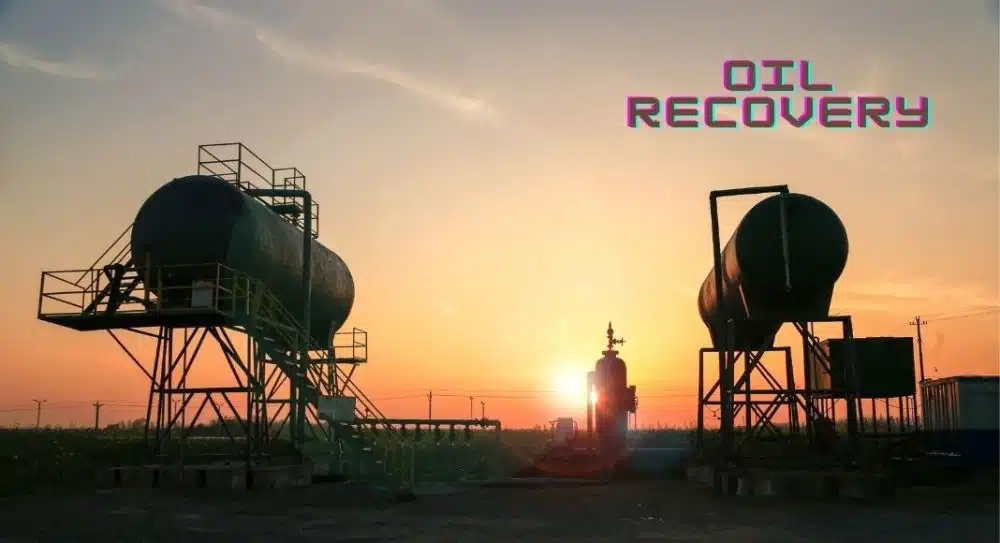
Enhanced oil recovery is the ability of an oil to flow to a well by injecting chemicals, water, and gases into the oil reservoir or changing the oil’s molecular properties. The key objective is to produce additional amounts of oil left behind by the primary and secondary recoveries by enhancing oil displacement efficiency and volumetric sweep efficiency.
Oil production is categorized into three phases: primary phase, secondary phase, and tertiary phase (Enhanced Oil Recovery). Immediate oil recovery is limited to hydrocarbons that naturally come to the surface or those that use artificial lift devices, such as pumps. Secondary recovery engages gas and water injection, displacing the oil and driving it into the earth. According to the Department of Energy, these two oil production methods recover only 20% of the oil in the wells.
The tertiary oil recovery method increases oil production. It is an expensive method to employ on an oil field; EOR can increase production up to 70% recovery. The most common form of the tertiary output is EOR, whereby high-pressure CO2 is alternated with water and injected into the oil wells to bond with the oil and carry the oil to the surface.
Use of CO2 in Enhanced Oil Recovery
Gas injection involves the use of natural gasses such as carbon monoxide, CO2, and Nitrogen. These gases expand in the reservoir and push additional oil to a production well. Other gases dissolve in the fat to lower its viscosity and improve flow rate. Gas injection accounts for about 70 percent of EOR production in America.
CO2 EOR is the injection of CO2 to raise the total pressure of an oil reservoir, pushing the oil towards production wells as a result. It is also possible for the CO2 to combine with the oil, increasing its mobility and enabling it to flow more freely. According to the International Energy Agency’s new worldwide database of enhanced oil recovery projects, about 500 thousand barrels of oil are produced daily utilizing CO2-EOR today, accounting for approximately 20% of total oil output from EOR.
The successful CO2 capture, pipeline, and injection industry has evolved over the past 50 years for CO2 enhanced oil recovery and is taking up the challenge of industrial carbon capture and subsurface storage.
The bulk of CO2 used in CO2-EOR operations today comes from naturally existing CO2 deposits underground. This may seem to be an amusing scenario, but it results from a lack of accessible CO2 near oil fields. Using natural resources has no advantage in terms of the intensity of the generated oil’s emissions. More than 70% of the CO2 injected for CO2-EOR in the United States currently comes from natural sources.
Part of the CO2 injected stays below the surface of the earth. As long as the CO2 that returns to the surface is separated and reinjected to create a closed loop, it may be used for long-term carbon dioxide storage.
Incentives by the Federal and State are assisting with expanding the transportation pipelines. Installation of new pipelines with the vast area of existing CO2 pipelines will eliminate most of the economic and technical risks of CO2 capture utilization and storage.
Benefits for Using CO2 in Enhanced Oil Recovery
- CO2 EOR has many environmental benefits. Co2 E.O.R. uses minimal new land for production and can reduce CO2 emission, which would be introduced to the atmosphere.
- Co2 E.O.R. is not a substitute for exploration of new oil wells, although it has massive benefits of producing local resources
- It can increase supply through production from existing oil fields.
- New gas pipelines required would be placed in the existing pipeline corridors where needed, reducing further land use.
- Co2 is captured instead of being released into the atmosphere.
- Used to its full potential, CO2 EOR could reduce overseas oil imports to by 10%
- Most of the CO2 used for EOR is naturally occurring in the oil reservoirs
- CO2 EOR is an essential component of US oil production, amounting to nearly 7% of US local oil production, or 360,000 barrels of oil a day.
- The technique is attracting the newest market interest inCo2 EOR.
- It has been tested successfully in the Permian Basin in West Texas and Eastern New Mexico.
Challenges of Using CO2 in Enhanced Oil Recovery
The main challenge in CO2 EOR is finding cost-effective and economical technologies to capture the Co2 from power and industrial generation sources. Technologies are available for CO2 capture, although they require more development.
In addition, excellent engineering and scientific understanding of geologic sequestration will help set long-term standards CO2 quality and long-term monitoring systems.
While improved oil recovery has been effective in certain places where conditions are ideal (for example, the Permian Basin), it is just out of reach in many others. The development and demonstration of new EOR technologies and new applications for current EOR systems may assist in speeding up their adoption.
Small producers have unique challenges in mature fields targeted for EOR, such as poor productivity wells, large water cuts, outdated infrastructure, and strict regulatory limitations. These are often low-margin activities that aren’t the focus of bigger service firms’ R&D efforts.
To avoid such challenges, it’s important to seek expert advice. Professional companies such as Melzer consulting exist to help clients identify the EOR methods suitable for your residual oil recovery project. Melzer Consulting will help you screen and optimize your oil recovery project.
Next Generation CO2 Enhanced Oil Recovery
The Department of Energy and other EOR professionals expanding its study into new sectors, looking into novel methods that may enhance the economic performance of CO2 injection and make it applicable to a wider range of reservoirs—growing the CO2 EOR technique out of the Permian Basin into basins much closer to the significant sources of artificial CO2. Next-generation CO2 EOR can produce over 60 billion barrels of oil using new techniques, including injection of large volumes of CO2, innovative flood floor designs to deliver CO2 to unswept areas of the oil reservoirs.
The Environmental Protection Agency regulations claim that the application of CO2 Enhanced Oil Recovery could increase the country’s oil recovery from approximately 40 percent to upwards of 70 percent. If this oil is added to the US reserves, the government will rank fourth in the world for the size of the reserves. If this oil is recovered, the country’s dependence on foreign oil will significantly reduce, an effort which the government has been striving for. However, a more comprehensive application of CO2 EOR methods in the US reservoirs requires a huge investment.






















