Earned wage access apps let employees receive part of their pay before their scheduled payday. In an employer-linked program, the app uses payroll or timekeeping data to calculate how much an employee can take early.
When payday arrives, payroll accounts for the money already received. Standalone apps may estimate income from bank deposits and recover the advance by debiting the employee’s account.
That difference matters when you check your pay stub or plan for bills. An employer-linked transfer may leave you with a smaller payroll deposit. A standalone app may leave the deposit untouched, then take money out of your bank account. In both cases, look at how much you receive today, what the transfer costs, and how much will be available after payday.
How earned wage access apps work for employees
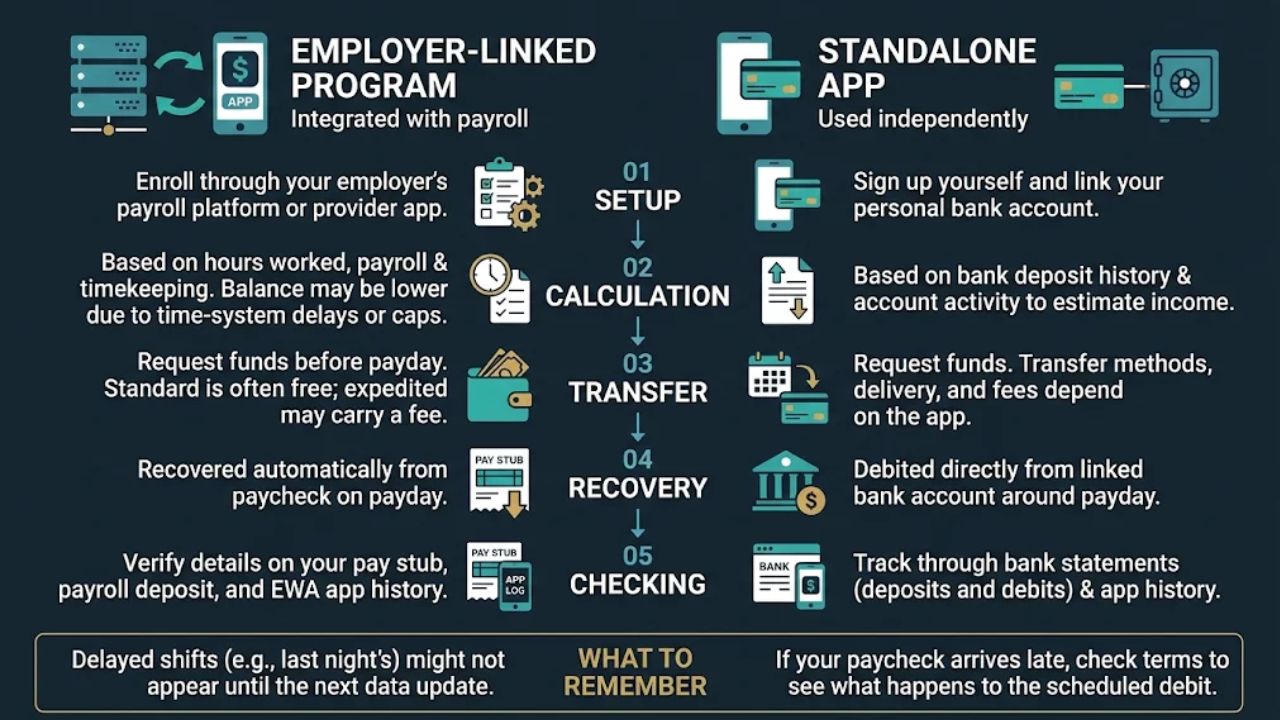
If your employer offers earned wage access (EWA), you typically enroll through its payroll platform or the provider’s app. The provider uses information about your earnings and the program’s limits to determine how much is available. You request an amount, choose a transfer method, and receive the funds before payday. A standard transfer may be free, while expedited delivery may carry a fee. Available methods and delivery times depend on the program.
The balance in the app can be lower than the wages you’ve earned so far. A program might count only shifts that have reached the timekeeping system, cap how much you can take in a pay period, or reduce the available balance after an earlier transfer. For example, a shift you finished last night might not be reflected in the app until the next data update. If the amount looks wrong, check your time record and ask payroll when approved hours are sent to the provider.
A standalone app works differently. You sign up yourself, and the provider may use recent deposits or other account activity to estimate your income. A provider that uses bank debits can collect the amount from your account around the expected payday. If your paycheck arrives late, check the provider’s terms for what happens to the scheduled debit. The name on the app alone tells you little about which recovery method it uses.
| What to check | Employer-linked program | Standalone app |
| How the available amount is calculated | Employer payroll or timekeeping data and program limits | Often deposit history or other account activity |
| How the provider typically recovers the amount | Through payroll, which accounts for the amount paid early | Often by debiting the linked bank account |
| Where to check the transaction | Pay stub, payroll deposit, and app history | Bank deposits and debits, plus app history |
These are typical arrangements. Read the transfer confirmation and terms for the amount, date, and method that apply to your request.
What $100 in early pay does to a $600 paycheck
Suppose your usual take-home pay is $600 after taxes and regular deductions. You request $100 through an employer-linked app. In this example, the provider takes a $3 expedited transfer fee out of the early payment. You receive $97 today, and $500 arrives on payday because payroll accounts for the full $100 advance.
| When | Amount received |
| Before payday | $97 |
| On payday | $500 |
| Total across both dates | $597 |
With a free transfer and the same $100 request, you would receive $100 before payday and $500 on payday, for a total of $600. In the paid example, the transfer fee accounts for the $3 difference. Some providers collect fees separately or handle them differently, so check the amount the app says will reach your account.
The timing matters if a bill is due on payday. If rent is $550 and you plan to cover it from that $600 paycheck, a $100 early transfer leaves a $50 gap unless you set aside some of the money you received early. Checking those two dates together can help you decide how much to request.
With a $100 early-pay request and a $3 fee taken out upfront, this worker receives $97 before payday and $500 on payday. Illustrative example.
What should employees check before taking early pay?
Start with the transfer that will arrive in time. Compare the arrival date and total cost of standard and expedited delivery. Look for a subscription charge, an optional tip, or a requirement to use a particular card or account for the free option. Then check when and where the provider will recover the money. For payroll recovery, estimate the remaining direct deposit. For a bank debit, compare the scheduled withdrawal with the dates your paycheck and bills usually post.
Small fees add up when you use the service regularly. Two $3 transfers per month cost $6 a month, or $72 over 12 months. That’s an illustration, and your total will depend on the fees and how often you transfer. In a 2024 analysis of eight employer-partnered providers, the Consumer Financial Protection Bureau (CFPB) found that workers in its 2021–2022 data averaged 27 transactions a year. That historical sample helps explain why transfer frequency matters when comparing fees.
Check which team can resolve different problems. If a transfer shows as complete but hasn’t arrived, the provider can trace it. If an approved shift is missing or the pay stub shows a different deduction than expected, start with your payroll team and have the app’s transaction record handy.
How earned wage access apps work for employers
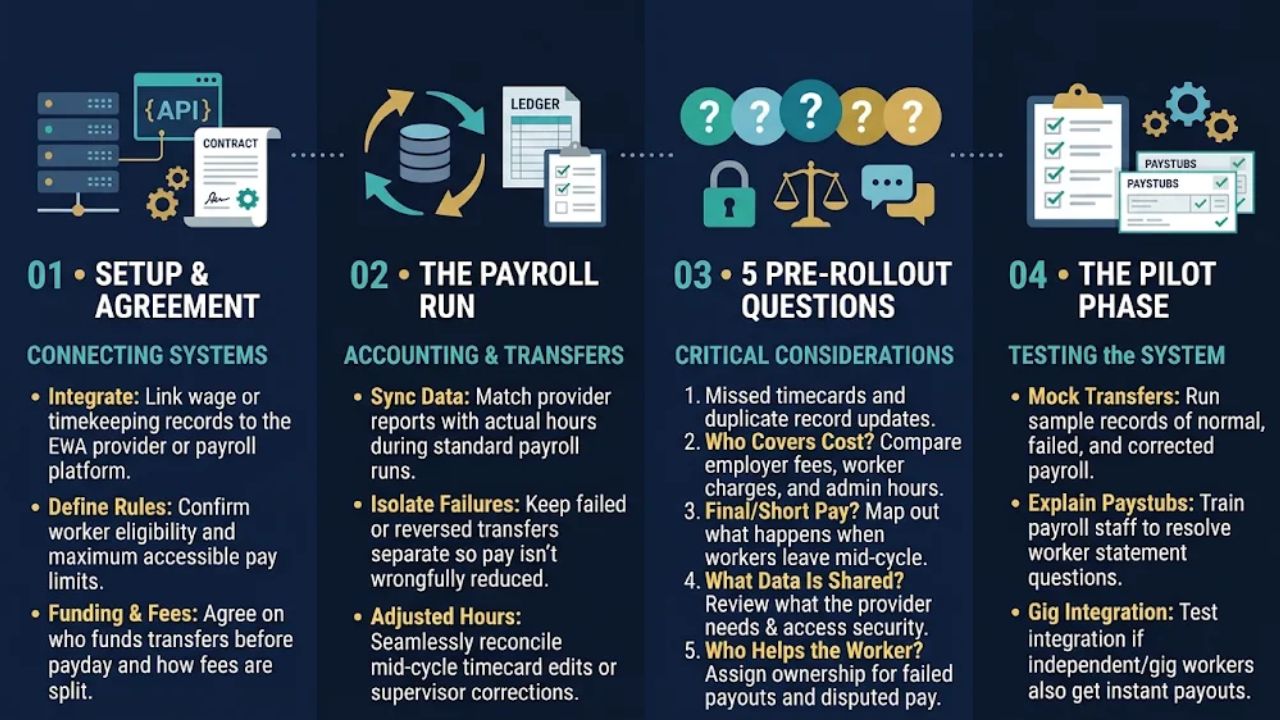
An employer offering EWA connects its wage or timekeeping records to a provider or turns on the feature in an existing payroll platform. The employer and provider agree on who is eligible, how much pay can be accessed, and when the balance updates. The contract also specifies who funds transfers before payday, who pays any fees, and how the parties settle the funds advanced. In a common arrangement, the provider funds the transfers and payroll sends back the amounts advanced when wages are processed.
The regular payroll run still has to account for every successful transfer. For each employee, the payroll team should be able to match the amount the provider reports with the amount accounted for in payroll. Failed or reversed transfers need their own status so they don’t reduce an employee’s paycheck. A correction after a supervisor approves a timecard can also change what should have been available in the first place.
Some of the most useful questions come up before rollout:
What happens when the data is late or wrong?
Confirm how the integration handles late timecards, missed data updates, changed hours, and duplicate transaction records.
Who covers the cost?
Compare employer charges, worker charges, available free transfers, and the time payroll staff will spend handling exceptions.
How do final pay and short paychecks work?
Agree on what happens if someone leaves midcycle or the remaining wages can’t cover the amount already paid. Review the arrangement against applicable wage and deduction rules.
What data does the provider need?
Ask which payroll fields it collects, who can access them, how long it keeps them, and how employee records are handled when the contract ends.
Who helps the worker?
Assign an owner for missing hours, failed payouts, and disputed deductions. Show employees where to find the transfer amount, fee, and effect on their next paycheck.
A pilot can make those decisions concrete. Use sample records to walk a normal transfer, a failed transfer, a corrected timecard, and a final paycheck through settlement. Ask payroll staff to explain each resulting pay stub using the statement an employee would receive. If the business also pays independent workers through a separate platform, see how instant payouts for gig workers operate.
Are earned wage access apps loans?
In the United States, the federal answer depends on the product. A December 2025 CFPB advisory opinion says products that meet its definition of Covered EWA fall outside the definition of credit under Regulation Z. Among the criteria, the amount must be based on accrued wages supported by payroll data, and recovery must occur through the payroll process.
The provider must also forgo individual credit-risk assessments and agree to restrictions on pursuing the worker if the payroll deduction falls short. The opinion leaves the status of other products open under Regulation Z and addresses only that regulation. Employers should check applicable state and local requirements for the program they plan to offer.
Follow the money through payday
For employees, the clearest way to evaluate earned wage access apps is to put the early deposit, the fee, and the amount available after payday side by side. For employers, take the same transaction from the time record through the transfer and pay stub. When those amounts match and both sides can see who handles an error, the program is easier to use and manage.
Final Thoughts
Earned wage access apps can help when a bill is due before payday. Before requesting a transfer, check how much will arrive today, what it costs, and whether the money left on payday will cover your next bills.
For employers, test what happens when a transfer fails, a timecard changes, or someone leaves midcycle. Employees should be able to see what they received early, how it affected their paycheck, and whom to contact if the amounts differ.
Frequently Asked Questions About Earned Wage Access Apps
What is earned wage access?
Earned wage access lets workers receive part of the pay they’ve already earned before their scheduled payday.
Will using an earned wage access app reduce my next paycheck?
With an employer-linked app, your payday deposit is usually smaller because you received some of that pay early. A standalone app may instead debit your bank account around payday.
Do earned wage access apps charge fees?
Some offer free standard transfers and charge for faster delivery. Depending on the app, you may also see a subscription fee or an optional tip.
Can I get early pay if my employer doesn’t offer it?
Yes. Some standalone apps let you sign up directly and use your deposit history to estimate how much you can access.
How much of my earned pay can I access early?
It depends on the provider, your eligible earnings, and any limits set by your employer. Check the available amount in the app before requesting a transfer.