

Struggling to see how your daily tasks can impact your future career? You’re not alone. Many people find it hard to connect their current work with their big dreams. This is where short-term goals come in.
They are the steps that lead you closer to your long-term career goals.
Short-term goals are like building blocks. Each one moves you forward, step by step. Our blog will show you how can short term goals best lead towards accomplishing long term career goals.
We’ll give examples and tips on making effective plans for both short and long-term success.
Ready to build your future? Let’s get started!
Understanding Short-Term Goals
Short-term goals are like stepping stones on the path to your big dreams. Think of them as quick wins—like improving your public speaking or mastering new software—that push you closer to your long-term career aims.
What are short-term goals?
Short-term objectives are tasks you can accomplish in under a year. They propel you nearer to significant career victories. Consider them as minor strides on your path to a large objective.
For instance, earning a certificate in six months is a short-term objective. These objectives maintain your concentration and ensure you’re consistently progressing.
Establishing these goals involves detailed strategies like utilizing intelligent targets or deconstructing major aspirations into smaller fragments. Suppose your grand aspiration is to guide a team.
In that case, begin by advancing your leadership abilities through online classes or guidance from a mentor. This makes the process appear less intimidating and more achievable, step by step.
Examples of short-term career goals
Short-term career goals pave the way for success. They assist you in inching closer to your larger aspirations. Below is a list of examples:
- Participate in three team meetings in a quarter to advance communication skills.
- Engage with 10 professionals on LinkedIn within a month to develop your network.
- Improve productivity by 15% via better time management within a span of six months.
- Complete five projects using industry software to hone technical skills.
- Achieve a professional certificate in your field within the year to increase qualifications.
- Participate in seminars, read blogs, or take part in workshops monthly to broaden knowledge.
- Exercise public speaking at local events twice a month to foster confidence and leadership skills.
- Allocate two hours a week to learn design or coding online, developing job-related competencies.
- Decrease personal debt by formulating and adhering to a budget plan, targeting a 10% reduction in three months.
- Put health and fitness first by integrating regular physical activity into the daily regimen, targeting a minimum of 30 minutes on most days of the week.
Each goal is defined and paves the way to major career milestones.
The Relationship Between Short-Term and Long-Term Goals

Short-term goals are steps. Long-term goals are the destination.
How short-term goals align with long-term objectives
Setting short-term goals helps you reach big dreams. Think about wanting to work at a Big 4 accounting firm in 10 years. To get there, start with smaller steps. Study Accounting and pass the CPA exam first.
Then, plan for an MBA. Aim for internships and network with professionals in the field.
These small wins are like markers on your career roadmap. They show you’re moving forward. Each time you gain experience or learn something new, it adds up. Over time, these efforts shape your resume and make your long-term goal more achievable.
The role of milestones in career progression
Milestones in career progression act like markers on a map. They show where you are and how far you still need to go. For example, getting a mentor or finishing a big project counts as milestones.
These steps help break down your big career goals into smaller parts.
By setting milestones, you can see clear pathways from where you start to where you want to end up. This process makes it easier to plan your next move and measure success along the way.
Each milestone reached is like a win that keeps you motivated and moving forward in your career path.
Importance of Short-Term Goals in Career Success

Short-term goals give your career a clear direction. They keep you moving, adding skills and meeting the right people along the way.
Building momentum and motivation
Setting small goals boosts confidence. You see progress. This feels good. It helps you keep going, even when work gets hard. Let’s say your big goal is to be a manager. Start by learning new skills and taking on small projects at work.
Every time you finish these tasks, it proves you can do more.
Staying focused also matters for motivation. Think about what you need for your career each day or week. Do one thing at a time and finish it well. For example, if improving public speaking is your goal, practice five minutes daily in front of friends or family.
Soon, this will become easier and boost your confidence to tackle bigger challenges ahead.
Enhancing focus and direction
Minor objectives aid in maintaining your direction. They provide a defined course to your profession. Consider them as incremental strides toward significant triumphs. For instance, utilizing SMART objectives retains your concentration.
SMART represents Specific, Measurable, Achievable, Relevant, and Time-bound.
Configuration of these objectives imply your understanding of where to channel your time and energy. It’s akin to possessing a guide in an unfamiliar metropolis. You circumvent fatigue due to the absence of confusion or squandering vitality on inappropriate assignments.
Also, accomplishing these landmarks can stimulate you to elevate your targets and exert more in your professional endeavor.
How to Set Effective Short-Term Career Goals

To set effective short-term career aims, use the SMART framework—goals should be Specific, Measurable, Achievable, Relevant, and Time-bound. Then break these aims into smaller steps you can act on.
Use the SMART framework
Establishing objectives using the SMART framework assures that they are well-defined and attainable. SMART is an acronym for Specific, Measurable, Achievable, Relevant, Time-bound.
This signifies that you lay down the precise task you wish to perform; identify a method to assess your advancement; confirm that it’s realistically achievable; reassess its alignment with your enduring objectives; and designate a deadline.
As an instance, if your objective is to boost productivity by 15% by enhancing time management within a span of three months, this target adheres to the entire SMART principles.
Applying the SMART approach aids in maintaining career planning on the right path. It transforms lofty ambitions into manageable increments that lead to triumph. By organizing immediate objectives like acquiring new abilities or soliciting guidance from mentors, these increments bring you nearer to significant career landmarks like securing an ideal job or attaining a preferred salary.
Each stage is explicit and emphasizes on augmenting performance metrics or broadening networks – critical aspects of climbing the ladder in any profession.
Break down larger goals into actionable steps
To achieve big career goals, start with small steps. This makes the journey manageable and clear.
- Choose a long-term goal, like working at a Big 4 accounting firm.
- Major in Accounting – this is your first step toward that big goal.
- Pass the CPA exam to prove your skills and knowledge.
- Consider getting an MBA to stand out and learn more.
- Find internships at accounting firms to gain real-world experience.
- Attend workshops and seminars on taxes and finances for extra knowledge.
- Join professional networks to meet people in your field.
- Apply for entry-level positions at smaller firms to build your resume.
- Set yearly goals for skills you want to learn or certifications you need.
- Keep track of all progress in a journal or computer file.
Each step moves you closer to where you want to be, with clear actions and deadlines.
Tips for Achieving Short-Term Goals
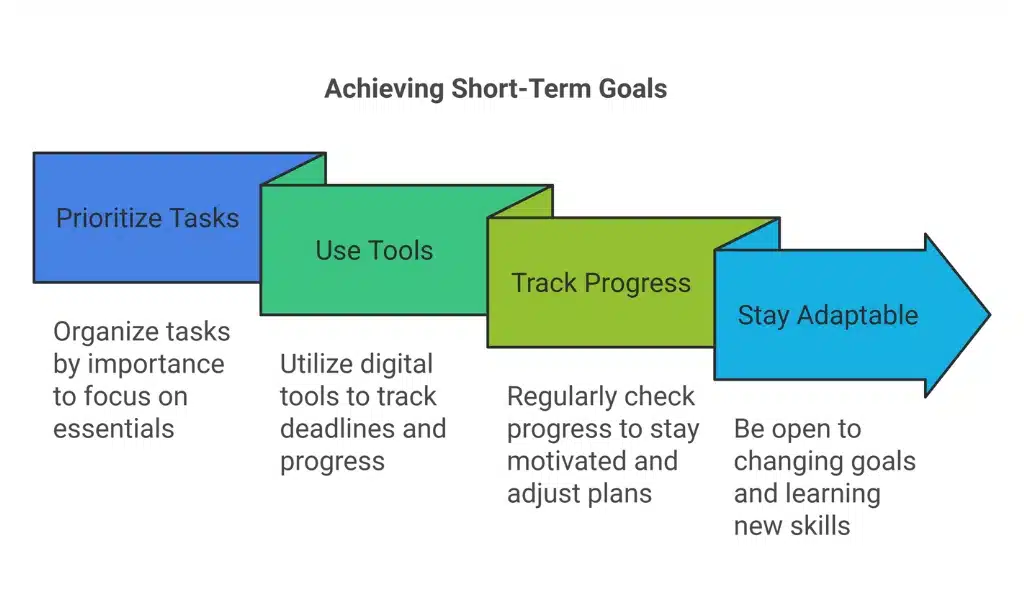
To hit short-term goals, focus on organizing your tasks. Keep an eye on your achievements, tweaking plans as needed.
Prioritize tasks effectively
Making a list of tasks helps you see what’s most important. Put the big, must-do items at the top. This way, you tackle essential goals first, as Tim Toterhi and career coaches suggest.
Checking off these top tasks builds momentum. It makes moving onto smaller ones easier.
Use tools like calendars or apps to keep track of deadlines. This keeps you on track without feeling overwhelmed. Seeing your progress boosts motivation and focus. It also helps avoid burning out from too much work at once.
Prioritizing is key for reaching big career goals step by step.
Track your progress regularly
Check how you’re doing often. Use tools like digital calendars and task management software. Plaky is a good choice. It lets you set goals, meet deadlines, and organize documents. This helps to keep your tasks in order.
Seeing your progress inspires you to keep going. It shows what works and what doesn’t. When a plan isn’t working, change it quickly. A clear view of small wins brings big rewards over time.
Stay adaptable and open to change
Staying adaptable means changing your plan when needed. The world changes fast, and so do job markets. You might need to learn new skills or change your goals to keep up. This is like adjusting your budget when money gets tight.
Just as you save for unexpected expenses, prepare for career shifts by staying open to learning.
To avoid burnout and stay on track, reassess your goals often. What worked yesterday might not work tomorrow. If a goal becomes unrealistic, find a new one that fits better with the current situation.
This keeps you moving forward without wasting time on things that no longer help your career grow.
Avoiding Common Pitfalls in Goal Setting
Setting goals is key, but so is avoiding traps. Waiting too long to start and setting goals too high can mess up plans.
Overcoming procrastination
To beat procrastination, set clear, simple goals. Leslie Flowers recommends using SMART criteria. This means goals should be Specific, Measurable, Achievable, Relevant, and Time-bound.
By setting a deadline for each task, you force yourself to focus and avoid putting off work.
Another way is tracking your progress. Use charts or apps to see how much you achieve each day. Celebrate small wins with positive reinforcement like taking breaks or rewards. This keeps motivation high and delays low.
Career programs often underline accountability—so tell someone your goals to stay on track.
Avoiding overly ambitious goals
Avoiding goals that are too big is key. Big goals can lead to failure. This makes you feel bad and lose motivation. Set small, clear targets instead. For example, if your long-term goal is to increase your salary, start with short-term steps like taking courses or finding a mentor in your field.
Small wins help you move forward and keep you motivated. They also make your big goal seem less scary. By breaking down a huge aim into parts, each step feels doable. Plus, tracking these smaller victories shows how much progress you’re making toward your bigger objective.
Using Short-Term Goals to Build Long-Term Success
Short-term goals act like stepping stones. They lead to big wins in careers.
Gaining relevant skills and experience
Gaining skills and experience is key for long-term career success. Learn skills like talking well and making good choices. Also, learn new things important for jobs today. For example, getting professional certificates helps a lot.
You need to do things that fit your big job goals. This means picking up the right education and working on projects related to what you want in the future. By doing this, you get better at your job and ready for bigger roles.
Expanding professional networks
Meeting new people helps you find jobs. Forbes says 85% of jobs come through who you know. Aim to meet 10 new professionals every month. This means going to events, seminars, and joining online groups related to your field.
Talk, share ideas, and help others in your network. Offer advice or introduce people when you can. Use sites like LinkedIn to stay in touch with those you meet. Keep your profile up-to-date so others see your skills and experience.
Improving performance metrics
Short-term goals boost your work performance. Aim to up your productivity by 15% using good time management. This means finishing projects faster or making more sales. Simple steps help you meet this goal, like organizing tasks and limiting work hours to stay sharp.
Skills and experiences grow as you reach these minor targets. They prepare you for bigger career moves later on. You learn what works best in managing time and effort efficiently. This practice leads directly to higher achievements in your job, showing clear results through improved metrics such as completed projects or increased sales numbers.
Takeaways
Setting short-term goals helps you reach long-term career dreams. They make big aims feel possible. Each small goal you hit pushes you closer to your final target. For example, learning new skills or meeting the right people moves you forward.
You see real progress every step of the way. This keeps you focused and excited to press on. So, setting smart short-term goals is key for long-term success in any career path.