

Hey there, are you worried about staying safe in the wild world of Web3? It’s a real concern, with cyber attacks and sneaky threats popping up left and right on decentralized platforms.
Here’s a cool fact to chew on: AI, or artificial intelligence, is changing the game by spotting dangers in blockchain technology before they strike. Now, let’s talk about solving those pesky security headaches.
In this blog, we’re breaking down the “Best Ways AI Is Being Used To Detect Web3 Security Threats,” giving you seven awesome tricks to keep your digital space locked tight. Stick around, it’s gonna be good!
Key Takeaways
- AI spots odd patterns in blockchain transactions using tools like Chainalysis, started in 2014 in New York City, to flag fraud before big losses.
- Machine learning helps detect fraud on Web3 platforms, with companies like POG Digital using AI since June 2022 for gameplay and scam prevention.
- AI protects smart contracts by finding bugs, with tools like Quantstamp using audits to stop issues in decentralized apps (dApps).
- AI fights phishing attacks in Web3 by scanning messages for fake links and using behavioral analysis to keep data safe.
- AI is expected to add $15.7 trillion to the global economy by 2030, boosting GDP by 14%, while enhancing Web3 security.
AI-Powered Anomaly Detection in Blockchain Transactions
Spotting odd patterns in blockchain networks is a big deal, and artificial intelligence (AI) is leading the charge. Imagine AI as a sharp-eyed detective, scanning tons of transactions on blockchain technology every second.
It picks up weird activities that don’t match the usual flow, like sudden huge transfers or funky patterns in decentralized applications (dapps). Companies like Chainalysis, started back in 2014 and based in New York City, use machine learning (ML) to track these oddities.
Their tools help flag fraud detection issues before they spiral into major losses.
Think of blockchain transactions as a busy highway; AI is the traffic cop watching for reckless drivers. With cyber threats lurking, such as sneaky phishing attacks, AI’s knack for data analysis keeps things safe.
It’s amazing how this tech, expected to add $15.7 trillion to the global economy by 2030 and boost GDP by 14%, also strengthens digital security. Stick with me, folks, as we move to how AI spots flaws in smart contracts next.
Identifying Smart Contract Vulnerabilities with AI

Moving from spotting odd patterns in blockchain transactions, let’s talk about another major success for AI in the Web3 space. We’re examining how artificial intelligence helps identify vulnerabilities in smart contracts.
These are self-executing agreements with rules embedded in code, and they operate automatically when conditions are fulfilled. Sounds impressive, right? But, if there’s a bug or flaw, hackers can slip through and create chaos.
That’s where AI comes in to make a difference.
Think of AI as an incredibly sharp investigator, analyzing every line of code for potential issues. Tools like Quantstamp use AI-powered audits to detect weaknesses in crypto applications before they turn into catastrophes.
With machine learning algorithms, these systems adapt from previous errors and identify risks in smart contracts more quickly than any person could. Plus, they address privacy concerns by employing methods like federated learning, training models on separate devices without exchanging sensitive information.
Isn’t it amazing how tech can protect decentralized applications, or dApps, with such precision? Let’s continue looking into how AI combats other Web3 threats next.
Using Machine Learning for Fraud Detection in Web3 Platforms
Hey there, let’s talk about how machine learning, or ML, is addressing fraud in Web3 platforms. Think of it as a digital guardian, detecting suspicious activities on decentralized applications, also known as dapps.
ML analyzes vast amounts of data on blockchain technology, identifying unusual patterns that could indicate a scam. It’s like having an incredibly sharp friend who knows when something feels off.
Companies like Chainalysis are at the forefront, using blockchain analytics to stop fraud before it gets out of hand. Their tools examine transactions in detail, ensuring your data security remains strong.
Now, get this, ML isn’t just making assumptions; it’s improving every day. Take POG Digital, for example, who moved to on-chain collections in June 2022. They use artificial intelligence for gameplay and fraud detection, ensuring cheaters have no opportunity to succeed.
And with AI and ML projected to contribute a massive $15.7 trillion to the global economy by 2030, increasing GDP by 14%, the impact of these tools is undeniable. So, whether it’s a deceptive pump-and-dump scheme or fraudulent accounts, machine learning is protecting you on Web3 platforms.
AI for Monitoring and Preventing Phishing Attacks
Let’s chat about how artificial intelligence is stepping up to tackle phishing attacks in the Web3 space. These sneaky scams try to trick you into giving away private info, like passwords or wallet keys, often through fake emails or websites.
AI jumps in here with smart tools that spot these traps before they snag you. Using machine learning techniques, AI scans for odd patterns in messages or links, catching phishing attempts in real time.
It’s like having a sharp-eyed guard dog that barks at anything fishy.
Now, think of AI as your personal shield, especially with nasty threats growing in decentralized apps. It uses natural language processing to read through texts and spot fake lures that mimic legit Web3 platforms.
Plus, with tricks like behavioral analysis, AI learns how you act online and flags anything out of the ordinary. Cool, right? Companies like Chainalysis are even blending AI with blockchain analytics to boost this protection.
Stick around, as we’re about to explore how AI fights insider threats next.
Leveraging AI to Detect and Combat Insider Threats
Insider threats can be a serious challenge, everyone. Envision someone within your Web3 project, perhaps even a valued team member, secretly causing damage. Alarming, isn’t it? Artificial intelligence, or AI, comes in like a vigilant protector to detect these concealed risks.
It monitors for unusual activity in decentralized systems, identifying warning signs before harm escalates. Consider AI your dedicated investigator, uncovering strange trends in data sharing or access records.
Through machine learning, it understands typical patterns and quickly highlights anything suspicious. This plays a vital role in maintaining confidence in Decentralized Autonomous Organizations, where AI also improves governance and decision-making.
Now, let’s discuss how AI tackles these hidden dangers directly. Imagine a malicious insider attempting to tamper with blockchain technology or access confidential data. AI-powered security systems, combined with bug bounties, serve as a strong barrier.
They monitor user behavior across decentralized applications, or dapps, using advanced tools like neural networks. Platforms like Fetch.ai apply machine learning to make Web3 more secure and accessible.
Additionally, AI supports scalability and teamwork in model development, creating tougher safeguards against such risks. So, stay tuned to learn how AI-driven threat intelligence strengthens protection for decentralized systems.
AI-Driven Threat Intelligence for Decentralized Systems
Hey there, folks, let’s chat about how artificial intelligence, or AI, is stepping up to guard decentralized systems in Web3. Picture AI as a sharp-eyed watchdog, always on the lookout for trouble in blockchain technology setups.
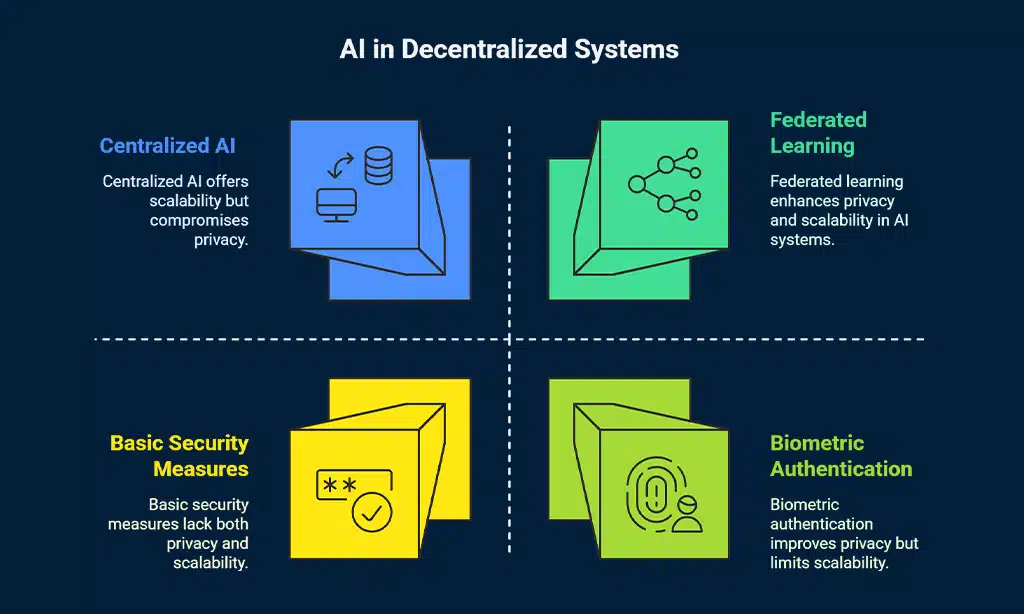
It uses cool tricks like federated learning to train models right on individual devices. This means your data stays private, no need to send it to some far-off cloud. Plus, decentralized AI cuts down on latency and bandwidth use, making things faster and safer.
Now, imagine AI beefing up security with smart tools like biometrics and behavioral analysis for authentication. It’s like having a bouncer who knows every face at the door. This helps spot threats before they sneak into decentralized applications, or dApps.
With AI-driven threat intelligence, privacy gets a boost, and scalability improves too. So, whether it’s a public blockchain or a new project, AI is there, keeping risks low and data security high.
Automating Malware Detection in Web3 Applications
Wow, everyone, envision a sneaky virus attempting to disrupt your awesome Web3 apps! AI comes to the rescue like a champion, automating malware detection to protect those decentralized applications, or dapps, keeping them secure.
It checks for harmful bugs instantly, using machine learning to identify unusual patterns that could threaten blockchain technology. Imagine it as a digital watchdog, always alert for any issues.
Now, visualize this: AI doesn’t just detect malware but also strengthens security with clever methods like biometrics and behavioral analysis. It’s like having a guard at the door, ensuring only trusted individuals access your Web3 environment.
With artificial intelligence and natural language processing, even chatbots become more intelligent, assisting users in avoiding phishing scams while maintaining strong data protection.
How impressive is that?
Takeaways
Hey there, readers, let’s wrap this up with a bang! AI is truly changing the game in spotting Web3 security threats, making our digital world safer. From guarding blockchain deals to catching sneaky fraud, it’s like having a sharp-eyed watchdog.
So, keep an eye on how artificial intelligence and machine learning shape decentralized apps. Isn’t it cool to see tech grow stronger every day?
FAQs on How AI Is Transforming Web3 Security
1. How does artificial intelligence spot dangers in Web3 setups like decentralized applications?
Well, my friend, artificial intelligence, or AI, dives deep into the world of dapps using machine learning models to sniff out odd patterns. It’s like a digital bloodhound, tracking down flaws in smart contracts before they bite. With blockchain technology at play, AI keeps an eye on public blockchains for sneaky threats.
2. Can AI help with data privacy in Web3 spaces?
Absolutely, AI technologies, such as differential privacy and homomorphic encryption, act like a trusty shield for your info. They guard data sharing on platforms tied to the Internet of Things, keeping your details safe as houses.
3. What role does machine learning play in fraud detection for blockchain gaming?
Machine learning, or ML, is the sharp-eyed detective in the realm of blockchain gaming. It sifts through heaps of data on AI cryptocurrencies and user-generated content to catch fraudsters red-handed. Think of it as a game of cat and mouse, where ML always stays one step ahead.
4. How does natural language processing tackle Web3 security risks?
Natural language processing, or NLP, is like a chatty guard dog for Web3. It uses sentiment analysis and text generation to spot fishy chatter or deepfakes that could harm the creator economy.
5. Why is federated learning a big deal for Web3 safety?
Federated learning is a clever trick up AI’s sleeve, letting systems train on data without spilling secrets. It boosts data security across IoT devices and cloud infrastructure, acting like a secret handshake among trusted pals in supply chain management.
6. How does reinforcement learning boost operational efficiency in Web3?
Hey, let’s talk about reinforcement learning; it’s like teaching a kid to ride a bike with constant tweaks. This AI-based method sharpens intelligent systems to manage risks in blockchain technologies. It fine-tunes responses for context-aware protection, making sure threats don’t stand a chance in areas like electronic health records.






















