Healthcare environments are unlike any other built space. Conditions inside a hospital don’t just affect comfort, they directly influence patient outcomes, infection rates, staff performance, and even how well critical equipment functions.
Humidity is one of the most important (and often overlooked) factors in this equation. Hospital humidity control systems are designed to keep relative humidity within a safe, clinically appropriate range across the entire facility.
In this article, we’ll look at why humidity control matters for patient safety, not just comfort, the risks of getting it wrong, and what a hospital-grade system actually needs to deliver.
Key Takeaways
- Low humidity allows viruses and bacteria to stay airborne longer, increasing infection risk for patients and staff.
- Dry air can lead to electrostatic discharge, which poses risks around oxygen systems and sensitive medical equipment.
- Self-evaporative humidification provides consistent, non-wetting moisture distribution.
- Systems integrated with air handling units can maintain humidity across the entire facility.
The Clinical Case For Humidity Control In Hospitals
Humidity management in hospitals plays a measurable role in infection prevention, healing, respiratory function, and equipment safety. The link between relative humidity and airborne pathogen behavior is well documented, and it’s something healthcare facilities can’t afford to ignore.
Airborne Pathogen Survival
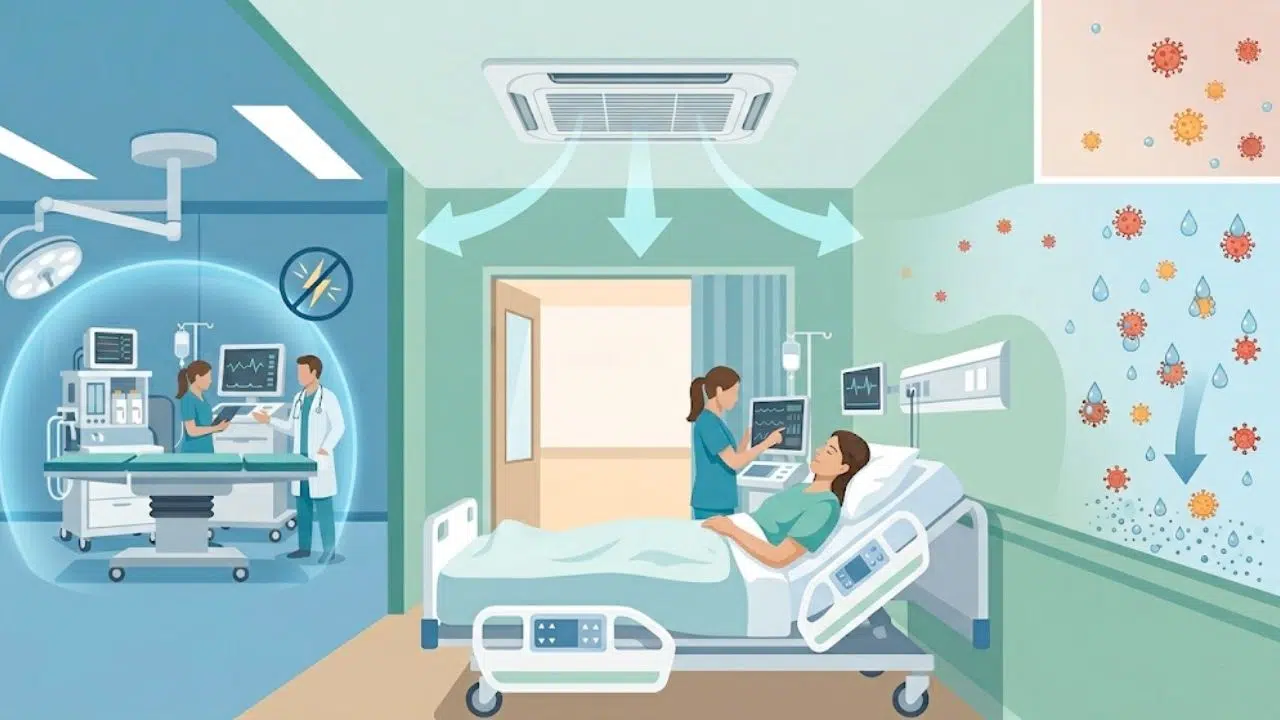
Viruses and bacteria tend to survive longer in dry air. When humidity drops below around 30 percent, these particles remain airborne for longer periods, increasing the chance they’ll be inhaled especially by patients with compromised immune systems.
Once humidity rises above 40 percent, those particles begin to absorb moisture, become heavier, and settle out of the air more quickly. That simple shift can significantly reduce exposure.
Wound Healing And Patient Recovery
Dry air can slow healing by drying out exposed tissue and interfering with the formation of new cells. In areas like burn units, maternity wards, and post-surgical recovery spaces, maintaining proper humidity directly affects recovery timelines. Patients in well-controlled environments tend to experience fewer complications like tissue dryness, nosebleeds, and respiratory irritation, all of which support faster recovery.
Respiratory Health
For patients with asthma, bronchitis, chronic obstructive pulmonary disease, or other respiratory conditions, dry air can actively worsen symptoms. Maintaining a balanced humidity level helps reduce irritation in the airways and supports more comfortable breathing for patients across all wards. It also helps preserve the moisture lining in the nose and throat, which acts as a natural barrier against airborne pathogens. When this barrier is compromised, patients may be more susceptible to infections and slower recovery.
Electrostatic Discharge Risks In Clinical Environments
Electrostatic discharge is often overlooked in hospital settings, but it becomes a real concern when humidity levels drop. When relative humidity falls below 40 percent, static electricity builds up more easily on clothing, surfaces, and equipment. In areas where oxygen is in use, even a small spark can pose a safety risk. In operating rooms and ICUs, where sensitive electronic equipment is constantly in use, static discharge can also interfere with device performance at critical moments.
A hospital humidity control system that maintains relative humidity consistently above 40 percent eliminates the conditions that allow static to build up, protecting both patients and the equipment supporting their care.
What Hospital Humidity Control Systems Must Deliver
| Requirement | Why It Matters |
| Non-wetting moisture distribution | Prevents surface condensation that can harbor pathogens |
| Uniform coverage across all zones | Eliminates low-humidity pockets in patient and clinical areas |
| CDC-compliant humidity range (30 to 50 percent RH) | Supports infection control and patient safety standards |
| Integration with air handling units | Delivers facility-wide coverage through existing infrastructure |
| Energy efficiency | Manages operational costs in large, continuously occupied facilities |
| Low maintenance design | Reduces service disruptions in a clinical environment |
Self-Evaporative Humidification In Healthcare Settings
Traditional humidification methods such as steam, ultrasonic, and high-pressure atomization all present challenges in clinical environments. Steam systems require significant energy and introduce heat into the air stream. Ultrasonic systems can produce white mineral dust if water isn’t properly treated. High-pressure systems risk creating wet surfaces which can become breeding grounds for bacteria and mould.
Self-evaporative humidification systems take a different approach. They produce droplets small enough to evaporate completely before reaching any surface. This means that even at relatively high humidity levels, no moisture accumulates on walls, medical equipment, flooring, or patient surfaces. As an added benefit, these systems help reduce airborne dust by causing particles to settle out of the air, improving overall air quality.
Coverage Across Hospital Zones
Different areas of a hospital have different humidity requirements and different sensitivity profiles. So any effective hospital humidity control system must be capable of maintaining distinct conditions across multiple zones simultaneously.
Operating Rooms And ICUs
These are the most sensitive environments. With complex electronics, oxygen systems, and high-risk patients, humidity needs to be tightly controlled, typically between 40 and 60 percent, with minimal variation.
Even small fluctuations can increase the risk of static discharge or interfere with sterile conditions, making consistency just as important as the target range itself.
Patient Wards And Recovery Rooms
General patient areas benefit from humidity levels in the 40 to 50 percent range. This supports both comfort and infection control. Maintaining consistent conditions across larger, multi-bed wards requires a system capable of delivering even distribution at scale.
Small variations between beds or zones can still affect patient comfort and recovery, particularly for those with respiratory or post-surgical needs.
Pharmacies And Medical Storage
Pharmaceuticals, biological samples, and certain medical supplies are highly sensitive to humidity. These areas often require tighter control than patient wards to ensure product stability and prevent packaging degradation. Even slight deviations can affect shelf life, efficacy, or compliance with storage standards, making precise monitoring essential.
Consistent humidity levels also help prevent condensation inside storage units, which can compromise labels and sterile packaging. In regulated environments, maintaining these conditions is critical for meeting audit and quality assurance requirements.
Conclusion
Hospital humidity control systems are part of a facility’s core patient safety infrastructure. Maintaining the right humidity levels helps reduce infection risk, supports faster recovery, protects critical equipment, and creates a safer working environment for healthcare staff.
In a setting where every environmental factor can influence outcomes, humidity control deserves the same level of attention as any other essential system.
Frequently Asked Questions
What relative humidity level does the CDC recommend for hospital environments?
The CDC generally recommends maintaining relative humidity between 30 and 60 percent in most healthcare areas. Some spaces, like operating rooms and ICUs, may follow stricter standards depending on accreditation requirements.
Can hospital humidification systems introduce contaminants into the air?
They can, if poorly designed or maintained. Systems that use untreated water or create surface moisture may allow bacteria to grow. High-quality systems use purified water and produce fully evaporative droplets, avoiding these risks.
How does humidity control reduce hospital-acquired infection rates?
Proper humidity reduces how long airborne pathogens remain active and suspended in the air. It also supports the body’s natural defenses, such as mucosal barriers, which play a key role in preventing infection.
What type of humidification system is best suited for operating rooms?
Operating rooms require precise, non-wetting humidity control. Systems that integrate with air handling units and maintain stable humidity without creating condensation are typically the most suitable.
Can an existing hospital HVAC system be upgraded to include humidity control?
Yes. Modern hospital humidity control systems are designed to integrate with existing air handling units and HVAC infrastructure. Systems can be retrofitted into existing buildings without requiring major construction, making it practical to upgrade older facilities to current humidity control standards.