

A health app can track sleep or remind you to exercise. That alone does not make it a treatment. Digital therapeutics use software to deliver an intervention intended to help prevent, manage or treat a health condition. The distinction matters because treatment claims should be backed by evidence, and some products fall under medical-device rules.
These products can run on a phone, computer or connected device. Some are prescribed; others are used with a clinician’s guidance. Their purpose goes beyond recording health information or offering general advice. The software itself is meant to play a therapeutic role.
The label does not guarantee that a product works, is regulated in the same way everywhere, or is available in every country. Readers need to check the specific product and its intended use.
What Are Digital Therapeutics?
Digital therapeutics are health software products that deliver medical interventions for a defined condition or health need. ISO describes them as products that deliver interventions based on clinical evidence and intended to produce therapeutic effects. Its definition excludes general-wellness products.
An intervention might involve structured lessons, guided exercises, feedback or a digital activity designed for a specific purpose. A program could, for example, deliver behavioural therapy techniques in sequence or adjust an activity to a user’s performance. Whether a clinician must prescribe or supervise the product depends on the product and the market.
The term is not a single regulatory category used identically around the world. In the United States, the FDA evaluates software functions under its medical-device framework when they meet the legal definition of a device. A health app does not become a medical device simply because it concerns health.
How Digital Therapeutics Work
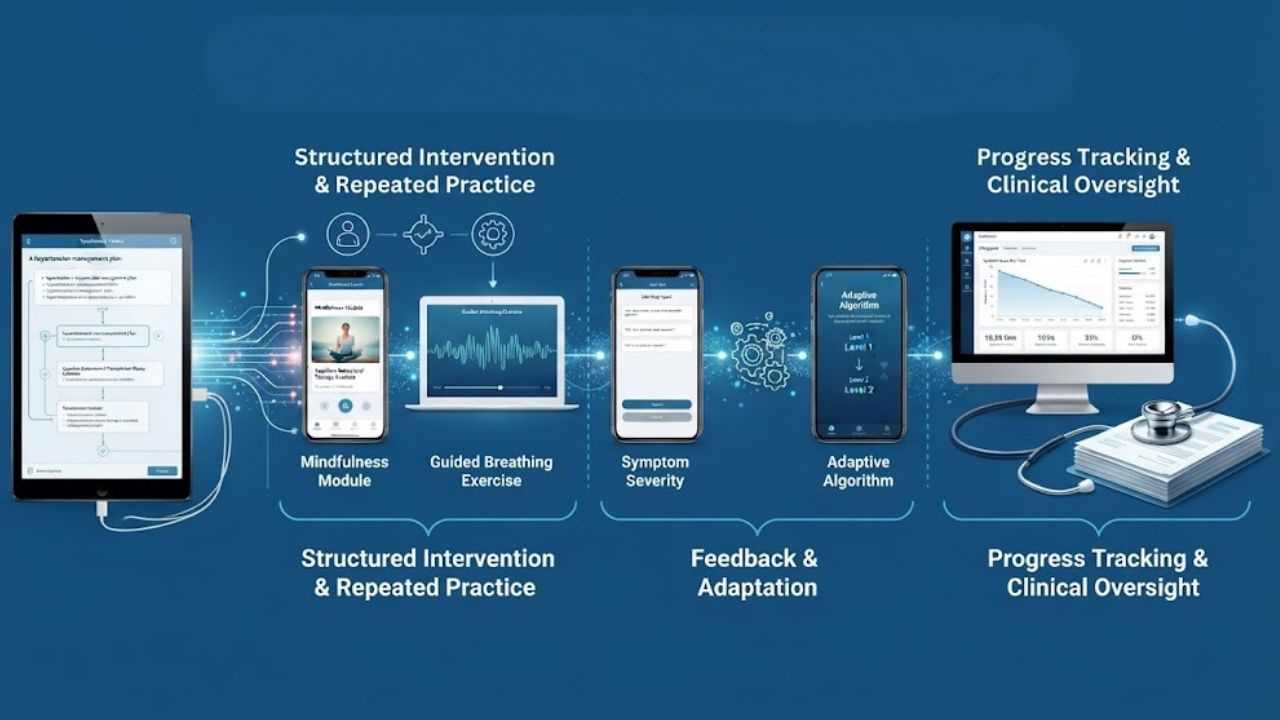
A product usually follows a treatment pathway designed for a particular condition, user group and intended outcome. Depending on the product, it may combine:
- A structured intervention: Lessons, exercises or activities intended to provide treatment, rather than only general information.
- Repeated practice: Sessions over time that help users practise skills or follow a treatment routine.
- Feedback or adaptation: Responses to a user’s answers, progress or performance. What that feedback means depends on the product’s intended use.
- Progress tracking: Records of activity or symptoms that may be visible to the user or care team.
- Clinical support: A healthcare professional may select the product, monitor progress or combine it with other care.
These features explain how software may deliver treatment. They do not prove that a particular product improves health. Researchers still need to test whether the intervention changes an outcome that matters and whether its benefits outweigh potential harms.
Imagine a clinician recommends a program for a specific condition. The software might teach a technique, guide the user through an exercise and record whether it was completed. The intended therapeutic work comes from that structured intervention—not simply from opening an app or keeping a digital diary.
Digital Therapeutics vs Health and Wellness Apps
“Health app” covers many different tools. Some count steps, log meals or provide general wellness advice. Others help people monitor a condition or deliver a therapeutic intervention. Those uses are not interchangeable.
| Type of tool | What it generally does | What to check |
| Wellness app | Supports habits such as activity, sleep or nutrition | Whether its claims are limited to general wellness |
| Health tracker | Records or displays health information | Whether it interprets data or makes treatment recommendations |
| Digital therapeutic | Delivers a software-based intervention for a defined health need | Evidence, intended use, regulatory status and clinician guidance |
The categories can overlap. The FDA’s guidance distinguishes software intended to support a healthy lifestyle from software intended for a medical purpose, and its approach depends on the software function and risk. A product’s marketing label alone does not establish its status.
Examples of Digital Therapeutic Approaches
Digital therapeutics can use different methods, including software that delivers behavioural therapy, programs that support treatment for substance use disorders, and interactive software designed to improve a specific function as part of care.
EndeavorRx is one U.S. example. The FDA record describes it as a prescription product intended to improve attention, measured by computer-based testing, in certain children aged 8–12 with ADHD. It is not intended as a stand-alone treatment. The record also says it may not improve typical behavioural symptoms such as hyperactivity.
The FDA’s database also records a 2018 510(k) decision for reSET-O, a computerized behavioural therapy device for substance use disorders. A software issue led to a recall initiated in 2021; the FDA records that recall as terminated in 2023. This is a historical example, not evidence that the product is currently available or suitable for a particular person.
These examples are not interchangeable treatments. Their intended users, evidence and conditions of use differ. A product’s marketing label cannot tell you what it has been shown to do.
What Evidence Should Support a Digital Therapeutic?
Evidence should match the product’s intended use. The useful question is not whether people like the interface or complete sessions. It is whether the intervention improves a meaningful outcome for the people it is designed to help.
Studies may examine symptom changes, daily functioning or another outcome relevant to the condition. The strength of the evidence depends on the study design, comparison group, duration, participants and whether results apply beyond the study.
A 2024 review examined 79 products cleared, approved or commercially released in the United States between 2019 and 2022. It found at least one efficacy or effectiveness study for 52 products. For 27, reviewers found no published efficacy or effectiveness study. Results were not always available before a product’s clearance, approval or release. Those findings describe the review’s sample and period; they do not settle whether a particular product works.
How Regulation Works—and Why It Varies
Digital therapeutics do not follow one global approval pathway. In the United States, the FDA uses a risk-based approach for software functions that meet the legal definition of a medical device. Some functions are regulated, some may fall under enforcement discretion, and others are not medical devices. Oversight depends on the function and risk, not just whether the software runs as an app.
Regulatory terms matter. “Clearance,” “approval” and “De Novo classification” refer to different FDA pathways. A U.S. regulatory record does not establish a product’s availability, approval or insurance coverage elsewhere. Check the relevant national authority for its status where you live.
Benefits and Limits
A software-based intervention can make treatment activities available between appointments or at home. Remote access may help people who face travel or scheduling barriers. Some products also let a care team review engagement.
The practical barriers are less glamorous: a compatible device, reliable internet access and enough time to complete sessions. A product may require a prescription or have costs that insurance does not cover. If a user stops engaging, the intervention may not be delivered as designed.
Nor should software be assumed to replace medication, therapy or clinician visits. If a product is designed to complement care, using it alone may fall outside its intended role. Before entering sensitive health information, check what the product collects, how it uses or shares the data, and whether you can delete your account or records.
What to Ask Before Using One
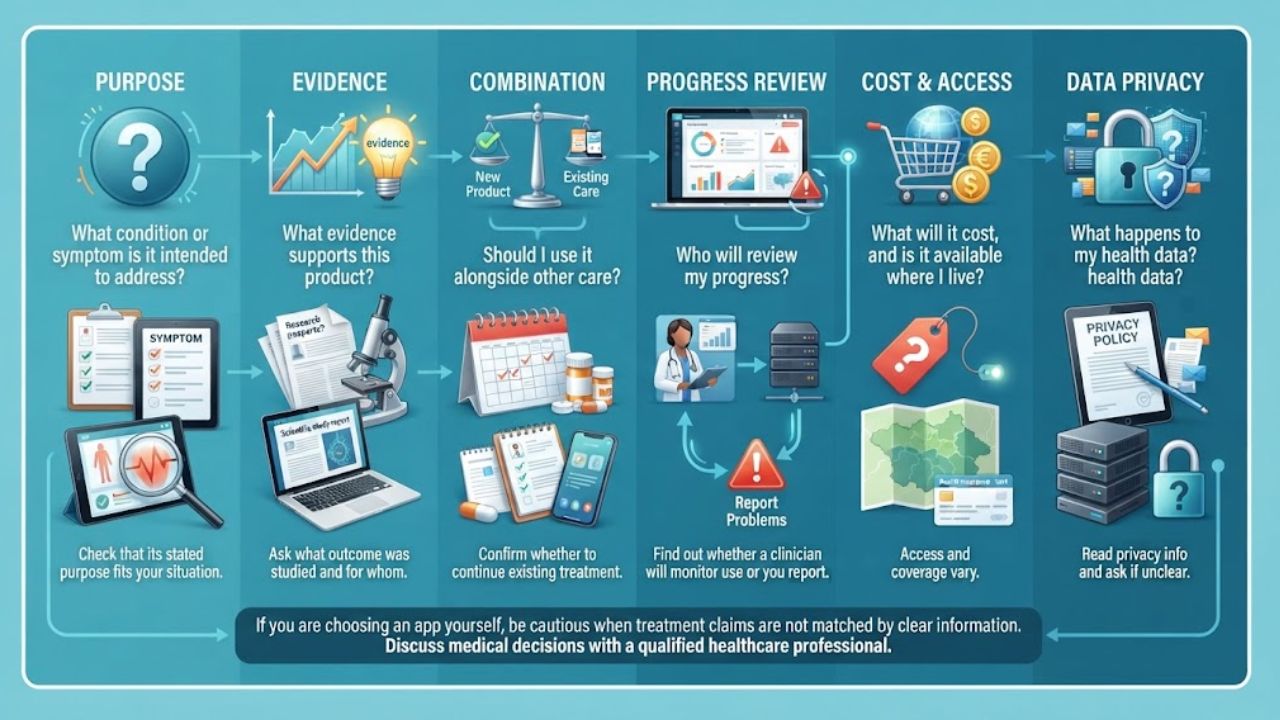
If a healthcare professional recommends a product, ask:
- What condition or symptom is it intended to address? Check that its stated purpose fits your situation.
- What evidence supports this product? Ask what outcome was studied and for whom.
- Should I use it alongside other care? Confirm whether to continue existing treatment and appointments.
- Who will review my progress? Find out whether a clinician will monitor use or whether you should report problems.
- What will it cost, and is it available where I live? Access and coverage vary.
- What happens to my health data? Read the privacy information and ask if anything is unclear.
If you are choosing an app yourself, be cautious when treatment claims are not matched by clear information about evidence, intended users or regulatory status. Discuss medical decisions with a qualified healthcare professional who understands your condition.
Final Thoughts
For anyone considering digital therapeutics, start with the product’s intended use and evidence, then check its status and role in your care. Ask a clinician whether it fits your situation. A useful product has a specific purpose; the label alone is not a reason to trust it.
Frequently Asked Questions (FAQs) About Digital Therapeutics
Are digital therapeutics the same as telehealth?
No. Telehealth is a way to receive healthcare remotely, such as through a video appointment. A therapeutic software product delivers an intervention. A clinician might recommend one during a telehealth visit, but the two serve different roles.
Can a product work without a clinician?
Some products may be accessed without a prescription, while others require one or are intended to be used with clinician supervision. Check the product’s approved or stated use in your country rather than assuming all software-based treatments follow the same rules.
Does an app-store listing mean a product is FDA-approved?
No. An app being available for download does not establish FDA review or authorization. The FDA’s device-software guidance and databases are the relevant places to check U.S. status.