Have you ever watched gas prices tick up at the pump and wondered if there is a better way to power our lives? We all want cleaner air and a future free from pollution, but we also need fuel that is reliable and affordable. It is a tough balance.
You are not the only one asking these questions. Scientists and engineers are working on a solution that feels like science fiction but is happening right now. It is called green hydrogen.
Here is the exciting part. This fuel is made using just water and renewable energy like wind or sunlight. It promises to power massive trucks, heat our homes, and clean up heavy industries without pumping a single ounce of carbon into the air.
In this guide, I will walk you through exactly how green hydrogen works and why the U.S. government is investing billions into it. We will look at the real costs, the coolest new tech, and how it might change your energy future sooner than you think.
Grab a coffee and let’s explore how we turn water into fuel.
What is Green Hydrogen?
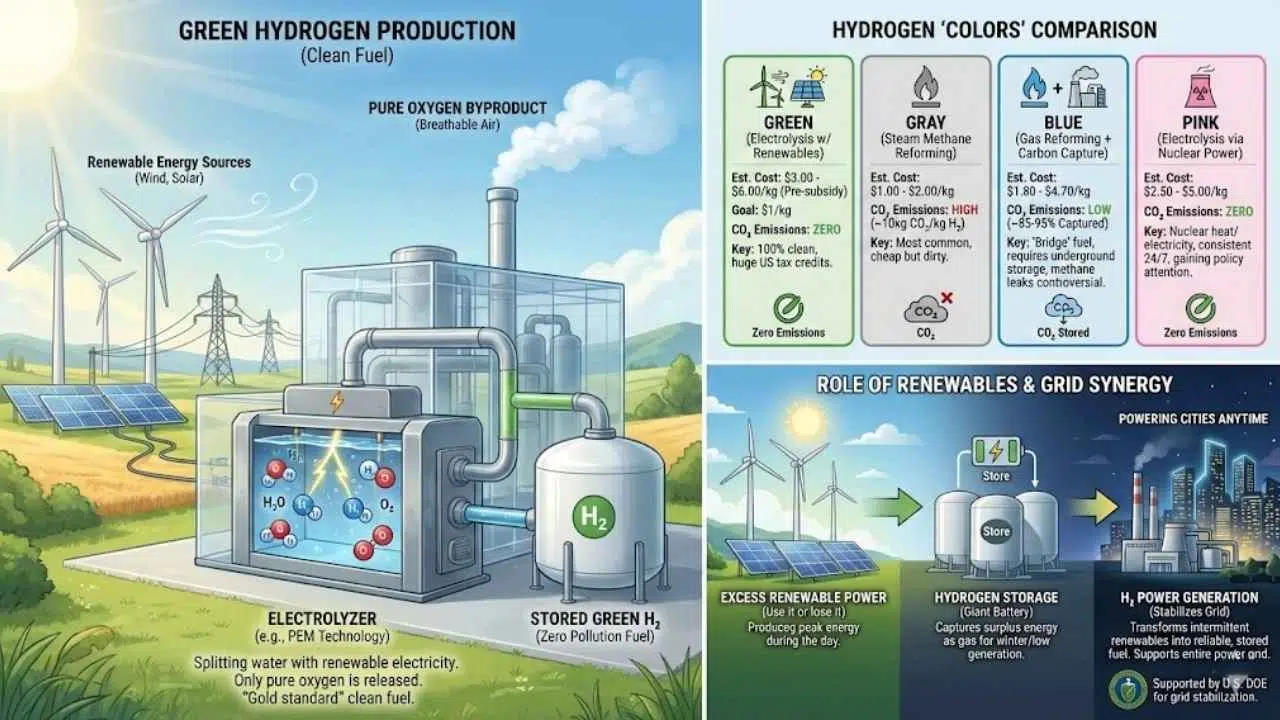
Green hydrogen is a clean fuel created by splitting water into two parts: hydrogen and oxygen. It is the “gold standard” of the hydrogen world because the entire process is powered by renewable energy, leaving zero pollution behind.
Definition and production process
Think of green hydrogen production as capturing lightning in a bottle. We use a machine called an electrolyzer to run a strong electrical current through water. This electricity splits the H2O molecules apart.
If the electricity comes from a clean source like a wind farm in Texas or a solar array in Arizona, the resulting hydrogen is “green.”
“The magic of this process is in the byproduct. When you make green hydrogen, the only thing you release into the air is pure oxygen. No smog, no carbon, just breathable air.”
This is different from how we have made hydrogen for decades. Traditionally, we used natural gas, which is dirty and releases carbon dioxide. Now, with advanced technology like Proton Exchange Membrane (PEM) electrolyzers, we can do it cleanly and efficiently.
Experts see this as a game-changer. It allows us to take sunshine from the summer, turn it into hydrogen, and store it for use in the winter. It transforms renewable energy from a “use it or lose it” resource into a stored fuel that can power a city anytime.
Comparison with other types of hydrogen
It can be confusing to hear about all the “colors” of hydrogen. They are all the same gas, but the labels tell you how they were made and how dirty the process was.
I’ve broken down the key differences below so you can see why green hydrogen is worth the extra effort.
| Type | Production Method | Est. Cost ($/kg) | CO2 Emissions | Key “Need to Know” |
|---|---|---|---|---|
| Green Hydrogen | Electrolysis with Renewables | $3.00 – $6.00 (Pre-subsidy) | Zero. Only oxygen is released. |
|
| Gray Hydrogen | Steam Methane Reforming | $1.00 – $2.00 | High. ~10 kg of CO2 for every 1 kg of H2. |
|
| Blue Hydrogen | Gas Reforming + Carbon Capture | $1.80 – $4.70 | Low. Captures ~85-95% of emissions. |
|
| Pink Hydrogen | Electrolysis via Nuclear Power | $2.50 – $5.00 | Zero. |
|
Role of renewable energy in production
Green hydrogen relies entirely on nature. You need massive amounts of clean electricity to run the electrolyzers. This is why you often see production plants proposed in windy places like the Great Plains or sunny areas like California.
The connection works both ways. Green hydrogen actually helps renewable energy grow. One of the biggest problems with wind and solar is that they sometimes produce too much power when we don’t need it. Instead of turning off the wind turbines, we can direct that extra energy into making hydrogen.
It acts like a giant battery. We store the energy in the form of gas and use it later when the sun sets or the wind dies down. This synergy is why the U.S. Department of Energy (DOE) is pushing so hard for it—it stabilizes the entire power grid.
Benefits of Green Hydrogen
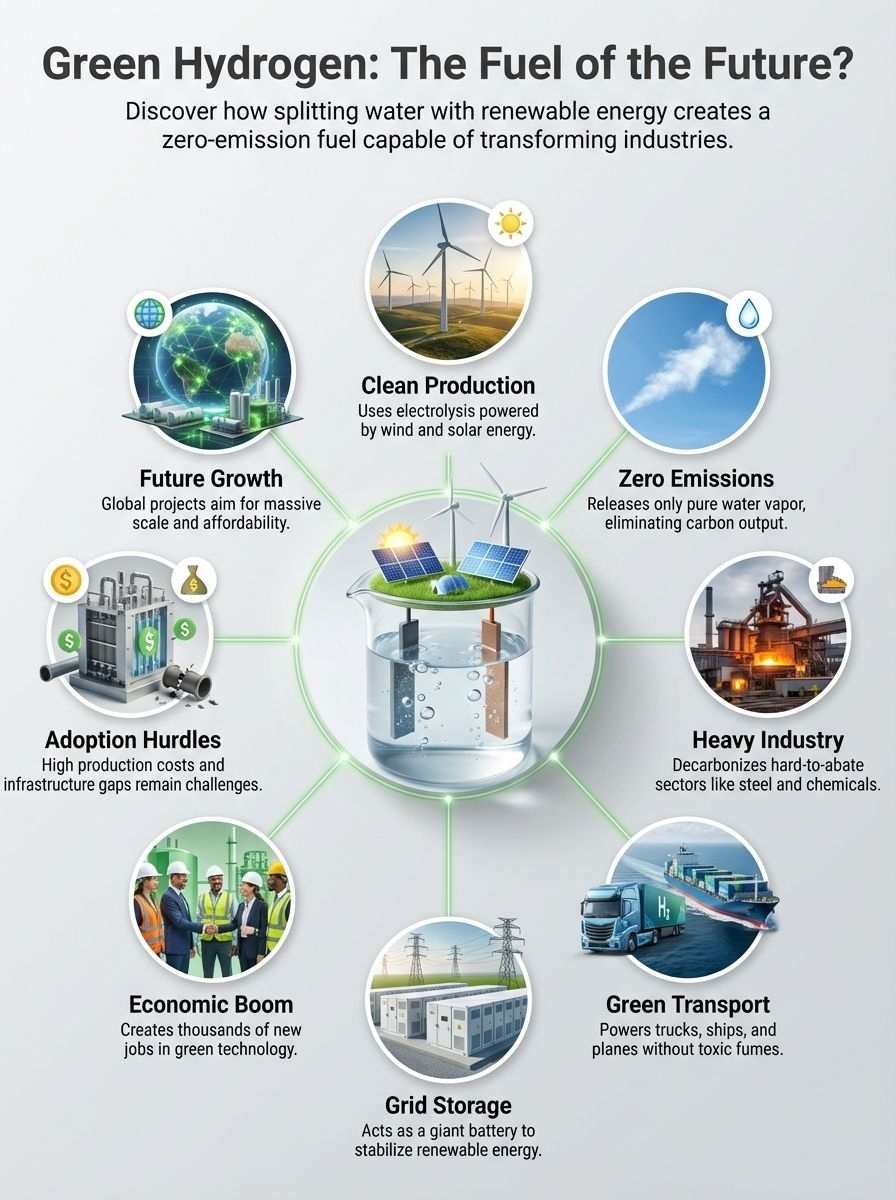
Why is there so much hype? It comes down to three big wins: saving the planet, creating American jobs, and securing our energy independence. The government is even backing this with the Inflation Reduction Act, which offers a tax credit of up to $3 per kilogram to make green hydrogen competitive.
Environmental impact and carbon reduction
The environmental case is simple and powerful. Burning green hydrogen produces water vapor and nothing else. There are no greenhouse gases and no particulates to choke our cities.
This is critical for the “hard-to-clean” sectors. We know how to electrify cars, but what about steel mills or container ships? They need intense heat and dense fuel that batteries just can’t provide.
The DOE has launched the “Hydrogen Shot” initiative. Their goal is ambitious but catchy: “1 1 1.” They want to reduce the cost of clean hydrogen to $1 per 1 kilogram in 1 decade. If we hit that target, green hydrogen becomes cheaper than natural gas, and the switch to clean energy becomes a financial no-brainer for businesses.
Economic opportunities and job creation
This transition is building a massive new industry from scratch. We need people to build the electrolyzers, lay the pipelines, and maintain the new fuel cell trucks.
The government’s “Hydrogen Hubs” program is a perfect example. They have awarded $7 billion to develop seven regional hubs across the U.S., from Appalachia to the Pacific Northwest. These hubs are expected to create tens of thousands of good-paying jobs.
Workers in traditional energy sectors like oil and gas are perfectly positioned for this. If you know how to fix a pipeline or manage a chemical plant, you already have the skills needed for the hydrogen economy. It is not just about green jobs; it is about sustainable careers for skilled tradespeople.
Energy security and diversification
Relying on foreign oil or gas markets can be risky. Prices spike due to global conflicts, and supply chains get disrupted. Green hydrogen offers a way out of that volatility.
Because you can make it anywhere you have water and electricity, it allows the U.S. to produce its own fuel right at home. A decentralized energy system is a safer system.
Imagine a future where a town in the Midwest powers its own emergency generators with hydrogen made from local wind farms. They wouldn’t be dependent on a pipeline from thousands of miles away. Diversifying our fuel mix makes the entire country more resilient against blackouts and shortages.
Applications of Green Hydrogen
You might be wondering where you will actually see this technology in your daily life. While it might not be in your driveway tomorrow, it is already moving into the massive machines that keep our economy running.
Transportation
You likely won’t trade your sedan for a hydrogen car soon because battery electric vehicles (EVs) are highly efficient for daily commuting. However, hydrogen shines where batteries struggle: heavy-duty trucking.
Batteries are heavy and take hours to charge. Hydrogen tanks are lighter and refill in minutes. That is why companies like Nikola are producing hydrogen fuel cell trucks like the Nikola Tre FCEV, which boasts a range of up to 500 miles. For a long-haul trucker, that range and quick refill time mean money.
We are also seeing it in public transit. Cities in California and Europe are running fleets of hydrogen buses. They run quiet, emit only water, and can handle long routes that would drain a standard battery bus before the day is done.
Industrial use
Industry is the “hidden” giant of carbon emissions. Making fertilizer, for instance, is responsible for a huge chunk of global CO2 because it uses dirty hydrogen from natural gas to make ammonia.
Green hydrogen can fix this. By switching to Green Ammonia, we can produce the fertilizer needed to grow our food without the massive carbon footprint. It is a change the consumer never sees, but the planet definitely feels.
Steelmaking is another frontier. Traditional steel plants use coal to strip oxygen from iron ore. New “green steel” plants are testing hydrogen to do the same job. The result is high-quality steel with water vapor as the exhaust instead of black smoke.
Energy storage and grid stability
Renewable energy has a timing problem. The sun shines at noon, but we turn our lights on at night. Green hydrogen acts as a bridge.
One of the most exciting projects happening right now is the ACES Delta project in Utah. They are converting massive underground salt caverns into storage tanks for green hydrogen.
These caverns can store enough fuel to power 150,000 homes for a year. It is basically a giant underground battery. When the grid needs power, they pull the hydrogen out and run it through turbines to generate clean electricity. This kind of seasonal storage is something lithium-ion batteries just cannot do.
Challenges Facing Adoption of Green Hydrogen
If this fuel is so great, why aren’t we using it everywhere already? There are a few speed bumps we need to smooth out before it goes mainstream.
Production costs and investments
The biggest hurdle is the price tag. Right now, green hydrogen costs roughly $3 to $6 per kilogram to produce. That is two to three times more expensive than the dirty gray hydrogen made from natural gas.
“The good news is that policy is changing the math. The Inflation Reduction Act’s 45V tax credit can pay producers up to $3/kg. This effectively makes green hydrogen as cheap as gray hydrogen for qualifying U.S. projects.”
Equipment costs are also high. Electrolyzers utilize expensive metals like platinum and iridium. Scientists are racing to find cheaper materials, and manufacturers are building larger factories to achieve “economies of scale” that will drive prices down.
Infrastructure development
We face a classic “chicken and egg” problem. Trucking companies won’t buy hydrogen trucks if there are no fueling stations. But energy companies won’t build stations if there are no trucks to use them.
Moving the gas is also tricky. Hydrogen molecules are tiny—the smallest in the universe—which means they can leak through seals that would hold natural gas tight. We need to upgrade our pipelines and build specialized tanker trucks.
The government’s H2Hubs program aims to solve this by building production and use in the same region. By keeping the users close to the producers, you minimize the need for expensive long-distance pipelines while the network grows.
Water usage concerns
You need water to make hydrogen—specifically, about 9 liters (2.4 gallons) of water for every kilogram of hydrogen. In drought-prone areas like the American West, this is a valid concern.
However, compared to the water used for cooling coal or nuclear plants, or growing crops for biofuels, hydrogen is actually quite water-efficient. The industry is also developing technology to use treated wastewater or desalinated seawater, ensuring we don’t drink up our freshwater supplies to make fuel.
Current Developments and Advancements in Green Hydrogen Technology
The race is on. The United States is not just talking about hydrogen; we are breaking ground on massive projects that will define the next century of energy.
Ongoing projects and initiatives
The map of American energy is being redrawn. Here are the major moves happening right now:
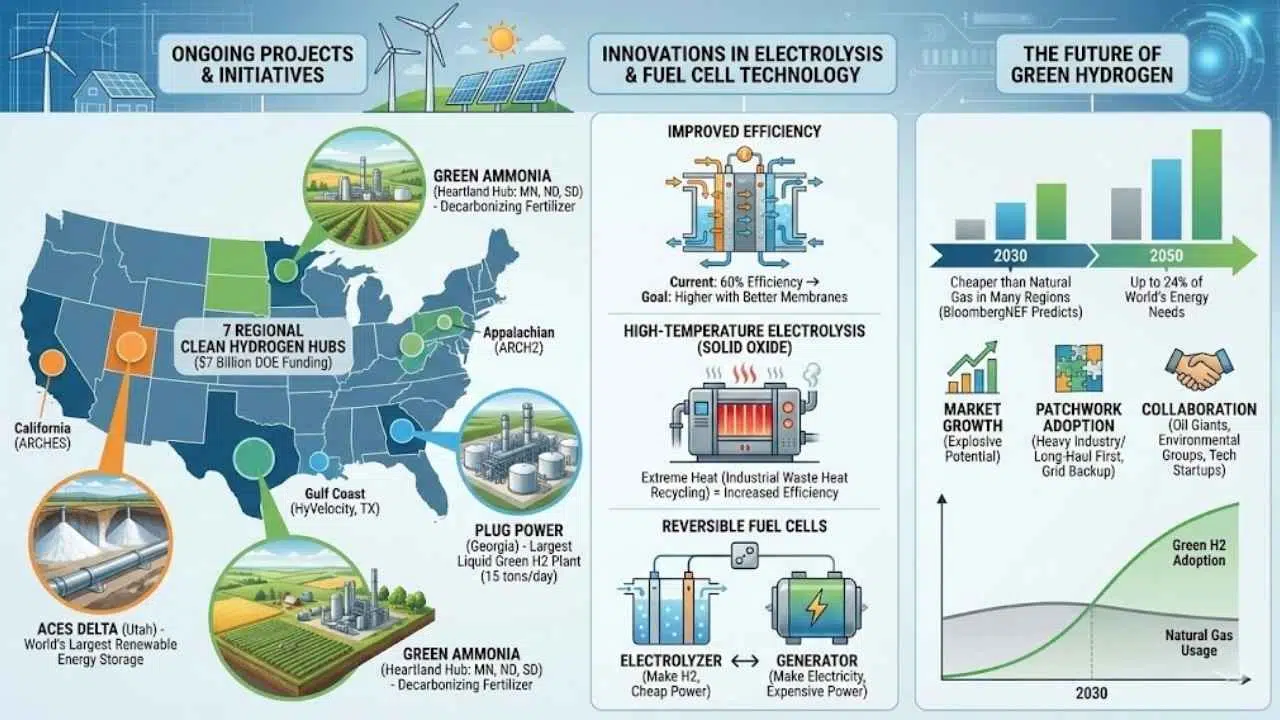
- The 7 Regional Clean Hydrogen Hubs: The DOE selected seven regions for $7 billion in funding. This includes the Gulf Coast Hub (HyVelocity) in Texas, the Appalachian Hub (ARCH2), and the California Hub (ARCHES).
- Plug Power in Georgia: In early 2024, Plug Power started operations at the largest liquid green hydrogen plant in the U.S., designed to produce 15 tons per day.
- ACES Delta in Utah: As mentioned, this is the world’s largest renewable energy storage project, creating a strategic reserve of clean fuel in salt caverns.
- Green Ammonia in the Heartland: The Heartland Hydrogen Hub (Minnesota, North Dakota, South Dakota) is focusing specifically on decarbonizing fertilizer production for farmers.
Innovations in electrolysis and fuel cell technology
Engineers are making the tech better, faster, and cheaper every day. One big focus is efficiency. Current fuel cells are about 60% efficient, but new designs utilizing better membranes are pushing that number higher.
Another breakthrough is in High-Temperature Electrolysis (Solid Oxide). These machines operate at extreme heat and are incredibly efficient when paired with industrial plants that have waste heat. It is a way to recycle energy that would otherwise be lost.
Finally, we are seeing “reversible” fuel cells. These devices can act as an electrolyzer (making hydrogen) when power is cheap, and then switch directions to act as a generator (making electricity) when power is expensive. It is two machines for the price of one.
The Future of Green Hydrogen
Where does this all lead? Experts believe we are standing at the edge of a new energy era. By 2050, green hydrogen could meet up to 24% of the world’s energy needs, but the next ten years are critical.
The market is poised for explosive growth. BloombergNEF predicts that in many parts of the world, green hydrogen will be cheaper than natural gas by 2030.
We will likely see a patchwork adoption. Heavy industry and long-haul transport will switch first because they have few other options. Eventually, as the grid gets cleaner, green hydrogen will quietly back up our power systems, ensuring the lights stay on during the darkest winter storms.
Collaboration is key. We are seeing partnerships between unlikely allies—oil giants, environmental groups, and tech startups—all working toward the same goal. It is a rare moment of unity driven by the sheer economic and environmental promise of this molecule.
Final Thoughts
Green hydrogen is more than just a buzzword. It is a vital tool for fixing the parts of our energy system that batteries alone cannot reach. It offers a way to keep our industries running and our trucks moving without harming the air we breathe.
We are still in the early days. The technology is expensive, and the infrastructure is just being built. But with the “1 1 1” goal in sight and billions in investment flowing into hubs across the country, the momentum is undeniable.
Whether you are an investor looking at the next big thing, or just someone who wants a cleaner planet, keep an eye on this space. The fuel of the future is arriving, one molecule at a time.