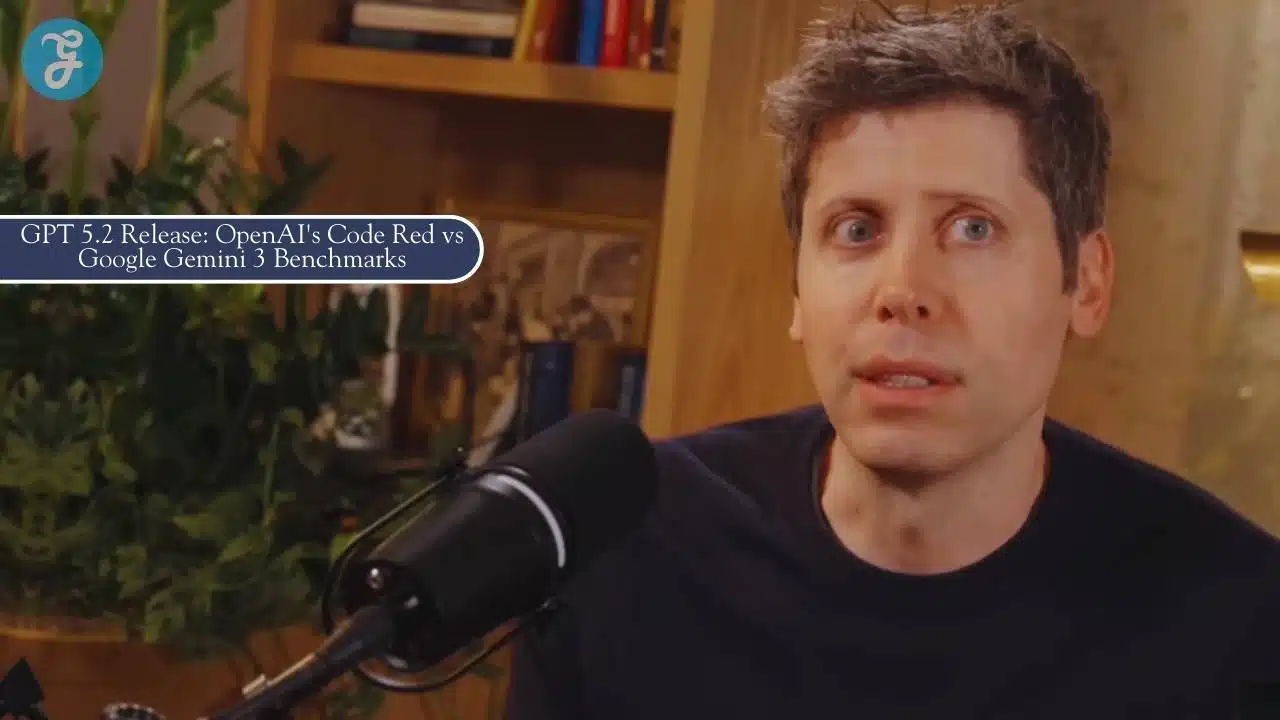
OpenAI is moving at breakneck speed to launch GPT-5.2 potentially as early as today, December 9, 2025, following CEO Sam Altman’s declaration of an internal “code red” alert triggered by Google’s Gemini 3 model surpassing ChatGPT across critical industry benchmarks. This dramatic shift from the originally planned later-December timeline underscores one of the most urgent competitive maneuvers in the AI industry since ChatGPT burst onto the scene three years ago, reshaping how everyday users and businesses interact with generative AI. Adding to the buzz, Altman is set to make his debut on NBC’s “The Tonight Show Starring Jimmy Fallon” this evening, December 8, a strategic media appearance timed perfectly to rally public and investor confidence as OpenAI fights to reclaim its frontrunner status in a rapidly evolving landscape.
Recent market data reveals clear cracks in ChatGPT’s once-unassailable dominance. Between August and November 2025, OpenAI’s flagship chatbot experienced a three-percentage-point drop in its share of global monthly active users, settling at around 55%, while Google Gemini saw an identical three-point gain during the same period. User growth for ChatGPT decelerated sharply to just 6% over those four months, bringing its total to approximately 810 million monthly active users—a figure that analysts at Sensor Tower interpret as evidence of approaching market saturation in the consumer AI space. In contrast, Gemini not only closed the gap but pulled ahead in key metrics like app downloads, session lengths, and overall engagement time, signaling shifting user preferences toward Google’s integrated ecosystem.
Strategic Pivot to Core Performance Enhancements
In a pivotal internal memo circulated to OpenAI employees in early December, Altman issued clear directives: immediately shelve all non-essential side projects and channel every resource into bolstering ChatGPT’s foundational strengths—namely, its speed, reliability, and advanced reasoning capabilities. This includes putting on indefinite hold ambitious initiatives such as advertising revenue integrations, autonomous AI shopping agents, specialized healthcare assistance tools, and the highly anticipated personal assistant known as Pulse, which was meant to handle complex daily tasks with human-like intuition. According to insights from The Information, Altman emphasized in the memo that early internal evaluations position GPT-5.2 ahead of Gemini 3 in several key areas, with The Wall Street Journal reporting that the upcoming update will laser-focus on “speed, reliability, and customizability” rather than pursuing eye-catching but peripheral features that could dilute core performance.
This pivot reflects a broader reckoning within OpenAI, where the leadership recognizes that sustained leadership demands unflinching attention to user pain points like response latency during peak hours, occasional factual inaccuracies in complex queries, and the flexibility needed for enterprise customization. By streamlining efforts, OpenAI aims to deliver a model that not only matches but exceeds competitors in real-world utility, potentially stabilizing its user base and attracting back enterprise clients who have begun exploring alternatives.
Benchmark Battle Reshapes the AI Competitive Landscape
The stakes couldn’t be higher, with Google’s Gemini 3 delivering standout results on rigorous evaluations that have become the gold standard for AI prowess. On Humanity’s Last Exam—a grueling 2,500-question benchmark spanning mathematics, physics, biology, history, and multi-step reasoning—Gemini 3 achieved an impressive 37.5% accuracy rate, dwarfing ChatGPT-5.1’s 26.5% performance and setting a new bar for holistic intelligence. Furthermore, Gemini 3 rocketed to a historic 1,501 Elo score on the LMSYS Arena leaderboard, where anonymous users blindly compare AI responses across diverse prompts, comfortably outpacing OpenAI’s current flagship and validating its edge in blind, human-judged scenarios.
This benchmark dominance has reverberated through the industry, extending pressure beyond just Google. Anthropic’s Claude Opus 4.5 has carved out a niche among enterprise customers by offering what experts call a “safer, more predictable” option with robust guardrails against hallucinations and ethical lapses. High-profile endorsements have amplified the shift: Salesforce CEO Marc Benioff openly lauded Gemini 3’s capabilities and announced his company’s migration away from ChatGPT, citing superior integration with business workflows—a sentiment echoed by other tech executives navigating the high costs of AI deployment.
Despite these headwinds, ChatGPT retains a formidable foothold with roughly 800 million weekly active users, as Sam Altman has highlighted in recent communications, providing OpenAI with unparalleled scale for data collection and model refinement. Yet the company continues to operate at a loss, grappling with existential questions about its business model in an arena dominated by rivals boasting mature revenue streams from cloud services, advertising, and hardware synergies. As GPT-5.2 rolls out, OpenAI’s ability to translate internal confidence into market-winning performance will define its trajectory in this high-stakes AI arms race.