

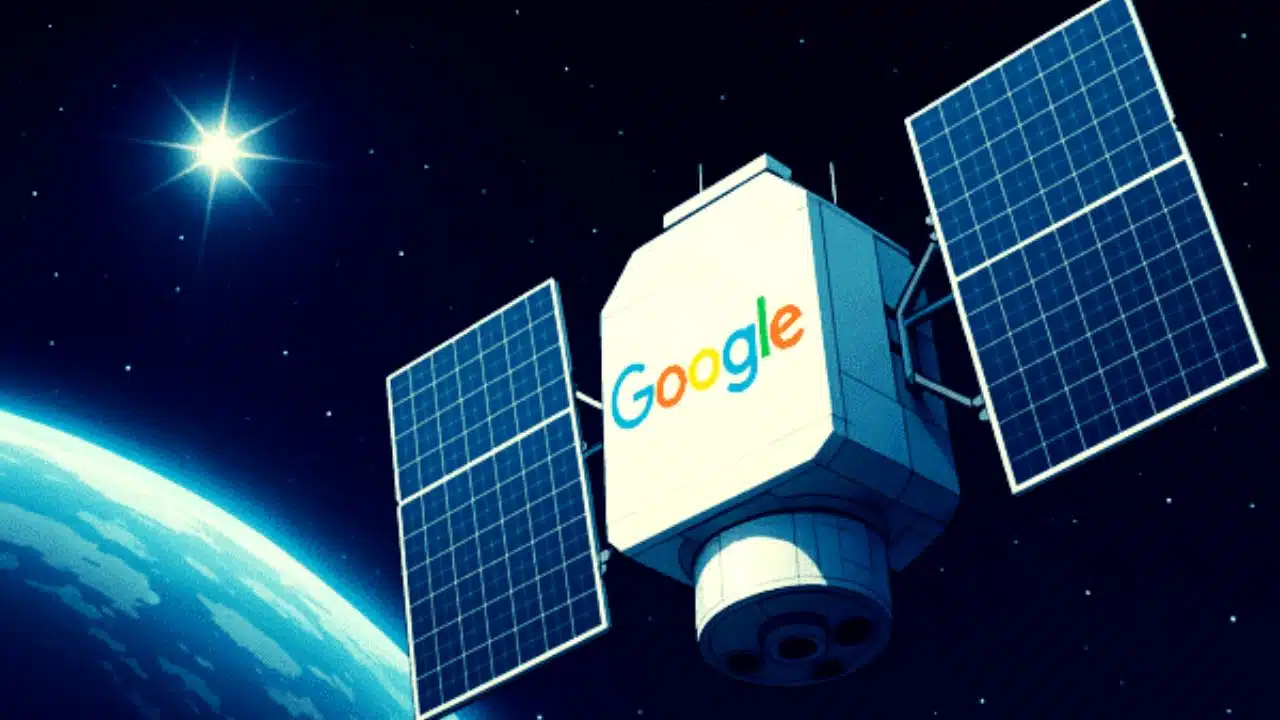
Google plans to begin testing solar-powered data centers in space as early as 2027 under a new initiative called Project Suncatcher, in one of the most ambitious attempts yet to tackle AI’s exploding energy needs. CEO Sundar Pichai has confirmed the company will send small racks of AI hardware into orbit on satellites built with partner Planet, with the longer‑term goal of scaling the idea into full-fledged orbital data-center constellations if the early missions succeed. By shifting part of its AI computing off‑planet and tapping virtually continuous sunlight in space, Google aims to ease pressure on terrestrial power grids and cut the environmental impact of future AI systems.
Project Suncatcher unveiled
Google introduced Project Suncatcher in November 2025 as a research moonshot to explore whether interconnected satellites equipped with its custom Tensor Processing Unit (TPU) chips could function as a distributed AI data center in low Earth orbit. The first concrete step is a learning mission that will launch two prototype satellites by early 2027 to test how TPUs, power systems and communications hardware perform in real orbital conditions. Company forecasts suggest that if launch prices keep falling, larger constellations of dozens of such solar-powered satellites could become economically comparable to some ground-based facilities by the mid‑2030s.
How space data centers work
In Google’s design, each satellite would carry solar arrays and AI accelerators, linking to neighboring spacecraft through high‑bandwidth free‑space optical connections so that the cluster behaves much like racks in a conventional hyperscale data center. Research highlighted by the company indicates that satellites placed in carefully selected orbits could remain in near‑constant sunlight and receive up to around eight times more solar energy over a year than similar panels at mid‑Earth latitudes. Data would be exchanged between the orbital cluster and the ground via laser links to Earth stations, with large AI training runs and other batch workloads seen as the most realistic early applications because they are more tolerant of latency than consumer-facing services.
AI’s growing power problem
The space effort comes amid mounting concern over the electricity appetite of AI infrastructure, with a recent U.S. Department of Energy analysis finding that U.S. data centers already consume more than 4% of national power and could climb into the low double digits by later this decade. By relocating some compute capacity into orbit and running it entirely on solar energy, Google argues it can help satisfy surging AI demand while freeing up land, water and grid capacity that would otherwise be devoted to cooling and powering ever larger server farms on Earth. UN officials and environmental advocates have also warned about the broader ecological footprint of AI—from mining and chip production to e‑waste and greenhouse-gas emissions—adding pressure on major tech firms to pursue more radical efficiency gains and cleaner energy sources.
Technical and economic hurdles
Google’s own researchers acknowledge that significant questions remain about how reliably advanced chips and optical systems can operate in harsh radiation belts, how hardware will be maintained when it cannot be easily serviced, and how to avoid worsening an already crowded orbital environment. Engineers are still modeling how to shed heat in the vacuum of space, secure low‑latency links to terrestrial networks, and ensure that malfunctioning satellites can be safely deorbited to limit debris risks. Cost is another major constraint: today’s launch prices are estimated at well above a thousand dollars per kilogram, but Google and outside analysts project that next‑generation rockets could cut that severalfold by the 2030s, potentially making orbital compute cost‑competitive for certain high‑value AI workloads.
What happens after 2027
The 2027 mission is framed as an engineering testbed rather than a commercial rollout, and Google has stressed that any move toward operational space-based data centers would follow only after multiple phases of experimentation and regulatory review. Pichai has said that successfully running at least one TPU in space by that time would mark the start of a new era in infrastructure, and he has suggested that extraterrestrial data centers could feel routine within about a decade if early results are positive. For now, Project Suncatcher positions Google at the forefront of an emerging “AI in orbit” race, signaling to competitors and policymakers that the company is prepared to look beyond Earth itself in search of sustainable computing power.






















