
Google has officially completed the rollout of its August 2025 Spam Update, which began on August 26, 2025 at 12:00 PM ET and concluded on September 22, 2025 at approximately 2:00 AM ET. The entire process spanned 27 days, making it significantly longer than the December 2024 Spam Update, which took about a week. This lengthier rollout created sustained volatility in search results, keeping publishers, site owners, and SEO professionals on edge for nearly a month.
Unlike some earlier rollouts, which finished quickly, this update stretched over multiple phases. Early signs of ranking volatility appeared within 24 to 48 hours of launch, with visible spikes in ranking shifts on August 27 and 28. After a short cooling-off period, search result turbulence resumed around September 9, causing renewed debate in the SEO community.
Global Reach and Scope
The update applied globally across all regions and languages, affecting websites in every major market. Google confirmed that the update focused on general spam detection rather than narrower areas such as link spam or site reputation abuse. This means the update targeted a wider range of manipulative practices, including:
-
Pages created primarily for manipulating rankings without offering user value.
-
Content with excessive duplication or automation designed to mislead search systems.
-
Sites deploying cloaking, doorway pages, or sneaky redirects.
-
Overly aggressive monetization tactics that violated Google’s spam policies.
Importantly, link spam was not a specific target this time, nor was the site reputation abuse policy. Instead, the emphasis was on maintaining the integrity of search results by filtering out tactics that degrade user experience.
Technical Context: The Role of SpamBrain
The Spam Update series, including this rollout, leverages Google’s SpamBrain AI system, first introduced in 2018. SpamBrain is a machine-learning framework designed to detect and neutralize evolving spam tactics at scale. Each iteration of the spam update represents a recalibration of SpamBrain’s models, improving its accuracy in detecting deceptive strategies.
While Google did not specify the technical changes in this update, many analysts believe that adjustments were made to adapt to AI-driven content manipulation, as well as to strengthen filters against newly emerging forms of automated spam.
Early Impact on Search Results
The August 2025 update was felt almost immediately:
-
Sharp fluctuations were observed within a day, with some sites experiencing dramatic declines in visibility.
-
Others, particularly those that had previously been suppressed by older spam filters, saw brief improvements.
-
After initial turbulence, rankings stabilized for several days, only to swing again around September 9.
Third-party rank tracking tools detected unusually high levels of volatility during these periods. However, after September 11, the usefulness of many tools declined due to technical changes in how Google delivers results.
The “num=100” Parameter Removal and Its Ripple Effects
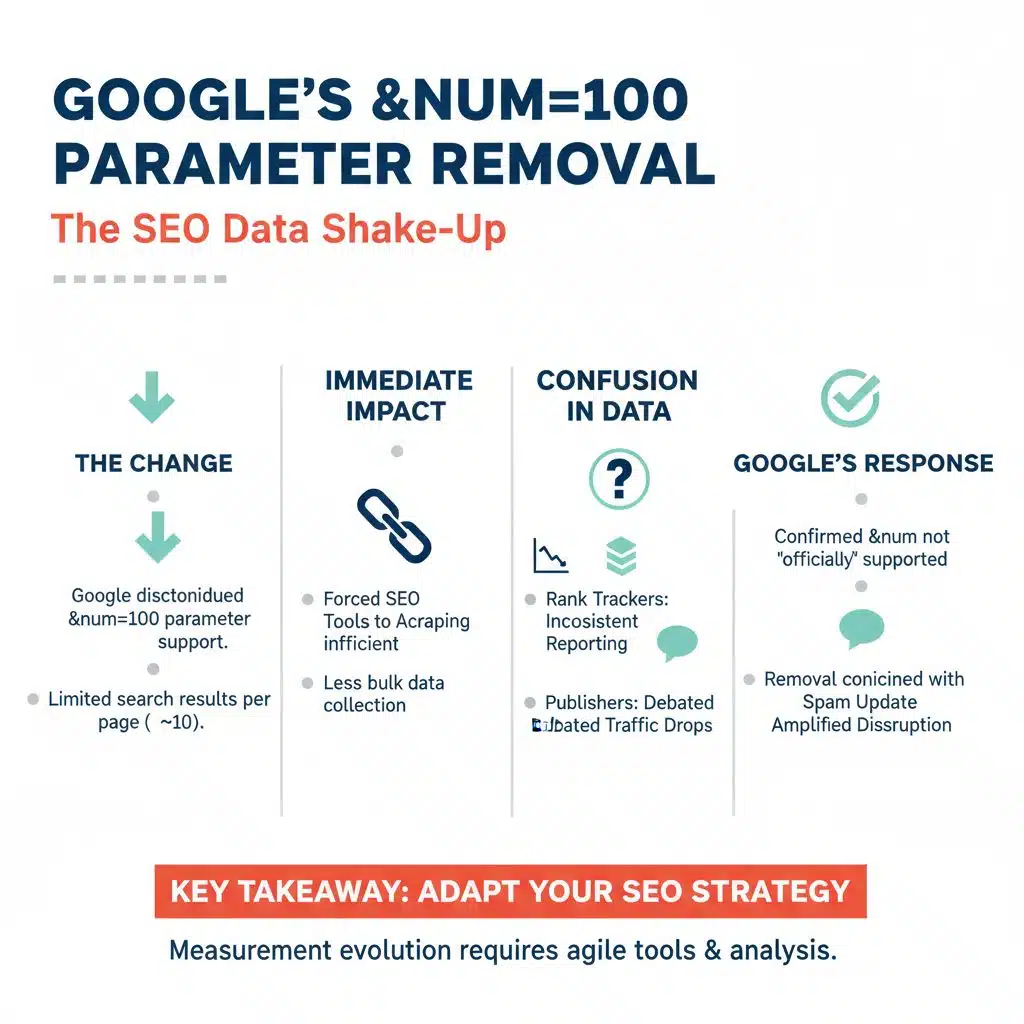
One of the most disruptive changes during this period was Google’s decision to discontinue support for the &num=100 search parameter. This setting had allowed users and SEO tools to display 100 search results per page. Its removal forced third-party rank trackers and scrapers to adjust, as they could no longer collect large sets of results in a single query.
The result was widespread confusion in SEO data reporting:
-
Google Search Console (GSC) began showing sudden declines in impressions for many sites.
-
SEO platforms relying on bulk scraping struggled to recalibrate, leading to inconsistent rank reporting.
-
Publishers debated whether traffic declines were real or caused by measurement issues.
Google later confirmed that the &num parameter had not been officially supported for years, although its sudden removal coinciding with a major spam update amplified the sense of disruption.
Experiences from Site Owners
Feedback from site owners and SEO practitioners reflected the uneven impact of the update:
-
Some reported that Google was funneling most of their traffic to a single page, while other high-value pages remained uncrawled or excluded.
-
Smaller niche publishers noted that indexing became more difficult, particularly after the first week of the rollout. Content that was previously picked up quickly began to take longer to appear in search.
-
Several webmasters described severe drops in impressions beginning around September 10, coinciding with both the second wave of the update and the fallout from the parameter change.
-
Others suggested that larger media outlets appeared to gain visibility, while smaller independent publishers suffered setbacks.
Interestingly, some smaller site owners welcomed Google’s changes, arguing that reduced access to scraping tools could prevent large SEO firms from exploiting competition data at scale.
How to Recover if Hit
For websites negatively impacted, the recovery process is neither quick nor guaranteed. Google has outlined clear steps:
-
Audit site content against Google’s Spam Policies. Remove or improve pages that exist solely for search manipulation.
-
Focus on original, high-quality, people-first content rather than automated or scraped material.
-
Avoid techniques such as cloaking, auto-generated pages, or deceptive redirects.
-
Ensure that all monetization methods comply with Google’s policies.
Recovery typically requires waiting until Google refreshes the spam algorithm, which may take several months. Even with fixes, sites must demonstrate consistent compliance over time before regaining trust in rankings.
Industry Impact and Wider Significance
The August 2025 Spam Update highlights several broader trends in the search ecosystem:
-
Updates Are Getting Longer
-
This rollout lasted nearly a month, significantly longer than most past spam updates. Longer updates create uncertainty for site owners, who must wait weeks to understand the full impact.
-
-
Data Transparency Challenges
-
The removal of the
&num=100parameter and changes in Search Console reporting created confusion, blurring the line between genuine ranking losses and measurement artifacts.
-
-
Shifting Balance of Power
-
Some independent publishers feel disadvantaged, as smaller sites struggle with indexing while larger outlets hold their ground. This feeds ongoing debate about whether Google’s updates disproportionately favor major media players.
-
-
SpamBrain Evolution
-
Analysts suspect SpamBrain has been recalibrated to detect AI-driven spam, which has become more prevalent with the rise of large language models producing low-quality content at scale.
-
The August 2025 Spam Update stands out as one of Google’s most disruptive spam updates in recent memory. Spanning nearly a month, it brought sweeping changes to search rankings, created volatility across industries, and coincided with a fundamental change in how search data can be tracked externally.
For site owners, the message is clear: compliance with Google’s spam policies is no longer optional. Those relying on outdated, manipulative, or low-value tactics are at greater risk of being penalized. Recovery will take time, but websites that consistently prioritize quality, originality, and user-first experiences will be best positioned to weather not only this update, but future ones as well.