


In 2026, the “Silicon Valley North” narrative has evolved from a promise into a global competitive reality. Canadian startups are no longer just building AI; they are leveraging it to dissolve geographic barriers and outmanoeuvre global incumbents with lean, high-leverage teams. By moving beyond experimentation to disciplined, operational execution, founders from Halifax to Victoria are using Generative AI for Canadian Startups to scale without the traditional heavy payrolls of the past decade.
How We Selected Our 8 Best Generative AIs for Canadian Startups Insights
To identify these proven strategies, we analyzed the 2026 success stories from the Vector Institute’s FastLane program, Scale AI cluster reports, and NRC IRAP’s latest AI Assist initiatives. We filtered our selection through four specific lenses to ensure these are not just trends, but “defensible moats” for Canadian firms:
Operational Leverage: We prioritized ways startups are doing more with fewer than 20 employees.
Sovereign Advantages: We looked at how firms use Canada’s unique data residency and ethical AI frameworks to win European and public sector contracts.
Time-to-Market: We selected methods that reduced R&D cycles from years to months.
Commercial Validation: Every insight is backed by 2026 data showing measurable revenue growth or successful global expansion.
8 Proven Ways Canadian Startups Use Generative AI for Global Growth
Canadian founders are shifting their focus from “building models” to “orchestrating outcomes.” Here is how they are currently competing on the world stage.
1. Rapid Prototype-to-Production via Agentic Workflows
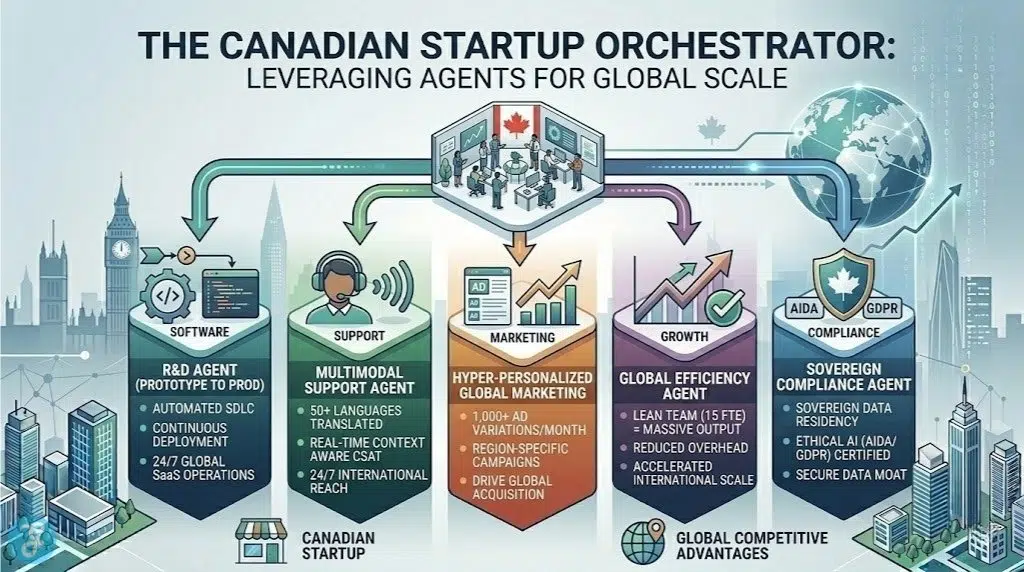
By 2026, the most successful Canadian startups have stopped manually coding every feature. Instead, they use “Agentic Workflows” to automate the software development life cycle. This allows a three-person engineering team to maintain a global-scale SaaS platform that would have required thirty engineers in 2023.
Best for: Early-stage SaaS and B2B tech founders
Pros:
- Dramatically lower technical debt
- Continuous deployment 24/7 without manual intervention
Things to consider: Over-reliance on agents can lead to “architectural drift” if senior human oversight is absent.
2. Building “Context Moats” with Proprietary Canadian Data
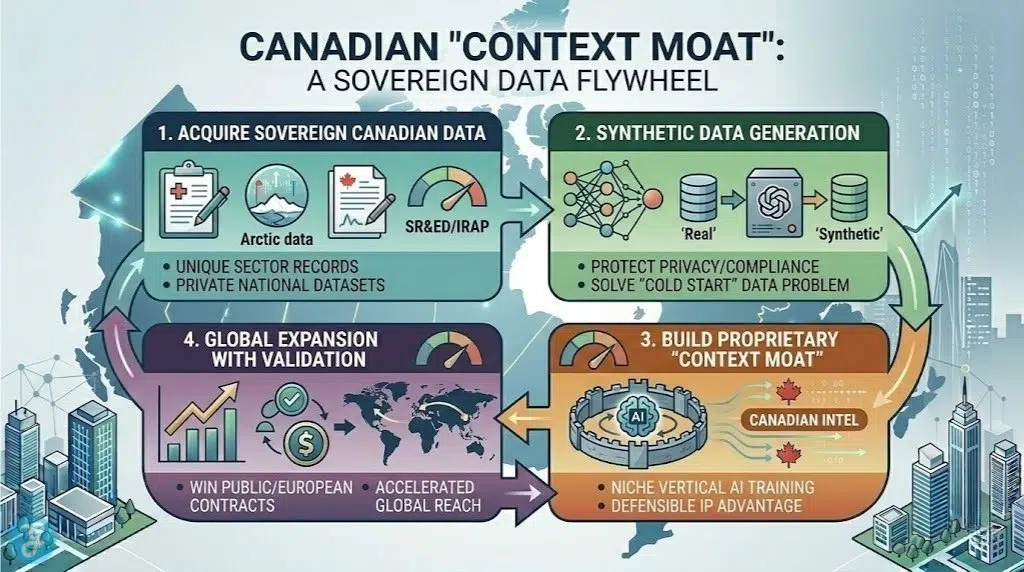
To compete with global giants like OpenAI, Canadian startups are focusing on niche vertical AI. By training smaller, high-performance models on specific Canadian data—such as national healthcare records or unique Arctic climate data—they create “Sovereign AI” products that are more accurate and compliant than generic global models.
Best for: HealthTech, FinTech, and Natural Resource startups
Pros:
- Higher accuracy for specialized industry tasks
- Natural protection against generic global competitors
Things to consider: Acquiring and cleaning proprietary data remains a significant upfront legal and technical cost.
3. Leveraging NRC IRAP AI Assist for R&D Subsidies
The Canadian government’s $100 million AI Assist program has become a secret weapon for global competition. Startups are using these non-repayable grants to cover up to 80% of the cost of technical staff. This allows Canadian firms to out-hire international competitors for top-tier machine learning talent while remaining capital-efficient.
Best for: High-growth startups needing deep R&D
Pros:
- Non-dilutive funding that preserves founder equity
- Direct access to Industrial Technology Advisors (ITAs)
Things to consider: The application process is rigorous and requires clear milestones and commercialization plans.
4. Multimodal Customer Success for Global Markets
Canadian e-commerce and service startups are using multimodal GenAI to provide 24/7 support in over 50 languages. A startup based in Montreal can now offer flawless customer success in Japanese and German without hiring a single international agent, allowing them to capture global markets from day one.
Best for: E-commerce (Shopify ecosystem) and global service providers
Pros:
- Instant global footprint with zero international payroll
- High CSAT scores through real-time, context-aware translation
Things to consider: Cultural nuance goes beyond language; AI still needs manual “vibe checks” for specific regional etiquette.
5. Generative Design in Advanced Manufacturing
In the “Scale AI” cluster, Canadian hardware startups are using generative design to optimize supply chains and product parts. By feeding manufacturing constraints into AI models, they are creating lighter, stronger, and cheaper components that outperform traditional designs, giving them a price edge in global logistics.
Best for: Cleantech, EV supply chains, and Agri-tech
Pros:
- Reduced material waste and lower shipping costs
- Faster iteration on physical hardware prototypes
Things to consider: Manufacturing these complex AI-designed parts often requires specialized 3D printing or high-end CNC facilities.
6. Automated Regulatory and ESG Reporting
Canadian startups are leading the way in “RegTech” by using GenAI to automate complex ESG (Environmental, Social, and Governance) and cross-border compliance reports. This allows them to enter strictly regulated markets—like the EU or California—faster than competitors who are still manually auditing their operations.
Best for: CleanTech and FinTech companies scaling internationally
Pros:
- Drastic reduction in legal and compliance overhead
- Faster entry into high-barrier international markets
Things to consider: AI-generated compliance reports must be final-checked by certified legal professionals to avoid liability.
7. Hyper-Personalized Global Marketing at Scale
Using tools like the Vector Institute’s FastLane insights, startups are generating thousands of personalized video and text ad variants for different global regions. A Toronto-based marketing tech firm can now run 1,000 unique campaigns across Southeast Asia with the same budget previously used for one generic Canadian campaign.
Best for: Consumer-facing apps and digital marketing agencies
Pros:
- Exponentially higher ad conversion rates
- Data-driven insight into global consumer preferences
Things to consider: Scaling marketing assets too fast can dilute brand consistency if not managed via a central brand-tuned model.
8. Synthetic Data Generation for Training
To bypass the lack of massive datasets, Canadian startups are using Generative AI to create high-fidelity “Synthetic Data.” This is particularly proven in the medical and autonomous vehicle sectors, where real-world data is scarce or sensitive. This allows them to train world-class models without violating privacy laws.
Best for: Biotech, MedTech, and Autonomous Mobility
Pros:
- Solves the “Cold Start” problem for training AI
- Complete protection of user privacy through non-real data
Things to consider: “Model Collapse” is a risk if the synthetic data is not carefully validated against real-world edge cases.
Quick Overview
The following overview highlights how Canadian startups are pivoting their AI strategies to meet 2026 global demands.
Comparison Table
| Strategy Pillar | Legacy Startup Model (2023) | AI-Native Canadian Startup (2026) |
| Team Size | Large (30-50 for global scale) | Lean (5-10 with AI agents) |
| R&D Funding | Private VC dependent | IRAP AI Assist + VC Mix |
| Market Entry | Regional first, then Global | Global from Day One |
| Data Focus | General Big Data | Proprietary Context Moats |
Our Top 3 Picks
- The Capital Edge: NRC IRAP AI Assist is the most effective way for Canadian firms to win the talent war.
- The Scaling Edge: Multimodal Support allows Canadian firms to ignore geographic borders.
- The Defensibility Edge: Context Moats built on proprietary data are the only way to survive the “Big Tech” AI onslaught.
Buyer’s Guide: How to Choose the Right Generative AI for Canadian Startups Strategy
Scaling a startup in 2026 requires more than just “using AI”—it requires a strategic framework that aligns with Canadian advantages.
The Selection Framework:
- Funding Alignment: Determine if your project fits the “Scientific R&D” criteria for SR&ED and IRAP stacking.
- Infrastructure Choice: Use local sovereign infrastructure (like Scale AI partners) to ensure your data stays under Canadian jurisdiction.
- Talent Orchestration: Shift from hiring “Developers” to hiring “AI Architects” who can manage agentic workflows.
Decision Matrix (Table):
| Choose “Agentic” Growth If… | Choose “Deep-Tech” Research If… |
| You are a lean SaaS startup needing to scale support. | You have a proprietary dataset in Health or Energy. |
| You need to launch in 5+ countries next month. | You are building a defensible IP moat for acquisition. |
| You have limited venture capital but high revenue. | You have strong ties to Mila, Vector, or Amii. |
The Final Checklist
Ask yourself the following questions to help you decide:
- Have you applied for the NRC IRAP AI Assist scoping project?
- Is your data residency strategy compliant with both Canadian and EU (GDPR) laws?
- Are your engineers spending more than 20% of their time on manual, automatable tasks?
- Have you built a “Synthetic Data” pipeline to protect user privacy?
- Does your brand voice remain consistent across your AI-generated global marketing?
Ending Thoughts
The success of Generative AI for Canadian Startups in 2026 is no longer about the technology itself, but about the speed of its integration. By leveraging federal R&D support, building proprietary context moats, and using agents to stay lean, Canadian founders are proving that you don’t need a Silicon Valley zip code to dominate a global market. The window for this “AI Moment” is open, and the startups that execute with discipline today will be the national anchors of tomorrow.
























