

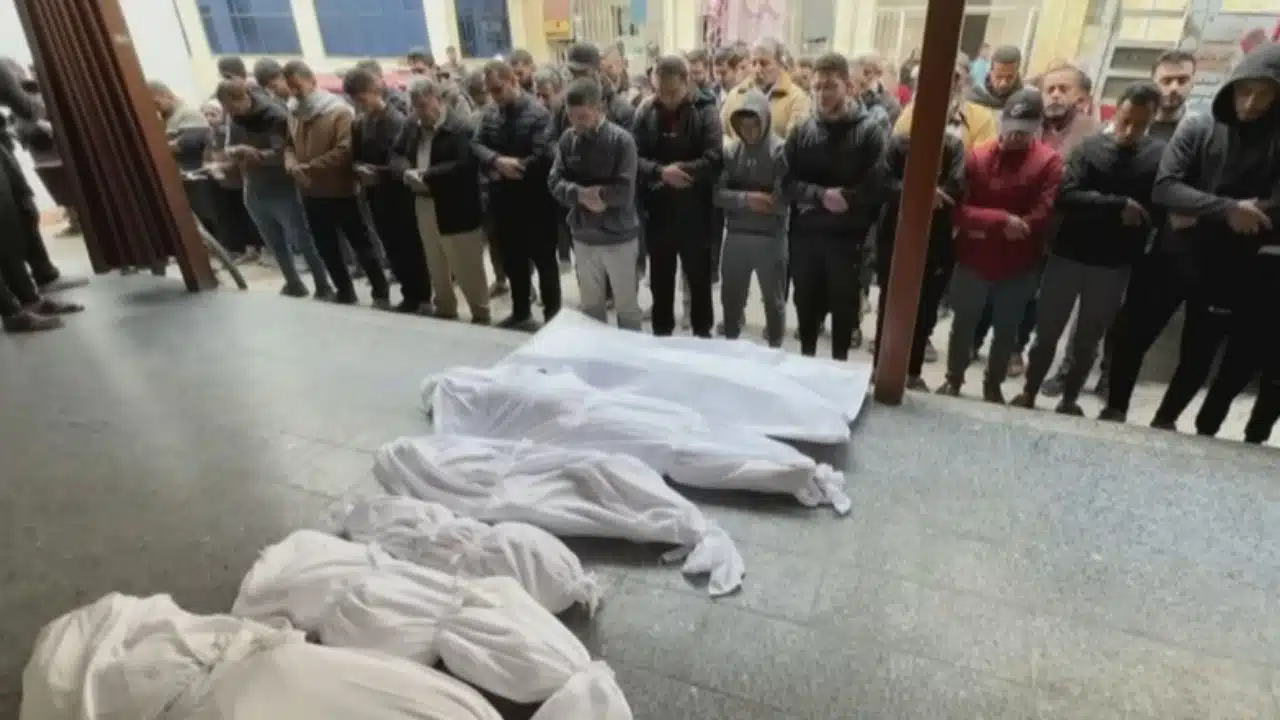
In war-torn Gaza City, scenes of sorrow and desperation unfold daily at hospitals overwhelmed by casualties. Alam Hirzallah recently recounted a heartbreaking personal loss at al-Shifa Hospital. His cousin’s wife, Asma Hirzallah, and her two children—Mayar, aged five, and Abdullah, just three—were killed after Israeli artillery shelled their home in eastern Gaza City. Their lifeless bodies were brought to the hospital on an electric tuk-tuk, one of the few transport options left in a city where infrastructure has been decimated.
At the hospital, staff requested ID numbers and full legal names, as required by the Palestinian population registry, which is administered by Israeli authorities. They issued a document confirming the three had been “martyred” and instructed the family to return later for official death certificates. But Alam now faces a distressing problem: they have nowhere to bury them. The nearest cemeteries lie in territories currently under Israeli control—an area civilians struggle to access safely due to ongoing military operations and checkpoints.
Gaza’s Reported Death Toll Surpasses 51,000
According to the Hamas-run Ministry of Health in Gaza, at least 51,266 people have been killed since the conflict erupted in October 2023. Of these, a significant proportion—almost one-third—are children under the age of 18, highlighting the devastating toll the war has had on non-combatants.
Israel, however, challenges the reliability of these figures. Officials claim that the statistics are being manipulated to serve as Hamas propaganda, inflating the death toll and particularly exaggerating the number of civilian deaths. Israeli authorities argue that the figures do not clearly differentiate between civilians and members of armed Palestinian factions such as Hamas and Palestinian Islamic Jihad (PIJ).
Despite these allegations, the reported figures from the Gaza health ministry continue to be used—albeit with attribution—by major international organizations, including UN agencies, humanitarian groups, and global media outlets, who acknowledge the difficulty of independent verification due to Israel’s restrictions on international press entry into Gaza.
Controversy Over the Removal of 3,000 Names
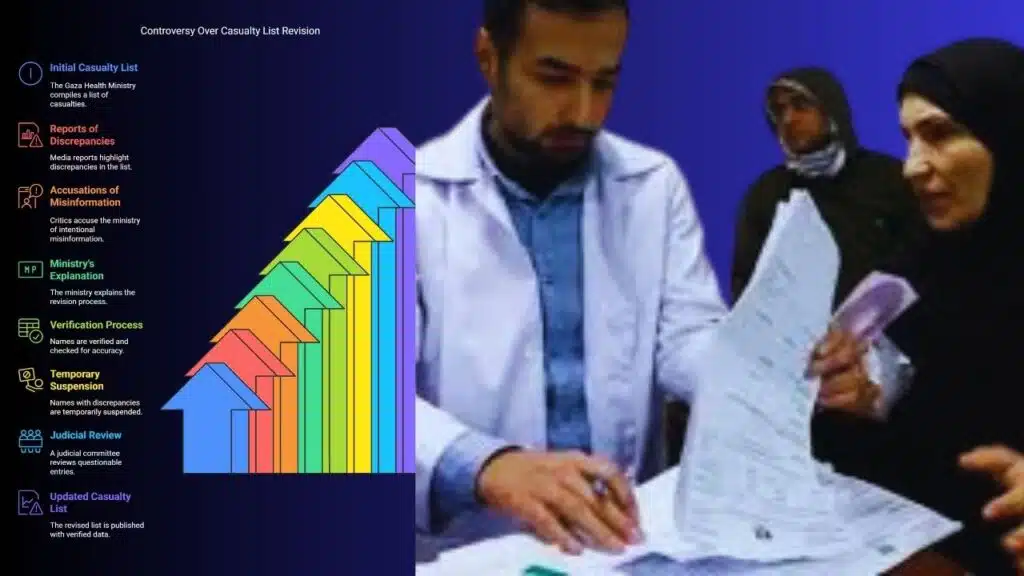
In recent months, questions have mounted about the accuracy of the Gaza Health Ministry’s casualty list. Reports emerged in late 2024 and early 2025 noting that approximately 3,000 names had been removed from the death toll between August and March. Critics, including the pro-Israel media watchdog group HonestReporting, have pointed to this revision as possible evidence of intentional misinformation rather than clerical errors.
However, Zaher al-Wahidi, the Gaza Ministry of Health’s head of statistics, rejected the accusation of data manipulation in an interview with the BBC. He explained that the removed names were part of an ongoing revision and verification process aimed at ensuring data integrity and public trust.
“It’s not a matter of removal,” Wahidi said. “We verify names based on updated information, and when discrepancies arise—such as duplicate entries or missing identity verification—we suspend the names temporarily for further checks.”
Wahidi emphasized that the Gaza Health Ministry has no interest in publishing inaccurate data, stating, “We work toward high credibility. A judicial committee is responsible for reviewing questionable entries.”
Evolving Data Collection: From Hospital Logs to Digital Forms
Before the war intensified in late 2023, hospitals served as the central reporting hubs for casualties. Bodies arriving at facilities like al-Shifa were registered into a centralized database, backed up at al-Rantissi Hospital. The database included names, ID numbers, causes of death, and the time and location of each incident.
However, repeated Israeli strikes on Gaza’s health infrastructure forced officials to shift to an online reporting system in early 2024. With hospitals damaged or inaccessible, families began using digital forms to report the deaths or disappearance of loved ones. While this approach expanded reporting capabilities, it also introduced new challenges in data accuracy and identity verification.
Many of the 3,000 names recently removed from the official fatality list were submitted via these online forms and lacked complete documentation. Wahidi confirmed that in some cases, individuals had been listed as dead but were later discovered to be alive, often found detained in Israeli prisons or sheltering elsewhere.
Additionally, some deaths were found to be unrelated to direct conflict, such as those resulting from untreated chronic illness, dehydration, or cold exposure—these cases, Wahidi clarified, were not added to the combat casualty list.
Independent Experts Call It a Cleanup, Not Manipulation
Professor Mike Spagat, chair of Every Casualty Counts, an independent organization that tracks war-related deaths, reviewed the revised data. He said there is no clear evidence that Gaza health officials are attempting to mislead the public.
“It appears to be a major cleanup effort, not manipulation,” said Spagat, who is also a professor at Royal Holloway, University of London. “If anything, the updated numbers slightly increase the proportion of adult males—countering the argument that women and children were overrepresented.”
He added that the casualty lists should have always been treated as provisional, especially given the chaotic conditions on the ground.
Bodies Still Trapped Under Rubble
A significant number of Gaza’s dead still lie under the ruins of collapsed buildings. The Health Ministry estimates that thousands of corpses remain unrecovered, while around 900 bodies have not yet been identified. During the two-month ceasefire in early 2025, roughly 800 remains were retrieved and added to the official tally.
In one example documented by the BBC in January 2025, a team from the Civil Defence agency retrieved human remains from the Wadi Gaza area—also known as the Netzarim Corridor. The area had been inaccessible for months due to Israeli military presence.
With no DNA testing facilities available, the team relied on personal effects—such as jewelry, ID cards, and even teeth—for identification. Each corpse was tagged with a serial number, and detailed logs were maintained to ensure accurate identification when relatives arrived to claim the bodies.
Israel’s Combatant Estimates and Civilian Toll
Israel claims that over 20,000 Hamas and Islamic Jihad fighters have been killed since the conflict began, including more than 100 “high-value targets” eliminated in April 2025 alone. However, Israeli authorities have not released figures for Palestinian civilian casualties nor offered a name-by-name rebuttal to the Gaza Health Ministry’s list.
The lack of distinction between fighters and civilians continues to be a contentious issue. Critics argue that this ambiguity in reporting contributes to conflicting international narratives and hinders accountability on both sides.
War Timeline and Ongoing Conflict
The conflict erupted on October 7, 2023, when Hamas launched a large-scale attack across the border into southern Israel, killing around 1,200 Israelis—most of them civilians—and capturing approximately 250 hostages, including women and children.
In retaliation, Israel launched a massive military operation against Hamas in Gaza. Since then, the Israeli Defense Forces (IDF) report that 408 of their soldiers have been killed in action. With Israeli airstrikes continuing and ground forces regularly re-entering Gazan neighborhoods, civilian casualties continue to rise sharply.
Media Blackout: Relying on Local Journalists
International journalists are still barred from entering Gaza independently, limiting the global media’s ability to verify claims from either side. As a result, broadcasters like the BBC rely heavily on a network of local Palestinian journalists who risk their lives to gather eyewitness testimonies, film scenes at bomb sites, and document conditions in hospital morgues.
These local contributions have been critical to piecing together the human impact of the conflict. Still, observers caution that limited access, political pressure, and information fog make objective assessment of the total death toll incredibly difficult.
The Truth Amid the Fog of War
While Israel accuses Hamas of inflating death tolls for political leverage, and Gaza insists on the authenticity of its numbers, one fact remains undisputed: the human cost of this conflict is staggering and still growing. The lack of independent access, the scale of displacement, the destruction of medical infrastructure, and ongoing fighting make data collection an enormous challenge.
Whether through formal hospital systems, online forms, or makeshift grave registries, Gazans continue the painful work of recording their dead—amid a war that shows no signs of ending.
The Information is Collected from BBC and AOL.
























