Relying on outdated tactics and unverified assumptions causes search engine optimization teams to waste thousands of dollars monthly on toxic or ineffective backlink campaigns. Recognizing common link building myths enables marketing managers to audit their link acquisition strategies, protect domain authority, and redirect budget toward efforts that yield measurable search visibility and organic revenue.
| Link Building Myth | The Technical Reality | Financial & Strategic Risk Level | Better Budget Allocation |
| 1. High DA/DR is the Only Metric | Third-party scores can be easily manipulated with spam. | High: Paying premium fees for artificially inflated domains. | Target site-level topical relevance and genuine organic search traffic. |
| 2. Quantity Over Quality | Google algorithms prioritize domain authority and contextual placement. | High: Burning budget on low-tier links that trigger spam filters. | Invest in high-value, editorially earned assets that attract organic links. |
| 3. Disguised Paid Links Are Safe | Machine learning pattern detection identifies commercial link networks. | Critical: Algorithmic suppression or manual action penalties. | Shift funds to digital PR, primary research, and data-driven outreach. |
| 4. Heavy Exact-Match Anchor Text | Unnatural anchor distributions violate search quality guidelines. | High: Devalued links or anchor text spam over-optimization penalties. | Maintain a natural mix of branded, URL, and partial-match anchor text. |
| 5. NoFollow Links Have Zero Value | Nofollow, sponsored, and UGC attributes pass topical relevance signals. | Medium: Passing up high-traffic referral opportunities. | Pursue links based on audience fit, referral traffic, and brand exposure. |
| 6. Guest Blogging Is Completely Dead | High-quality, editorially vetted guest contributions build authority. | Medium: Missing authoritative publications due to overly strict rules. | Publish original analysis on reputable, audience-aligned industry publications. |
| 7. Reciprocal Links Always Penalty | Natural cross-referencing occurs organically between industry resources. | Low: Over-policing organic, helpful business partnership links. | Allow organic link exchanges when they genuinely serve reader intent. |
| 8. Paid Directory Links Guarantee ROI | General web directories offer negligible indexation or link equity. | Medium: Subscribing to low-tier directory packages without traffic. | Restrict directory spend to verified niche or local business platforms. |
| 9. Link Building Is a One-Time Sprint | Competitors continually build links, and backlink decay reduces authority over time. | High: Dropping rankings after halting outreach campaigns. | Budget for ongoing monthly digital PR and content refresh outreach. |
| 10. Broken Link Building Is Highest ROI | Conversion rates on cold broken link outreach have dropped below 1 percent. | Medium: Spending hundreds of labor hours on low-yield outreach. | Reallocate outreach hours to unlinked brand mentions and original data pitches. |
10 Costly Link Building Myths That Drain Your Marketing Budget
1. Domain Authority or Domain Rating Is the Only Metric That Matters
One of the most expensive assumptions in search engine marketing is treating third-party domain metrics like Ahrefs Domain Rating (DR) or Moz Domain Authority (DA) as absolute indicators of link quality. These metrics are proxy scores created by software companies, not official Google ranking factors. Spammers frequently inflate DR by building networks of redirected domains or blast campaigns pointing to a single site.
When buying guest posts or sponsored placements based solely on a high DR score, you risk paying top dollar for a website that carries zero actual organic search traffic, holds no topical overlap with your business, and operates purely as a link farm. Always evaluate organic traffic trends, indexation health, and topical alignment before committing capital.
2. Buying Mass Backlinks Beats Earning High-Quality Placements
Chasing high link volumes leads companies to purchase cheap link packages offering hundreds of directory or blog comment backlinks for a few hundred dollars. Google algorithms treat link volume without contextual relevance as spam.
A single link from an editorially managed publication read by your prospective customers delivers vastly more topical authority and search equity than five hundred low-quality links from automated networks. Spending a budget on volume dilutes outreach resources and exposes your domain to link disavow management costs when low-tier links trigger algorithmic suppression.
3. Paid Link Networks Are Safe If You Disguise The Placements
Many agencies claim they operate private outreach networks that evade Google spam detection through unique IP hosting or subtle footprint masking. However, spam detection models analyze link graphs, sudden backlink velocity spikes, and outbound linking patterns at scale.
When a network gets identified and devalued, every client linked within that network loses organic visibility simultaneously. Rebuilding search equity after a manual action or algorithmic devaluation requires months of audits, disavow filings, and heavy financial reinvestment.
4. Heavy Exact-Match Anchor Text Yields Faster Ranking Gains
Pushing exact-match target keywords into anchor text across every acquired backlink remains a common pitfall. While anchor text helps search engines understand page context, over-optimizing anchor text distributions violates search quality guidelines.
In natural linking environments, websites link using brand names, full URLs, article titles, or generic phrases like “source.” Maintaining an unnatural ratio of exact-match anchors signals commercial manipulation, leading algorithms to ignore those links or penalize the target page.
5. NoFollow and Sponsored Links Hold Zero SEO Value
Believing that non-dofollow links are completely useless causes teams to reject high-value press coverage and trade publication features. Google updated its link attribute treatment, converting rel=”nofollow”, rel=”sponsored”, and rel=”ugc” from strict exclusions into interpretive hints.
A sponsored link on a prominent industry portal drives qualified referral traffic, builds brand equity, and signals contextual association to search crawlers. Furthermore, a backlink profile containing exclusively dofollow links appears artificial to automated evaluation models.
6. Guest Blogging Is Dead and Should Be Eliminated
Following public warnings about guest blogging spam, some marketers abandoned guest posting entirely. The reality is that low-grade, automated guest posting designed solely for keyword-stuffed backlinks is dead, but authoritative guest contributions remain highly effective.
Writing an insightful, original analysis for a respected industry magazine exposes your brand to an established audience while earning an editorial backlink. The difference lies in editorial standards: if a site accepts any article without rigorous review, the link carries little value; if the site enforces strict editorial guidelines, the link provides lasting authority.
7. Reciprocal Linking Automatically Triggers Search Penalties
Many SEO managers refuse to link to strategic partners who link back to them, fearing an immediate reciprocal link penalty. While artificial, large-scale link exchange schemes violate webmaster guidelines, natural two-way linking occurs routinely across the web.
If a company references a research study published by a partner, and that partner later cites a relevant resource from the company, both search engines and human readers benefit. Penalty risks apply to automated, non-contextual link swapping schemes, not legitimate cross-referencing between industry peers.
8. Purchasing Subscriptions to General Web Directories Yields ROI
Allocating monthly budgets to general link directory submissions, bookmarking sites, or press release distribution services with syndication links is largely an ineffective use of funds. Search engines easily identify low-effort syndication networks and strip those links of ranking equity.
Unless a directory is a trusted industry-specific portal or a verified local business directory like Google Business Profile, general directory links yield almost zero indexing value or search mobility.
9. Link Building Is a One-Time Campaign With a Fixed Endpoint
Treating link acquisition as a one-off project with a fixed end date leads to long-term authority decay. Competitors continuously publish new content and earn fresh backlinks, while older websites naturally experience backlink loss over time due to page redesigns, domain expirations, and content updates.
Halting link building efforts once initial ranking targets are hit allows competitors to outpace your domain authority within months. Link acquisition must operate as a perpetual, core component of your broader content marketing and PR roadmap.
10. Broken Link Building Delivers the Highest Return on Investment
Broken link building involves finding dead outbound links on third-party sites, recreating the missing content, and pitching webmasters to update the link to point to your new resource. While theoretically sound, cold email response rates for broken link pitches have dropped significantly over recent years.
Spending dozens of team hours identifying broken links often yields low conversion rates because webmasters lack the time or incentive to update old content. Reallocating those same outreach hours to unlinked brand mentions, original data surveys, or expert commentary pitches delivers significantly higher placement rates for the same operational spend.
Deconstructing Link Building ROI: A Modern Capital Allocation Framework
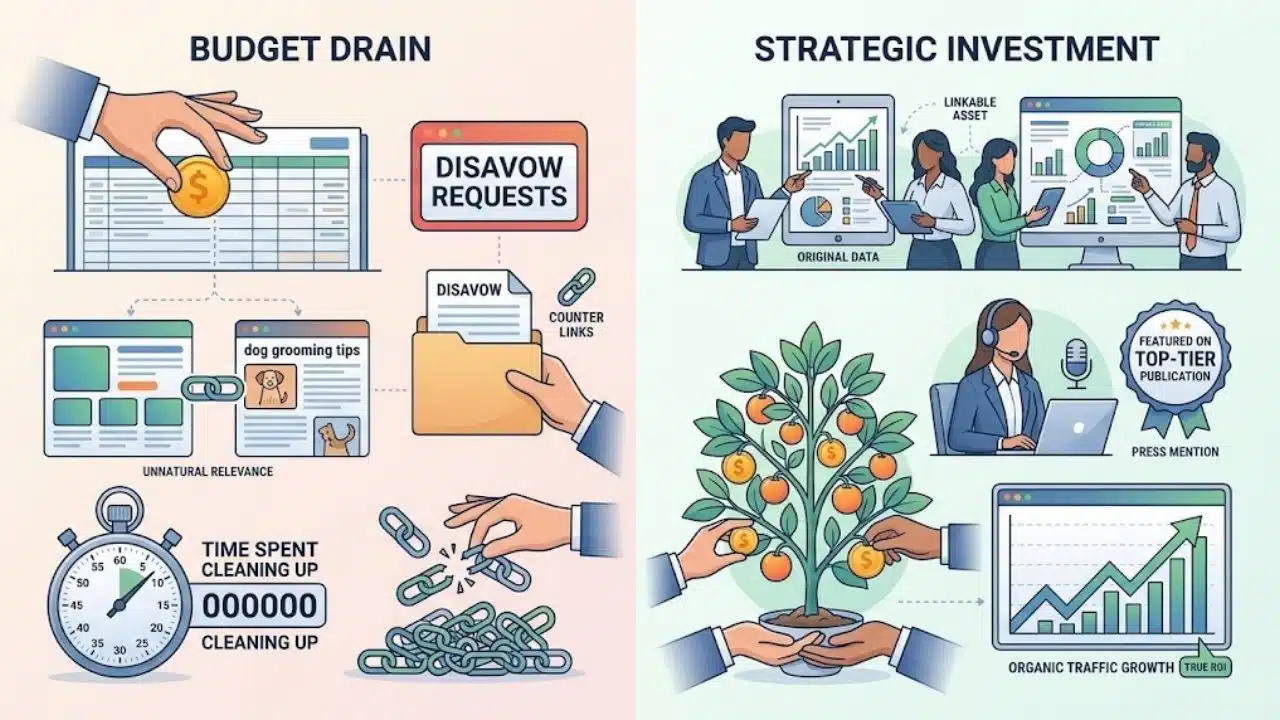
The underlying failure in traditional link building strategies is treating backlinks as commodities bought in bulk rather than digital assets earned through authoritative content distribution. Buying links based on vanity metrics creates fragile search engine visibility that collapses as search algorithms update.
Sustainable backlink strategies treat link acquisition as an extension of corporate communications and digital PR. Instead of distributing budget across low-grade outreach services, high-performing marketing teams concentrate resources into three core areas:
When your organization publishes primary research or unique industry data, journalists, bloggers, and industry analysts cite your pages naturally. This model shifts your budget from paying for low-quality manual link placements to funding authoritative content assets that attract editorially earned backlinks over time.
Frequently Asked Questions (FAQs) About Link Building Myths
How can I tell if a website selling guest posts is a link farm?
Examine the site’s organic traffic trend using SEO tools like Ahrefs or Semrush. If the domain shows high DR but near-zero organic search traffic, or if it publishes articles on wildly unrelated topics (such as casino tips alongside home gardening advice), it is a commercial link farm.
What is a healthy anchor text ratio for an organic backlink profile?
A natural anchor text profile typically consists of 60 to 70 percent branded anchors (brand name, domain URL), 20 percent partial-match or contextual phrase anchors, 5 to 10 percent generic anchors (“click here”, “website”), and less than 5 percent exact-match keyword anchors.
Should I use Google’s Disavow Tool to clean up low-quality links?
Google’s automated algorithms are designed to ignore low-quality or spammy backlinks automatically. You should generally only use the Disavow Tool if your website has received an explicit manual action warning in Google Search Console or if you suspect a targeted negative SEO attack.
How long does it take for new backlinks to impact search rankings?
The ranking impact of a new backlink depends on the linking site’s crawl frequency and authority. It typically takes anywhere from two weeks to three months for search engine crawlers to discover, index, and recalculate ranking signals derived from new backlink placements.
Is it safe to pay for press releases for link building purposes?
Press releases are valuable for corporate announcements and brand exposure, but the links contained within mass-distributed press releases should always carry the rel="nofollow" or rel="sponsored" attribute. Using dofollow exact-match links in press releases violates search quality guidelines.