


I still remember the sinking feeling of trying to validate my first B2B software product. I’d get on a call, proudly show off a semi-functional prototype, and wait for the praise. Instead, I’d hear that polite, dreaded phrase: “This looks really interesting. Let us know when it’s ready.”
It took me a year of wasted engineering cycles to realize a harsh truth: asking for a “beta tester” usually invites casual tire-kickers. If you are building a complex B2B product, you don’t need beta testers. You need design partners and design partner program.
A beta tester logs in to see if your code breaks. A design partner signs up to co-build a solution to a problem that is actively costing them time or money. They give you their time, internal data, and honest friction points. In return, you build a tool that solves their exact “hair-on-fire” problem, granting them heavy influence over your roadmap and preferential pricing.
If you want to stop guessing what the market wants and start building alongside the people who will actually buy it, here is the playbook I use to run a design partner program.
The Magic Number: 5 to 15 Partners
One of the biggest traps founders fall into is trying to recruit as many early users as possible. Resist that urge. You want exactly 5 to 15 design partners.
Here is why that ratio matters:
- Fewer than 5: You lack signal diversity. You risk over-fitting your entire product to the quirky, hyperspecific workflows of just one or two companies. You accidentally become their unpaid IT consulting firm.
- More than 15: You simply won’t have the calendar space to maintain weekly synchronous time with them. The relationship degrades from a true partnership into a glorified email newsletter.
Hitting that 5-to-15 sweet spot gives you enough overlapping data to spot genuine market patterns, but keeps the group intimate enough that you can jump on a quick screen-share to watch exactly where their mouse hesitates.
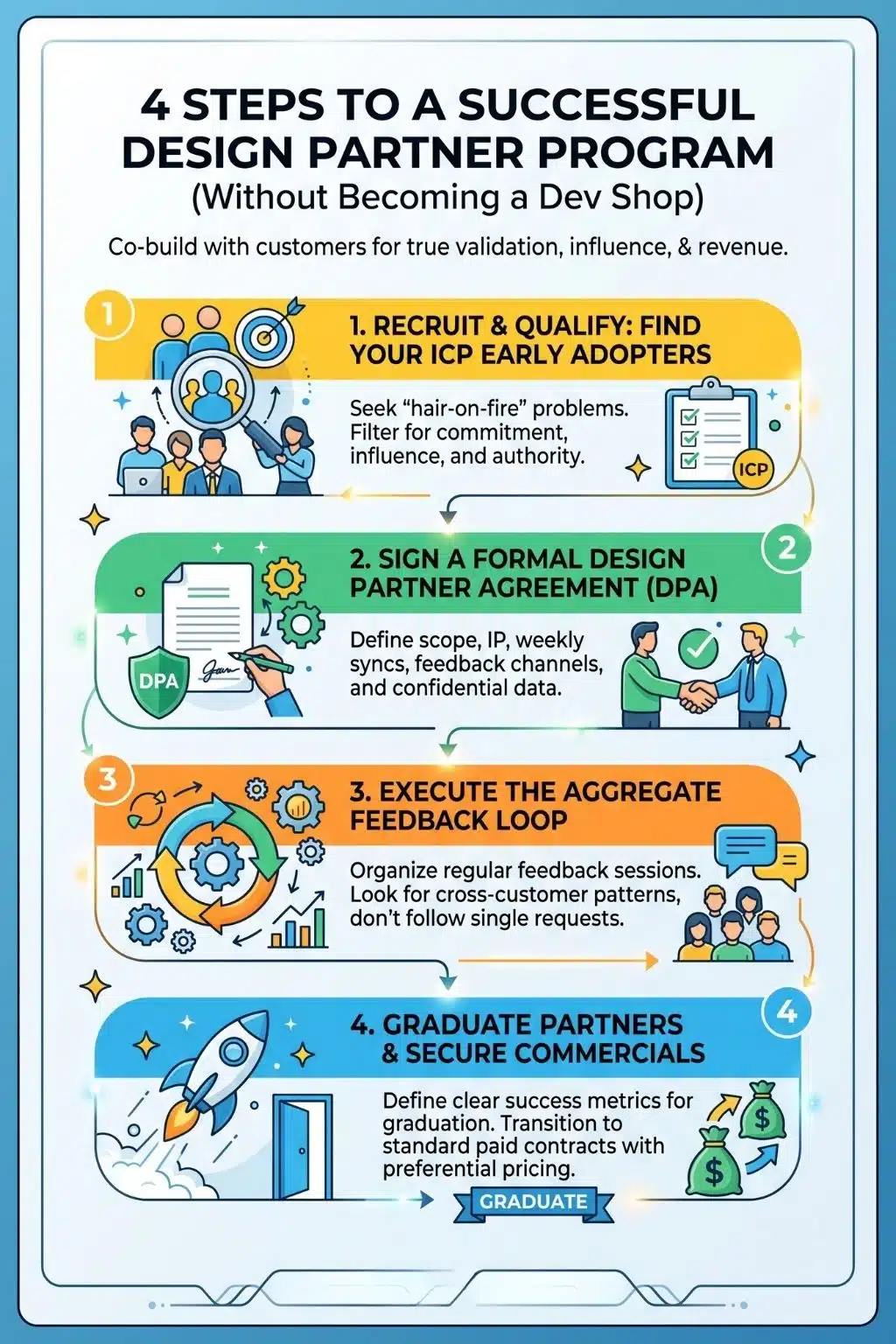
The 4-Step Playbook for Running the Program
Running this program effectively requires a strict operational rhythm. If you wing it, you will lose your partners’ attention.
1. Recruit for “Bleeding Neck” Problems
Don’t just ask your industry friends to try your app. Your first design partners must perfectly match your Ideal Customer Profile (ICP). Look for people who are currently suffering from the problem so badly that they are actively paying for, or building, a miserable workaround. A prospect stringing together Zapier automations, offshore virtual assistants, and Excel macros to do a job is your perfect candidate.
2. Ditch the LOI for a Real Agreement
Throw out the vague Letters of Intent (LOIs). An LOI holds no weight and sets zero boundaries. You need a simple Design Partner Agreement (DPA). Before involving expensive lawyers, sit down with the partner and agree on the business realities:
- The Time Tax: “We expect a 45-minute call every two weeks, plus asynchronous feedback within three days of a new feature drop.”
- IP Ownership: You own 100% of the intellectual property, features, and code built during the partnership, even if they literally sketched the feature on a napkin for you.
- The Finish Line: Define the exact metric that proves the pilot worked (e.g., “Saves your accounting team 10 hours a week”).
3. Aggregate, Don’t Dictate
Set up a shared Slack channel and dedicated bi-weekly syncs. Your job on these calls is not to sell; it is to observe. Have them share their screen and attempt a task. Watch where they stumble. When they ask for a highly specific feature, do not immediately add it to Jira. Instead, take that request to your other 9 partners and see if they need it too. Your goal is to build features that solve the pattern, not the individual request.
4. Graduate Them to Paid Contracts
Do not fall into the “perpetual free tier” trap. From day one, everyone needs to know when the design phase ends. This usually happens when the product can handle their core use cases without manual, back-end configuration from your engineers.
At graduation, you transition them to standard commercial terms. I recommend a steep, lifetime discount (e.g., 30% to 50% off) as a thank-you for their early faith and patience. But make no mistake: they must start paying.
Building With, Not Just For
Ultimately, a great design partner program shifts your mindset from guessing what the market wants to actively building it alongside the exact people who will buy it.
It requires a lot of vulnerability, you have to show them messy prototypes, half-finished features, and bugs that crash the app. But that honesty breeds incredible loyalty. Treat your design partners like an extension of your own product team. Respect their time, listen to their frustrations, and never be afraid to have the pricing conversation. When you do it right, your early partners won’t just become your first paying customers; they will become your loudest champions in the market.
Frequently Asked Questions on Design Partner Program
1. Should I charge my design partners from day one?
Increasingly, yes. Charging a small, heavily discounted pilot fee is the ultimate demand test. If a company won’t pay a fraction of the cost for early access to a solution, their problem probably isn’t painful enough to build a scalable business around.
2. How do I prevent one massive partner from hijacking my product roadmap?
Set firm boundaries in the DPA. Explicitly state that you will not build custom, one-off integrations just for them. If a massive enterprise demands a hyper-specific feature that no one else needs, offer to build it only as a separate, paid professional services contract. Guard your core roadmap fiercely.
3. What if a design partner stops responding to feedback requests?
Fire them gracefully. A design partner program is not a charity. If they stop attending meetings or logging in, they are taking up a valuable slot. Send a polite email stating that you are pausing their design partner status to make room for active participants, but that you’d love to reconnect when the product is officially launched.
4. How long should a design partner program last?
Typically between 3 to 6 months. Anything shorter isn’t enough time to iterate on complex B2B workflows and squash bugs. Anything longer suggests you are stuck in a perfectionism loop and dragging your feet on taking the product to the broader market.
5. How do I actually find these people?
Cold outreach on LinkedIn targeting specific job titles is a start, but the best partners often come from niche communities. Look for complaints in specialized Slack groups, Reddit forums, or industry conferences. When someone vents about a broken process, send them a message saying, “I’m building something to fix exactly this. Want to help me shape it?”





















