


Most people asking how edtech startups make money are really asking two questions at once. Which model brings in cash, and which one can a small team actually survive on? Those are not the same question, and the gap between them is where most education apps quietly die.
I work on the technical side at Edutorial. We publish Alphabet Magic: Trace & Phonics on the App Store and on Google Play. It is free to download and earns through in-app purchases. That was not decided in a strategy meeting. It came out of a series of small, unglamorous choices about children, parents, privacy law, and platform fees. Each choice closed off a model we could have used.
This is what the options look like from inside a working app, with the 2026 numbers that changed this year.
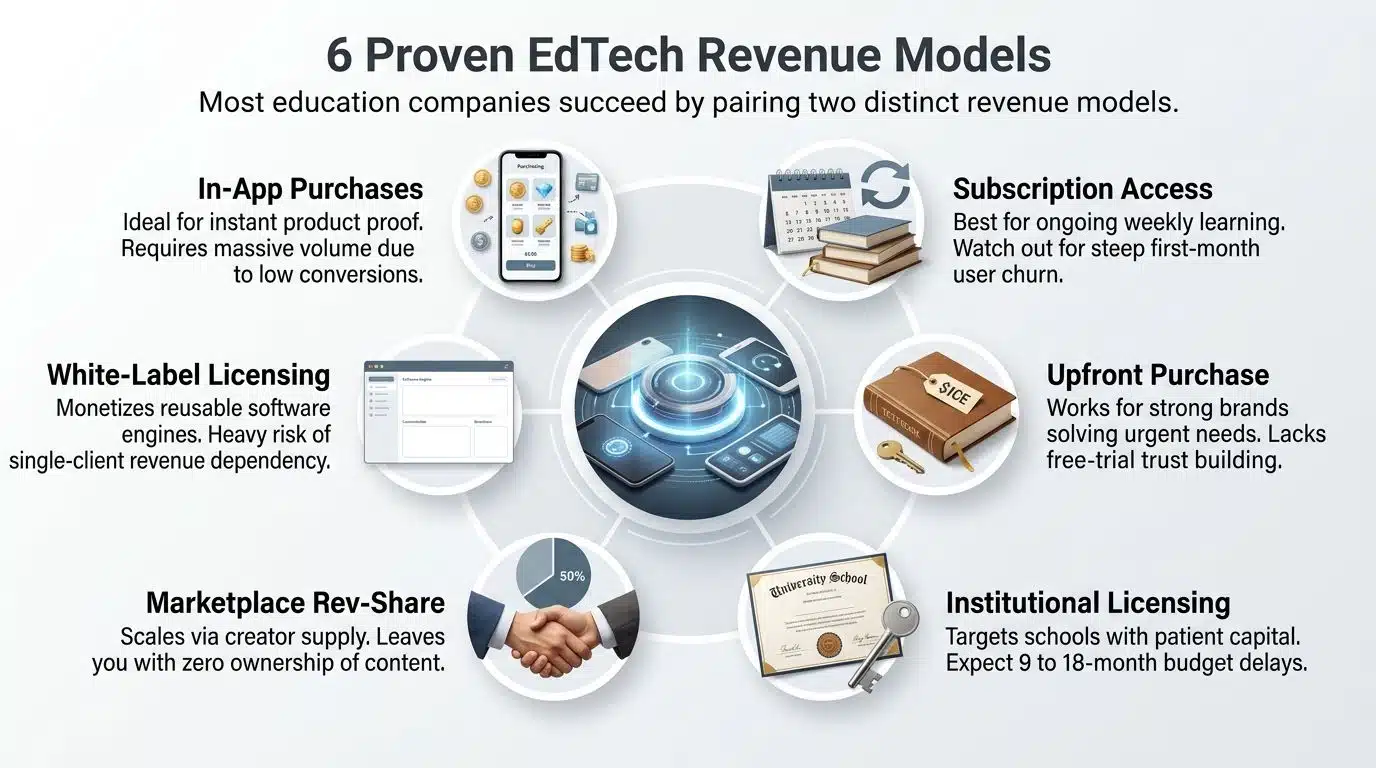
The Six Models that Actually Pay in Education
| Model | Who pays? | Works best when | Main risk |
|---|---|---|---|
| Free download + in-app purchase | Parent or learner | The product proves itself in one session | Low conversion, high volume needed |
| Subscription | Parent or learner | Learning happens weekly, not once | Churn after the first month |
| Paid upfront | Parent or learner | Strong brand or a narrow, urgent need | No trial means no trust |
| School or district license | Institution | You can wait out a budget cycle | Cash arrives 9 to 18 months later |
| Marketplace revenue share | Learner, split with creator | Supply of teachers or courses is real | You own neither the content nor the demand |
| Licensing or white-label | Another company | Your content or engine is genuinely reusable | One client becomes your whole business |
Most companies end up running two of these at once. Duolingo is the clearest public example: daily active users grew 23% to 58.7 million in the second quarter of 2026, with paid subscribers up 17% to 12.7 million, and it still runs advertising alongside subscriptions. If you want a wider view of the combinations, we broke them down separately in our guide to potential edtech business models.
Why We Went Free With In-App Purchase
Parents do not pay for a phonics app before their child has touched it. A four-year-old either engages with letter tracing in the first two minutes or hands the tablet back. No screenshot or app store description wins that argument. So the download had to be free, and the paywall had to sit after the child had traced a few letters and the parent had watched it happen.
That decision costs money, and the data is blunt about it. RevenueCat’s 2026 report, built on more than 115,000 subscription apps, found that freemium apps convert at a median 2.1% by day 35 while hard paywall apps convert at 10.7%, and revenue per install at day 60 sits at $0.38 for freemium against $3.09 for hard paywalls. That is roughly an eight-to-one gap in early revenue per install.
We accepted it because the alternative is worse for a kids’ product. A hard paywall on an untested phonics app produces refunds and one-star reviews, and reviews are the only distribution a small publisher has.
Two other benchmarks are worth planning around. Median day-35 download-to-paid conversion is 2.56% in North America against 1.37% in India and Southeast Asia, so the same app earns very differently depending on where installs come from. And education has a real strength: education apps now post the highest median weekly subscription renewal rate at 58%. Learning habits renew when the habit is weekly.
The Store Fees Changed in 2026 and the Math Moved
This is the part of how edtech startups make money that founders most often get wrong, because the rates they memorized are out of date.
On Apple, the standard commission is still 30%, but the Small Business Program drops it to 15% if you earned under one million dollars in App Store proceeds last calendar year, and new developers get the 15% rate from the day they ship. Since the 2025 court order, US apps can also send users to a web checkout. Link-outs currently carry no Apple commission, and on August 14, 2026 Apple asked the court to approve 15% standard, 10% for partner programs, and 5% for Small Business Program members. Those rates are not in force until a judge approves them, so the commission-free window is still open as I write this.
Google moved further. From June 30, 2026, in the US, EEA, and UK, Google separated its service fee from its billing fee: the service fee starts at 10% on your first $1M in annual earnings, and that 10% also applies to all auto-renewing subscriptions. A 5% billing fee applies on top only if you use Google Play’s billing system, and one-time purchases above the $1M line run 20% for new installs and 25% for existing ones.
For a small publisher, that means the platform takes 15% or less, not 30%. Enroll in Apple’s program on day one. Model your fees by buyer region, not by where your company is registered.
Advertising Looks Free and Is the Most Expensive Option for a Kids’ App
We do not run third-party ads. That was a legal call, more than a product one.
The FTC’s amended COPPA Rule became enforceable on April 22, 2026, with civil penalties reaching $53,088 per violation. The rule does not ban advertising to children, but it now requires separate, named opt-in parental consent before a child’s data goes to each third party, which includes every ad SDK in your mediation stack. Outsourcing the ad serving does not outsource the liability.
For anyone building for under-13s, that removes the ad-supported model in practice. You are left with parent payment, school payment, or someone else’s money. Worth knowing before you write it into a pitch deck.
Why we sell to parents
School revenue is real and it is also slow. Roughly $190 billion in federal ESSER relief has been spent, K-12 deal activity has dropped about 20%, and 42% of K-12 business officials say competition for education dollars is rising significantly. District budget planning usually starts in January or February with board approval in May or June, so missing that window pushes you a full year. Higher education runs on 9- to 18-month sales cycles.
A team of our size cannot fund eighteen months of pilots out of pocket. Consumer money is smaller per user and arrives this week. That trade is the honest reason we stayed parent-direct, and it is the same reason many of the edtech startups to watch start consumer and add institutional sales only after they have cash in the bank.
What I’d Check Before Picking a Model
- Who physically holds the card. In K-12, the payer, the user, and the decision-maker are three different people.
- Whether your audience’s rules kill a model outright, like COPPA kills ads for young children.
- Your fee math per region, not one global number.
- How many months of runway the sales cycle demands. Institutional revenue needs a bank balance that consumer revenue does not.
- Whether the model still works if your conversion rate is half the median. Plan for the bad case; the good case takes care of itself.
If you are earlier than this and still shaping the product, our walkthrough on how to start an edtech startup covers the stage before monetization.
Final Thoughts
How edtech startups make money comes down to a single question: who has both the money and the reason to hand it over this month. For us that is a parent watching a child trace a letter. For a curriculum company, it is a district with a bond measure. The models are not better or worse than each other. They are better or worse matched to who your learner is and how fast you need to be paid.
Pick the model your buyer already fits, then fix the fee math and the legal exposure before you scale spending on it.
Frequently Asked Questions (FAQs)
1. Do I have to use in-app purchases at all in 2026?
Not in the US. Both platforms now allow external purchase links, and Apple’s link-out commission sits at zero while the court decides. You take on payment processing, tax, and refunds yourself, so it pays off only at real volume.
2. Is a subscription always better than a one-time purchase?
Only when learning is recurring. Subscriptions now carry Google’s 10% service fee at any revenue level, which makes them cheaper to run than they were, but a single-outcome product still churns fast.
3. What does an education app realistically convert at?
Around 2% of downloads are paid by day 35 for freemium apps, roughly double that in North America at higher price points. Anything far above that usually means a hard paywall, not a better product.





















