
A local AI model needs to leave enough memory for the rest of your computer—and answer quickly enough to be useful. Choosing the best open-source AI models for local use starts with that constraint, then the work you actually need done.
Qwen3.5-9B is a useful first candidate for mixed tasks. Gemma 3 4B suits smaller image-based workflows, while Qwen2.5-Coder-7B offers focused coding assistance. The remaining choices address particular needs, from compact text processing to application development. The order reflects those uses rather than a universal performance ranking.
One distinction matters throughout: downloadable weights do not automatically make an AI system fully open source. The Open Source Initiative’s definition also requires relevant code and training-data information. This list includes open-weight models with custom terms alongside permissively licensed releases.
1. Qwen3.5-9B: A Versatile Starting Candidate
Qwen3.5-9B can handle written prompts and image questions in the same deployment. Its Apache 2.0 license and configurable thinking behavior make it a reasonable starting point for an assistant that explains scripts, summarizes documents, and discusses screenshots.
The setup deserves attention before the download. Support for older Qwen models does not establish support for this architecture or its vision features. Choose a compatible runtime and quantization, then begin with a short context setting.
Its advertised native context is 262,144 tokens. Treat that as model capacity, not a recommended laptop configuration. For a straightforward rewrite or classification task, disabling thinking through the supported template setting avoids unnecessary extended output.
2. Gemma 3 4B IT: Smaller-Scale Image Understanding
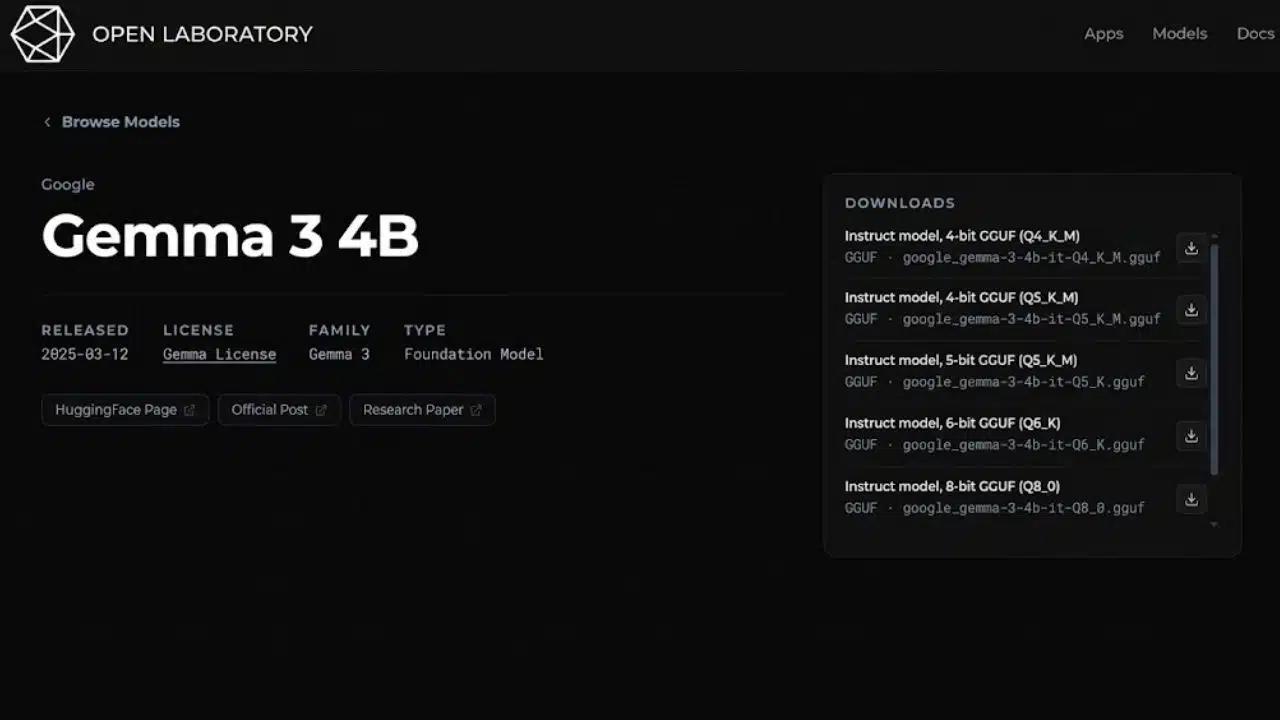
A screenshot assistant does not necessarily need a large model. Gemma 3 4B IT accepts text and images and generates text, making it worth comparing with Qwen when memory is tighter.
Download the instruction-tuned 4B variant deliberately. Gemma 3 1B is text-only, and a runtime without the necessary vision components cannot provide image understanding simply because the model family supports it.
Gemma uses Google’s custom terms; its official Hugging Face repository requires accepting them. For photographed documents, begin with clear images and a few requested fields. Check names, totals, and small print against the original before relying on the output.
3. Phi-4-mini-instruct: Compact Text and Technical Tasks
Phi-4-mini-instruct is a 3.8-billion-parameter, MIT-licensed text model. Microsoft identifies memory-constrained applications and mathematical or logical reasoning among its intended uses. It also supports function calling.
Its factual limitations shape the recommendation. Use it to explain a supplied calculation or answer from a relevant passage; avoid treating it as an encyclopedia. Microsoft explicitly warns that its size limits stored factual knowledge.
This is separate from Phi-4-multimodal-instruct. Choose it for text work, and remember that its 128K context support does not establish comfortable memory use at that length.
4. Qwen2.5-Coder-7B-Instruct: Focused Coding Assistance
Qwen2.5-Coder-7B-Instruct remains useful as an established coding specialist with official GGUF quantizations, including Q4_K_M. Those releases give readers a clear download path for compatible local runtimes.
The Apache 2.0 model has 7.61 billion parameters and targets code generation, reasoning, and repair. Its place here is for contained work: explaining a function, drafting tests, or proposing a fix. It is not presented as the current coding benchmark leader.
Give it the failing function, relevant types, dependency versions, and actual error message. A stack trace alone rarely supplies enough context for a dependable change. Review the patch and run tests before accepting it.
5. SmolLM3-3B: For Inspectable, Lightweight Experiments
SmolLM3 stands out for what accompanies its Apache 2.0 weights: public training details, a data mixture, and training configurations. That makes it particularly relevant to developers who want to examine how a model was built.
The three-billion-parameter model supports thinking and non-thinking modes. Its six natively supported languages are English, French, Spanish, German, Italian, and Portuguese.
Consider it for narrow tasks such as classifying short notes or extracting fields from supplied text. Evaluate the language and output format your application actually needs; broad conversational fluency is a different requirement.
6. Llama 3.2 3B Instruct: For an Existing Llama Setup
The strongest reason to choose Llama 3.2 3B Instruct is an existing integration that already works. Meta documents dialogue, summarization, and tool-use capabilities, with eight officially supported languages.
This compact release is text-only and uses the Llama Community License plus associated acceptable-use terms. Review those conditions before distributing an application.
For a new project, familiarity with the Llama name is not enough to settle the choice. Retain it when integration costs matter and its results meet the task; otherwise, compare another small model before committing.
7. DeepSeek-R1-Distill-Qwen-7B: For Reasoning Experiments
Despite the name, this is not the full DeepSeek-R1 model compressed into a small file. It is a Qwen-derived model fine-tuned on examples curated using R1.
Its niche is local mathematical and logical reasoning experiments. Long responses can become an inconvenience when all you need is a short summary.
DeepSeek recommends a temperature of 0.5–0.7 and putting instructions in the user prompt rather than adding a system prompt. Follow that model-specific guidance when evaluating it. The release is MIT-licensed, with its Apache 2.0 Qwen ancestry documented. Judge its final answers against known solutions, not the length of its explanations.
8. gpt-oss-20b: For Configurable Reasoning and Tool Use
gpt-oss-20b offers adjustable reasoning effort and function calling under Apache 2.0. It warrants consideration when those controls justify a larger deployment.
The documented 16GB memory figure applies to MXFP4 quantization in a compatible setup. It is not a blanket assurance for every computer with 16GB installed: context, runtime overhead, and other applications need room too.
Choose software that explicitly supports Harmony, the model’s message format. Function calling also requires surrounding application code to execute actions. Downloading the weights does not install a working browser, Python environment, or complete agent.
9. Ministral 3 8B Instruct: For Local Application Backends
For an application combining image input with structured responses, Ministral 3 8B Instruct offers vision, native function calling, and JSON output capabilities under Apache 2.0.
It contains an 8.4-billion-parameter language component and a 0.4-billion-parameter vision encoder. Mistral documents that the FP8 release fits into 12GB of VRAM, with lower requirements possible through further quantization. Allow headroom for the workload.
Choose Instruct for ordinary assistant development; Base and Reasoning are separate variants. Validate returned JSON against your schema and check its values. Correct formatting does not establish correct extraction.
Before You Download
File size, running memory, and response speed are different constraints. Eight billion weights stored at four bits amount to roughly 4GB before metadata, additional components, and runtime overhead. Conversation caching adds further memory use.
Start with a compatible model in LM Studio or use llama.cpp for direct control. Supported CPU and CPU/GPU hybrid execution can expand your options, but neither guarantees interactive speed.
Privacy requires checking the entire application. LM Studio supports offline chat and document processing after the necessary downloads. Remote embeddings, search, or cloud fallback elsewhere in the workflow can change where information travels.
Final Thoughts
The best open-source AI models for local use should earn their place on your actual workload. Choose two that fit your available memory, compare their answers and response times, and keep the smaller one when it performs reliably. Upgrade when a measured limitation is blocking useful work.
Frequently Asked Questions (FAQs)
What should a useful model test include?
Use tasks you can score: a document question with a known answer, a coding change with tests, or extraction with expected fields. Include an incomplete input to see whether the model asks for clarification or invents missing details.
Should you buy new hardware first?
Usually, start with the hardware available. Establish whether the problem is insufficient memory, slow responses, or weak answers before spending money. Those problems do not necessarily have the same solution.
Does a model’s language count tell you how well it translates?
No. A supported-language list is a starting point for evaluation. Compare examples from your intended language pair, including specialist vocabulary and tone, before using the model for translation work.