

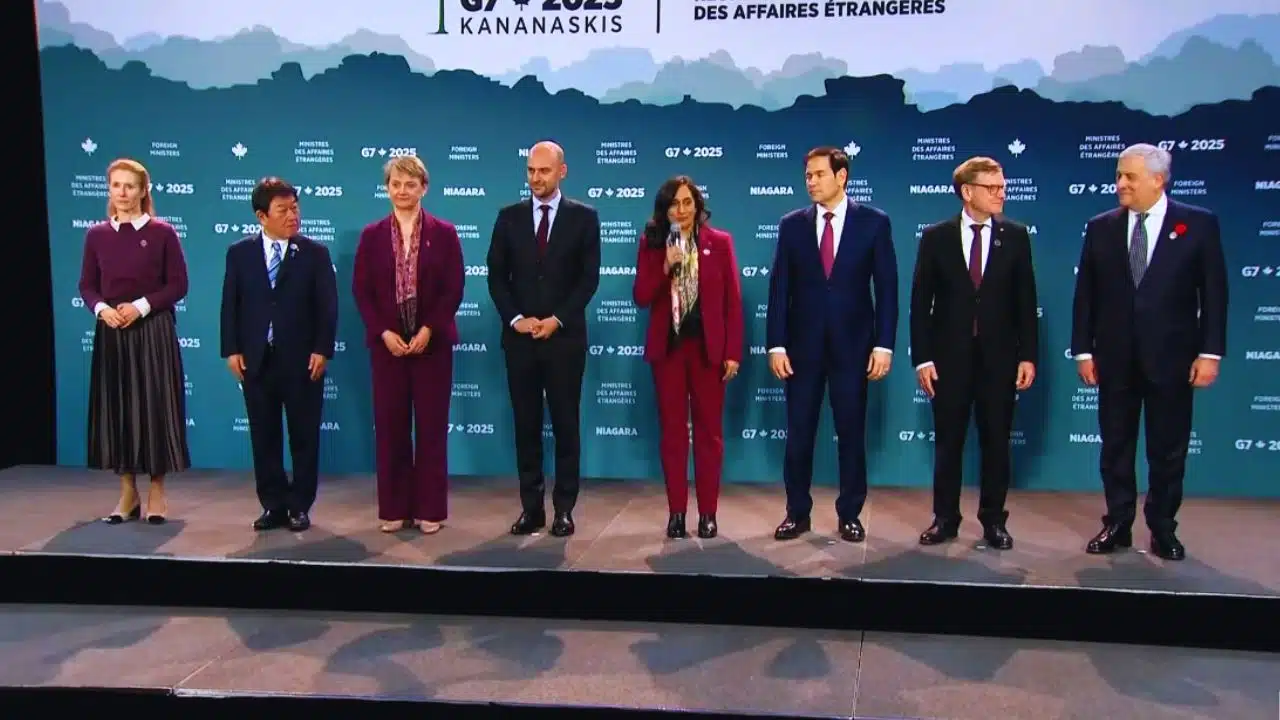
Foreign ministers from the Group of Seven (G7) leading industrialized democracies—comprising Canada, France, Germany, Italy, Japan, the United Kingdom, and the United States—convened in the picturesque Niagara-on-the-Lake region of Ontario, Canada, starting Tuesday evening, November 11, 2025. This two-day summit, hosted by Canadian Foreign Minister Anita Anand, brought together key diplomats to tackle pressing global challenges, including escalating trade disputes, defense commitments, and ongoing conflicts in Ukraine and the Middle East. The gathering also included outreach partners such as Australia, Brazil, India, Mexico, Saudi Arabia, South Korea, South Africa, and Ukraine, expanding the dialogue to address issues that span beyond traditional G7 boundaries.
U.S. Secretary of State Marco Rubio, representing the United States under President Donald Trump, arrived amid heightened tensions, emphasizing in a social media post that the discussions would prioritize “the safety and security of Americans FIRST” while navigating a range of critical international matters. The location, just across the U.S. border on Lake Ontario, symbolically underscores the proximity and interdependence of North American allies, yet it also highlights the fragility of these ties in light of recent bilateral frictions.
Canada, holding the G7 presidency for 2025, chose Niagara-on-the-Lake for its serene setting in wine country, providing a neutral backdrop for what Anand described as “productive sessions” focused on multilateral cooperation in an era of rising protectionism and geopolitical volatility. The summit’s timing, just weeks before the holiday season and amid Canada’s first major snowfall of the year, added a layer of logistical challenge, with Anand noting the arrival of “15 foreign ministers…to the Great White North” as a testament to the group’s commitment to dialogue despite adverse conditions.
Experts, including those from the University of Toronto’s G7 Research Group, observe that while the ministers’ level allows for more straightforward negotiations without direct presidential involvement, the shadow of Trump’s policies continues to influence proceedings, potentially fostering both urgency and division. This meeting builds on prior G7 efforts to uphold shared values like democracy, human rights, and economic stability, but it arrives at a moment when U.S.-led initiatives on trade and security are testing the alliance’s cohesion. The agenda reflects Canada’s emphasis on forward-looking strategies, with sessions designed to produce actionable outcomes on everything from humanitarian aid to supply chain resilience.
Trade Disputes Intensify Under Trump’s Tariff Agenda
At the heart of the summit’s early discussions were the deepening rifts caused by President Trump’s aggressive trade policies, particularly his imposition of tariffs on imports from key allies like Canada. Relations between Washington and Ottawa have deteriorated significantly, culminating in Trump’s abrupt suspension of bilateral trade negotiations earlier this month. This decision stemmed from an advertisement run by the Ontario provincial government in U.S. media, which criticized Trump’s tariffs as harmful to cross-border commerce and consumer prices; the ad’s satirical tone reportedly infuriated the U.S. president, leading to the halt in talks that were aimed at updating the United States-Mexico-Canada Agreement (USMCA). Canadian Prime Minister Mark Carney responded swiftly, issuing a public apology for the ad and expressing readiness to resume discussions whenever the U.S. is prepared, highlighting the economic stakes involved—Canada exports over $500 billion in goods to the U.S. annually, making it the country’s largest trading partner.
Anand, during a pre-summit interview, acknowledged the complexity of the U.S.-Canada relationship, stating that “every complex relationship has numerous touch points,” and stressed the need to advance cooperation on non-trade issues like security and diplomacy even as economic grievances persist. Her planned one-on-one meeting with Rubio was expected to address these strains, though she clarified that U.S. trade matters fall under a different department, allowing the foreign ministers to focus on broader diplomatic avenues. The tariffs, which target sectors like steel, aluminum, and automobiles, have broader implications for the entire G7, as Trump has signaled intentions to renegotiate deals with Europe and Japan to prioritize American manufacturing and reduce trade deficits.
European allies, including Germany and France, have voiced concerns that such measures could trigger retaliatory tariffs, slowing global economic growth projected at just 2.8% for 2026 by the International Monetary Fund. The summit provided a platform for ministers to explore collective responses, such as joint advocacy for fair trade rules under the World Trade Organization and strategies to diversify supply chains away from over-reliance on any single market. Analysts warn that without reconciliation, these disputes could erode the G7’s ability to present a united front against external economic pressures, such as those from China’s state-subsidized industries.
Defense Commitments Divide NATO Allies in the G7
Defense spending emerged as one of the most contentious topics, fueled by Trump’s insistence that NATO members dramatically increase their contributions to 5% of gross domestic product (GDP) by 2035—a proposal that more than doubles the alliance’s existing 2% target established at the 2014 Wales Summit. This ambitious goal, broken down into 3.5% for direct military expenditures and 1.5% for broader security investments like infrastructure and cybersecurity, is framed by the U.S. as essential for equitable burden-sharing, given that America currently covers about 70% of NATO’s total budget. All G7 nations except Japan are NATO members, making the demand particularly relevant, yet it has exposed significant disparities Canada and Italy currently allocate the lowest percentages among G7 peers, hovering around 1.4% and 1.5% respectively, while countries like the UK and Germany are closer to 2.1% but face domestic pushback for further hikes.
In a key announcement, Anand committed Canada to meeting the 5% target by 2035, detailing how the nation’s recent federal budget incorporates an $80 billion Canadian dollars (approximately $58 billion USD) infusion into defense over the next decade. This includes investments in modernizing the Canadian Armed Forces, enhancing Arctic capabilities, and procuring new equipment like fighter jets and naval vessels, with an interim milestone of reaching 2% this fiscal year.
“We are going to reach 2 percent this year and 5 percent of GDP by 2035,” Anand affirmed to reporters, positioning the pledge as a demonstration of Canada’s reliability within the alliance. However, not all allies share this timeline; UK Foreign Secretary Yvette Cooper highlighted political and budgetary obstacles in Western Europe, where rapid increases could strain public services amid cost-of-living pressures. In contrast, smaller NATO members like Estonia, Lithuania, and Latvia—former Soviet republics with firsthand experience of Russian threats—have pledged to achieve 5% as early as 2026, driven by heightened security concerns near Russia’s borders.
NATO Secretary General Mark Rutte has credited Trump’s pressure for accelerating commitments, noting that 23 of 32 members already meet or exceed 2%, up from just three in 2014, but the 5% push remains divisive. Critics, including environmental advocates, argue that diverting such vast sums—potentially trillions globally—toward military purposes could undermine funding for climate action and social welfare, especially as NATO’s northern flank faces Arctic challenges from climate change itself. The G7 discussions aimed to bridge these gaps through phased implementation plans and shared procurement initiatives, ensuring that increased spending enhances collective deterrence without fracturing the alliance.
Ukraine Support Strengthens Amid Winter Preparations and Russian Escalation
The summit’s second day opened with a dedicated session for Ukrainian Foreign Minister Andriy Sybiha, where G7 ministers reaffirmed their unwavering backing for Kyiv as Russia intensifies attacks on civilian infrastructure, particularly energy grids vital for the upcoming winter. With over 1,000 days of conflict since Russia’s full-scale invasion in February 2022, Ukraine faces severe humanitarian strains, including widespread blackouts from missile strikes that have damaged 50% of its power generation capacity, according to the International Energy Agency. The UK led with a £13 million (about $16.5 million USD) pledge to repair Ukraine’s power, heating, and water systems, announced by Cooper as a direct counter to Russian President Vladimir Putin’s strategy to “plunge Ukraine into darkness and the cold as winter approaches. This funding targets immediate fixes for substations and pipelines, alongside humanitarian aid to support millions displaced or without reliable utilities.
Canada echoed this commitment by fast-tracking the final $10 million CAD installment of its $70 million contribution to the Ukraine Energy Support Fund, a multilateral initiative pooling resources for rapid response repairs. Broader G7 actions include a landmark agreement to freeze approximately $300 billion in Russian central bank assets held in Western jurisdictions until the war ends, with profits from these reserves—estimated at $5-6 billion annually—channeled into up to $50 billion in low-interest loans for Ukraine’s reconstruction, as outlined in the World Bank’s needs assessment totaling $524 billion over the next decade.
This mechanism bars any Russian involvement in post-war rebuilding and ties loan repayments to sustained asset immobilization, providing Ukraine with predictable financing for housing, infrastructure, and economic recovery. Ministers also discussed tightening sanctions on Russia’s shadow fleet of oil tankers and dual-use technology exports if no ceasefire materializes, while committing to ongoing military aid, including advanced air defenses and artillery to counter intensified drone and missile campaigns.
Despite this unity, subtle divisions linger over endgame strategies. Most G7 members advocate a hardline against territorial concessions, viewing them as rewarding aggression, whereas Trump has publicly suggested Ukrainian President Volodymyr Zelenskyy consider ceding Crimea and eastern regions for peace—a stance rejected by Kyiv and echoed in recent failed summit attempts with Putin, postponed after Moscow dismissed immediate ceasefire calls. Diplomats at the summit appreciated the absence of Trump himself, allowing for unfiltered coordination, as noted by G7 Research Group Director John Kirton, who described it as “certainly beneficial” for progress on unified messaging. The session concluded with pledges for sustained diplomatic pressure on Russia and outreach to Global South partners like India and South Africa to isolate Moscow internationally.
Gaza Ceasefire and Middle East Reconstruction Efforts Reveal Internal Splits
Turning to the Middle East, ministers addressed the fragile Gaza ceasefire brokered under Trump’s plan earlier in 2025, with Rubio urging Anand to facilitate an international conference for long-term reconstruction to ensure its durability. The U.S.-proposed framework, endorsed by G7 leaders in June, envisions a multi-phase process an immediate, unconditional ceasefire phased exchanges of hostages held by Hamas and Palestinian prisoners full demilitarization of Gaza supervised by a U.S.-led multinational force involving Arab and European contributors; and a transitional technocratic administration paving the way for broader Palestinian governance reforms.
Rubio emphasized during a recent Washington breakfast with Anand that Hamas must fully disarm and be excluded from any future role in Palestinian institutions, aligning with Trump’s vision of a deradicalized region secured against Iranian influence. Anand affirmed shared agreement on the plan’s importance, noting it as “both welcome and crucial” for regional stability, while committing Canada to help convene stakeholders for post-conflict rebuilding estimated at $90 billion by the United Nations.
The G7 has pledged significant humanitarian support, including $2 billion in aid since the truce’s implementation, focusing on food security, medical supplies, and shelter for Gaza’s 2.3 million residents amid ongoing displacement. However, internal disagreements persist over the path to a two-state solution. Britain, Canada, and France have advanced unilateral recognitions of a Palestinian state, independent of resolving the current violence, to signal commitment to sovereignty and counter perceptions of bias toward Israel—a move that contrasts with the U.S. insistence on security guarantees and normalization with Arab states first.
These differences were aired constructively, with ministers agreeing to coordinate with Egypt, Jordan, and Saudi Arabia on stabilization forces and economic incentives for peace. Broader talks encompassed threats from Iranian proxies in Yemen and Lebanon, aiming to prevent escalation that could derail the ceasefire, while addressing Sudan’s parallel crisis through similar multilateral approaches.
Additional Global Priorities: From Arctic Security to Humanitarian Crises
The agenda extended to emerging transnational issues, starting with Arctic security, where melting ice caps are opening new shipping routes contested by Russia and China, prompting G7 discussions on enhanced patrols and environmental safeguards. Critical minerals like lithium and rare earths—essential for electric vehicles and renewable energy—were another focus, with ministers exploring diversified sourcing to reduce dependence on adversarial suppliers and support green transitions. Maritime safety in the Indo-Pacific, including freedom of navigation amid South China Sea tensions, saw commitments to joint exercises with partners like Australia and Japan.
Humanitarian emergencies in Haiti and Sudan rounded out the talks, with the G7 pledging coordinated aid $500 million for Haiti’s gang violence response, including UN peacekeeping reinforcements, and sanctions against Sudan’s warring factions to facilitate ceasefires and refugee support. Canada’s presidency emphasized inclusive partnerships, inviting non-G7 voices to foster solutions that “transcend our borders,” as Anand put it, reinforcing the forum’s adaptability in a multipolar world. Outcomes from these sessions are expected to inform the G7 leaders’ summit next year, underscoring the group’s enduring role in promoting stability despite internal and external pressures.
The information is collected from Business Standard and The Haitian Times.





















