

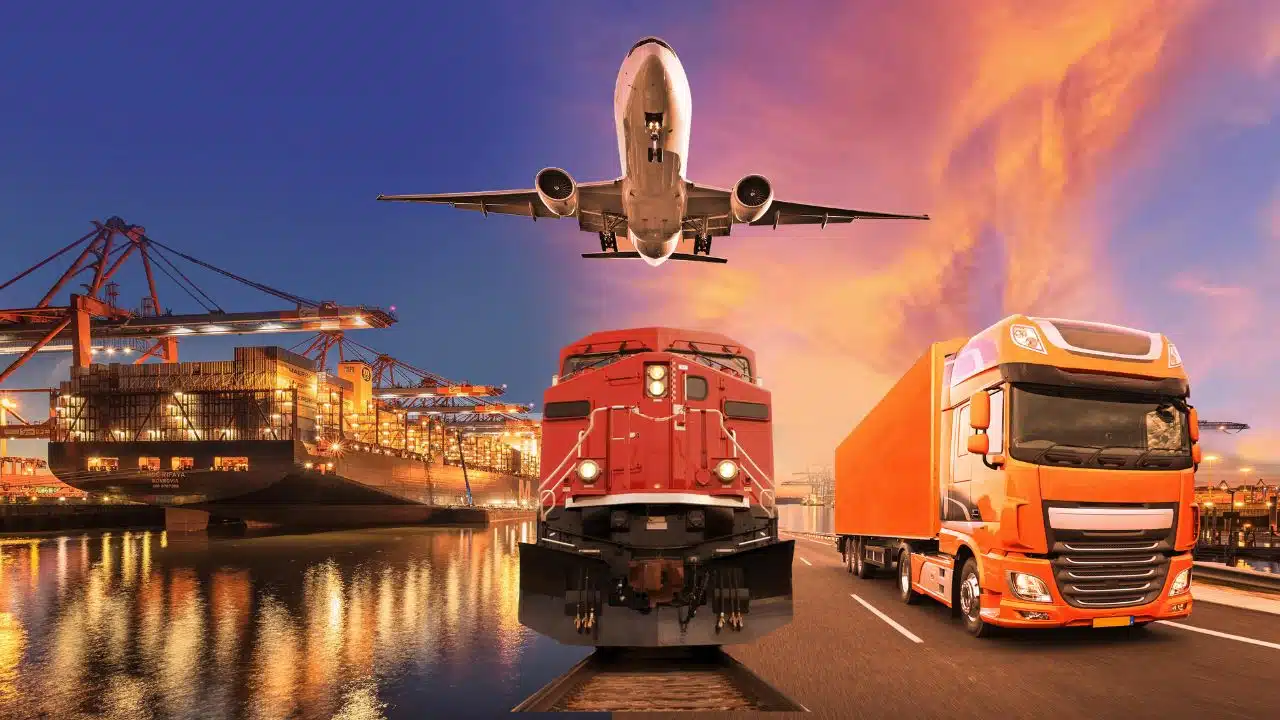
“Global freight forwarding is projected to grow to over USD 200 billion by 2030, driven by e-commerce and cross-border supply chains.”
Behind every smartphone assembled in Asia, every pallet of machinery parts crossing Europe, and every container of goods unloaded at US ports, there is an unseen profession keeping trade on track: the freight forwarder.
Without them, global commerce would stumble over customs regulations, missed shipping schedules, and rising costs. Freight forwarding is, in many ways, the quiet architecture of international trade, making sure goods move from A to B with as little friction as possible.
What Is Freight Forwarding? A Simple Definition
At its simplest, freight forwarding is the business of arranging the transport of goods across borders. Forwarders rarely own ships, trucks, or planes themselves; instead, they act as coordinators who connect shippers with carriers, manage customs paperwork, and consolidate loads to reduce expenses.
For small and medium-sized enterprises (SMEs), this service is essential. International trade involves a complex mix of rules, documents, and transport choices. Freight forwarders simplify that process, making it possible for businesses to trade internationally without being overwhelmed by logistics.
Sea, Air and Road: The Pillars of International Freight
International freight relies on three main modes of transport: sea, air and road.
Sea freight remains the backbone of global trade, carrying around 90 percent of the world’s goods. It is the most cost-effective option for bulk cargo and long distances, with companies choosing between full container loads (FCL) or less than container loads (LCL) depending on their shipment size.
Air freight services are the fastest option for international shipping when time is critical. Although more costly than sea or road transport, they are often chosen for high-value, urgent or time-sensitive goods that need to reach their destination quickly.
Road freight plays a central role in national deliveries, moving goods quickly and reliably within a country. From full truck loads to groupage services that combine smaller shipments, it offers the flexibility and reach that businesses of all sizes depend on.
From Customs to Cargo: The Forwarder’s Toolkit
Getting goods from one country to another involves far more than transport alone. Every shipment must comply with customs regulations, be properly declared, and carry the right paperwork. This is where freight forwarders prove their worth. They handle customs declarations, organise the correct documentation, and liaise with clearance agents to avoid unnecessary delays.
Forwarders also consolidate smaller shipments into larger loads, which reduces costs for businesses and improves efficiency. In practice, they act as both problem solvers and advisors, helping companies navigate international rules while ensuring goods keep moving.
SMEs and the Global Marketplace
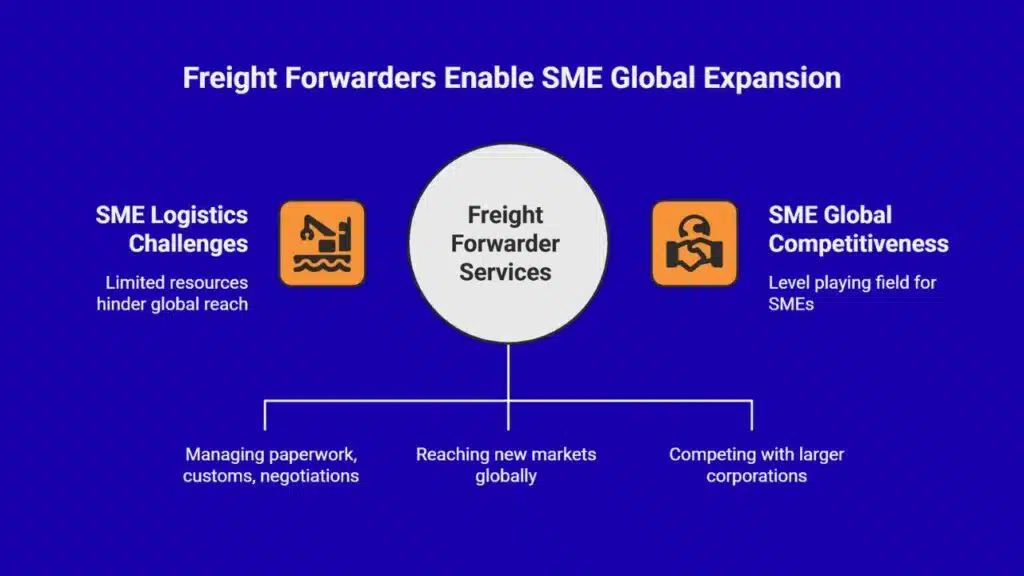
Large multinationals often have in-house logistics teams and established networks, but for small and medium-sized enterprises, the landscape looks very different. An SME in New York that wants to export to Australia or import components from the UK faces the same paperwork, customs checks and carrier negotiations as a global corporation, yet without the same resources. Freight forwarders level the playing field.
By handling the complexities of shipping, they make it possible for smaller firms to expand internationally, reach new markets and compete with larger rivals. For many SMEs, using a forwarder is not just convenient but essential for survival in a competitive global economy.
Risks, Delays and the Value of Expertise
International trade is rarely without risk. Port strikes, adverse weather, regulatory changes and even small errors in paperwork can disrupt shipments. For businesses, these issues translate into missed deadlines and unexpected costs. Freight forwarders provide expertise that reduces these risks.
By anticipating potential problems, advising on the best routes and ensuring documents are correct, they minimise the chances of disruption. Their experience is particularly valuable when goods move through multiple countries, where regulations and requirements can differ at every border.
The Future of Freight Forwarding
Freight forwarding is evolving alongside global trade. Digital tracking systems are giving customers greater visibility of their shipments, while automation is helping to reduce human error in customs documentation. At the same time, sustainability is becoming a central issue, with businesses under pressure to choose greener transport options and reduce their carbon footprint.
Freight forwarders are at the centre of this transition, guiding companies through changing regulations and offering alternatives that balance cost, speed and environmental responsibility. What remains clear is that as long as businesses continue to trade internationally, freight forwarders will remain the essential link between suppliers, carriers and customers worldwide.





















