
Free homeschooling sounds simple until you start searching. One site says it offers a complete curriculum. Another gives you worksheets. Another has excellent math lessons but no full school-year plan. Another is free for students but charges for parent tools. Another is faith-based. Another is secular. Another is technically a public online school, not independent homeschooling at all. That is why choosing free online homeschool curricula requires more judgment than simply picking the first “free” program on Google.
A good no-cost curriculum can save families hundreds or even thousands of dollars, but it does not remove the parent’s responsibility to check grade coverage, worldview fit, recordkeeping, assignments, assessments, and local homeschool requirements. Homeschool laws vary by state and location, and HSLDA’s legal guide notes that requirements can include withdrawal rules, testing, mandatory subjects, and other state-specific obligations.
The best free homeschool programs are useful because they reduce cost without forcing every family into the same model. Some families need a full day-by-day plan. Some need a secular online structure. Some want a Christian curriculum. Some only need math, science, or high school textbooks. Some need a directory to combine different free resources.
This guide compares 9 free online homeschool curricula and curriculum resources that families can realistically use for free schooling at home.
What Counts as a Free Online Homeschool Curriculum?
Not every free learning website is a homeschool curriculum. A full homeschool curriculum usually gives families a planned sequence of lessons across subjects and grade levels. A course library gives access to classes or materials but may not organize the whole school year for you. A subject platform may be excellent for math or science but incomplete for language arts, history, art, or physical education. A directory helps you find free resources but does not teach the student by itself.
That difference matters because parents need to know how much planning still falls on them.
For this list, I included resources that meet at least one of these standards:
| Selection Factor | Why It Matters |
| Free access | The core educational materials are genuinely usable without a required paid curriculum purchase. |
| Homeschool usefulness | Families can use the resource for full curriculum planning, subject coverage, or structured course support. |
| Clear grade or subject coverage | Parents can understand who the resource is for. |
| Reasonable credibility | The platform has a clear educational purpose, curriculum structure, or established resource base. |
| Honest limitations | The resource does not need to be perfect, but families should know what it does and does not provide. |
The goal is not to pretend every option is equal. The goal is to help parents choose the right free curriculum mix for their child.
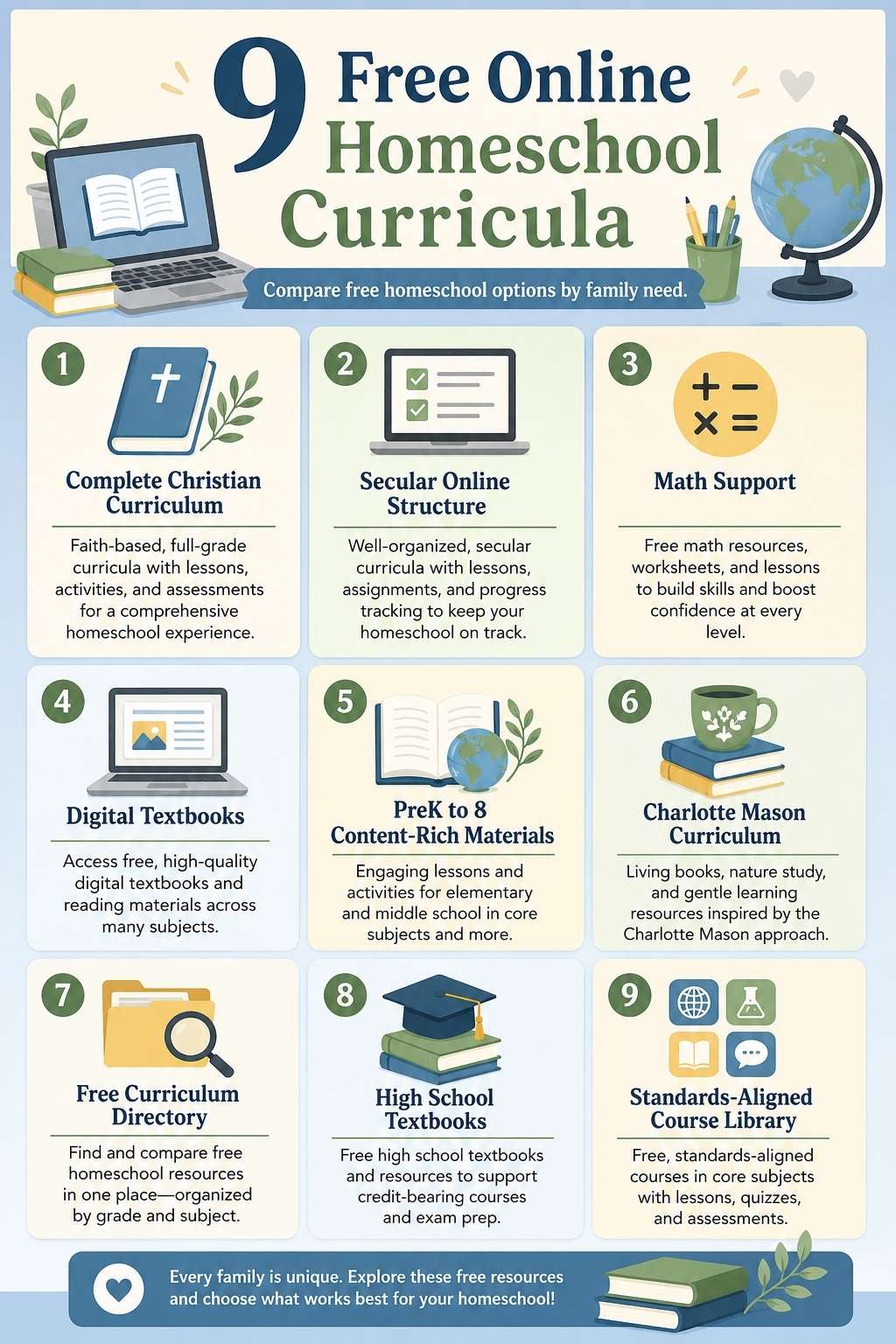
9 Free Online Homeschool Curricula and Resources Worth Considering
The right choice depends on your child’s grade level, reading ability, family worldview, parent availability, and how much structure you want. Some of these are closer to full free homeschool programs. Others are better as building blocks.
1. Easy Peasy All-in-One Homeschool
Easy Peasy All-in-One Homeschool is one of the clearest matches for families searching for a complete free online homeschool curriculum.
It offers 180 days of homeschool lessons and assignments and covers subjects such as reading, writing, grammar, spelling, vocabulary, math, history, social studies, geography, science, Spanish, Bible, computer, music, art, PE, health, and logic. The site states that it uses free materials found online, and it also notes that families may need basic supplies for experiments or art projects.
The biggest strength is structure. Parents who feel overwhelmed by planning may appreciate that Easy Peasy gives children a daily path instead of asking families to build everything from scratch. It also has a separate high school site, which makes it easier for families with older learners to continue beyond elementary and middle school.
This is not a neutral curriculum, though. Easy Peasy is Christian in orientation, so it will fit some families very well and be the wrong choice for others.
Best for: Families who want a complete free Christian homeschool curriculum with daily structure.
Why it stands out: It is one of the few free options that feels close to an open-and-go homeschool plan.
Things to consider: The site says it does not keep student records, so parents still need to handle recordkeeping, compliance, and documentation themselves.
2. Discovery K12
Discovery K12 is a strong option for families who want a secular online homeschool structure.
Its official curriculum page describes it as an online secular homeschool curriculum with 180 days of digital curriculum for Pre-K through 12th grade. It includes seven main courses: reading/literature, language arts, math, history/social studies, science, visual/performing arts, and physical education. It also includes extras such as Spanish, HTML coding, healthy living, personal finance, business, and home economics.
Discovery K12 is useful because it gives families a full-time or part-time framework. Parents can follow its schedule, move ahead, go back, or start anytime. For families who want free schooling at home but do not want a faith-based curriculum, this is one of the most relevant options.
The important catch is the parent side. Discovery K12 allows users to create a free student account, but the Parent/Teacher Account is a premium upgrade. That paid upgrade includes tools such as reports, assessment results, transcripts, gradebook features, quiz and test scores, answer keys, and more.
Best for: Families wanting a secular Pre-K–12 online homeschool curriculum.
Why it stands out: It has a structured 180-day format and broad subject coverage.
Things to consider: The free student account can be useful, but parents who want advanced tracking and reporting tools may need the premium upgrade.
3. Khan Academy
Khan Academy is not a complete homeschool curriculum in the same way Easy Peasy or Discovery K12 tries to be, but it is one of the strongest free academic resources available.
Its library covers standards-aligned practice and lessons across K–12 math through early college, grammar, science, history, AP, SAT, and more. That makes it especially helpful for homeschool families who need a strong free math backbone, extra science instruction, grammar practice, or test-prep support.
Khan Academy works best when parents use it intentionally. For example, a family might use Khan Academy as the main math resource, then pair it with reading, writing, history, and science materials from other sources. Older students can use it for SAT prep, AP review, and independent study.
The platform is clean, flexible, and genuinely free. The limitation is that it is not always an open-and-go full homeschool plan across every subject and grade.
Best for: Math, science, grammar, test prep, and independent academic support.
Why it stands out: It gives families high-quality free lessons and practice without requiring a paid subscription.
Things to consider: Parents may need to build a schedule around it and add resources for subjects not fully covered in the way their homeschool requires.
4. CK-12
CK-12 is a strong free resource for families who want digital textbooks, practice, videos, flashcards, and interactive learning support.
The platform says it provides free online textbooks, videos, exercises, flashcards, and real-world applications for more than 5,000 concepts. It is especially useful for math and science, though families can use it in different ways depending on grade level and subject needs.
CK-12 is better understood as a flexible learning library than as a complete homeschool schedule. Parents who want full day-by-day guidance may find it too open-ended. But parents who want free digital books, adaptive practice, and concept explanations may find it extremely useful.
It can work well for middle school and high school students who need extra explanation, review, or a free textbook-style structure. It can also support families who want to customize a no-cost curriculum instead of following a single provider.
Best for: Free digital textbooks, math support, science support, and concept practice.
Why it stands out: It gives families access to a large library of free learning materials that can be adapted to different needs.
Things to consider: Parents may need to decide the sequence, pacing, assignments, and assessments.
5. Core Knowledge Foundation
Core Knowledge Foundation is a strong option for families who want content-rich curriculum materials, especially for younger and middle-grade students.
The Foundation provides open access to curriculum materials for Preschool through Grade 8, and it says full versions for most products are available to download for free. Materials can be used, adapted, and shared with attribution, though they cannot be sold.
This is a good fit for parents who like structured academic content and do not mind downloading, organizing, and teaching from materials themselves. It is especially useful for families who want more than a random worksheet collection. Core Knowledge is built around a content-rich approach, which means students build background knowledge in literature, history, science, the arts, and language.
The trade-off is parent labor. This is not a child logs in and the curriculum runs itself type of resource. It is more materials-based than app-based.
Best for: Families wanting free PreK–8 curriculum materials with strong content structure.
Why it stands out: It offers substantial downloadable curriculum materials, not just scattered activities.
Things to consider: Parents may need to print, organize, teach, and adapt the materials for homeschool use.
6. AmblesideOnline
AmblesideOnline is a free Charlotte Mason homeschool curriculum for families who want a literature-rich, living-books approach.
Its official site describes it as a free homeschool curriculum using Charlotte Mason’s classically based principles. Its curriculum overview offers booklists and plans across multiple years, including upper grades.
This is a very different kind of free homeschool program. It is not a modern dashboard with digital quizzes and progress bars. It is built around books, narration, nature study, habit formation, short lessons, poetry, art, music, and a slower educational rhythm.
For the right family, that can be a strength. It gives children a rich, thoughtful education without requiring expensive boxed curricula. But it asks more from the parent. Families need to source books, follow the schedule, lead discussions, and understand the Charlotte Mason method well enough to use it properly.
Best for: Families who want a free Charlotte Mason curriculum.
Why it stands out: It offers a complete educational philosophy, not just free lesson links.
Things to consider: It is book-heavy, parent-led, and not ideal for families wanting mostly screen-based independent learning.
7. Freedom Homeschooling
Freedom Homeschooling is best understood as a free curriculum directory, not one unified curriculum.
Its site organizes free homeschool curriculum for all grades and subjects, and it can help parents find complete programs, subject materials, and other free options in one place. The directory approach is useful because homeschool families often need to mix and match rather than rely on one source for everything.
For example, a parent might use Freedom Homeschooling to find a free science curriculum, then use Khan Academy for math, Core Knowledge for language arts or history, and OpenStax for an older student’s advanced subject. That kind of resource-finding can save time.
The downside is that a directory does not make the educational decisions for you. Parents still have to evaluate quality, grade fit, worldview, pacing, completeness, and whether links are current.
Best for: Parents who want to find free homeschool programs by subject and grade.
Why it stands out: It saves time by organizing free curriculum resources in one place.
Things to consider: It is not one curriculum. It is a resource hub, so parents still need to choose and combine materials carefully.
8. OpenStax
OpenStax is one of the best free options for older homeschool students, especially high schoolers taking advanced subjects.
OpenStax, part of Rice University, provides free open educational resources and digital tools for high school, college, and beyond. Its K–12 page says its high school textbooks are standards-aligned and 100% free online, with educator resources such as LMS course shells, lecture slides, lab manuals, assessment banks, and answer keys.
This is not the right fit for a young child who needs interactive games or a parent who wants a daily homeschool checklist. But for older learners, OpenStax can be extremely valuable. It can support high school science, math, economics, social sciences, and college-prep study.
The biggest strength is textbook quality and cost. The biggest challenge is that parents or students need to build the course structure around the materials.
Best for: High school students, advanced learners, dual-enrollment-style preparation, and textbook-based courses.
Why it stands out: It offers serious academic textbooks without the usual textbook cost.
Things to consider: It works best when the parent or student can create pacing, assignments, and assessments.
9. Georgia Virtual Learning Free Resources
Georgia Virtual Learning Free Resources can be useful for homeschool families who want standards-aligned digital course content, especially for middle and high school.
The Georgia Virtual Learning free resources page offers more than 130 flexible, standards-aligned, textbook-independent courses with custom-built interactives. The site says the resources support standards-based content, remediation, enrichment, summer learning, and more, and that courses are audited annually for relevance and quality.
This is a strong resource because it gives families access to course-style materials rather than scattered worksheets. It can be especially useful for older students who need structured subject content in areas such as math, science, English, social studies, world languages, electives, or AP support.
The caveat is that Georgia Virtual Learning resources are aligned to Georgia standards and are not the same thing as enrolling in a full homeschool program. Families outside Georgia can still find value, but they should compare the materials with their own local or state requirements.
Best for: Middle and high school course content, enrichment, remediation, and standards-aligned study.
Why it stands out: It offers a large free digital course library with annually reviewed materials.
Things to consider: It is a course resource library, not a complete homeschool enrollment program.
Quick Comparison: 9 Free Online Homeschool Curricula
| Resource | Best For | Free Status | Main Caveat |
| Easy Peasy All-in-One Homeschool | Complete Christian homeschool schedule | Free online curriculum | Christian worldview; parents keep records |
| Discovery K12 | Secular Pre-K–12 structure | Free student account | Parent tools are a premium upgrade |
| Khan Academy | Math, science, grammar, test prep | Free learning platform | Better as a supplement than a full curriculum |
| CK-12 | Digital textbooks and practice | Free OER-style resource | Strongest for math/science support |
| Core Knowledge Foundation | PreK–8 content-rich curriculum | Free downloads | Parent planning and teaching required |
| AmblesideOnline | Charlotte Mason homeschool families | Free curriculum plan | Book-heavy and parent-led |
| Freedom Homeschooling | Finding free resources by subject | Free directory | Not one unified curriculum |
| OpenStax | High school and advanced courses | Free online textbooks | Best for older students |
| Georgia Virtual Learning Free Resources | Middle/high school course content | Free course library | Georgia-aligned, not full enrollment |
How to Choose the Right Free Homeschool Program
Start by deciding whether you need a full curriculum or a resource to fill a gap.
If you want a day-by-day plan, start with Easy Peasy or Discovery K12. If you want a secular academic supplement, Khan Academy and CK-12 are stronger. If you want downloadable materials for younger grades, Core Knowledge is worth reviewing. If you want a literature-based Charlotte Mason path, AmblesideOnline is a better match. If you are building a custom homeschool plan, Freedom Homeschooling can help you find more free options. If your student is older, OpenStax and Georgia Virtual Learning Free Resources can support high school-level learning.
Then check worldview. This matters more than many parents expect. Easy Peasy is Christian. AmblesideOnline is Charlotte Mason with a Christian orientation. Discovery K12 is secular. Khan Academy, CK-12, OpenStax, Core Knowledge, and Georgia Virtual Learning are generally more academic or resource-based rather than faith-based.
Next, check parent workload. Some programs are more independent. Others require heavy parent involvement. A free curriculum is not truly “free” if the hidden cost is five hours of daily planning you cannot sustain.
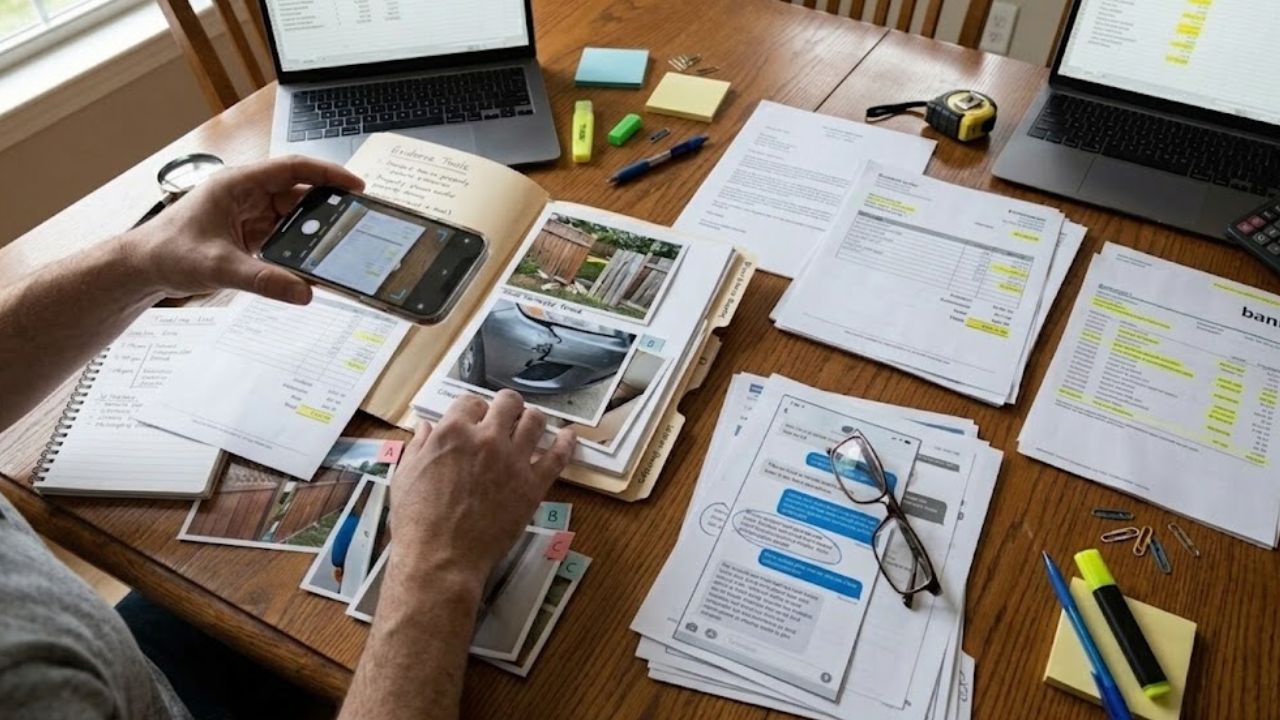
Finally, check records and requirements. A curriculum can provide lessons, but parents may still need to track attendance, work samples, grades, test results, portfolios, or required subjects depending on local homeschool law. Discovery K12 itself notes that using its platform means independently homeschooling and following state homeschool laws.
Common Mistakes to Avoid
- Assuming “free” means complete. Some free resources are excellent but only cover one subject or one grade range.
- Confusing online public school with homeschooling. Tuition-free online public schools may be available in some states, but they usually involve enrollment, public school rules, teachers, schedules, and state accountability. That is different from independent homeschooling.
- Ignoring records. If a platform does not keep official records, parents need a system for attendance, assignments, grades, reading logs, test scores, or portfolios.
- Choosing based only on cost. A free program that frustrates your child or overwhelms the parent may not be the best fit.
- Using too many platforms at once. A child does not need five different dashboards for one school day. Start simple, then add resources only when there is a real gap.
A Simple Way to Build a No-Cost Curriculum
A strong free homeschool setup might look like this:
- Use one main curriculum spine, such as Easy Peasy, Discovery K12, Core Knowledge, or AmblesideOnline.
- Add one strong academic support tool, such as Khan Academy for math or CK-12 for science.
- For older students, use OpenStax or Georgia Virtual Learning Free Resources for advanced course content.
- Use Freedom Homeschooling when you need a free subject replacement, elective, or extra resource.
- Create your own parent record system. A spreadsheet, binder, planner, or portfolio can track lessons completed, books read, writing samples, test scores, projects, and attendance.
This approach keeps free schooling at home manageable. The goal is not to collect every free curriculum on the internet. The goal is to build a usable plan your family can actually follow.
Final Thoughts
The best free online homeschool curricula are not always full school-in-a-box programs. Some are complete schedules. Some are course libraries. Some are textbook platforms. Some are directories. Some are better for younger children, while others are better for high school. Some are Christian. Some are secular. Some are parent-led. Some are more independent.
That is why the right choice depends on your family’s real needs.
Start with structure. Decide whether you need a full free homeschool program or a subject-specific no-cost curriculum. Check worldview, grade coverage, parent workload, recordkeeping, and legal requirements. Then test one option before building your whole school year around it.
Free curriculum can be powerful. But the best homeschool plan is not the one with the most links. It is the one your child can learn from and your family can sustain.
Frequently Asked Questions About Free Online Homeschool Curricula
1. What are the best free online homeschool curricula?
Some of the best free online homeschool curricula and resources include Easy Peasy All-in-One Homeschool, Discovery K12, Khan Academy, CK-12, Core Knowledge Foundation, AmblesideOnline, Freedom Homeschooling, OpenStax, and Georgia Virtual Learning Free Resources.
2. Can I homeschool for free online?
Yes, families can homeschool using free online resources, but parents still need to plan carefully. Free materials may not include official records, grading, transcripts, teacher support, printed workbooks, or state-specific compliance help. You may need to combine several resources.
3. Is Discovery K12 really free?
Discovery K12 offers a free student account and online curriculum access. However, its Parent/Teacher Account is a premium upgrade with additional tools such as reports, gradebook features, assessment results, answer keys, and transcripts.
4. Is Khan Academy a complete homeschool curriculum?
Khan Academy is a strong free learning platform, especially for math, science, grammar, history, AP, and SAT support. However, many families use it as a supplement or subject backbone rather than a complete homeschool curriculum for every grade and subject.
5. What is the best free secular homeschool curriculum?
Discovery K12 is one of the strongest free secular online homeschool curriculum options because it offers a structured Pre-K through 12th grade curriculum. Khan Academy, CK-12, Core Knowledge, OpenStax, and Georgia Virtual Learning can also support secular homeschool planning.
6. Do free homeschool programs keep official records?
Some free homeschool programs provide progress tools, but parents should not assume official recordkeeping is included. Easy Peasy states that it does not keep student records, and Discovery K12’s advanced parent reporting tools are part of a premium upgrade. Parents should keep their own records based on local requirements.