
You have decided to leave the rat race and start your own freelance business or agency. You are ready to put in the work, but you are immediately hit with a paralyzing choice: Free Google Certifications vs Paid Bootcamps for Clients. Which one actually moves the needle?
On one hand, you have the low-risk, high-trust badge from a tech giant for roughly $39 a month. On the other hand, you have the high-intensity, $15,000 bootcamp promising to turn you into a “pro” in 12 weeks. If you choose the wrong one for your specific stage, you could waste months of time or thousands of dollars.
In this deep dive, we will strip away the marketing hype and look at the hard data: which path actually converts into paid client invoices?
Key Takeaways
- Clients buy results, not paper. A certificate helps strangers trust you; your portfolio gets them to sign the check.
- AI has raised the bar. Knowing the skill isn’t enough; you must show you can use AI to deliver that skill faster and cheaper than the competition.
- Avoid the “Student Look.” Scrub your portfolio of generic bootcamp projects. One real-world “spec project” is worth ten “To-Do List” apps.
- The Hybrid Path wins. Get the cheap Google badge for trust, build a “Client-First” portfolio, and invest your savings in Sales and AI training.
The Hard Truth: Clients Don’t Buy Paper
Here is the brutal reality that most course creators won’t tell you: Clients do not buy certifications; they buy results. A certificate proves you passed a test. A diploma proves you paid tuition. Neither proves you can solve a client’s specific, painful business problem.
However, in the algorithmic world of 2025 freelancing—where AI is flooding platforms with generic proposals—these credentials play very different, strategic roles. One gets you found by the algorithm; the other gets you skilled enough to deliver.
The Case for Google Career Certificates: The “Trust Badge”
Best For: Platform-based freelancers (Upwork, Fiverr, LinkedIn), Complete Beginners, and Low-Budget Starts.
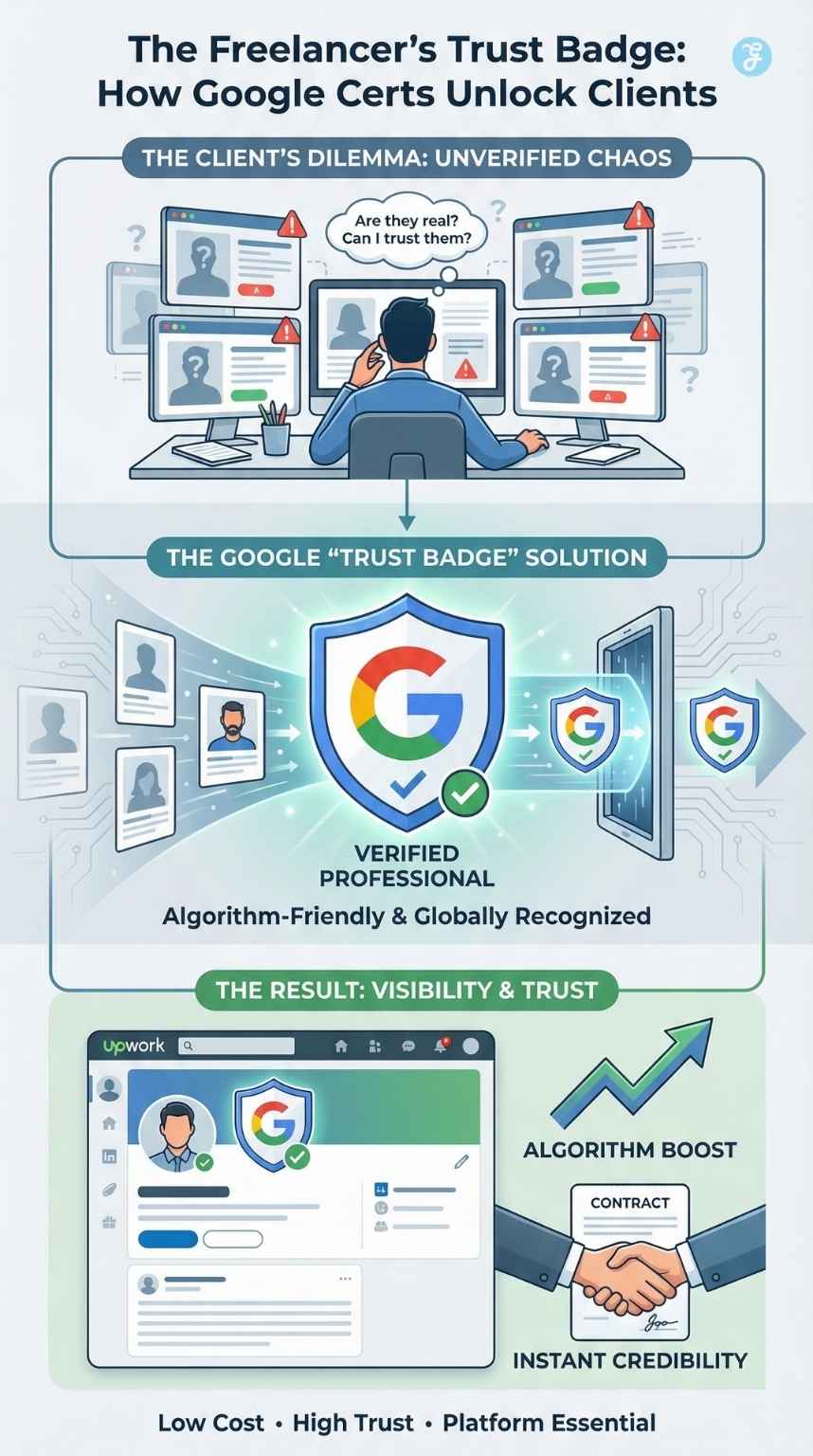
If your client acquisition strategy relies on marketplaces like Upwork, Fiverr, or LinkedIn Services, the Google Career Certificate is your strongest asset for one specific reason: Algorithmic Trust.
1. The “Scam Filter” Effect
In 2025, the barrier to entry for freelancing is zero. This has flooded the market with low-quality talent and bots. Clients are terrified of hiring a scammer or someone incompetent.
- The Google Badge: When a client sees the “Google Certified” badge on your Upwork profile or LinkedIn header, it acts as an immediate psychological “safety valve.” It doesn’t prove you are an expert, but it proves you are a real person who has put in at least 100+ hours of effort.
- The Credly Connection: Platforms like Upwork previously allowed direct Credly integration. While this has shifted to manual verification in some areas, having the badge visible in your portfolio images or certification section still increases profile click-through rates (CTR) by signaling professional intent.
2. The Cost-Benefit Ratio (ROI)
- Cost: Approximately $39–$49/month (via Coursera).
- Time: 3–6 months (or 1 month if you sprint).
- Risk: Extremely low.
If you are testing a new niche, say, pivoting from writing to UX Design, spending $50 to test the waters is financially responsible. Spending $10,000 on a UX bootcamp before landing a single client is financial suicide.
3. The “Platform SEO” Boost
Search algorithms on freelance platforms prioritize “complete” and “verified” profiles.
- Upwork: Profiles with verified certifications often rank higher in client searches than those without.
- LinkedIn: The “Licenses & Certifications” section is indexed. Recruiters and business owners searching for “Data Analytics Consultant” are more likely to find profiles populated with recognized keywords from these certs (e.g., “R Programming,” “Tableau,” “Wireframing”).
The Trap:
Do not mistake the Certificate for a Portfolio. The projects you build in the Google course are templated. Thousands of other students have the exact same “coffee shop app” in their portfolio. If you send only these projects to a high-ticket private client, you will likely be ignored.
4. The Hidden Costs They Don’t Tell You About
When choosing between these paths, look beyond the tuition fee. The “Real Price” often includes hidden taxes on your time and wallet.
The Hidden Cost of Bootcamps ($15k becomes $25k):
- Opportunity Cost: If you quit your job to study full-time for 3 months, you aren’t just paying $15k tuition. You are also losing 3 months of salary. That $15k course actually costs you $30k+.
- The ISA Trap: “Income Share Agreements” sound great (pay nothing until you’re hired), but the fine print often takes 15% of your gross income for 2 years. You could end up paying back $30,000 for a $15,000 education.
The Hidden Cost of Google Certs ($39 becomes $1,000+):
- The “Subscription Drag”: It’s only $39/month, so you procrastinate. “I’ll finish it next week.” Six months later, you’ve paid $240 and still haven’t finished.
- The “Upsell” Reality: To actually be freelance-ready, you will likely need to buy extra software (Adobe CC, Figma Pro, Hosting, Domain Name) that the course doesn’t cover. Budget an extra $500 for your “Freelance Starter Stack.”
The Case for Paid Bootcamps: The “Skill Accelerator”
Best For: Career Switchers, High-Ticket Freelancers, and those needing “Forced Discipline.”
If Google Certs are about visibility, Bootcamps (like General Assembly, Springboard, or specialized niche academies) are about competence and network.
1. Portfolio Depth vs. Breadth
High-paying clients ($5,000+ projects) typically don’t look at your education section; they look at your “Case Studies.”
- The Bootcamp Advantage: Good bootcamps force you to build 3–4 complex, custom projects. You aren’t just following a tutorial; you are often building a full-stack application or a complete brand identity system.
- Client Perception: When a client asks, “Can you build a custom e-commerce checkout flow?”, showing a complex bootcamp project answers “Yes” instantly. A multiple-choice test result from Google does not.
2. The Hidden Value: The Network
This is the only justification for the $10,000+ price tag in 2025.
- Instructor Referrals: Bootcamp instructors are often working industry professionals. When they are overloaded with freelance work, they pass it to their best students. This is how many bootcamp grads get their first high-ticket client.
- Alumni Networks: You enter a private Slack channel with thousands of alumni working at companies. If they need a freelancer, they post there first, bypassing public job boards entirely.
3. The “Sunk Cost” Motivation
It is a psychological reality: You are more likely to quit a $39 course than a $15,000 one. If you know you lack self-discipline, the financial pain of a bootcamp can be the fire you need to actually finish and launch your business.
The Trap:
Debt. Starting a freelance business with $15,000 in debt puts you in a desperate mindset. Desperate freelancers undercharge, take bad clients, and burn out. If you cannot afford the bootcamp in cash, the stress may kill your freelance career before it starts.
The AI Factor: Why “Just Learning the Skill” Is No Longer Enough
In 2025, the baseline for “hireable” has shifted. Three years ago, a Junior Data Analyst could get clients just by knowing how to clean data in Excel. Today, a client can upload that spreadsheet to ChatGPT and get it cleaned in 30 seconds.
This changes the value of your certification:
- The Bootcamp Gap: Most bootcamps are still teaching curricula from 2023. They teach you to code from scratch, but they rarely teach “AI-Assisted Engineering” or “Prompt Engineering for Designers.” You might graduate as a slow expert in a fast world.
- The Google Advantage: Surprisingly, Google is faster at updating its curriculum. Their newer modules often include “AI Essentials” or specific training on using AI tools responsibly.
The Client Expectation: Clients do not want to pay you for 10 hours of work that AI can do in 10 minutes. They want to pay you for the Strategic Oversight.
- Old Pitch: “I can write SEO articles for you.” (Client thinks: I can do that with Claude.)
- New Pitch: “I use an AI-hybrid workflow to produce high-ranking SEO content at 2x the speed, and I personally verify every fact and optimize the tone.” (Client thinks: Sold.)
Verdict: If your chosen path (Bootcamp or Cert) doesn’t explicitly teach you how to integrate AI into your workflow, you are learning an obsolete method.
Comparison: The Client Acquisition Scorecard
To make this decision easier, let’s look at how each path scores on the factors that actually matter for winning business.
| Feature | Google Career Certificates | Paid Bootcamps ($10k+) |
| Cost | Low ($39–$49/mo) | High ($10k–$16k) |
| Trust Factor | High (Universal Brand Recognition) | Medium (Varies by School Reputation) |
| Portfolio Strength | Low (Generic/Templated) | High (Custom/Complex) |
| Platform SEO | Excellent (Algorithm Friendly) | Neutral (Not auto-recognized) |
| Networking | Low (Peer grading only) | High (Alumni & Mentors) |
| Time to Finish | 1–6 Months | 3–9 Months |
| Client Perception | “Safe, Verified, Entry-Level” | “Skilled, Professional, Capable” |
The “Missing Link”: Why Neither Might Get You Clients
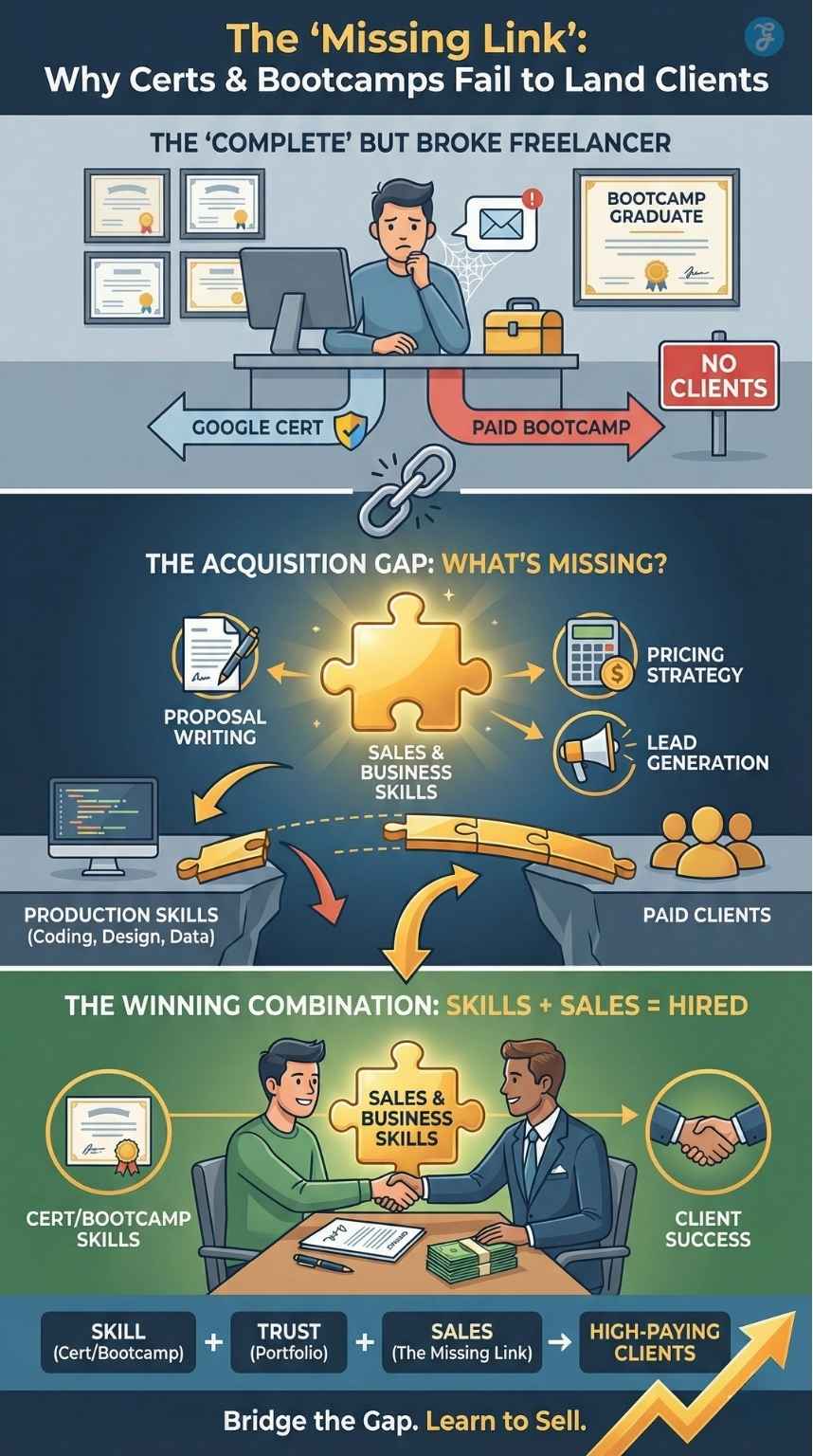
You can have a wall full of Google Certificates and a diploma from the best Bootcamp in the world, and still have zero clients.
Why? Both of these paths teach Production Skills (how to do the work), but they rarely teach Acquisition Skills (how to sell the work).
The Hard Truth for 2025:
- Clients don’t care that you know Python (a Production Skill).
- Clients care that you can “Automate their boring data entry tasks to save them 10 hours a week” (A Business Offer).
If you rely solely on the certification to do the selling for you, you will fail. You must bridge the gap between “I have a certificate” and “I can solve your problem.”
The “Portfolio Red Flags” That Kill Client Deals
You can have the certification, but if your portfolio commits these sins, clients will close the tab immediately. I see these mistakes in 90% of junior portfolios:
- The “Lorem Ipsum” Sin: Never use placeholder text in your designs. It screams, “I didn’t think about the content.” Real clients need to see that you understand how design and text work together to sell.
- The “To-Do List” App: Every coding bootcamp grad has a “To-Do List” or “Weather App” in their portfolio. It is the hallmark of a student. Remove it. Replace it with a tool that solves a business problem, like an “Inventory Tracker for Shopify” or a “Lead Generation Scraper.”
- The “Ghost” Case Study: You show the final image, but you don’t show the struggle. Clients want to see the process. Did you interview users? Did you sketch 10 bad versions before the good one? Show the mess. It proves you can think.
- The “Group Project” Trap: If you include a group project from your bootcamp, you must specify exactly what you did. Did you code the backend, or did you just pick the colors? If you are vague, clients assume you did the easy part.
The Winning Strategy [The Hybrid Model]
If your goal is strictly Freelance Clients (not a full-time corporate job), do not spend $15,000 on a bootcamp. Instead, use this “Hybrid” budget strategy to get the best of both worlds for under $1,000.
Step 1: The “Trust Badge” (Month 1-2)
- Action: Enroll in the Google Certificate relevant to your niche (UX, Data, Digital Marketing).
- Goal: Sprint through it. Do not aim for perfection; aim for completion.
- Result: You get the badge. Add it to your LinkedIn, Upwork, and email signature. You have now passed the “Scam Filter.”
Step 2: The “Spec” Portfolio (Month 3)
- Action: Do not rely on the Google course capstone. It is too generic.
- Goal: Create 2 “Spec Projects” (Spectulative Projects). Find a local business with a terrible website or broken marketing. Redesign it for free (you don’t even have to tell them).
- Result: You now have a portfolio that looks like real client work, solving real problems, which rivals any bootcamp grad’s portfolio.
Step 3: The Sales Education (Month 4)
- Action: Take the $14,000 you saved by not doing a bootcamp and invest $500–$1,000 into a specific Sales/Freelance Course.
- Focus On: Proposal writing, pricing psychology, and lead generation.
- Result: You now have the Skill (from self-study/Google), the Trust (from the Badge), and the Sales Ability to actually close the deal.
Final Thoughts
In 2025, the “credentialism” of the corporate world is fading in the freelance economy. A client in New York doesn’t care if a freelancer in London or Dhaka has a degree from a fancy bootcamp. They care that when they ask a question, you have a smart answer, and when you deliver work, it drives revenue.
Use the Google Certification as your launchpad, not your destination. Get the badge, put it on your profile, and then get back to the real work: building things that solve problems.