


Finland’s MaaS story has never really been about one magic app. That was the public-facing dream for a while, of course. Open one app, see every transport option, pay once, move across the city or country without thinking about operators, fare zones, ticket rules, or timetable chaos. Simple idea. Much harder reality.
A real journey doesn’t care about neat industry categories. You might start with a local bus, switch to a train, continue by coach, walk to a ferry terminal, or compare the whole thing against a flight or taxi. For the traveller, it’s one trip. For the transport industry, it’s a maze of data, pricing, payment systems, operators, APIs, city rules, and public-sector coordination.
That’s why Finnish MaaS platforms are still worth studying, even after the early hype around Mobility as a Service cooled down. Finland’s strongest MaaS examples today aren’t only flashy consumer apps. They include ticketing infrastructure, routing engines, public transport IT systems, payment platforms, and journey-comparison tools.
In other words, Finland’s MaaS market has matured. The conversation has moved from “Which app will replace private cars?” to a more useful question: Which platforms actually make public transit easier to plan, pay for, and connect? These five Finnish platforms show that shift clearly.
How I Selected These Finnish MaaS Platforms
This list focuses on practical public transit integration, not nostalgia. A platform had to be active, publicly verifiable, and clearly connected to Finnish mobility, journey planning, ticketing, routing data, mobile fare collection, or multimodal transport. It also had to do more than show a timetable or sell one operator’s ticket.
That distinction matters because MaaS isn’t just a front-end experience. A beautiful app can still fail if the route data is weak, the ticketing layer is clumsy, or the payment flow breaks down. The best Finnish examples work because they solve different parts of the same problem.
Some help passengers plan and buy journeys. Some help cities and operators sell tickets. Some provide the shared public transport data that other apps depend on. Together, they show how MaaS works when it’s treated as infrastructure rather than a buzzword.
1. Matkahuolto Matkat
Matkahuolto Matkat is probably the cleanest current example of a user-facing MaaS experience in Finland.
It doesn’t try to sound futuristic. That’s part of why it works as a business case. The platform focuses on a very ordinary passenger problem: getting from one real place to another without stitching the journey together manually across several services.
In practice, that means connecting long-distance buses, trains, local transport, commuter services, and ferry-linked routes in one planning and ticketing experience. That’s close to the original MaaS promise, but with a more grounded Finnish shape.
The Everyday Trip Problem It Solves
Public transport integration usually breaks down at the edges. A train route may be easy to find. A bus ticket may be easy to buy. A local connection may exist. But when those pieces need to work together, the passenger often becomes the integration layer. They compare tabs, check operators, guess transfer times, and hope the ticket rules make sense.
Matkahuolto Matkat reduces that friction by bringing several journey pieces into one service. The platform is especially useful for trips that don’t begin and end at major train stations. That’s a big deal in Finland, where regional and long-distance travel often depends on bus networks as much as rail.
It’s also a reminder that MaaS doesn’t need to look glamorous to be valuable. Sometimes the win is simply helping someone plan the whole journey without turning it into research homework.
Why It Deserves a Place
Matkahuolto Matkat belongs on this list because it shows what MaaS looks like after the pitch-deck era.
It’s not promising to reinvent all mobility overnight. It’s helping people combine public transport options, understand realistic routes, and buy tickets with less friction. That’s the kind of practical integration passengers actually notice.
For Finnish public transit, the platform’s strength is its ability to connect national, regional, and local travel layers. That kind of coverage is more useful than a slick app with thin transport access.
Where It Works Best
Matkahuolto Matkat is strongest for travellers planning trips across Finland where buses, trains, local transit, and ferry-linked connections may all matter. It’s a useful fit for people who want one planning and purchase flow instead of jumping between separate operator websites.
2. PayiQ
PayiQ sits in a quieter part of the MaaS stack, but it solves one of the hardest problems: payment.
That might sound boring until you try to build a real integrated transit system. A journey planner can show a perfect route, but if the passenger can’t easily buy the right ticket, the experience still fails. Ticketing is where many MaaS ideas fall apart.
PayiQ is a Finnish mobile fare-collection and ticketing platform. It helps transport operators, cities, and mobility providers sell digital tickets through apps, APIs, and white-label solutions.
The Hidden Payment Layer Behind Better Transit
MaaS depends on trust. Riders need to know that the ticket they bought is valid, that the payment went through, that the fare product matches the journey, and that the operator can recognize it.
That’s exactly the kind of behind-the-scenes problem PayiQ handles. Its platform supports mobile ticketing, payment processing, fare collection, fraud prevention, and integration with transport services. It can be used through PayiQ’s own ticketing app, white-label apps, or API connections.
This makes PayiQ less visible than a consumer travel app, but arguably more important for operators. Cities and transit providers don’t just need a nice interface. They need a ticketing system that fits their fare rules, passenger base, payment methods, and service model.
Why PayiQ Matters for MaaS
PayiQ matters because MaaS can’t be only about showing mobility options. Someone has to make the payment layer work. Someone has to handle fare products, validation, settlement logic, app-based ticketing, user accounts, and fraud controls. When that layer is clunky, riders feel it immediately.
PayiQ’s value is that it gives transport providers a flexible way to make mobile ticketing part of a larger mobility system. That’s essential for cities and operators that want digital transit without building everything from scratch.
Where It Works Best
PayiQ is best suited for public transport operators, municipalities, city mobility services, and private mobility providers that need mobile fare collection, ticketing apps, API integration, or white-label ticketing infrastructure.
3. Waltti / Waltti Solutions
Waltti is the kind of platform that proves MaaS isn’t always a startup story. It’s better understood as public transport infrastructure. Waltti Solutions supports ticketing and digital public transport services for Finnish urban regions. It’s tied to public transport authorities, regional mobility needs, and the everyday work of making buses and local transit easier to use.
That may not sound as shiny as a consumer mobility app, but it’s exactly where serious transit integration happens.
The Public-Sector Backbone
Regional public transport is messy because every city and region has its own needs. Fare zones differ. Service patterns differ. Passenger behaviour differs. Political priorities differ. A one-size-fits-all private MaaS app can’t magically flatten that complexity.
Waltti helps by giving Finnish urban regions shared digital tools for public transport ticketing, travel cards, mobile tickets, and passenger information. It gives local transport authorities a common foundation while still allowing regional transit systems to serve their own passengers.
That balance matters. Public transit integration can’t work if every region builds isolated systems, but it also can’t work if local differences are ignored.
Why It Belongs Here
Waltti belongs on this list because Finnish MaaS wouldn’t be credible without public-sector digital infrastructure.
Private apps can improve the passenger experience, but public transport authorities still control much of the real mobility network. They need reliable ticketing systems, passenger tools, route information, and service platforms that can support day-to-day operations.
Waltti represents that institutional layer. It’s not the loudest part of MaaS, but it’s one of the most necessary.
Where It Works Best
Waltti is best for Finnish urban regions, public transport authorities, municipalities, and passengers who depend on regional ticketing and public transit services outside a single private mobility ecosystem.
4. Digitransit
Digitransit is the platform most passengers may never know by name, yet many journey-planning experiences in Finland rely on the kind of infrastructure it provides.
That’s the strange thing about good routing technology. When it works, it disappears.
Digitransit is a public transport route and timetable information service developed by HSL, Waltti Solutions, and Fintraffic. It provides routing, geocoding, maps, timetable data, stop information, and APIs that developers and transport services can use.
The Routing Engine Under the Surface
A transit app is only as good as the data underneath it. If the stops are wrong, the routes are unclear, or the timetable data is incomplete, the user loses confidence fast. And once riders stop trusting the planner, they go back to familiar habits: private cars, taxis, or whatever option feels less risky.
Digitransit helps solve that foundational problem by providing a shared route-planning and public transport data layer. Developers can use its APIs to build journey planners, mobility services, and public transport tools without starting from zero.
This is where Finland’s MaaS model becomes more interesting than a single app. The country has invested in reusable mobility infrastructure that other services can build on.
Why Digitransit Is Essential
Digitransit belongs here because it supports the basic intelligence of public transit integration.
Before passengers can compare options, buy tickets, or plan transfers, a system needs to know where stops are, what routes exist, how schedules connect, and how walking legs fit around the public transport network. That’s not glamorous work, but it’s the foundation.
Digitransit also supports a healthier mobility ecosystem because it gives developers and public authorities a shared technical base. That reduces duplication and improves the quality of journey-planning services.
Where It Works Best
Digitransit is best for developers, public authorities, app builders, route-planning services, transport planners, and mobility platforms that need reliable Finnish public transport data and routing APIs.
5. Perille
Perille fills a different gap in the MaaS landscape: comparison. Not every traveller already knows which mode they want. Sometimes the real question is whether to take a train, bus, flight, taxi, or some combination of them. Price matters. Travel time matters. Transfers matter. Environmental impact increasingly matters too.
Perille helps users compare travel options across Finland, including buses, trains, flights, taxi prices, duration, and impact. It’s a more consumer-facing platform than Digitransit and more comparison-led than Waltti or PayiQ.
The Traveller’s Decision Layer
A route planner tells you how to get somewhere. A ticketing platform helps you pay. A comparison platform helps you decide.
That’s where Perille fits. It’s useful for longer or more complex journeys where passengers may want to compare the trade-offs before choosing a route. A cheap bus may take longer. A train may be more comfortable. A flight may save time but add emissions and airport transfers. A taxi may work only for the last mile.
Those decisions are part of real mobility behaviour. Public transit integration isn’t just about showing public transport. It’s about helping users understand when public transport is the better choice.
Why Perille Strengthens the List
Perille belongs here because MaaS needs more than route data and tickets.
It also needs a decision interface. Travellers want to compare options in human terms: time, money, convenience, and environmental effect. That kind of comparison can make public transport more competitive, especially for intercity journeys where people might otherwise default to driving or flying.
Perille’s role is not to run the public transport backbone. Its value is helping the passenger choose with more context.
Where It Works Best
Perille is best for travellers comparing long-distance options across Finland, especially when they want to weigh buses, trains, flights, taxis, prices, trip duration, and environmental impact in one place.
Quick Overview of These Finnish MaaS Platforms
| Platform | Core Role | Strongest Integration Value | Best Suited For |
| Matkahuolto Matkat | Journey planning and ticketing | Connects buses, trains, ferries, local and regional routes | Travellers planning trips across Finland |
| PayiQ | Mobile fare collection | Handles tickets, payments, APIs, and white-label transit apps | Cities, transport operators, and mobility providers |
| Waltti / Waltti Solutions | Public transport IT and ticketing | Supports regional public transport services and digital ticketing | Finnish urban regions and transport authorities |
| Digitransit | Routing and timetable data infrastructure | Powers route planning, APIs, maps, and public transport data services | Developers, authorities, planners, and mobility apps |
| Perille | Multimodal travel comparison | Compares buses, trains, flights, taxis, time, price, and impact | Travellers choosing between long-distance options |
Why Whim Still Belongs in the Story
No serious article about Finnish MaaS can ignore Whim. Whim, created by MaaS Global, helped put Finland at the centre of the global MaaS conversation. It pushed the idea that users could plan, book, and pay for different transport modes through one app. For a while, it was the example people pointed to when explaining what MaaS could become.
But it shouldn’t be included as one of the five active Finnish platforms today. MaaS Global filed for bankruptcy in 2024, and the technology behind Whim was acquired by the Dutch platform umob. That doesn’t erase Whim’s importance. It just changes how we should talk about it.
Whim proved the idea had global appeal. Its collapse proved something else too: MaaS is commercially difficult. Integrating mobility services takes more than a clean interface. It requires operators, public authorities, pricing models, payment systems, open data, customer habits, and long-term financial patience to line up at the same time.
That’s rare. The current Finnish MaaS story is less dramatic, but more useful. It’s not about one app winning everything. It’s about several platforms solving different pieces of the integration puzzle.
What Finland Teaches About Public Transit Integration
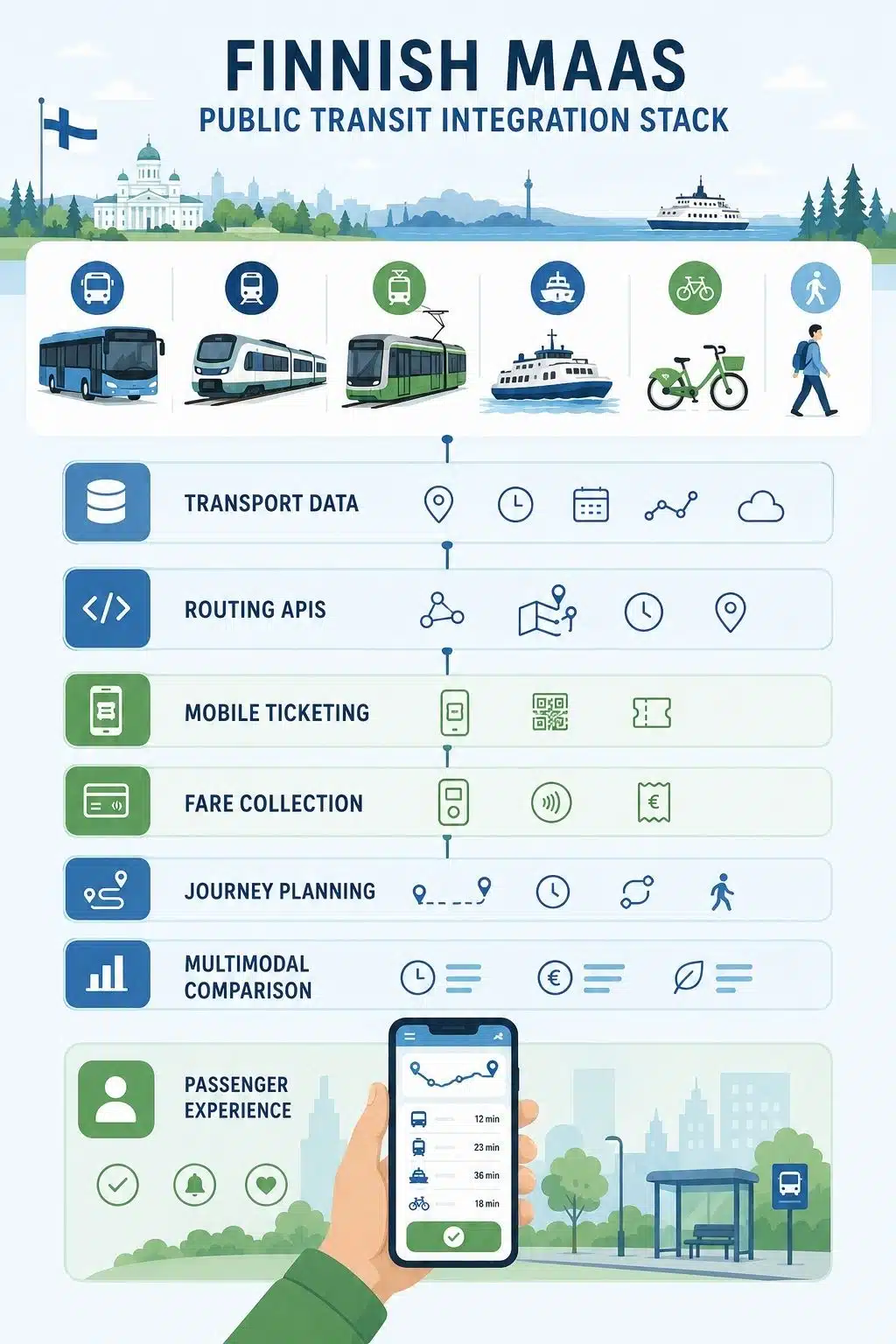
Finland’s MaaS ecosystem shows that mobility integration works like a stack.
At the bottom, you need data. That’s where Digitransit matters. Then you need public-sector ticketing and regional service infrastructure, which is where Waltti fits. You need fare collection and payment systems, where PayiQ plays a role. You need consumer-facing trip planning and ticket purchase, where Matkahuolto Matkat stands out. Then you need comparison and decision support, where Perille adds value.
No single layer replaces the others. This is the part many MaaS pitches got wrong. They treated the app as the revolution. In reality, the app is only the visible tip. The more difficult work sits in public transport data, ticketing agreements, operator relationships, payment systems, fare rules, routing quality, and regional governance.
That’s why Finland is still relevant. Not because every early MaaS experiment survived, but because the country helped show what the real integration layers look like.
What Transit Leaders Can Learn From Finland
- Public transport has to remain the centre of MaaS. If MaaS becomes only a bundle of scooters, ride-hailing, rental cars, and private mobility subscriptions, it misses the point. Public transit is the high-capacity backbone. Without it, MaaS becomes convenience tech for people who already have options.
- Ticketing matters as much as routing. A journey planner that can’t help the rider buy or validate the right ticket is only halfway useful.
- Open data and APIs aren’t nice extras. They’re the plumbing. If cities want developers, operators, and passengers to use shared mobility services, the data has to be accessible, accurate, and reusable.
- Patience. Transport doesn’t move at startup speed. It involves regulation, infrastructure, unions, operators, procurement, subsidies, political decisions, accessibility requirements, and public trust. That can frustrate private innovators, but it’s also why public-sector platforms like Waltti and infrastructure services like Digitransit matter.
MaaS succeeds when it respects how transit actually works.
Business Opportunity in Finnish MaaS Platforms
The biggest opportunity in Finnish MaaS may not be another all-in-one consumer app. The stronger opportunity is in the layers that make transport easier to connect: ticketing, payment, routing APIs, data quality, real-time information, multimodal comparison, accessibility, fare integration, and regional digital services. That’s where the business case becomes more durable.
Consumer apps can win attention quickly, but infrastructure platforms often create longer-term value. Cities need better ticketing. Operators need better payment tools. Developers need better data. Passengers need easier planning. Regions need shared systems they can trust.
The best Finnish MaaS platforms don’t all compete in the same lane. They support different parts of the mobility experience. That’s healthy.
A mature MaaS ecosystem shouldn’t depend on one company doing everything. It should let public authorities, private platforms, transport operators, and developers build around shared standards and usable tools.
Wrapping Up
Finland’s MaaS story has changed, but it hasn’t disappeared. The early startup spotlight has faded. The practical integration work continues.
Matkahuolto Matkat gives travellers a more connected way to plan and buy trips across public transport modes. PayiQ handles the payment and mobile ticketing layer that integrated transit depends on. Waltti supports regional public transport ticketing and digital services. Digitransit provides the routing and timetable infrastructure behind many journey-planning experiences. Perille helps users compare travel options in a way that reflects real decisions, not just route geometry.
Together, these Finnish MaaS platforms show where public transit integration is heading.
The future probably won’t be one app that controls everything. It’ll be a network of systems that work well enough together that the passenger doesn’t have to think about the complexity underneath. That’s the real MaaS promise. Not a perfect app. A simpler trip.
Frequently Asked Questions About Finnish MaaS Platforms
1. What are Finnish MaaS platforms?
Finnish MaaS platforms are mobility services, ticketing systems, data platforms, routing tools, or travel apps that help connect transport options such as buses, trains, ferries, taxis, local transit, and long-distance travel into a more usable journey experience.
2. Why is Finland important in Mobility as a Service?
Finland became one of the earliest global testbeds for Mobility as a Service because it supported open transport data, interoperability, digital ticketing, and passenger-centred mobility services earlier than many other markets.
3. Is Whim still one of the main Finnish MaaS platforms?
Whim is historically important, but it shouldn’t be treated as one of the main active Finnish platforms today. MaaS Global filed for bankruptcy in 2024, and the technology behind Whim was later acquired by the Dutch platform umob.
4. What is Digitransit?
Digitransit is a Finnish public transport routing and timetable information platform. It provides APIs, route planning, map services, stop information, and public transport data used by apps, developers, and public transport services.
5. Is Waltti a MaaS app?
Waltti is better described as a public transport IT and ticketing platform rather than a private MaaS marketplace app. It supports regional public transport services, mobile tickets, travel cards, and digital passenger tools across Finnish urban areas.






















