

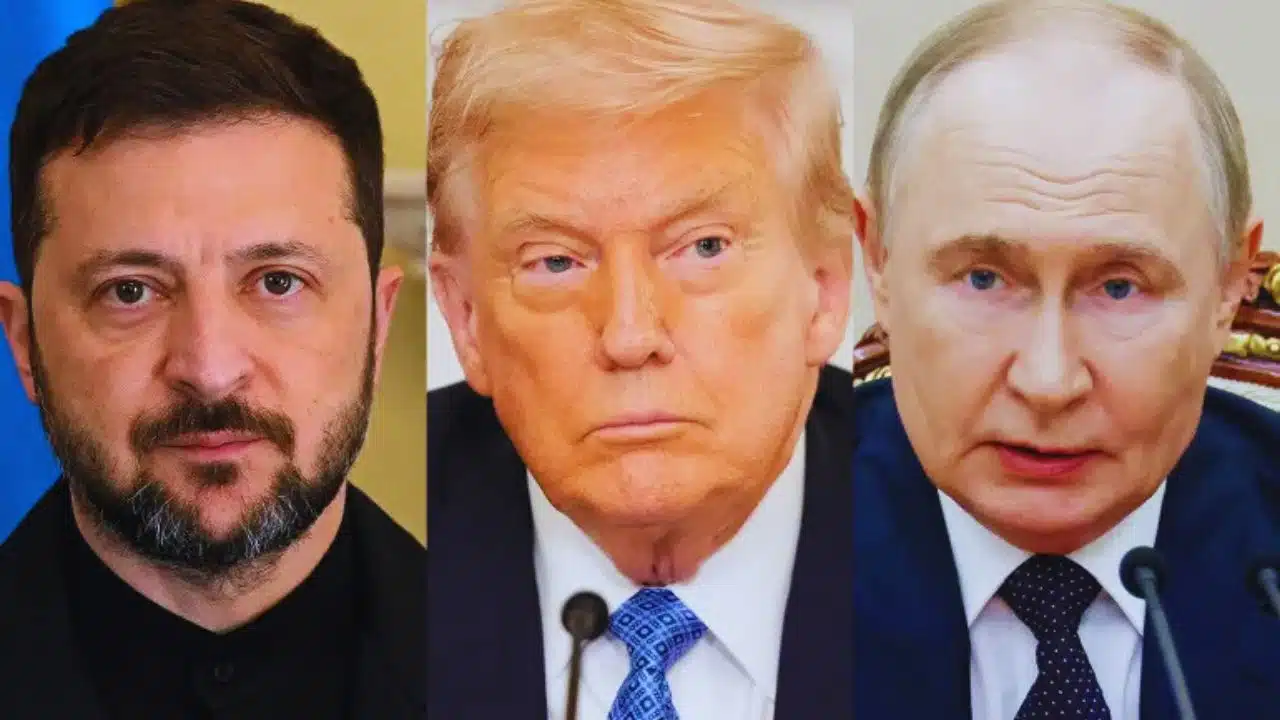
In a landmark policy shift, leaders from the European Union’s major powers, alongside the United Kingdom and Ukraine itself, have formally endorsed U.S. President Donald Trump’s controversial proposal for an immediate ceasefire in Ukraine.
The joint declaration, issued late Tuesday, aligns Europe with Trump’s Ukraine ceasefire position, which calls for halting the war along the current line of contact, a move that has been swiftly rejected by Moscow and met with cautious analysis by geopolitical experts.
Key Facts & Quick Take
- Unified Stance: Leaders from Germany, France, the U.K., Italy, Poland, and top E.U. officials, in coordination with Ukrainian President Volodymyr Zelenskyy, released a joint statement supporting a ceasefire based on current frontlines.
- Ceasefire with Conditions: The backing is not unconditional. The statement insists that Ukraine must enter any negotiations from a “position of maximum strength” and firmly states that “international borders must not be changed by force.”
- Russia Rejects Proposal: The Kremlin has dismissed the plan. Russian Foreign Minister Sergei Lavrov declared that a freeze would legitimize “Nazi rule” in parts of Ukraine and contradicts earlier understandings between Trump and Putin.
- Economic Pressure Ramps Up: European leaders pledged to intensify economic sanctions and are actively developing measures to use the full value of frozen Russian sovereign assets to provide Ukraine with necessary resources.
- High Human Cost: The push for a ceasefire comes as the United Nations reports a sharp escalation in civilian casualties. The first eight months of 2025 saw a 40% increase in civilian harm compared to the same period in 2024.
A New Transatlantic Front
The coordinated announcement on October 21, 2025, represents the most significant diplomatic alignment between Europe and the Trump administration on the Ukraine war to date. After months of divergent strategies, the joint statement signals a desperate, unified push to de-escalate a conflict now entering its fourth year, a war that has ravaged Ukraine and destabilized the global economy.
The declaration unequivocally states: “We strongly support President Trump’s position that the fighting should stop immediately, and that the current line of contact should be the starting point of negotiations.”The signatories include German Chancellor Friedrich Merz, French President Emmanuel Macron, British Prime Minister Keir Starmer, and European Commission President Ursula von der Leyen, among others.
Critically, the statement is a two-pronged strategy: an olive branch in one hand, a sword in the other. While endorsing the halt in fighting, the leaders accused Russia of duplicity, noting that “Russia’s stalling tactics have shown time and time again that Ukraine is the only party serious about peace.” To that end, they committed to bolstering Ukraine’s position, ensuring it is not forced into a disadvantageous peace.
The Trump Doctrine: “Stop the Killing”
The European move is a direct response to a whirlwind of personal diplomacy by President Trump, who has made ending the war a cornerstone of his foreign policy. In recent days, Trump held a reportedly tense White House meeting with President Zelenskyy and a two-hour phone call with Russian President Vladimir Putin.
His public messaging has been blunt and simple, urging both sides to accept the current battlefield reality as a starting point. “They should stop where they are. Let both claim Victory, let History decide,” Trump stated on Sunday. “Enough blood has been shed.”
This approach marks a departure from previous strategies focused on a complete Russian withdrawal before talks could begin. Trump’s “leave it the way it is” policy has been criticized by hawks as rewarding Russian aggression, but it has now gained the official backing of a war-weary Europe.
Latest Data & Statistics: The War’s Staggering Toll
The urgency behind this diplomatic push is underscored by the grim reality on the ground and its cascading economic consequences.
- Civilian Casualties Surge: The UN Human Rights Monitoring Mission (OHCHR) reported on October 14, 2025, that it has documented more than 50,000 civilian casualties (killed and injured) since the full-scale invasion began. In a deeply concerning trend, the agency noted a 37% increase in civilian casualties between December 2024 and May 2025 compared to the prior year, highlighting the escalating human cost.
- Europe’s Economic Paradox: Despite sweeping sanctions, European nations have paid more than €213 billion for Russian energy since the war’s start, according to a Reuters analysis. While overall EU imports from Russia have plummeted by approximately 86% since 2022, trade in non-sanctioned goods like fertilizers continues, and some member states have paradoxically increased energy imports, inadvertently funding Moscow’s war machine.
- Russia’s Weakening Economy: The Kremlin’s war economy is showing signs of severe strain. A combination of sanctions, the cost of the protracted conflict, and effective Ukrainian strikes on Russian energy infrastructure has led experts to predict a potential budget deficit of around $100 billion for Russia in 2026. This growing economic fragility is seen as a key leverage point for the West.
Official Responses and Expert Analysis
Moscow’s Defiant Rejection
The Kremlin’s response to the joint statement was swift and negative. Russian Foreign Minister Sergei Lavrov told reporters that Trump’s proposal for an immediate freeze was unacceptable, claiming it “would mean only one thing: a large part of Ukraine would remain under Nazi rule.” This rhetoric signals that Russia’s core war aims, including regime change in Kyiv, remain unchanged, posing the single greatest obstacle to the ceasefire’s success.
A ‘Managed Freeze’ or a Slippery Slope?
Experts are divided on the viability and wisdom of the new approach. Analysts at the Center for Strategic and International Studies (CSIS) describe the most likely outcome not as a formal peace treaty but as a “managed freeze of the current conflict.”
“In practice, that could mean shelving formal NATO membership for now… It would stop short of de jure recognition of Moscow’s seizures while acknowledging the de facto line of control as a temporary military reality—not a political settlement,” an expert analysis from CSIS explains.
The primary goal of such a freeze would be to “reduce the rate of killing” and give Ukraine time to harden its long-term defenses. However, critics fear it could simply give Russian forces time to regroup for a future offensive and normalize the seizure of territory by force, setting a dangerous international precedent.
What to Watch Next
The diplomatic offensive is set to continue at a rapid pace. European leaders will convene for an E.U. Council meeting in Brussels on Thursday to hash out the details of increased pressure on Moscow, followed by a “Coalition of the Willing” gathering in London on Friday.
The key question remains the status of a potential face-to-face summit between President Trump and President Putin, which was tentatively planned to be held in Budapest. White House officials have recently downplayed the likelihood of a meeting in the “immediate future,” suggesting that significant gaps remain between the U.S. and Russian positions.
The unified backing for Trump’s Ukraine ceasefire plan marks a pivotal moment in the war. It is a high-risk, high-reward strategy that aligns Washington and Brussels but puts them on a direct collision course with a defiant Moscow. While the proposal offers a potential pathway to stop the bloodshed that is devastating Ukraine, its success hinges on whether unprecedented economic pressure can force a reluctant Kremlin to a negotiating table it still seems determined to avoid. For the millions of civilians caught in the crossfire, the outcome of this diplomatic gambit cannot come soon enough.
























