


HTML5 has revolutionized web development, providing developers with powerful tools to create dynamic, efficient, and engaging websites and applications. Whether you’re a seasoned developer or just starting, understanding these essential HTML5 features is crucial for staying ahead in the ever-evolving web landscape.
In this article, we’ll explore the 7 Essential HTML5 Features Every Developer Should Know, explaining their functionality, benefits, and practical applications.
By the end, you’ll be equipped to leverage HTML5’s full potential and enhance your web development skills.
1. Semantic Elements for Better Structure
Semantic elements in HTML5 define the meaning of web content more clearly, making it easier for both search engines and developers to understand the document structure. Unlike non-semantic elements like <div> and <span>, which only serve as generic containers, semantic elements provide explicit contextual meaning to the content, enhancing both readability and search engine optimization.
These elements also improve website accessibility, as assistive technologies can interpret them correctly, ensuring a better user experience for individuals relying on screen readers. By adopting semantic elements, developers create structured, well-organized, and maintainable code that contributes to a more efficient and user-friendly web environment.
Key Semantic Elements and Their Uses
| Element | Purpose |
| <article> | Defines independent, self-contained content (e.g., blog posts, news articles) |
| <section> | Groups related content together |
| <header> | Represents introductory content or a navigational link |
| <footer> | Defines footer section of a document |
| <nav> | Indicates navigation links |
| <aside> | Represents side content, like sidebars |
Benefits of Semantic HTML5
- Improved SEO—Search engines prioritize structured content.
- Better Accessibility—Screen readers and assistive technologies can interpret the content more effectively.
- Enhanced Maintainability—More readable and organized code.
Example: Semantic vs. Non-Semantic Markup
Non-Semantic Markup
<div id=”header”>
<h1>My Blog</h1>
</div>
Semantic Markup
<header>
<h1>My Blog</h1>
</header>
By using semantic elements, you ensure better code readability and search engine optimization.
2. Native Audio and Video Support

HTML5 eliminates the need for third-party plugins like Flash by introducing native support for audio and video elements. These elements provide seamless multimedia integration directly within web pages, improving performance and reducing security vulnerabilities associated with outdated plugins.
By leveraging HTML5’s native media capabilities, developers can ensure greater cross-platform compatibility, faster load times, and enhanced user experiences on both desktop and mobile devices.
Additionally, HTML5 supports various audio and video formats, offering flexibility in content delivery without requiring additional software installations.
The <audio> Elements
Basic Video Embed Example:
<video controls>
<source src=”video.mp4″ type=”video/mp4″>
Your browser does not support the video tag.
</video>
Basic Audio Embed Example:
<audio controls>
<source src=”audio.mp3″ type=”audio/mpeg”>
Your browser does not support the audio tag.
</audio>
Benefits of Native Audio & Video Support
- Cross-browser compatibility
- Eliminates reliance on Flash
- Supports multiple file formats (MP4, WebM, Ogg, MP3, WAV)
- Allows control attributes (play, pause, volume)
3. Canvas API for Dynamic Graphics
The Canvas API enables developers to create graphics, animations, and game elements directly in the browser without additional plugins. It provides a drawable region defined by an element, allowing developers to use JavaScript to render 2D graphics and animations.
This API is widely used in interactive applications, data visualization, and even complex browser-based games. The Canvas API offers fine-grained control over pixels, enabling high-performance rendering without needing additional libraries or frameworks. Additionally, it supports various image manipulation techniques, making it a versatile tool for creative web development.
Example: Drawing a Rectangle in Canvas
<canvas id=”myCanvas” width=”200″ height=”100″></canvas>
<script>
var canvas = document.getElementById(“myCanvas”);
var ctx = canvas.getContext(“2d”);
ctx.fillStyle = “blue”;
ctx.fillRect(20, 20, 150, 75);
</script>
Uses of the Canvas API
- Creating interactive graphics
- Developing browser-based games
- Implementing real-time data visualizations
4. Local Storage and Session Storage
HTML5 introduces the Web Storage API to store data locally on the user’s browser, providing a more efficient and secure way to manage client-side data compared to traditional cookies. Unlike cookies, which are sent with every HTTP request, Web Storage enables faster data retrieval and reduces unnecessary network traffic.
It consists of two key mechanisms: Local Storage, which retains data permanently unless explicitly deleted, and Session Storage, which maintains data only for the duration of the session.
These features allow developers to enhance user experience by storing preferences, login states, and other essential data without relying on server-side storage.
| Feature | Local Storage | Session Storage |
| Data Persistence | Permanent until cleared | Expires when the session ends |
| Storage Limit | 5MB+ | 5MB+ |
| Accessibility | Accessible across sessions | Only available for the current session |
Example: Storing Data in Local Storage
<script>
localStorage.setItem(“username”, “JohnDoe”);
console.log(localStorage.getItem(“username”));
</script>
5. Form Enhancements for Improved User Experience
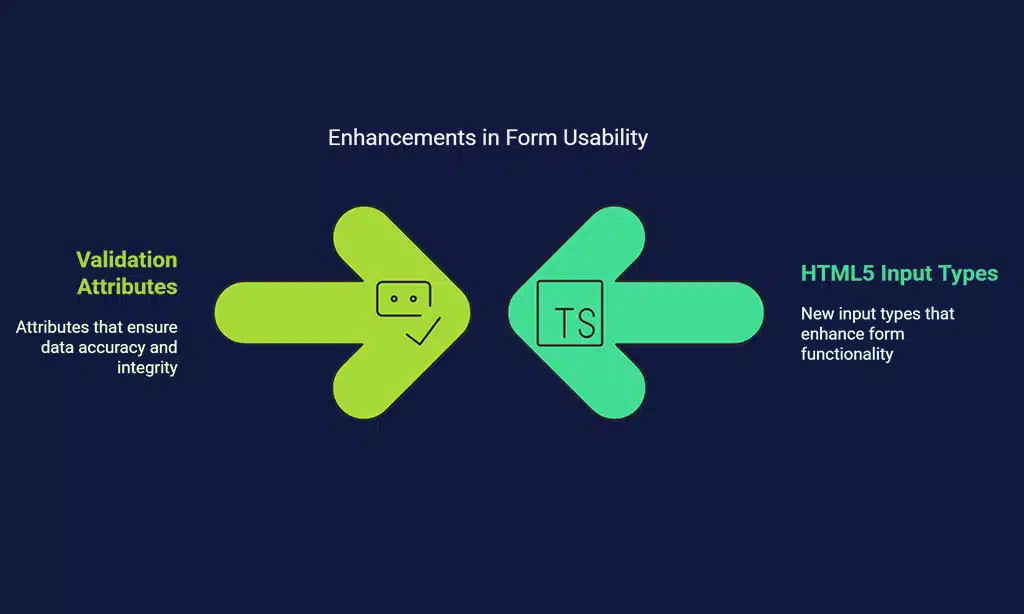
HTML5 introduces new input types and validation attributes to improve form usability, making forms more interactive and user-friendly. These enhancements allow developers to provide better input experiences, reducing the need for JavaScript-based validation and improving accessibility.
By leveraging these built-in features, developers can create smarter forms that respond dynamically to user input, ensuring better data integrity and enhanced usability.
New Input Types
- <email>—Ensures valid email format
- <date>— Displays date picker
- <range>—Adds a slider input
Example: HTML5 Form with Validation
<form>
<label for=”email”>Email:</label>
<input type=”email” id=”email” required>
<button type=”submit”>Submit</button>
</form>
6. WebSockets for Real-Time Communication
WebSockets provide real-time, bi-directional communication between the client and server, enabling instant data exchange with minimal latency. Unlike traditional HTTP requests, which follow a request-response model, WebSockets establish a persistent connection that allows continuous data transfer.
This makes WebSockets ideal for applications requiring live updates, such as chat systems, financial market tracking, multiplayer games, and collaborative document editing. By leveraging WebSockets, developers can create highly interactive, efficient, and responsive web applications, improving the overall user experience and reducing unnecessary network overhead.
WebSockets provide real-time, bi-directional communication between the client and server.
WebSockets vs. AJAX
| Feature | WebSockets | AJAX |
| Data Flow | Full-duplex | Request-response |
| Latency | Low | High |
| Use Cases | Live chat, gaming, stock updates | Form submissions, API calls |
Example: WebSocket Implementation
<script>
var socket = new WebSocket(“ws://example.com/socket”);
socket.onmessage = function(event) {
console.log(“Message from server:”, event.data);
};
</script>
7. Geolocation API for Location-Based Features
The Geolocation API enables websites to retrieve the user’s location and provide personalized experiences based on geographic data. This powerful feature allows applications to offer navigation services, local search results, weather updates, and other location-based functionalities.
By using JavaScript, developers can request a user’s current coordinates and integrate mapping services like Google Maps to enhance user interaction. The API ensures privacy by requiring user consent before accessing location data, maintaining a balance between functionality and security.
Example: Get User Location
<script>
navigator.geolocation.getCurrentPosition(function(position) {
console.log(“Latitude: ” + position.coords.latitude + “, Longitude: ” + position.coords.longitude);
});
</script>
Use Cases of the Geolocation API
- Navigation apps (Google Maps, Uber)
- Location-based advertising
- Weather services
Takeaways
HTML5 has transformed web development, offering powerful features that enhance performance, user experience, and interactivity.
By mastering these essential HTML5 features every developer should know, you can build modern, feature-rich applications that stand out in today’s digital landscape.





















