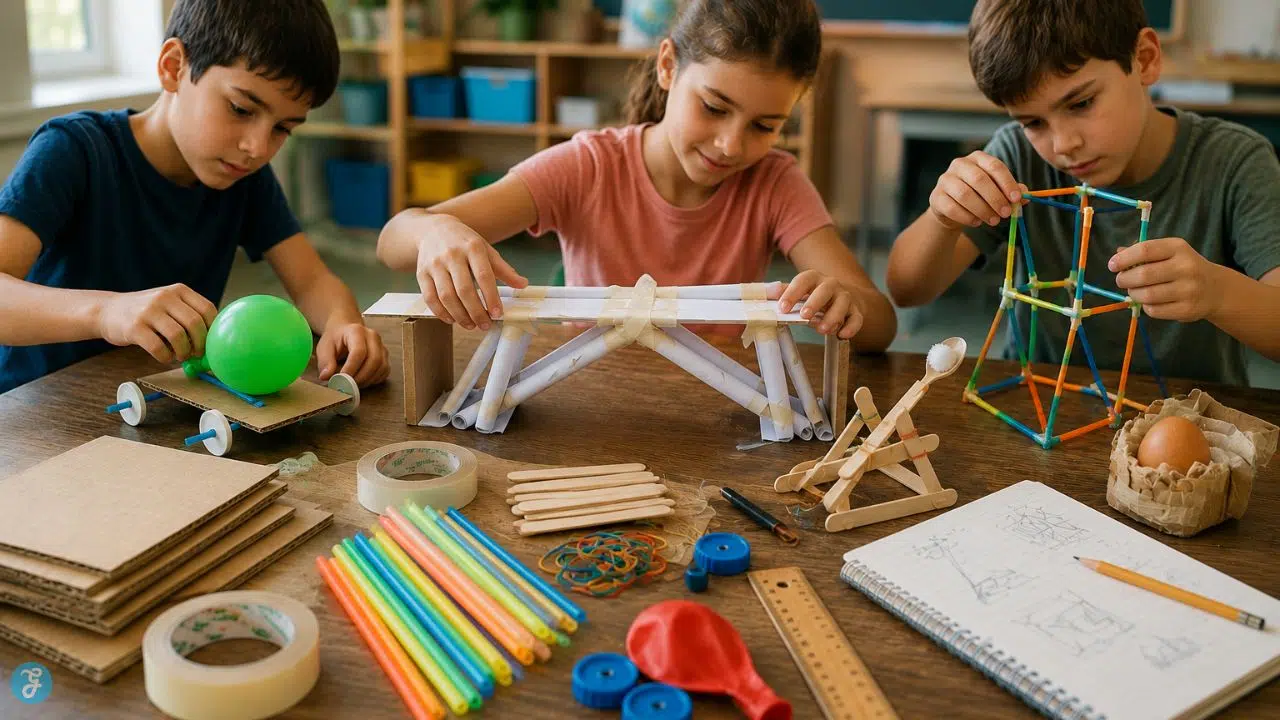
Good engineering projects for beginners do not start with expensive kits, complicated tools, or a child being told to “just follow the instructions.” That is building. It is not always engineering. Engineering begins when kids have a problem to solve. Can you build a bridge that holds more coins? Can you design a tower that survives a fan? Can you make a paper glider fly farther? Can you protect an egg from a fall? Can you move a toy car using air, gravity, or stored energy?
That is where the learning happens. The best beginner engineering projects teach kids to design, test, fail, change something, and test again. They learn that the first version is rarely the best version. They also learn that “it broke” is not the end of the project. It is data. Annoying data, maybe, but still data.
This list includes 7 hands-on engineering projects kids can build with simple materials at home, in classrooms, in homeschool lessons, or in after-school STEM programs. Each project focuses on real beginner engineering skills: structure, force, motion, stability, load, energy, design trade-offs, and problem-solving.
What Makes a Beginner Engineering Project Actually Useful?
A useful engineering project should do more than keep kids busy with cardboard and tape.
It should give them a design problem, a few constraints, and a chance to improve. That is what separates a real engineering challenge from a craft activity. Crafts usually aim for something nice-looking. Engineering projects aim for something that works.
A strong beginner project usually includes:
- A clear challenge
- Simple materials
- A build phase
- A test phase
- A failure or improvement phase
- A short reflection
- A chance to redesign
For example, “build a bridge” is fine. But “build a bridge from paper that holds the most coins across a 12-inch gap” is better. Now kids have a goal, limits, and a way to measure success. That is beginner engineering at its best: practical, messy, testable, and surprisingly fun.
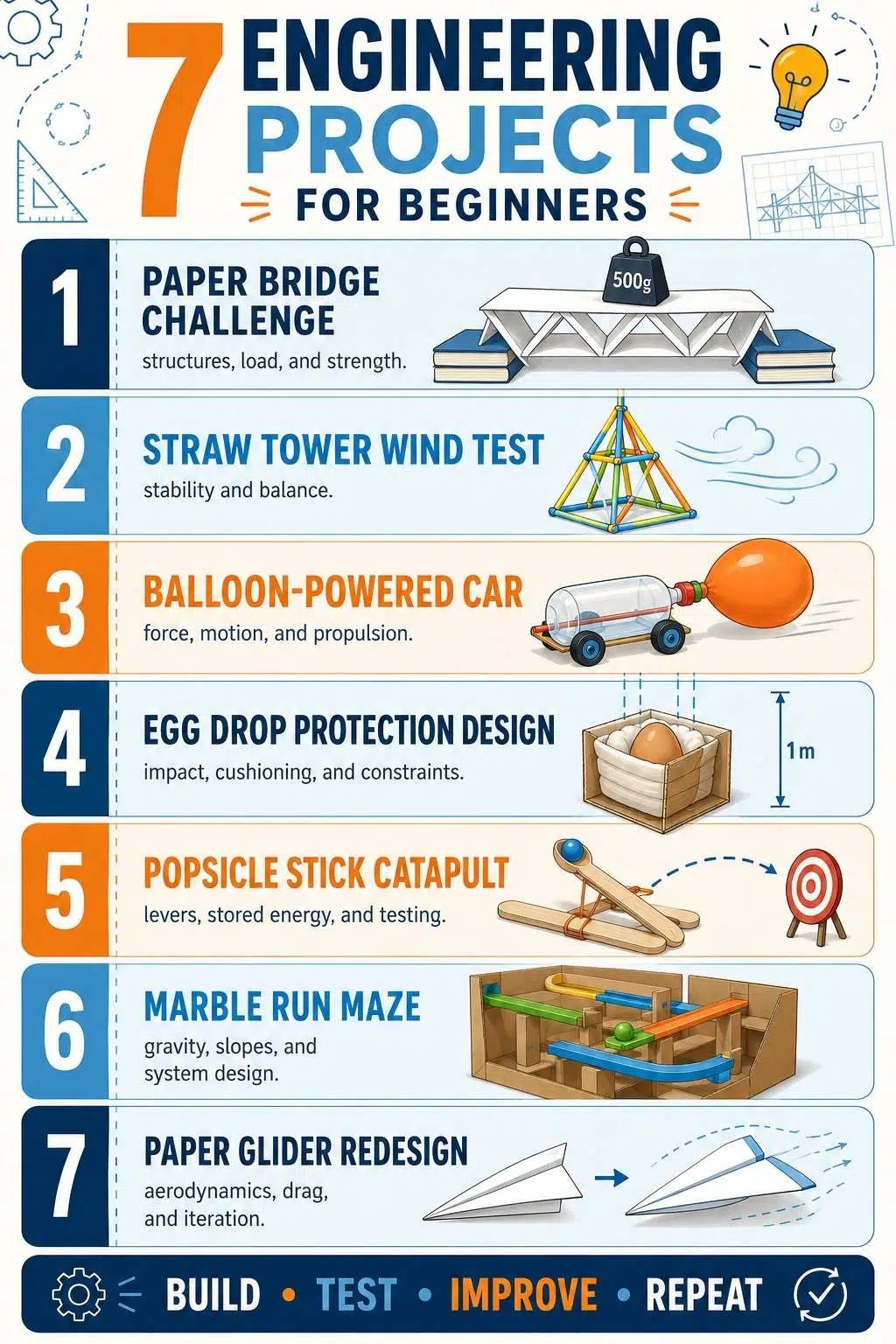
7 Engineering Projects for Beginners Kids Can Build
These projects work best when kids build more than one version. The first version shows what they thought would work. The second version shows what they learned.
1. Paper Bridge Challenge
The paper bridge challenge is one of the easiest engineering projects for beginners because it uses simple materials but teaches a real structural idea: shape affects strength.
Give kids a few sheets of paper, tape, and two stacks of books. Their challenge is to build a bridge across the gap between the books and see how many coins, blocks, or small objects it can hold before bending or collapsing.
At first, many kids will lay one flat sheet across the gap. It usually fails quickly. Then they start folding, rolling, layering, or creating beams. That is the engineering moment. They begin to realize that the same material can behave very differently depending on shape.
What kids learn: Load, compression, tension, structure, support, and redesign.
You’ll need: Paper, tape, books, coins or small weights, ruler, and notebook.
Try this: Let kids test flat paper, folded paper, rolled paper, and accordion-fold paper.
Make it more engineering-focused: Limit the materials. For example, use only two sheets of paper and 12 inches of tape.
2. Straw Tower Wind Test
This project teaches stability in a way kids can see immediately.
Ask kids to build the tallest tower they can using straws and tape. Then test it with gentle wind from a fan or by blowing from a safe distance. The tower should stand as tall as possible while surviving the wind test.
Kids quickly learn that height alone is not enough. A tall tower with a weak base falls over. A wide base helps. Triangles can add strength. Too much weight at the top creates problems.
This is a great DIY engineering kids activity because it turns trial and error into visible learning.
What kids learn: Stability, balance, center of gravity, bracing, and structural design.
You’ll need: Drinking straws, tape, scissors with supervision, ruler, and fan.
Try this: Compare square frames and triangle frames.
Safety note: Use a low fan setting and keep loose materials away from the blades.
3. Balloon-Powered Car
A balloon-powered car is a classic kids build project because it combines design, motion, and just enough chaos to keep everyone interested.
Kids build a small car using a lightweight base, wheels, axles, tape, and a balloon. When the inflated balloon releases air, the car moves forward. The challenge is to make the car travel as far as possible.
The engineering problem is not only “attach a balloon.” Kids must think about wheel alignment, friction, weight, air direction, axle movement, and balance. If the car spins, drags, or barely moves, they have to diagnose why.
What kids learn: Force, motion, propulsion, friction, wheel alignment, and testing.
You’ll need: Cardboard, bottle caps or toy wheels, straws, skewers, tape, balloon, and scissors.
Try this: Test different wheel sizes or balloon positions.
Make it more advanced: Measure distance traveled and change only one design feature at a time.
4. Egg Drop Protection Design
The egg drop is famous for a reason. It teaches kids that engineering often means protecting something fragile under real constraints.
The challenge is simple: design a container or landing system that protects an egg from a drop. Kids can use materials such as paper, cardboard, cotton balls, straws, string, tape, paper bags, or recycled packaging.
This project teaches impact forces, cushioning, distribution of force, and trade-offs. A giant pillow-like container may protect the egg, but what if materials are limited? A parachute may slow the fall, but what if the drop area is small?
That is where the design gets interesting.
What kids learn: Impact, cushioning, energy transfer, constraints, and redesign.
You’ll need: Egg or plastic egg, cardboard, paper, tape, straws, cotton balls, string, and drop-safe area.
Try this: Use a plastic egg first, then test with a real egg if cleanup is manageable.
Safety note: Always have an adult manage the drop height and cleanup. Do not drop from unsafe places.
5. Popsicle Stick Catapult
A popsicle stick catapult introduces kids to levers and stored energy without needing complicated tools.
Kids use popsicle sticks, rubber bands, and a plastic spoon or bottle cap to build a small launcher. The goal can be distance, accuracy, or consistency. They can launch soft pom-poms, cotton balls, or paper balls toward a target.
The best part is testing. A stronger rubber band may launch farther. A different spoon angle may change direction. A heavier object may travel differently. Kids can adjust the lever arm, tension, and launch angle.
This project feels playful, but it teaches real mechanical thinking.
What kids learn: Levers, force, stored energy, angles, distance, and accuracy.
You’ll need: Popsicle sticks, rubber bands, plastic spoon or bottle cap, tape, and soft projectiles.
Try this: Create a target zone and see which design is most accurate.
Safety note: Use only soft objects and never aim at people, pets, faces, or breakable items.
6. Marble Run Maze
A marble run maze is a strong beginner engineering project because kids design a system, not just one object.
Using cardboard, paper tubes, tape, straws, and recycled materials, kids build a track that moves a marble from start to finish. The goal may be to make the marble travel slowly, avoid falling off, pass through turns, or trigger a small action at the end.
This project teaches cause and effect. If the slope is too steep, the marble flies off. If the track is too flat, it stops. If a turn is too sharp, the marble escapes. Every problem tells kids what to adjust.
What kids learn: Gravity, slope, speed, friction, systems, and troubleshooting.
You’ll need: Cardboard, paper towel tubes, tape, scissors, marble, books or blocks for elevation.
Try this: Build one fast marble run and one slow marble run.
Make it smarter: Time each run and ask kids to redesign for either speed or control.
7. Paper Glider Redesign
Paper airplanes are fun, but paper glider redesign turns them into engineering.
Kids build a basic paper glider, test how far it flies, then change one feature at a time. They can adjust wing size, nose weight, folds, tail flaps, paper type, or launch angle.
The important rule is to test fairly. Use the same starting line. Throw with similar force. Measure distance. Record changes. Then redesign.
This teaches kids that engineering is not guessing once. It is changing one variable, testing, and learning from the result.
What kids learn: Aerodynamics, lift, drag, stability, variables, and iteration.
You’ll need: Paper, paper clips, tape, ruler or measuring tape, and open space.
Try this: Add a paper clip to the nose and compare flight distance.
Safety note: Do not throw gliders toward faces, windows, fans, or fragile objects.
Best Beginner Engineering Projects by Age
| Age Group | Best Projects |
| Ages 5-6 | Paper Bridge, Straw Tower, Marble Run |
| Ages 7-8 | Balloon Car, Paper Glider, Simple Catapult |
| Ages 9-10 | Egg Drop, Catapult Testing, Advanced Marble Run |
| Ages 11+ | Multi-version redesigns, measured testing, design journals |
Age ranges are flexible. Younger kids can do harder projects with help, and older kids can make simple projects more advanced by adding limits, measurements, and redesign rounds.
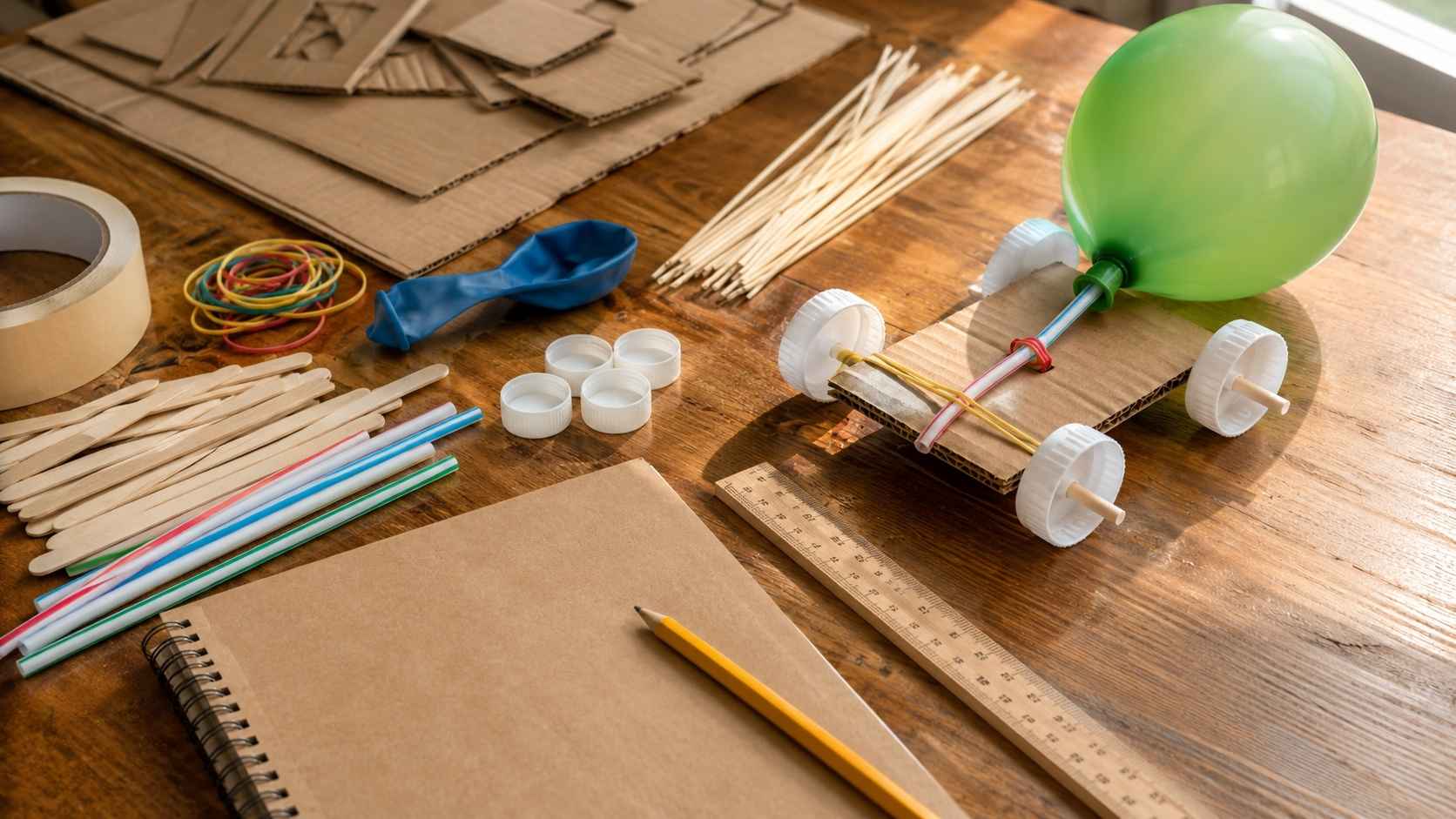
Simple Materials for DIY Engineering Kids Projects
You do not need expensive engineering kits to start.
Useful materials include:
- Cardboard
- Paper
- Tape
- Straws
- Popsicle sticks
- Rubber bands
- Balloons
- Bottle caps
- Skewers
- Paper clips
- String
- Paper towel tubes
- Plastic spoons
- Cotton balls
- Pom-poms
- Marbles
- Ruler
- Measuring tape
- Notebook
- Pencil
The best beginner engineering bin is full of ordinary materials kids can cut, bend, stack, tape, test, and rebuild.
Common Mistakes to Avoid
Giving kids too many instructions. If every step is already decided, they are assembling, not engineering.
- Helping too quickly. Let kids struggle safely. The leaning tower, stuck marble, weak bridge, or crooked car is part of the lesson.
- Praising only success. A failed design with a smart improvement can teach more than a lucky first attempt.
- Using too many materials. Limits create better thinking.
- Skipping measurement. Distance, height, time, weight, or number of coins can turn a fun build into a real test.
A Simple Engineering Design Process for Kids
Use this beginner-friendly version:
- Ask: What problem are we solving?
- Imagine: What are a few possible ideas?
- Plan: Which idea will we build first?
- Build: Make the first version.
- Test: See what happens.
- Improve: Change one thing.
- Test again: Compare the result.
This process works for bridges, towers, cars, gliders, catapults, marble runs, and almost every beginner engineering challenge.
Final Thoughts
Engineering projects for beginners should not feel like perfect Pinterest builds. They should wobble a little. They should break sometimes. They should make kids say, “Wait, what if we try this instead?” That is the point.
When children build a paper bridge, straw tower, balloon car, egg drop container, catapult, marble run, or glider, they are learning how engineers think. They are solving problems with limited materials. They are testing ideas. They are noticing failure. They are improving the design.
That is real engineering. The best project is not the one that works perfectly on the first try. It is the one kids want to rebuild.
Frequently Asked Questions About Engineering Projects for Beginners
1. What are easy engineering projects for beginners?
Easy engineering projects for beginners include paper bridges, straw towers, balloon-powered cars, egg drop containers, popsicle stick catapults, marble runs, and paper gliders. These projects use simple materials and teach real design, testing, and problem-solving skills.
2. What is a good engineering project for young kids?
A paper bridge or straw tower is a good engineering project for young kids because the materials are simple and the results are easy to test. Kids can quickly see whether the bridge holds weight or the tower stays standing.
3. How do kids learn engineering through build projects?
Kids learn engineering by solving a problem, building a design, testing it, finding what failed, and improving it. This process teaches critical thinking, creativity, measurement, structure, motion, and persistence.
4. Do beginner engineering projects need special kits?
No. Many beginner engineering projects use household or classroom materials such as paper, cardboard, tape, straws, rubber bands, balloons, popsicle sticks, bottle caps, and marbles. Simple materials often lead to better creativity.
5. What is the difference between a craft and an engineering project?
A craft usually focuses on making something look nice or follow a set pattern. An engineering project focuses on solving a problem. It includes testing, constraints, redesign, and improvement.
6. How can parents make DIY engineering kids projects more useful?
Parents can make projects more useful by asking kids to predict, build, test, measure, and improve. Instead of fixing the design for them, ask what they noticed and what they want to change next.