Choosing paint used to be mostly about color. Now it is also about smell, indoor air, ingredients, durability, children, pets, allergies, cleanup, waste, and whether the “eco” label on the can actually means anything. That is where eco-friendly paint options get confusing.
One brand says low VOC. Another says zero VOC. Another says natural paint. Another says non-toxic paint. Then you find limewash, clay paint, milk paint, mineral paint, recycled paint, plant-based paint, water-based acrylic, and third-party certified coatings. Suddenly, choosing white paint for a bedroom starts to feel like reading a chemistry label in a hardware aisle.
The good news is that you do not need to become a paint scientist to make a better choice. You just need to understand what each option is good at, where it falls short, and which trade-offs matter for your room. A nursery, bathroom, rental unit, old home, kitchen, exterior wall, and decorative feature wall do not all need the same paint.
This guide compares the most common eco-friendly paint options, including low VOC paint, natural paint, mineral-based finishes, recycled paint, and non-toxic paint claims. The goal is not to crown one perfect paint for every home. There is no such thing.
The goal is to help you choose a paint that is healthier, practical, durable enough, and honest about its limits.
What Makes Paint Eco-Friendly?
Eco-friendly paint is paint designed to reduce harm to people, indoor air, and the environment compared with conventional high-emission or solvent-heavy paints.
That can mean several things:
- Lower VOC content
- Lower VOC emissions after application
- Fewer hazardous additives
- Water-based formulation
- Mineral or plant-based ingredients
- Safer cleanup
- Lower odor
- Better ingredient transparency
- Third-party certification
- Recycled content
- Longer durability
- Less waste over time
- Safer manufacturing practices
But “eco-friendly” is not one fixed standard. A paint can be low VOC but still contain synthetic preservatives. A natural paint can still irritate sensitive users if it contains certain oils, lime, casein, or fragrances. A recycled paint can reduce waste but may not offer the same color precision as a premium low-emission paint. A “non-toxic paint” label can sound reassuring but still needs proof.
That is why the smartest approach is to compare paints by use case, not marketing language.
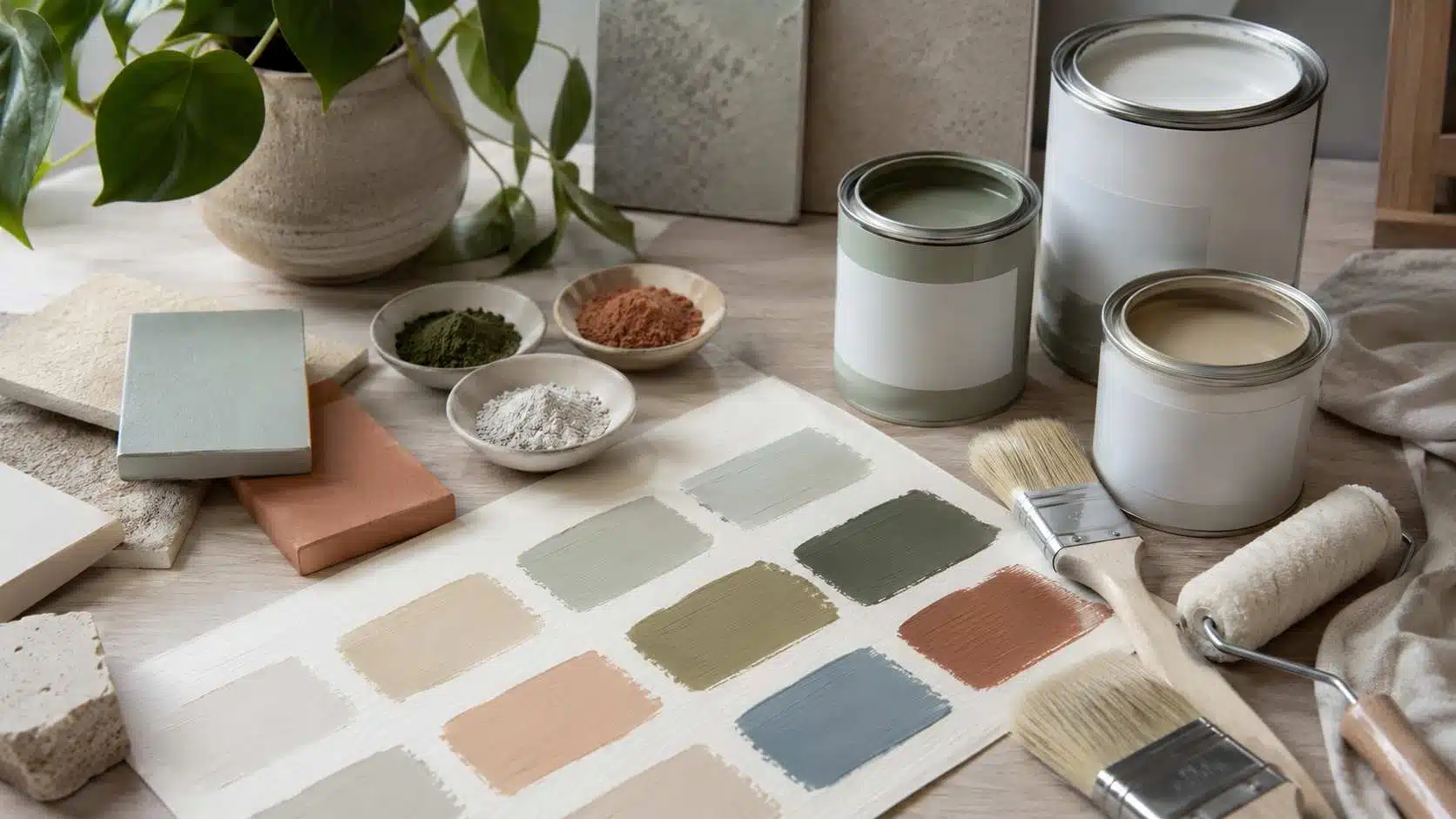
Why VOCs Matter in Paint
VOC stands for volatile organic compound. In simple terms, VOCs are chemicals that can evaporate into the air. Some VOCs are linked with odor, irritation, headaches, and indoor air-quality concerns. Paint is not the only VOC source in a home, but painting a room can create a noticeable short-term exposure because a large wet surface dries indoors.
This is why many homeowners look for low VOC paint or zero VOC paint. However, VOC labels can be tricky. A paint’s VOC content tells you something useful, but it does not tell you everything about health, odor, emissions, or ingredient safety.
Here is the difference:
| Term | What It Usually Means | What to Watch |
| VOC content | VOC amount in the paint formula, often shown in grams per liter | May not fully reflect emissions after painting |
| VOC emissions | What the paint releases into indoor air over time | Better indicator for indoor air concerns |
| Low VOC paint | Lower VOC content than conventional paint | Definitions vary by region, product type, and finish |
| Zero VOC paint | Very low VOC content, not always literally zero chemicals | Tinting and additives can change final VOC levels |
| Non-toxic paint | Marketing or certification-based claim that suggests safer ingredients | Needs proof, not just a label |
| Natural paint | Made partly or mostly from mineral, plant, clay, lime, casein, or other natural ingredients | Natural does not automatically mean allergy-safe or maintenance-free |
The practical takeaway is simple. Look beyond the front label. Check the technical data sheet, safety data sheet, VOC number, emission certification, tint system, and recommended use.
Low VOC Paint: The Most Practical Eco-Friendly Choice for Most Homes
Low VOC paint is usually the easiest eco-friendly paint option for everyday homeowners. It looks and behaves much like regular modern wall paint, but it is formulated to reduce VOC content. Most low VOC paints are water-based acrylic or latex paints, which makes cleanup easier and odor lower than many solvent-based products.
Low VOC paint works well for:
- Bedrooms
- Living rooms
- Hallways
- Home offices
- Dining rooms
- Kids’ rooms
- Rental units
- General interior repainting
- DIY projects
The biggest advantage is practicality. You can usually find low VOC paint in many colors, sheens, finishes, and price ranges. It is familiar to painters, easy to apply, and more forgiving than many specialty natural finishes. But low VOC does not mean chemical-free.
A low VOC paint may still contain preservatives, binders, surfactants, defoamers, mildewcides, colorants, and other additives. That does not automatically make it unsafe, but it means “low VOC” should not be treated as the same thing as “pure” or “non-toxic.”
Low VOC paint is best when you want a better mainstream paint without changing the entire painting process.
Zero VOC Paint: Better for Sensitive Indoor Spaces, With Caveats
Zero VOC paint sounds like the cleanest modern option. For many homes, it can be a strong choice, especially in rooms where odor and indoor air concerns matter.
Good uses include:
- Nurseries
- Bedrooms
- Classrooms
- Healthcare-adjacent spaces
- Homes with sensitive occupants
- Apartments with limited ventilation
- Rooms that need to be used soon after painting
But “zero VOC” does not always mean literally nothing is emitted. First, some standards allow very small VOC amounts. Second, tinting can add VOCs depending on the colorant system. Third, a paint can have low VOC content but still include other chemicals that matter to sensitive people.
This does not mean zero VOC paint is bad. It means you should still check the full product information.
For best results, look for:
- Zero VOC base
- Low-VOC or zero-VOC colorants
- Third-party emissions certification
- Clear safety data sheet
- Low odor
- Good coverage
- Washability for the room
- Mold resistance where appropriate
- Compatibility with primer
Zero VOC paint is a strong option for indoor repainting, but it is not a free pass to paint with windows closed and sleep in the room immediately. Good ventilation still matters.
Natural Paint: Healthier-Sounding, But More Complicated
Natural paint usually refers to paint made from ingredients such as clay, lime, chalk, casein, plant oils, plant resins, mineral pigments, water, cellulose, or other naturally derived materials.
It appeals to people who want fewer petrochemical ingredients and a more breathable, low-odor finish.
Natural paint can be beautiful. It can create soft, matte, textured, mineral, earthy finishes that conventional acrylic paint often cannot match. But it is not always the easiest choice.
Natural paint may require:
- More careful surface preparation
- Specific primers
- Special application tools
- Longer curing time
- More maintenance
- Less scrub resistance
- Limited color range
- Compatibility checks
- Skilled application for even results
Natural also does not automatically mean safe for every person. Milk paint may contain casein, which matters for people avoiding milk-derived ingredients. Limewash is highly alkaline when wet and requires careful handling. Plant oils and natural fragrances can bother some sensitive users.
Natural paint is best when you want a specific finish and are willing to follow the product’s rules.
Clay Paint: Best for Soft Matte Interior Walls
Clay paint is one of the most attractive natural paint options for interior walls. It usually creates a very matte, soft, earthy finish with subtle depth. It is popular in natural homes, low-tox interiors, plaster-like aesthetics, and warm minimalist spaces.
Clay paint works well for:
- Bedrooms
- Living rooms
- Meditation rooms
- Low-traffic interior walls
- Natural interiors
- Feature walls
- Homes with breathable wall systems
Its strengths are comfort and appearance. Clay paint can make a wall feel warmer and softer than standard acrylic paint. Its weakness is durability.
Clay paint is usually not the best choice for high-splash, high-scrub, or high-moisture areas unless the specific product is designed for that use. Kitchens, bathrooms, mudrooms, and children’s play areas may need something tougher or more washable.
Choose clay paint when atmosphere matters more than heavy-duty performance.
Limewash: Best for Mineral Texture and Old-World Character
Limewash is a mineral-based finish made from limestone that has been processed into lime and mixed with water and pigments.
It creates a soft, cloudy, textured finish that changes with the wall surface and application method. It is often used for old-world interiors, Mediterranean-style walls, masonry, plaster, and exterior mineral surfaces.
Limewash works well for:
- Plaster walls
- Brick
- Stone
- Masonry
- Feature walls
- Historic-style interiors
- Breathable wall systems
- Some exteriors, depending on product and surface
Limewash can be very eco-friendly in the right context because it is mineral-based, breathable, and often low in synthetic ingredients. It can also age beautifully. But it is not the same as regular paint.
It may not work well over every modern latex-painted wall without preparation. It can rub off if not properly applied or cured. It may need multiple coats. It may look uneven, which is part of the charm but not ideal for people who want a perfectly uniform finish.
Limewash is best for people who want texture, movement, and mineral character. It is not best for people who want a smooth, wipeable, modern wall finish with no variation.
Milk Paint: Best for Furniture and Rustic Finishes
Milk paint is a traditional paint made from ingredients such as milk protein, lime, pigments, and other simple components, depending on the formula. It is often sold as a powder that you mix with water. It is popular for furniture, cabinetry, crafts, and rustic or vintage finishes.
Milk paint works well for:
- Wood furniture
- Decorative pieces
- Rustic finishes
- Farmhouse-style projects
- Crafts
- Small DIY projects
- Raw wood
- Distressed finishes
Its appeal is character. Milk paint can create a soft, authentic, old-fashioned look that synthetic paint sometimes imitates but does not quite match. Its limitations are important.
Milk paint may need a bonding agent on non-porous surfaces. It may require sealing for durability. It can behave unpredictably on previously finished surfaces. It is not usually the first choice for standard modern wall painting unless the product is designed for that.
Use milk paint when you want a natural, traditional finish, especially on furniture or decorative woodwork.
Mineral and Silicate Paint: Best for Breathable, Durable Mineral Surfaces
Mineral paint, especially silicate paint, bonds chemically with mineral surfaces such as masonry, concrete, stucco, and plaster.
It is known for breathability, durability, UV stability, and long life on the right surfaces. It is often used in historic restoration, masonry exteriors, mineral interiors, and buildings where moisture movement matters.
Mineral paint works well for:
- Masonry
- Stucco
- Concrete
- Lime plaster
- Mineral renders
- Historic buildings
- Breathable wall systems
- Certain exterior projects
This can be one of the strongest eco-friendly paint options when durability and breathability matter. A finish that lasts longer can reduce repainting, waste, and material use over time. But it is not universal.
Silicate paint needs compatible mineral surfaces. It may not perform correctly over standard acrylic latex paint unless the surface is prepared with the correct primer or system. It is also more specialized than mainstream interior wall paint.
Mineral paint is best when the wall system calls for it. It is not something to buy casually because the word “mineral” sounds healthy.
Recycled Paint: Best for Reducing Waste
Recycled paint is made by collecting leftover paint, processing it, filtering it, blending it, and reselling it. Its main environmental benefit is waste reduction. Paint waste is a real issue, and recycling usable leftover paint keeps material out of disposal streams while creating a lower-cost product.
Recycled paint works well for:
- Garages
- Basements
- Rental refreshes
- Community projects
- Low-budget repainting
- Utility spaces
- Large areas where exact color is less critical
The biggest advantage is sustainability through reuse. The trade-off is control.
Recycled paint may have fewer color choices, less predictable batch consistency, and less specialty performance than premium new paint. It may not be the best fit when you need a very specific color, finish, certification, or low-emission profile.
Recycled paint is a smart option when reuse matters and the project does not require premium precision.
Plant-Based Paint: A Growing Middle Ground
Some newer paint brands use plant-based binders, bio-based resins, or partially renewable ingredients to reduce reliance on petroleum-derived components.
These products can be appealing because they aim to combine modern paint performance with better ingredient sourcing.
Plant-based paints may work well for:
- Interior walls
- Bedrooms
- Living rooms
- Design-conscious homes
- Lower-odor repainting
- Homeowners who want modern performance with greener ingredients
But “plant-based” needs scrutiny. A paint can contain some plant-derived ingredients and still include synthetic additives. That may be acceptable, but the label alone does not tell the whole story.
Check:
- Percentage of bio-based content
- VOC content
- Emission certification
- Preservatives
- Durability
- Washability
- Tint system
- Technical data sheet
Plant-based paint is promising, but it should be judged by evidence, not vibes.
Water-Based Acrylic or Latex Paint: Not Always Bad
Some people assume that if paint is not natural, it is automatically bad. That is too simple. A high-quality water-based acrylic or latex paint with low emissions, strong durability, good coverage, and a long service life may be a better environmental choice than a fragile natural finish that needs frequent repainting.
Durability matters. If a paint lasts for years, resists washing, covers well, and does not need three extra coats, it may reduce waste and labor even if it is not made from all-natural ingredients. Modern low VOC acrylic paints are often the most practical choice for busy homes because they balance:
- Lower odor
- Lower VOC content
- Good durability
- Good color selection
- Washability
- Easy application
- Availability
- Predictable results
This is why the best eco-friendly paint option for many homes is not the most romantic one. It is the one that performs well with lower emissions and fewer repainting problems.
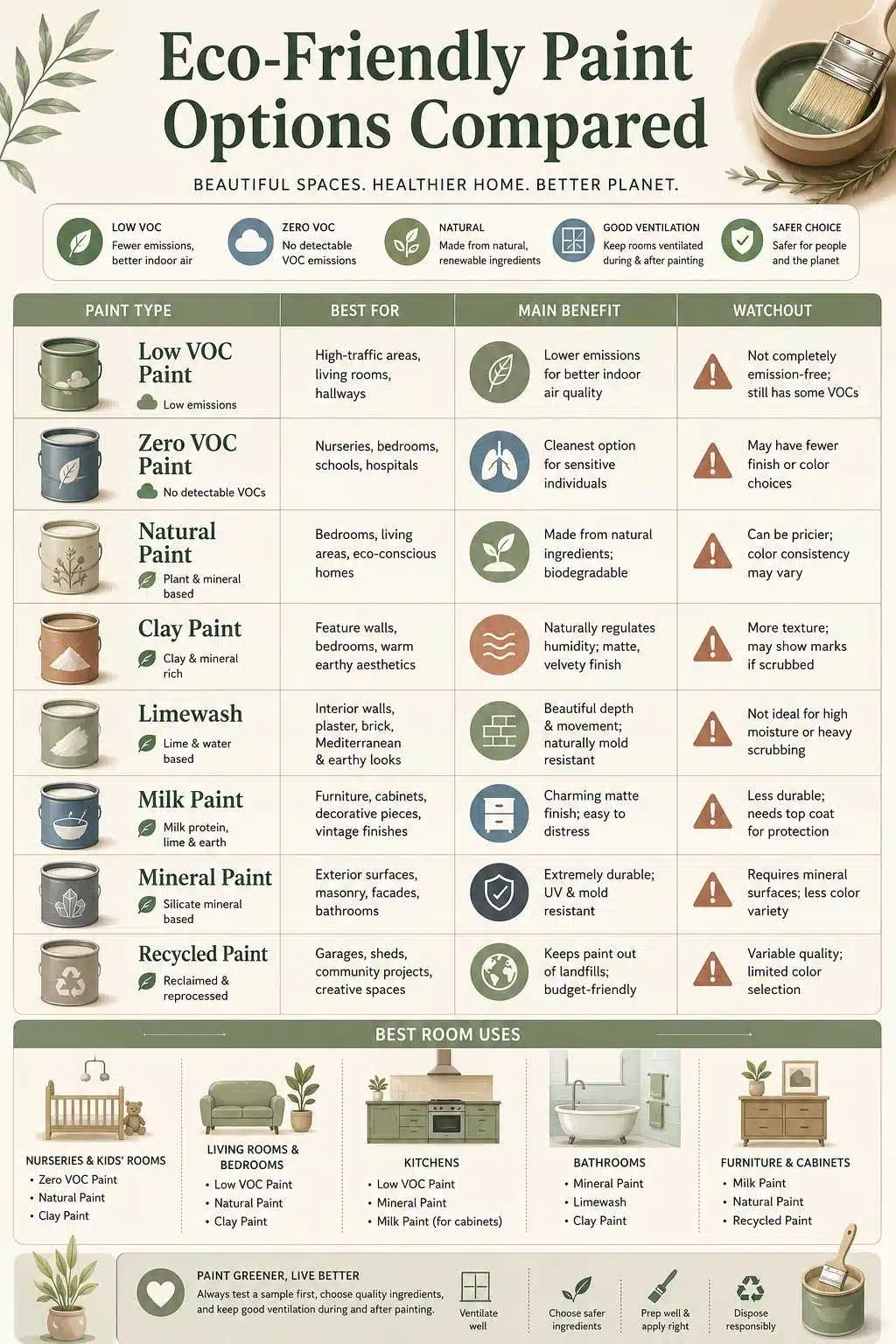
Eco-Friendly Paint Options Compared
Here is a practical comparison of the main choices.
| Paint Option | Best For | Strengths | Watchouts |
| Low VOC paint | Most interior rooms | Easy to find, practical, lower odor, good durability | Not chemical-free |
| Zero VOC paint | Bedrooms, nurseries, sensitive spaces | Very low VOC content, lower odor, mainstream performance | Tinting may add VOCs, still check ingredients |
| Clay paint | Soft matte interior walls | Natural look, warm texture, breathable feel | Less washable, not ideal for wet or high-traffic areas |
| Limewash | Plaster, brick, masonry, feature walls | Mineral, breathable, beautiful movement | Needs compatible surface and careful application |
| Milk paint | Furniture, wood, rustic finishes | Traditional, simple ingredients, character-rich | May need bonding agent or sealer |
| Mineral/silicate paint | Masonry, stucco, mineral plaster | Durable, breathable, long-lasting on right surfaces | Not for every surface |
| Recycled paint | Utility areas, budget projects | Reduces waste, affordable | Limited colors, variable performance |
| Plant-based paint | Modern interior walls | Renewable ingredient potential, lower-odor options | Check actual bio-based content and certifications |
| Standard acrylic latex, low-emission | Busy homes, washable rooms | Practical, durable, broad color range | Ingredient transparency varies |
The best option depends on what you value most: indoor air, natural ingredients, washability, durability, waste reduction, surface breathability, or budget.
Low VOC Paint vs Natural Paint
Low VOC paint and natural paint are often compared, but they solve different problems. Low VOC paint is usually about reducing VOC content while keeping modern paint performance. Natural paint is usually about using simpler, mineral, plant, clay, lime, or casein-based ingredients.
| Factor | Low VOC Paint | Natural Paint |
| Ease of use | Usually easier | Varies by product |
| Color range | Usually broad | Often more limited |
| Durability | Often strong | Depends on type |
| Washability | Often better | Often lower unless sealed |
| Odor | Usually low | Usually low, but can vary |
| Ingredient simplicity | Mixed synthetic formulation | Often simpler |
| Availability | Easy to find | More specialized |
| Best use | Everyday interior repainting | Natural interiors, feature walls, specialty finishes |
Choose low VOC paint when you need practical performance with lower emissions.
Choose natural paint when ingredient simplicity, breathability, texture, or a mineral look matters more than mainstream convenience.
Low VOC Paint vs Zero VOC Paint
Low VOC and zero VOC paints are close relatives, but they are not identical. Zero VOC paint generally has a stricter VOC target than low VOC paint. That makes it attractive for sensitive indoor rooms. But performance still matters.
A zero VOC paint that needs extra coats, scuffs easily, or performs badly in a bathroom may not be the best choice. A high-quality low VOC paint may be more practical for certain spaces.
Use zero VOC paint for:
- Bedrooms
- Nurseries
- Low-ventilation spaces
- Sensitive households
- Quick re-occupancy rooms
- Interior walls where odor matters
Use low VOC paint for:
- General repainting
- High-traffic rooms
- Hallways
- Kitchens
- Rentals
- Spaces needing better durability
- Projects with wider color and finish needs
The best choice is not only the lowest VOC number. It is the best balance of emissions, durability, surface fit, and room use.
Certifications That Matter
Certifications can help cut through greenwashing, but they are not all the same. Useful certifications and standards to look for may include:
| Certification or Standard | What It Helps With |
| GREENGUARD / GREENGUARD Gold | Low chemical emissions into indoor air |
| Green Seal GS-11 | Paint and coating environmental and health criteria |
| Cradle to Cradle Certified | Material health and circularity factors |
| Declare label | Ingredient transparency |
| MPI Extreme Green | Performance and environmental screening |
| SCAQMD Rule 1113 compliance | VOC content limits for architectural coatings |
| EU Ecolabel, where relevant | Environmental criteria in European markets |
You do not need every certification. For most homeowners, the strongest practical combination is:
- Low or zero VOC content
- Low emissions certification
- Clear safety data sheet
- Good durability for the room
- Responsible colorant system
That tells you more than a vague green leaf icon on the can.

What to Check Before Buying Eco-Friendly Paint
Before choosing from eco-friendly paint options, check the practical details.
1. VOC Content
Look for the actual VOC number, usually listed in grams per liter. Do not rely only on words like “green,” “eco,” or “clean.”
2. VOC Emissions
If indoor air is your top concern, look for emissions testing or certifications, not only VOC content. VOC content is what is in the can. VOC emissions are what enters the air.
3. Tint and Colorants
The base paint may be low VOC, but tinting can affect the final product. Deep colors may require more colorant, so check whether the colorant system is also low VOC.
4. Sheen
Paint sheen affects durability, washability, and appearance.
Common choices:
- Flat or matte: hides imperfections, less washable
- Eggshell: softer look, moderate durability
- Satin: more washable, good for busy spaces
- Semi-gloss: moisture-resistant, good for trim
- Gloss: durable but shows imperfections
Eco-friendly does not remove the need to choose the right sheen.
5. Room Conditions
A bedroom and a bathroom need different paint. Bathrooms need moisture resistance. Kitchens need cleanability. Kids’ rooms need durability. Old plaster may need breathability. Exterior walls need weather resistance.
Choose paint for the room, not just the label.
6. Surface Compatibility
Some natural and mineral paints need specific surfaces. Do not assume limewash, clay paint, or silicate paint will behave like standard wall paint.
Check whether the product works over:
- Drywall
- Plaster
- Brick
- Concrete
- Previously painted walls
- Wood
- Metal
- Masonry
- Exterior surfaces
Surface compatibility prevents expensive mistakes.
7. Coverage and Number of Coats
A cheaper eco paint that needs four coats may not be a better deal. Check coverage, primer needs, and application instructions. Good coverage saves time, money, and material.
8. Durability and Washability
If the wall needs frequent cleaning, choose a washable low-emission paint.
This matters in:
- Kitchens
- Hallways
- Kids’ rooms
- Rentals
- Mudrooms
- Bathrooms
- Stairways
A delicate natural finish may look beautiful but frustrate you in a high-contact area.
9. Safety Data Sheet
A safety data sheet will not always be fun to read, but it can reveal warnings, handling requirements, and chemical information. At minimum, check it for unusual precautions, strong hazard statements, or ventilation instructions.
Best Eco-Friendly Paint Options by Priority
Sometimes the room is less important than your top concern.
| Priority | Best Paint Direction |
| Lowest odor | Zero VOC or low-emission certified paint |
| Natural ingredients | Clay, limewash, milk, mineral, plant-based paint |
| Washability | Durable low VOC acrylic or latex paint |
| Old plaster or masonry breathability | Limewash or mineral paint |
| Furniture character | Milk paint |
| Waste reduction | Recycled paint |
| Sensitive indoor spaces | Zero VOC with emissions certification |
| Budget-friendly eco choice | Low VOC mainstream paint |
| Long exterior life | Mineral paint or durable low VOC exterior coating |
This is the easiest way to choose. Start with what matters most, then narrow the options.
Eco-Friendly Paint for Older Homes
Older homes need extra care. If your home was built before 1978, lead-based paint may be present under newer paint layers. This matters before sanding, scraping, drilling, or disturbing old paint.
Do not treat “eco-friendly repainting” as only choosing a healthier new paint. Surface preparation can be the more serious health issue.
Before repainting an older home:
- Check the age of the home
- Test for lead if needed
- Avoid dry sanding unknown old paint
- Use lead-safe practices
- Hire certified professionals where required
- Control dust carefully
- Use proper protective equipment
- Follow local rules
Painting over intact old paint may be straightforward. Disturbing old paint is where the risk rises. A low VOC topcoat does not make unsafe prep work safe.
Practical Painting Tips for Better Indoor Air
Even with better paint, application matters.
Use these steps:
- Ventilate before, during, and after painting
- Open windows when weather allows
- Use fans to move air outdoors, not into other rooms
- Keep children, pets, and sensitive people away during painting
- Follow drying and curing times
- Close paint cans tightly
- Store leftover paint safely
- Dispose of old paint according to local rules
- Avoid painting right before sleeping in the room
- Use low-odor primers when possible
The paint choice matters. The painting process matters too.
Which Eco-Friendly Paint Option Should You Choose?
Here is the simple version.
- Low VOC paint: If you want the easiest mainstream upgrade for most rooms.
- Zero VOC paint: If you are painting bedrooms, nurseries, or sensitive indoor spaces and want lower odor and lower VOC content.
- Clay paint: If you want a soft, natural, matte wall finish in a low-traffic room.
- Limewash: If you want mineral texture, movement, and breathability on a suitable surface.
- Milk paint: If you are painting furniture, raw wood, or rustic decorative pieces.
- Mineral or silicate paint: If you have masonry, plaster, stucco, or a breathable wall system that benefits from mineral coatings.
- Recycled paint: If waste reduction and budget matter more than perfect color control.
- Plant-based paint: If you want a modern interior paint with renewable-material potential, but check the actual product data.
For most homes, the best choice is often a high-quality low VOC or zero VOC paint with low-emission certification and good durability. It may not sound as romantic as limewash or clay paint. But if it works, lasts, cleans well, and reduces indoor emissions, it is a smart eco-friendly choice.
Final Takeaway: The Best Eco-Friendly Paint Is Honest About Its Trade-Offs
Eco-friendly paint options are not all trying to do the same job. Low VOC paint makes mainstream painting healthier and easier. Zero VOC paint can reduce odor and VOC content further. Natural paint offers simpler ingredients and beautiful texture. Mineral finishes can be breathable and long-lasting. Recycled paint reduces waste. Plant-based paint points toward better material sourcing.
But no label should do your thinking for you. The best paint for your home depends on the room, surface, ventilation, durability needs, sensitivity concerns, color goals, and budget. If you want a safe practical rule, use this:
Choose the lowest-emission paint that still performs well for the room. That is where health, sustainability, and common sense meet.
Frequently Asked Questions About Eco-Friendly Paint Options
1. What are the best eco-friendly paint options?
The best eco-friendly paint options include low VOC paint, zero VOC paint, clay paint, limewash, milk paint, mineral or silicate paint, recycled paint, and some plant-based paints. The best choice depends on the room, surface, durability needs, and indoor air concerns.
2. Is low VOC paint worth it?
Yes, low VOC paint is worth it for most interior projects because it reduces VOC content while still offering familiar application, broad color options, and good durability. It is one of the most practical eco-friendly paint choices for everyday homes.
3. Is natural paint better than regular paint?
Natural paint can be better if you value simpler ingredients, mineral finishes, breathability, or a softer handmade look. However, it may be less washable, more specialized, or harder to apply than modern low VOC paint. The better choice depends on the room.
4. Is non-toxic paint really non-toxic?
Not always. “Non-toxic paint” is not always a precise or regulated claim. Look for VOC content, emissions testing, third-party certifications, safety data sheets, ingredient transparency, and clear product documentation before trusting the label.
5. What paint is best for a nursery or bedroom?
A zero VOC or very low VOC paint with low-emission certification is usually a strong choice for nurseries and bedrooms. Choose a durable, washable finish for kids’ rooms because cleanability matters as much as low odor.
6. Can eco-friendly paint be used in bathrooms and kitchens?
Yes, but choose carefully. Kitchens and bathrooms need moisture resistance, washability, and durability. A low VOC bathroom-rated or kitchen-suitable paint is often better than a delicate natural paint unless the natural product is specifically made for those conditions.