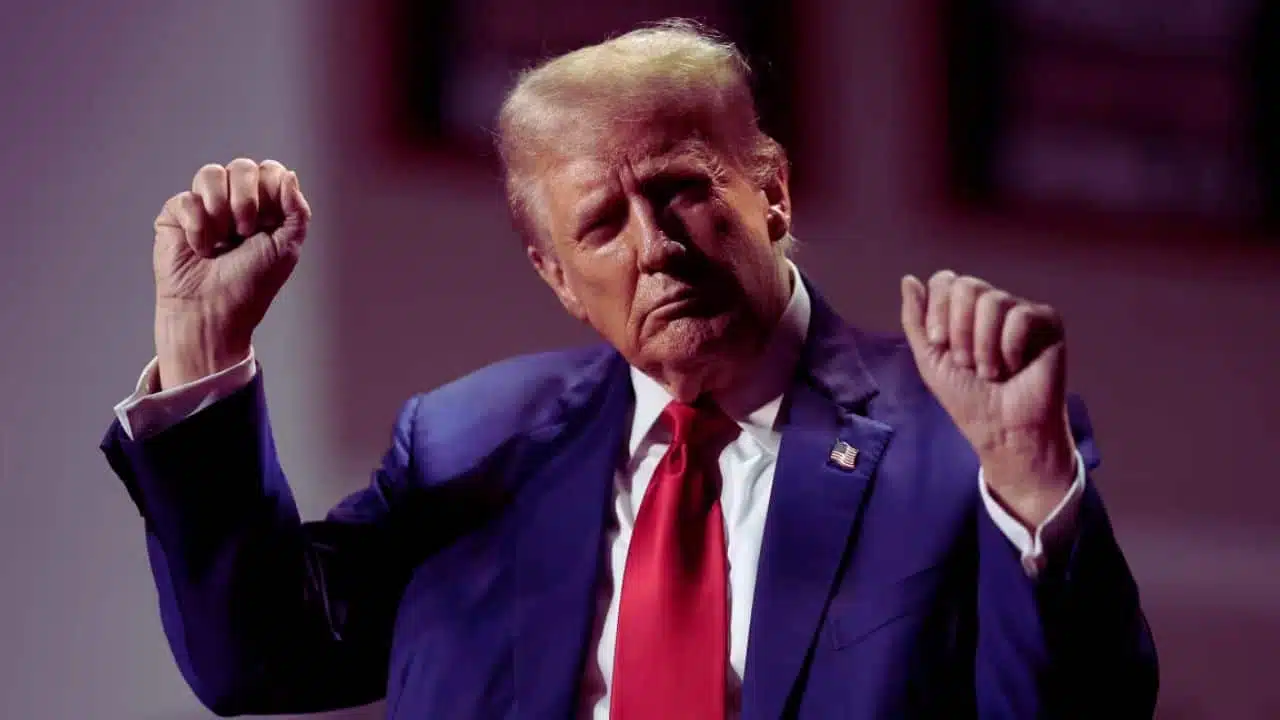
In a momentous return to political leadership, Donald Trump has been elected as the 47th President of the United States. Following his victory in Wisconsin, which pushed him past the threshold of 270 electoral votes, Trump has re-secured his place in the White House, marking one of the most remarkable comebacks in recent political history. This win caps a long and often controversial journey back to the presidency for Trump, who previously held office as the 45th president from 2017 to 2021.
A Hollywood-Like Comeback Story for Donald Trump
This election victory is a major political rebound for Trump, one that would have seemed unlikely after his loss in 2020. Since leaving office, he has faced an array of challenges that included both legal and public opinion battles. Over the last four years, Trump was involved in multiple lawsuits, convictions, and high-profile investigations, all of which cast doubt on his future in politics. Additionally, he faced the challenge of a highly polarized public, with strong opinions both for and against him, particularly following the January 6th insurrection at the U.S. Capitol.
Despite these hurdles, Trump’s supporters remained deeply committed, and his campaign rallied significant support, highlighting issues like economic recovery, national security, and American energy independence. His appeal to his core voter base ultimately contributed to his victory, defying earlier projections by some experts that his path to the presidency would be steep. In many ways, his re-election has taken on the air of a Hollywood-style comeback, bringing a former president back to the White House who was once seen as unlikely to return.
The Role of State Certification and the Electoral College
With the vote count completed, the focus shifts to the certification process, a standard step in U.S. elections that ensures the legitimacy and accuracy of the results. The certification process begins at the state level, where each state’s election officials review and formally certify their election results. This step is crucial, as it verifies the accuracy of the vote tallies and addresses any discrepancies that may have arisen during counting. Certification solidifies the states’ results and paves the way for the Electoral College to proceed with its role in the election.
On December 17, electors from each state will gather in their individual states, as required by law, to cast their official votes for president and vice president. This decentralized gathering is a hallmark of the Electoral College, preventing electors from convening as a single national body. The process allows each state to independently confirm its electoral results while maintaining a broader national framework. Although largely a formality, the Electoral College vote is a fundamental step in the U.S. electoral system, ensuring that each state’s vote is respected and accounted for in the final outcome.
What Happens in the Event of an Electoral Tie?
Though uncommon, it is technically possible for a presidential election to result in an electoral tie, with both candidates receiving an equal number of electoral votes. In this rare scenario, the election outcome is determined by the House of Representatives rather than by popular or electoral vote alone. When the election goes to the House, each state delegation casts a single vote to decide the presidency. Historically, this process has only happened twice—once in 1801 and again in 1825. Although no tie occurred in this election, the provision serves as a safeguard to ensure that the presidency is determined, even under unusual circumstances.
The Congressional Count and Certification Process
After the electors cast their votes, they send their certifications to Congress, where the final certification and count take place. On January 6, Congress will hold a special joint session, attended by both the House of Representatives and the Senate, to officially count and certify the electoral votes. The Vice President, serving as the President of the Senate, presides over this session. During the session, officials from each state submit their electoral vote certificates, which are then opened, reviewed, and formally counted.
This step is significant as it provides an additional layer of transparency and accountability in the election process. The congressional certification allows elected representatives to confirm the integrity of the results publicly, and it assures the American people of the legitimacy of the outcome. Once the votes are certified, the winner is formally declared, solidifying the path to inauguration.
Inauguration Day: The Transition of Power
With the electoral and congressional certification processes completed, the final milestone is the inauguration ceremony on January 20. Traditionally held on the steps of the U.S. Capitol, this historic event marks the official start of the president’s term in office. At noon on January 20, Donald Trump and Vice President-elect JD Vance are scheduled to be sworn in, marking the beginning of their administration.
Inauguration Day is more than just a ceremony; it represents a peaceful transition of power, a hallmark of American democracy. Despite the intense political climate that has characterized recent elections, the inaugural event serves as a reminder of the resilience of the U.S. political system and the unity that binds the country. The swearing-in ceremony for Trump and Vance will include the oath of office, taken by the president and vice president, followed by an inaugural address that outlines their vision and goals for the coming term.
The Symbolic Impact of Trump’s Victory
Trump’s return to the White House is symbolic for many of his supporters, representing a return to what they view as essential values of American governance. His campaign emphasized themes such as economic growth, energy independence, and a focus on domestic issues that resonated with his voter base. The election outcome underscores the strong divisions within the U.S. electorate but also highlights the enduring influence of Trump’s platform and his ability to mobilize voters.
For the country as a whole, the upcoming Trump administration signals a potential shift in policy direction, both domestically and internationally. His victory demonstrates the dynamic nature of American politics, where no outcome is certain, and a former president can indeed make a successful return to power after facing significant setbacks.
As the U.S. moves forward under the leadership of President Trump and Vice President Vance, the nation’s focus will likely center on the administration’s approach to key issues like economic recovery, foreign policy, and social unity. In a time of change, the U.S. political system continues to reflect both its challenges and its strengths, as shown through a robust electoral process and the orderly transition of power.
The Information is Collected from Firstpost and Yahoo.